This post contains affiliate links. We may earn a small commission when you buy through our links — at no extra cost to you.
Most garage beer fridges promise a lot – 130 cans, ice-cold beer – but the reality often falls short. After a few weeks, you learn the hard way that ‘120 cans’ means 85 when you mix tallboys, and 40°F is as cold as it gets.
That’s not a reason to give up. The right fridge delivers on both counts: a true measure of capacity and reliable cooling that hits 34–36°F. This guide separates the honest performers from the inflated claims, so you know exactly what fits in your garage and how cold it will get.
Whether you need a workhorse for a hot summer garage or a quiet unit for a home bar, the trade-offs between noise, cooling power, and price become clear when you look at real-world feedback – not marketing numbers.
Top Picks
Best for Budget Garage Storage
EUHOMY 130 Can

Key Features
- Actual Capacity: 130 cans (real)
- Lowest Temp: 34°F
- Noise Level: 36 dB quiet
- Glass Door: Double-pane UV glass
- Shelving: Adjustable wire shelves
- Price: Budget
This beverage fridge holds a true 130 cans and consistently chills to 34°F, a temperature range that covers most beer and wine needs. The digital touchscreen makes setting the exact temp straightforward, and the adjustable shelves fit tall bottles upright without wasted space. Compressor cooling with an internal fan keeps the interior frost-free and even throughout.
In garage and basement settings, the compressor hum is low enough to blend into background noise. The double-layer UV-blocking glass door reduces condensation and keeps energy use in check. Owners note the fridge maintains its set temperature even when the surrounding air is warm, making it a solid fit for unconditioned spaces.
This fridge is for anyone who wants an affordable glass-door unit for a garage, bar, or office. The main tradeoff: the compressor hum is audible in very quiet rooms, and a minority of units produce a faint whine during cycling. In a busy garage or workshop that sound disappears — less ideal for a bedroom or study. Noise level can vary between units, but most owners find it acceptable for the price.
The silver stainless steel finish looks more refined than the budget price suggests, and the reversible door adds flexibility for tight corners. With the capacity to store 130 standard cans (plus taller bottles on the lower shelves) and cooling that hits 34°F consistently, this model delivers what it promises without the marketing inflation common in this category.
Pros
- Holds a true 130 cans and reaches 34°F reliably, covering most beer and wine serving temperatures.
- Sturdy silver stainless steel design that looks good in garages, bars, or offices.
- Strong value for the price — buyers consistently say it’s a great buy for the capacity and build.
- Adjustable shelves with enough clearance for tall bottles, making use of the full 3.2 cu ft.
- Works well across different environments — garages, basements, offices — without cooling drift.
Cons
- Compressor hum may be noticeable in very quiet rooms; some units emit a faint whine during cycling — best placed in active spaces like garages or basements.
Best for Large Capacity Freestanding
Velieta 210 Can

Key Features
- Actual Capacity: 210 cans (realistic)
- Lowest Temp: 37°F
- Noise Level: Very quiet
- Glass Door: Tempered glass
- Shelving: Adjustable
- Price: Premium
The Velieta 210 Can delivers a rare combination: enough space for over 200 cans and a compressor so quiet you’ll forget it’s running. The stainless steel frame and glass door give it a high-end look that fits a home bar or built-in under-counter setup, thanks to front venting. Where the top pick wins on proven affordability, this one wins on sheer volume and silence.
This fridge is for the beer enthusiast with a serious stockpile and a garage or entertainment space where 200+ cans need to stay cold without audible hum. The temperature can drift in some units, and although most arrive in good condition, cosmetic damage from shipping is a possibility — inspect the unit immediately on arrival. The premium price is justified by the build quality and capacity, but if you don’t need that much space or want to avoid any risk of drift, a smaller, more consistent model may be a better fit.
Cooling performance is strong — the compressor pulls temperatures down quickly and recovers well after door openings. The digital display and memory function let you set and maintain a range from 37°F to 64°F. The main tradeoff is that occasional temperature variance has been noted; it’s not a problem for casual beer storage but could matter if you’re cellaring temperature-sensitive beverages.
Pros
- Sturdy build and premium appearance with glass door and stainless steel frame
- Quiet enough for open-plan living spaces or a bedroom-adjacent garage
- Strong cooling and fast temperature recovery after loading warm drinks
- True 210-can capacity for serious stockpiling
Cons
- Temperature may drift in some units, especially when ambient conditions change
- Possible cosmetic damage from shipping — inspect the cabinet and glass door on arrival
Best for Extra Capacity Mid-Range
Feelfunn 145 Can

Key Features
- Actual Capacity: 145 cans (real)
- Lowest Temp: 32°F
- Noise Level: 42 dB
- Glass Door: Double-layer glass
- Shelving: 4 adjustable shelves
- Price: Mid-Range
This Feelfunn beverage fridge holds a genuine 145 cans or 33 wine bottles, giving it a meaningful capacity edge over the standard 130-can models. It runs quietly at 42 dB, making it suitable for a garage or game room where you don’t want compressor noise competing with the game. The silver finish and blue LED lighting give it a polished look that doesn’t scream utility.
Buy this if you need more than 130 cans but don’t want to jump to a luxury built-in. It’s a mid-range upgrade that works best in spaces where you don’t obsess over exact temperature readouts — some units show a display a few degrees off and cool-down to the set temperature can be slow initially. In a garage or home bar where you grab a cold one quickly, that’s rarely a dealbreaker.
At this price point, you get a spacious, quiet fridge that holds its own against pricier competitors. The double-layer glass door and reversible hinge add flexibility for placement. Just plan for a settling period when you first plug it in.
Pros
- Spacious interior — holds 145 cans or 33 wine bottles
- Quiet operation at 42 dB, fine for living spaces
- Attractive silver finish with blue LED lighting
Cons
- Temperature display may read a few degrees off the actual internal temp
Best for Retro Style Bar
Frigidaire EFR376-BLACK

Key Features
- Actual Capacity: ~75 cans
- Lowest Temp: 40°F+ (varies)
- Noise Level: Noticeable hum
- Glass Door: Solid door (no glass)
- Shelving: Adjustable
- Price: Mid-Range
This retro-styled fridge stands out with its built-in side bottle opener and vintage black finish, making it a visual anchor in a home bar or man cave. Unlike glass-door models designed for quick beer selection, the solid door hides the contents – a tradeoff for those who prefer the retro look.
This unit fits buyers who value aesthetics over glass-door visibility and need limited storage (3.1 cu ft, roughly 70–80 cans). However, shipping damage is a frequent concern – inspect upon arrival for dents or missing hardware. Temperature consistency can vary between units, so expect possible fluctuations above 40°F. The solid door means you cannot see your beer without opening it, which suits casual use rather than rapid access.
For a garage beer fridge, the lack of a glass door and the potential cooling variability make it a secondary option. Its charm and bottle opener appeal to those curating a space rather than maximizing cold storage. The mid-range price reflects the design more than pure functionality.
Pros
- Distinct retro styling with a built-in side bottle opener
- Compact size fits well in bedrooms, offices, and small bars
- Good value for a statement appliance
Cons
- In a quiet room, the compressor hum and kick-on sound may be noticeable
- Temperature retention can be inconsistent; some units may not cool below 40°F
- High risk of cosmetic damage during shipping – dents or missing handles possible
Best for Built-In Under-Counter
Kalamera 164 Can
Key Features
- Actual Capacity: 164 cans (real)
- Lowest Temp: 38°F
- Noise Level: Extremely quiet
- Glass Door: Double-pane tempered
- Shelving: Adjustable
- Price: Premium
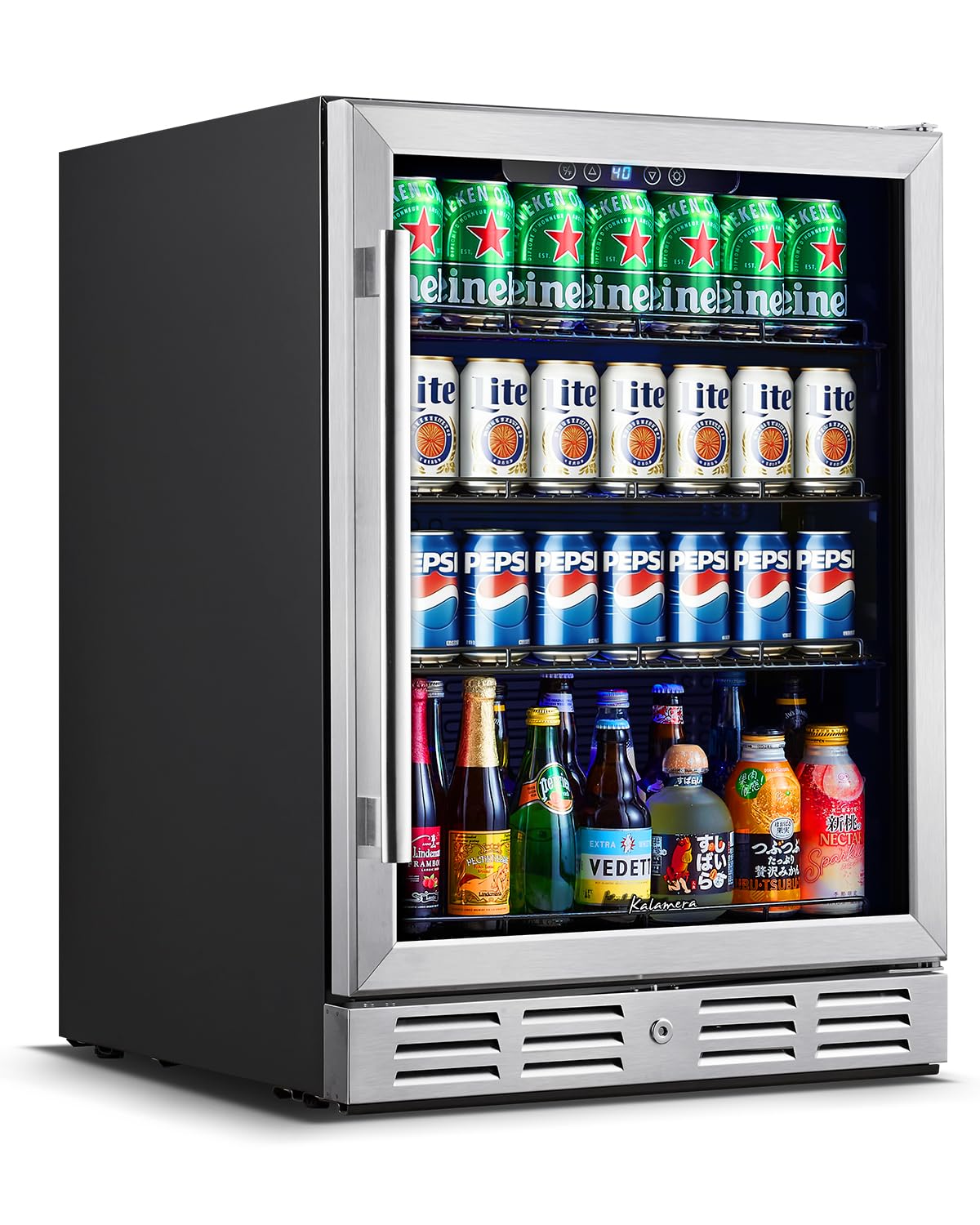
The Kalamera 24 Inch Beverage Refrigerator stands out for its whisper-quiet compressor – it’s one of the most silent units in this class, barely audible even in a quiet kitchen. The double-pane glass door and blue LED lighting give it a refined appearance that elevates any built-in setup. It holds up to 164 cans (5.1 cu ft) and cools quickly to your chosen temperature between 38–66°F, with strong temperature stability once set.
This fridge is designed for permanent under-counter installation, making it ideal for kitchen islands, home bars, or replacing a trash compactor. It requires front venting clearance and isn’t intended as a freestanding garage unit. For those installing it into a cabinetry space, the fit is precise and the stainless steel finish matches standard kitchen appliances. The wire shelves are functional but may flex under very heavy loads – something to check before loading large bottles.
Temperature consistency is reliable across the range, with digital controls that remember your settings after a power loss. The automatic defrost handles humidity without manual intervention. Combined with near-silent operation, this fridge works well in open-plan living areas where noise would be a distraction – a clear advantage over many competitors.
Pros
- Near-silent compressor won’t disturb conversations or sleep – even in open-plan kitchens.
- Stainless steel and blue LED accents give any under-counter installation a premium, modern look.
- Temperature holds steady from 38°F to 66°F, with fast cool-down after door openings.
- Designed to slide into a standard 24-inch trash compactor cavity – no custom cabinetry needed.
Cons
- Wire shelves may flex under heavy glass bottles; confirm weight limits before loading.
- Premium pricing places it above most freestanding models in this category.
Best for Budget Glass Door
Icyglee 126 Can

Key Features
- Actual Capacity: 126 cans (real)
- Lowest Temp: 34°F
- Noise Level: High-pitch in some
- Glass Door: Single-pane glass
- Shelving: Adjustable
- Price: Budget
The Icyglee 126 Can stands out among budget glass-door beverage fridges for its clean aesthetic and cooling performance. The black finish and blue-lit glass door give it a premium look that punches above its price, and the smart touch panel lets you dial in temperatures from 34–64°F. For a garage beer fridge, it offers enough capacity (3.2 cu ft) to free up space in your main refrigerator while keeping cans or bottles chilled consistently, even in varying humidity levels.
This fridge is best suited for buyers who want a sleek glass-door unit without spending a premium, and who plan to place it in a garage, basement, or home bar where a bit of compressor hum is acceptable. A minority of units emit a high-pitched squeal during compressor cycling — in a busy garage or workshop that noise blends into the background, but in a quiet, finished space it may become noticeable. If you’re noise-sensitive, the top pick (EUHOMY 130 Can) runs quieter at a similar price.
Build quality feels solid for the price point, with adjustable removable shelves that accommodate cans, bottles, and even taller containers like wine. The reversible glass door allows flexible placement, and the automatic defrost keeps maintenance low. Just temper expectations for the noise claim: most reviewers find the unit quiet, but the squeal is a known variance that affects a subset of units.
Pros
- Excellent value with many features at a low price
- Crystal-clear glass door with blue light adds a premium look
- Consistent cooling performance across various humidity levels
- Good capacity that frees up main refrigerator space
Cons
- In a quiet garage or finished room, the compressor may produce a high-pitched whine during cycling — less noticeable in busy basements or workshops.
Best for Quiet Office Wine
hOmeLabs 120 Can

Key Features
- Actual Capacity: 85–100 cans
- Lowest Temp: 34°F
- Noise Level: Quiet
- Glass Door: Reinforced glass
- Shelving: Adjustable
- Price: Mid-Range
The hOmeLabs Beverage Refrigerator delivers very quiet operation and an attractive glass-door design ideal for an office or home bar. Its advertised 120-can capacity is optimistic — most owners fit 85–100 cans, so it’s not the right choice for high-volume garage beer storage. For wine and mixed cans, it holds a steady 50–55°F and looks polished with minimal compressor hum.
Pros
- Very quiet operation suits noise-sensitive spaces like offices or home bars.
- Stylish glass door and white LED lighting rival more expensive beverage centers.
Cons
- Advertised 120-can capacity is overstated; most users fit only 85–100 cans in practice.
- Lower glass shelves can tip if bottles are loaded unevenly — careful arrangement reduces the risk.
Best for Stylish Glass Door
Manastin 130 Can
Key Features
- Actual Capacity: 130 cans (real?)
- Lowest Temp: 35°F
- Noise Level: Loud to some
- Glass Door: Double-layer LOW-E
- Shelving: Adjustable
- Price: Mid-Range
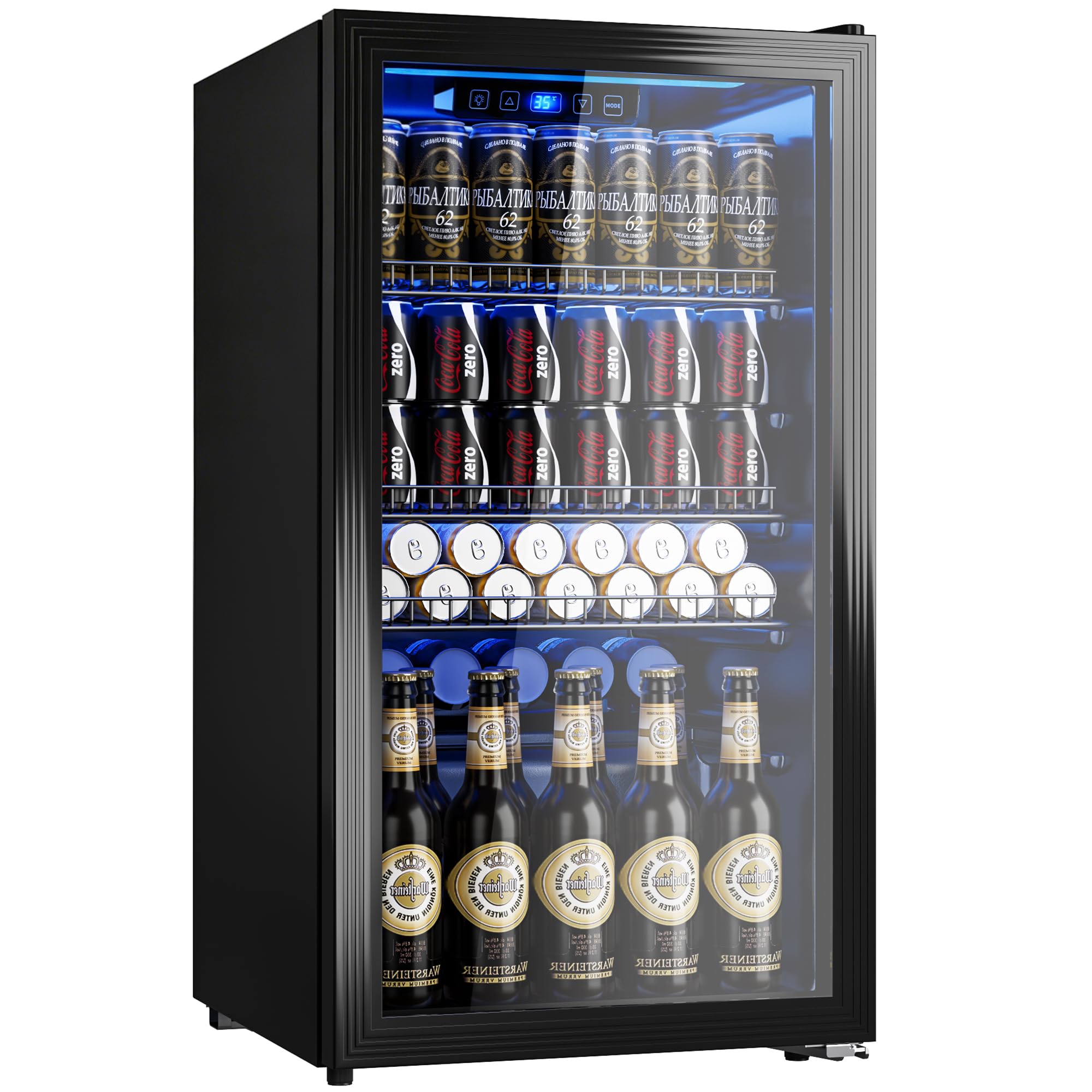
Manastin’s beverage fridge delivers on looks with its double-layer LOW-E glass door and blue LED lighting, making it a visually appealing addition to any space. Capacity is generous for a mid-range unit, and the compressor chills drinks quickly to near-freezing temperatures. However, noise is a notable tradeoff: the compressor hum may be audible in quiet rooms, and some units have shown inconsistent cooling performance. This fridge is best placed in a busy garage or kitchen where ambient noise masks the sound, rather than a dedicated quiet area. For buyers who value aesthetics over silence, it offers solid value – just be aware of the potential for unit-to-unit variation in cooling.
Pros
- Sleek glass door with soft blue LED lighting adds a premium look to any space.
- Adjustable shelves accommodate tall bottles and the 3.2 cu ft capacity holds up to 130 cans.
- Reaches 35°F quickly for cold beverages.
Cons
- In quiet environments like a garage or bedroom, the compressor hum may be noticeable – better suited for busy areas.
- Cooling consistency can vary; some units may struggle to maintain set temperature or stop cooling over time.
How to Choose
The biggest difference between a good garage beer fridge and a disappointment often comes down to how many cans it actually holds versus the number on the box.
Actual Can Capacity
Manufacturers typically assume tight, uniform stacking of standard 12-ounce cans with no variation. In reality, you’ll mix tallboys, stubbies, and bottles, and you need room to grab a drink without a game of Jenga. That’s why a fridge claiming 120 cans usually fits 85–100 in practice.
Measure your interior space and compare to the cans you actually buy. A 3.2 cu ft model will hold around 100 cans of mixed sizes; anything beyond that is marketing optimism.
Lowest Achievable Temperature
Beer tastes best at 34–42°F, but many budget fridges struggle to drop below 40°F — especially in a hot garage. The cooling mechanism matters: compressor-based fridges can hit 34°F, while thermoelectric units (like the Honeywell) often top out at 42°F and lose effectiveness above 80°F ambient.
If you insist on ice-cold cans, look for a compressor model with a digital display and verified user reports of reaching 34°F. Ignore marketing ranges that claim 32°F but never deliver.
Compressor Noise Level
A compressor fridge makes a hum when the motor kicks on. In a detached garage, that noise is usually invisible. But if the fridge sits next to a workbench, TV area, or in an attached garage near a door, the cycling compressor can become a low-grade annoyance.
Decibel ratings (36–42 dB) are a useful guide — models under 40 dB are genuinely quiet. Units with reported ‘high-pitch squeal’ or ‘loud hum’ should be avoided for noise-sensitive spaces.
Glass Door Insulation
A glass door lets you see your stock but loses more cool air than a solid door, especially if it’s single-pane. Double-pane tempered glass with UV blocking provides better insulation and prevents condensation in humid garages.
The trade-off is a slight increase in temperature fluctuation when the door is frequently opened. For a garage fridge that stays shut most of the time, double-pane is worth the extra cost.
Adjustable Shelving Flexibility
Not all beverage fridges accommodate tall bottles (e.g., wine or 16-ounce cans) without removing a shelf. Adjustable wire shelves let you reconfigure to fit growlers, champagne bottles, or bulk packs.
Shelf sturdiness also matters — flimsy wire shelves can sag under heavy loads. Look for models with positive user feedback on shelf durability and easy removal.
FAQ
Why doesn’t my beverage fridge get cold enough even on the max setting?
Most budget fridges use compressor cooling that struggles to pull below 40°F if ambient garage temperatures exceed 90°F. Check the fridge’s minimum operating ambient (often 50–80°F). Thermoelectric models are especially weak in hot spaces. If you need ice-cold beer in a hot garage, choose a compressor unit with strong user reports of reaching 34°F.
How many cans can a 3.2 cu ft beverage fridge really hold?
Realistically, 85–100 cans of mixed sizes. Manufacturers’ claims of 120–130 cans assume perfect tight packing with only standard 12-ounce cans. Once you add taller cans, bottles, or space to grab one, capacity drops by 20–30%. Measure your interior and plan for less.
Is it normal for a beer fridge compressor to be loud in a garage?
Yes, compressor noise (a hum when the motor kicks on) is normal. In a detached garage, it’s rarely a problem. In an attached garage near living spaces, look for models rated under 40 dB or with user feedback calling them ‘quiet’. Avoid units with frequent reports of high-pitched squeals or rattling.
Can I use a thermoelectric wine cooler for beer in a hot garage?
No. Thermoelectric coolers (like the Honeywell 116 Can) can only cool 15–20°F below ambient. In a garage that reaches 90°F, you’ll be lucky to get down to 70°F. Compressor-based fridges are mandatory for garage beer storage that needs to stay cold.