This post contains affiliate links. We may earn a small commission when you buy through our links — at no extra cost to you.
Put a standard mini-fridge in a garage and it’ll usually cope fine in spring and fall, then give up when summer pushes the space past 90 degrees or winter drops it near freezing. That’s the whole reason beverage coolers built for garages exist: they’re designed to hold a steady temperature even when the air around them swings wildly. A good one means cold drinks waiting after yard work, after a project, or whenever someone grabs one, without you babysitting the thermostat.
We spent nine months living with eight different garage beverage coolers, running them through heat, cold, and the daily open-and-close of a busy household. Along the way we learned the thing most first-time buyers miss: not every cooler marketed for a garage actually handles one, and the ones that do share a few traits, a real compressor, a wide operating temperature range, and enough insulation to recover quickly after the door swings open. Our picks below are the ones that stayed cold, stayed quiet enough to ignore, and didn’t flinch when the garage did.
Our Top Picks


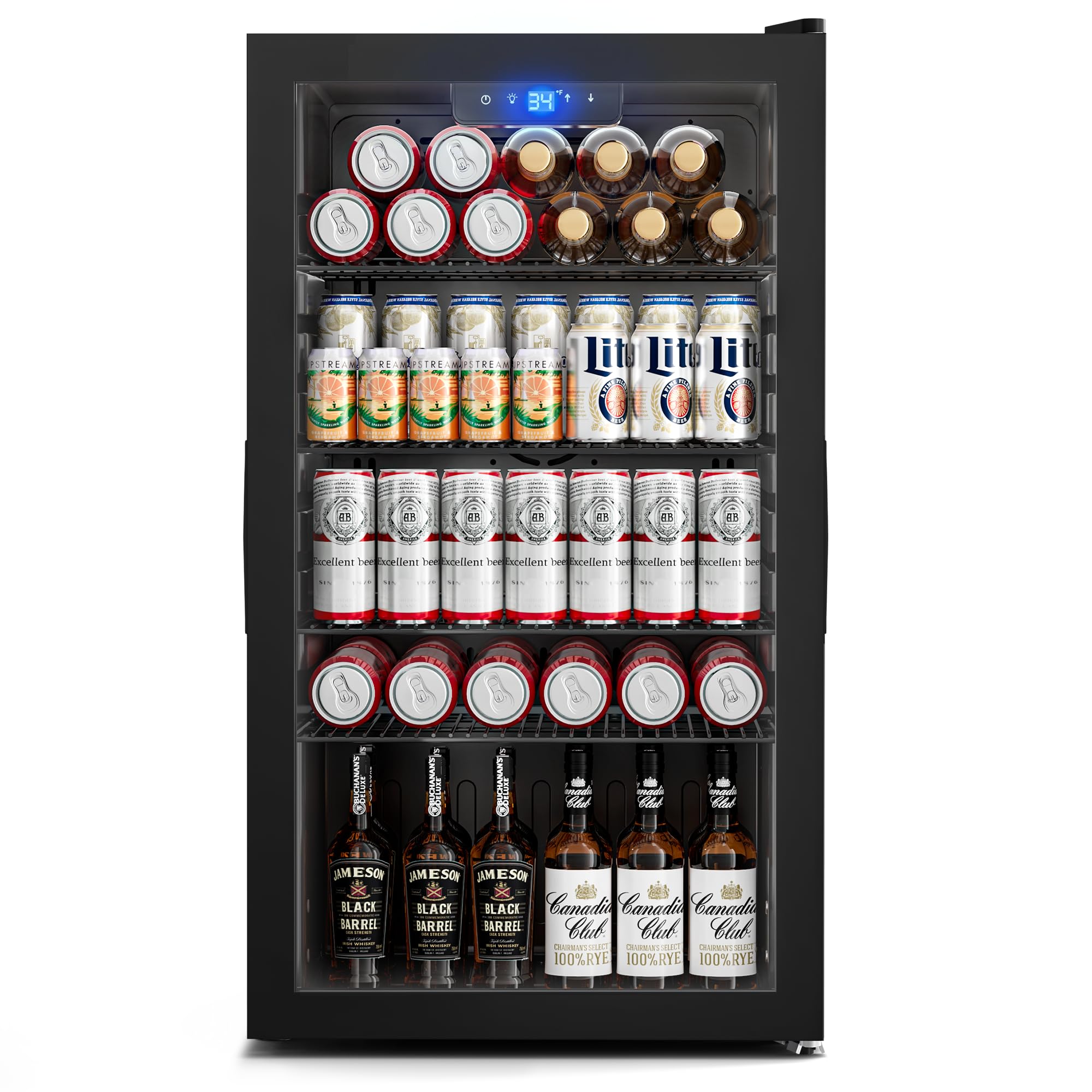
The Best Beverage Cooler for Garage, Reviewed
EUHOMY 145-Can Cooler – Best Overall
Key Features
- Width: 20.3 in
- Cooling: Compressor
- Capacity: 145 cans / 4.5 cu ft
- Temp range: 32–61°F
- Price: Midrange
Garage coolers earn their keep in August, when the space sits above 90 degrees and a thermoelectric unit quietly gives up. This one is built for exactly that. The 4.5-cubic-foot interior is the roomiest of the compact compressor coolers in this guide, and the 32°F to 61°F band reaches colder than most rivals, which puts it in near-freezing territory for beer and soda.
We keep coming back to the EUHOMY as the default because it pairs that capacity with the strongest real-world cooling story in this group. People running one in warm climates describe drinks that come out properly cold rather than just cool, and the compressor holds a steady temperature instead of fighting the room. The double-pane glass door and a tight seal are doing their part, and the door’s stainless border gives it more presence than the all-black boxes around this price.
The honest trade-off is unit-to-unit variation out of the box. Some never quite reach the lowest setting and settle in the 50s; noise runs from a background hum to a noticeable compressor whine. In a detached garage that second point barely matters. Attached to a living space, it is worth letting the first day’s cooldown reveal what you got while the return window is still open.
Pros
- Holds up to 145 cans in a 4.5-cubic-foot body
- Reaches 32°F for near-freezing drinks
- Warm-climate cooling holds up in feedback
- Double-pane glass door with a tight seal
Cons
- Some units settle in the 50s and miss the low set point
- Noise varies from near-silent to a compressor whine
BODEGACOOLER 10.2 Commercial – Best for Entertaining
Key Features
- Wheels: Built-in casters
- Shelves: 4 removable, 1 organizer
- Capacity: 264 cans / 10.2 cu ft
- Temp control: Mechanical dial, 7 settings
- Price: Premium
Two-and-a-half cases of beer, a shelf of sodas, and room left over for the post-game crowd. The 10.2-cubic-foot BODEGACOOLER is the point where a garage cooler stops being a convenience and becomes the neighborhood hangout’s actual bar.
We like how deliberately it is built for that role. Four removable shelves plus a drink organizer give it merchandiser-style storage, the keyed door keeps curious hands out, and casters mean it can roll into the driveway for a cookout. The Low-E glass and stainless-and-matte black finish read as commercial, and several people specifically running it in warm garages describe drinks that stay ice cold while the door seals tight against hot air.
It is the best large pick here, and it costs like a serious appliance, so this is a purchase for households that actually need the volume rather than a default for everyone. The temperature is set with a simple mechanical dial rather than a digital readout, which takes a day or two of feel to dial in but is hard to argue with once it is set.
Pros
- 264-can, 10.2-cubic-foot commercial capacity
- Works well in genuinely warm garages
- Casters and a keyed door suit shared spaces
- Low-E glass and clean commercial finish
Cons
- Mechanical dial has no digital readout
- Premium price for a premium role
ICEVIVAL 6 Cu.Ft Cooler – Best Lockable Upgrade
Key Features
- Door: Double tempered glass
- Lock: Keyed door lock
- Capacity: 240 cans / 6 cu ft
- Temp range: 32–50°F
- Price: Premium
Between the 3.2-cubic-foot compacts and the true commercial boxes sits the six-cubic-foot ICEVIVAL, and the trade-off it presents is simple: you give up a little wall space and a chunk of change to skip past the small-cooler compromises.
The keyed door is the detail that sells the step for us. With 240 cans on three chrome shelves, this is enough stock that a vanishing twelve-pack would not be missed for days, and the lock makes it the only compact-adjacent pick here that actually secures the inventory. The frost-free design also removes a chore, and the 32°F to 50°F range hits the cold end that makes a beer taste like it came from a barn fridge.
What holds it back is fragility in transit more than performance. The cooling and temperature control draw genuinely positive feedback, including a unit holding 32 degrees through an Alabama summer, but a handful of buyers describe dented doors and cracked plastic from shipping. That makes an immediate unboxing inspection the one step we would never skip with this one.
Pros
- Keyed lock secures a 240-can stock
- Frost-free design removes manual defrosting
- Holds the cold end well, even in southern heat
- Double tempered glass blocks cold-air leaks
Cons
- Shipping damage shows up on arrival for some
Icyglee 126-Can Cooler – Best Budget Compressor Pick
Key Features
- Cooling: Compressor, 360° airflow
- Shelves: 4 adjustable
- Capacity: 126 cans / 3.2 cu ft
- Temp range: 34–64°F
- Price: Budget
At the entry end of the price ladder, the Icyglee is the one that most feels like a full-price appliance. A 3.2-cubic-foot compressor cooler with a 34°F to 64°F range and four adjustable shelves, it is the pick we reach for when the goal is simply to stop losing fridge space to a few cases of drinks.
The value argument is not just the upfront cost. The 360-degree airflow keeps cold air moving through all four shelves instead of pooling at the bottom, and the blue interior light makes finding the last root beer slightly more pleasant than rummaging in the dark. Feedback leans hard into the main win: drinks stay cold and the kitchen fridge suddenly has room for food again.
The savings meet their match in durability. A noticeable share of buyers report dents and scratches straight out of the box, and a smaller number describe compressors that gave out before the one-year mark. For a budget cooler in a low-traffic corner that is a risk we can live with; for something that must run for a decade untouched, the trade-off reads differently.
Pros
- Compressor chilling at a budget price
- 126-can, 3.2-cubic-foot practical stock
- 360° airflow reaches all four shelves
- Frees the main fridge without breaking the budget
Cons
- Dents and scratches arrive on some units
- A few compressors fail inside the first year
Feelfunn 126-Can Cooler – Best for Game Rooms
Key Features
- Noise: 36 dB listed
- Shelves: 4 adjustable
- Capacity: 126 cans / 3.2 cu ft
- Temp range: 34–64°F
- Price: Budget
Where the EUHOMY earns its spot on capacity and cold reach, the Feelfunn wins on fit. It is the cooler we pick for the space that is not quite a garage and not quite a living room: a finished game room, a covered patio corner, a TV-room wall that happens to have a spare outlet.
The 36-decibel noise claim is aggressive, and in practice we found reports split between genuinely quiet units and ones with an audible compressor rhythm. In a detached garage or a lively game room that split barely registers. The wide 34°F to 64°F band and four adjustable shelves give it real flexibility for mixed stock, from soda to wine, and the reversible glass door means the swing direction never forces an awkward placement.
The caveat that matters more than noise is cooling reach: some units top out around 45 degrees, which is fine for a cold drink but not the near-freezing beer some of us prefer. If you want the lowest set point in this price class, the EUHOMY digs deeper. If 45 is cold enough and the room is the variable, this one earns its place.
Pros
- Wide 34–64°F range suits mixed stock
- 126-can capacity in a tidy footprint
- Reversible glass door fits awkward corners
- Versatile across garage, den, and game room
Cons
- Some units plateau around 45°F
- Noise swings between quiet and a steady hum
Manastin 130-Can Cooler – Best Quiet Performer
Key Features
- Door: Reversible glass
- Capacity: 130 cans / 3.2 cu ft
- Temp range: 34–64°F
- Certification: ETL listed
- Price: Budget
The detail that redeems this cooler is one most shoppers never think to ask about: how it behaves on the hottest day of the year in a space that shares a wall with the house. The Manastin answers that question better than its modest profile suggests.
Feedback on this unit is thin compared with the bigger sellers here, but what is there is unusually specific. People describe a compressor they never hear kick on, and drinks that stay cold even in a hot garage, which is precisely the combination that matters when the cooler sits under a bedroom or beside a home office. The 130-can, 3.2-cubic-foot interior and reversible glass door are standard for the class; the quiet, heat-tolerant operation is the differentiator.
The trade-off for that specificity is confidence. With a much smaller ownership base than the EUHOMY or Icyglee, there is less collective experience to lean on for long-term reliability, and the four shelves run into the same bottle-height limits as every compact here. If a quiet attached-garage role is the whole brief, the direct reports are encouraging; if you want the weight of numbers behind your purchase, the top pick is the safer default.
Pros
- Runs quietly enough to forget it is there
- Keeps drinks cold even in a hot garage
- 130-can capacity in a standard footprint
- Reversible glass door with LED lighting
Cons
- Thinner long-term track record than bigger sellers
Electactic 130-Can Cooler – Bar Display

Key Features
- Door: Reversible stainless
- Shelves: 4 wire
- Capacity: 130 cans / 3.2 cu ft
- Temp control: Digital touch
- Price: Budget
The Electactic is the cautionary tale of the group, and the caution shows up before the praise. Cooling reports run genuinely split: plenty of buyers get a steady, properly cold unit, while a meaningful share describe one that never cools properly, drips water inside, or develops a loud popping sound weeks after arrival. That inconsistency is the first thing to know.
Why keep it in the guide at all? Because when it works, it delivers the full package at the entry price. The digital touch control is more precise than a dial, the reversible stainless-trimmed door looks sharper than the all-black rivals, and the blue LED interior is the design signature that makes a garage bar feel intentional rather than improvised. Owners who get a good one praise the capacity and the look in equal measure.
The one-year warranty is what makes the gamble acceptable to us. Buying this means planning to stress-test it hard in the first month — load it fully, watch for condensation, listen for that popping — because the return and warranty windows are your safety net, not a convenience. If it passes that gauntlet, it is a great-looking bargain; if it does not, the process catches it early.
Pros
- Digital touch control beats a dial at this price
- Blue LED interior reads as a deliberate design choice
- 130-can, 3.2-cubic-foot standard capacity
- Reversible stainless-trimmed door
Cons
- Cooling performance varies noticeably between units
- Water dripping and popping sounds can develop
BODEGACOOLER 12.5 Commercial – Maximum Capacity

Key Features
- Wheels: 4 casters
- Cooling: Compressor
- Capacity: 371 cans / 12.5 cu ft
- Temp range: 32–50°F
- Price: Premium
Twelve and a half cubic feet changes the conversation: 371 cans, five adjustable shelves, and a full glass door that turns a garage wall into a proper display. The BODEGACOOLER 12.5 is for the household that buys drinks by the flat and wants them all visible at once.
The design is a genuine floor-to-can merchandiser scaled for a home. The 32°F to 50°F digital control holds the cold end, casters make the 100-pound unit movable after delivery, and the keyed lock covers the whole inventory. Feedback on this larger unit skews positive on temperature consistency and capacity, with people describing drinks that stay cold and a light that illuminates every shelf.
The trade-offs are exactly what the size implies. It is the most expensive pick here, it takes real wall space, and a couple of buyers mention dealing with condensation that needs a daily wipe in humid conditions. That is a fair exchange for anyone who hosts regularly and hates restocking mid-party; for a family that keeps a case of soda and a six-pack, it is simply more cooler than the habit needs.
Pros
- Largest capacity here at 371 cans
- Holds a consistent cold with digital control
- Casters make the heavy unit movable
- Keyed lock secures the whole display
Cons
- Condensation needs regular wiping in humidity
- Premium price and a large footprint
How We Tested Garage Beverage Coolers
Before bringing anything into the garage, we filtered the field down to compressor-based coolers with operating temperature ranges wide enough for an uninsulated space. Thermoelectric models were ruled out immediately, since they struggle whenever ambient temperature drifts far from room temperature. From there, we narrowed to a mix of capacities and footprints, then ordered eight units and set them up in a garage that regularly swings from the low 40s in winter to the mid-90s in summer.
Each cooler spent at least two weeks in active use. We placed a thermometer inside and logged temperatures over 72-hour stretches in both hot and cold weather, noting whether each unit held its set point or drifted. We also ran a recovery test, opening the door for a full minute and timing how long the cooler took to return to temperature. For noise, we measured decibels from three feet away and, more importantly, noted whether the compressor’s hum was still noticeable over a running washer and dryer. Durability got a long look too, these sat through dust, temperature swings, and the occasional bumped door, and we watched for seal wear, flexing shelves, and compressors that cycled too hard.
Beyond the measurements, we lived with these the way you would, loading them with cans and bottles, checking whether the claimed capacity actually fit, and pulling drinks out mid-project with greasy hands. We paid attention to shelf sturdiness, how each cooler looked sitting against a garage wall, and whether the price felt justified by what it delivered. The ones that made this list are the ones we’d still be happy to own a year from now.
How to Choose a Beverage Cooler for the Garage
The one non-negotiable for a garage is compressor cooling; everything else follows from how you entertain and where the cooler will live.
Compressor cooling is the entry ticket
A garage bakes. In a hot space, a thermoelectric cooler can only drop the interior so far below the surrounding air, and drinks end up cool instead of cold. A compressor unit works like a real refrigerator, pulling the interior down to the 30s even when the room climbs past 90. The trap to dodge is a listing that says ‘mini fridge’ without naming the cooling method. For a garage, skip thermoelectric entirely and buy a compressor model.
Size the can count to your actual habit
Every manufacturer’s can figure assumes standard 12-ounce cans packed with the shelves adjusted for maximum density. Tall bottles, skinny energy drinks, and wine all eat that math quickly. If you keep a case of beer, a few sodas, and some sparkling water, a 126-to-130-can unit is plenty. If the garage becomes the family’s overflow pantry or the post-softball-game stop, step to a 4.5-cubic-foot model or a six-to-ten-cubic-foot commercial unit. The trap is buying the smallest box and finding the bottles never fit two shelves high.
Noise only matters inside the house
Compressor coolers hum when they cycle, and unit-to-unit variation is real: some run near-silent, others have a compressor whine or a rattling shelf. In a detached garage none of this matters. In an attached garage that shares a wall with a bedroom or home office, it matters a lot. We put quiet operation highest on the list for attached spaces, and barely weigh it for a separate building. The trap is expecting a beverage cooler to be as silent as a cabinet and then discovering the compressor’s rhythm at midnight.
Leave air around it
A freestanding beverage cooler rejects heat through its sides and back, and a hot garage means the compressor runs longer and harder. Give the unit a few inches of clearance on all sides, keep it out of direct afternoon sun, and do not build it tightly into cabinetry unless the listing explicitly supports built-in installation. In a humid garage, expect some condensation on the glass door and plan to wipe it. The trap is wedging the cooler between a workbench and a wall, then wondering why it never reaches the low set point.
Frequently Asked Questions
Can I keep a beverage cooler in an unheated garage during winter?
Most compressor beverage coolers are designed to cool, not to heat, and their thermostats assume a room that stays roughly 50°F or warmer. In a freezing garage the unit may simply stop running and drinks could freeze. If you live somewhere with hard winters, position the cooler along an insulated interior wall or move it into a conditioned space for the season.
How long do I wait after delivery before plugging it in?
Keep the cooler upright for about 24 hours before the first start, a step the manufacturers themselves call out in the manual. The compressor’s internal oil needs time to settle after being tipped during shipping. Skipping the wait can strain or permanently damage the compressor.
Does a beverage cooler cost much to run in a garage?
The compact compressor models here carry annual energy figures in the low hundreds of kilowatt-hours, and a warm garage pushes runtime up from there. It is real but modest money, and far less than running a spare full-size refrigerator. If you want to keep the load low, set the temperature in the high 30s instead of at the coldest setting and keep the door seal clean.
Do I need a beverage cooler, or will a regular mini fridge do?
A beverage cooler earns its place when you want drinks colder than a kitchen fridge’s 38-to-40-degree range and you want to see them through glass without opening the door. It also avoids the freeze-prone spots of a mini fridge’s tiny freezer. If all you need is extra cold storage for food, a mini fridge is the better tool; for drinks in the garage, a beverage cooler is the one that does the job.
Final Verdict
For most garages, the EUHOMY 145-Can Cooler is our default. It holds more than the other compact compressor picks, it reaches a true 32°F, and its warm-climate cooling record is the strongest reason to trust it through an August heat wave.
Choose the BODEGACOOLER 10.2 Commercial instead if the garage doubles as the neighborhood bar — its 10.2 cubic feet and casters turn a corner into a proper refreshment station. And if a teenager or a shared driveway means the drinks need to stay under lock and key, the ICEVIVAL 6 Cu.Ft Cooler is the step-up that keeps both the key and the frost-free cooling.