This post contains affiliate links. We may earn a small commission when you buy through our links — at no extra cost to you.
Most under-counter beverage refrigerators advertise can counts that assume you’ll stack every can perfectly without shelf spacers. In practice, that 180-can model might only fit 160 cans once you account for wire shelf gaps and odd bottle shapes.
Temperature consistency is another moving target. Some units struggle to reach their listed low end, especially in warm climates, while compressor noise can turn a quiet home bar into a constant hum.
This guide focuses on models that deliver on their core promises — usable capacity, stable cooling, and quiet enough for living spaces — so you get a fridge that matches your actual setup, not the marketing photo.
Top Picks
Best for Wine + Beverage Mix
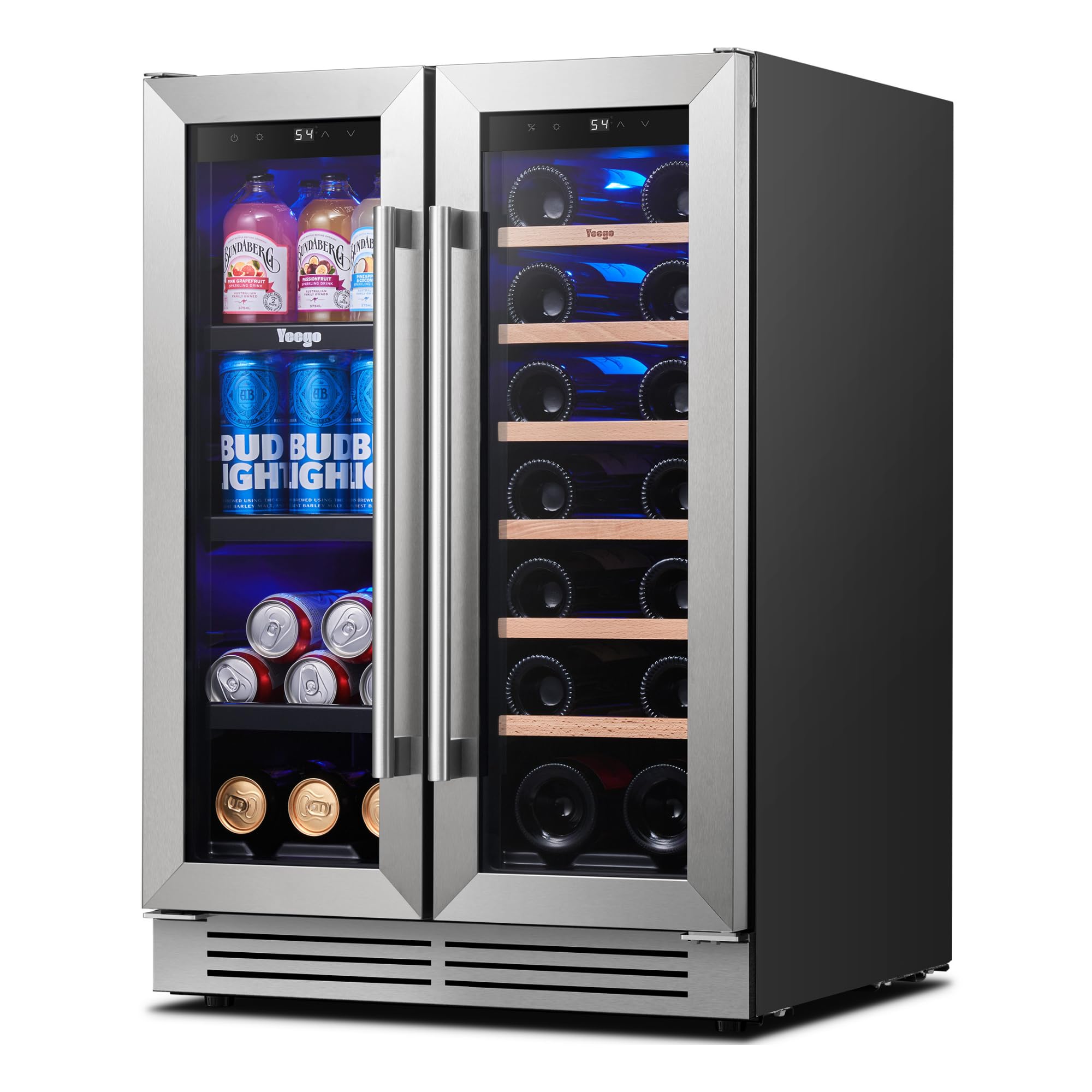
Yeego YG-WF24 Dual Zone
Key Features
- Capacity: 20 bottles+60 cans
- Temp Range: 36°F–72°F
- Installation: Built-in or freestanding
- Cooling Method: Compressor
- Price: $$
The dual-zone compressor holds reds and whites at separate temperatures without introducing compressor noise into a kitchen or bar area. Wooden shelves and interior LED lighting give the glass-front cabinet a refined look that matches cabinetry or countertops, supporting both a dining room and a home bar setup.
In warm kitchens, the bottom beverage zone may run slightly warmer than the set temperature — a trade-off that suits everyday drinking but not long-term cellaring. Larger champagne or Pinot Noir bottles may not fit on standard shelves without removing one, a consideration for mixed collections.
This fridge fits wine enthusiasts who also want cold soda or beer on hand, with enough can capacity for a home bar or small kitchen. The 60-can limit means it won’t support frequent large parties, but the combined wine-and-beverage layout avoids needing two separate under-counter units. The unit can be built in or freestanding, matching the buyer’s under-counter installation requirement.
Pros
- Almost silent compressor allows placement in dining or living spaces without noise intrusion.
- Wooden shelves and interior LED give a high-end look that complements kitchen or bar décor.
- Dual zones maintain accurate temperatures for wine and beverages simultaneously.
- Sturdy construction and solid feel justify the mid-range price tag.
Cons
- When storing both zones near capacity, temperature may drift slightly between compartments — less noticeable for daily drinking than for aging wine.
- Oversized bottles such as champagne or Pinot Noir may require shelf removal to fit, limiting flexibility for varied collections.
Best for Quiet Single Zone
Velivi KMYL150B 180 Can

Key Features
- Capacity: 180 cans
- Temp Range: 37°F–64°F
- Installation: Built-in or freestanding
- Cooling Method: Compressor & Fan
- Price: $$
The Velivi beverage fridge runs so quietly that you’ll likely forget it’s there — a real asset in a home bar or open kitchen where noise matters. Its compressor and fan hold a steady 37°F even in warm ambient conditions, so soda, beer, and water come out reliably cold. The glass door and wood shelves give it a clean, intentional look that fits under counters or freestanding.
Temperature retention is consistent across the full range (37°F–64°F), and the 180-can capacity matches real-world stacking of standard 12-ounce cans. A small number of units arrive with door alignment issues or minor exterior dents — cosmetic rather than functional, but worth checking on delivery. The built-in/under-counter installation is straightforward with front ventilation.
This fridge is a strong fit for buyers who prioritize quiet cooling and a single temperature zone for canned drinks, water, and milk. It holds wine bottles fine but lacks a separate wine compartment — if you need to store reds and whites at different temps simultaneously, a dual-zone model (like the one we cover as our top pick) would be a better match. The lock (key type) adds security for shared spaces.
Pros
- Near-silent compressor won’t disturb conversation or sleep
- Stays within a degree of the set temperature across the entire range
- Solid stainless-and-glass build with attractive wood shelving
- Mid-range price that undercuts many similarly quiet competitors
Cons
- Door alignment may be off on some units, requiring minor adjustment
- Single temperature zone cannot serve wine and beverages at different temperatures simultaneously
Best for High-Volume Parties
Velieta KMYL150 210 Can

Key Features
- Capacity: 210 cans
- Temp Range: 37°F–64°F
- Installation: Built-in or freestanding
- Cooling Method: Compressor
- Price: $$
The Velieta packs 210 cans into a 24-inch footprint, more than any other model we looked at. It cools quickly and maintains temperature well, and the glass door and stainless steel trim give it a high-end look that rivals pricier brands.
This fridge is best for home bars, large households, and anyone who frequently hosts gatherings and needs to stock a lot of beverages. The compressor is quiet enough for a kitchen or living area, though it does produce a low hum — not a problem in active spaces. The main tradeoff is shipping: units can arrive with dents or scratches due to packaging that doesn’t fully protect the fridge.
Cooling performance is a strong point: the compressor brings drinks to temperature rapidly and holds a consistent range from 37°F to 64°F. A few buyers have noted temperature drift between units, so it’s worth monitoring during the first few days of use.
Pros
- High-quality build with a solid feel and glass door that blends into a kitchen or bar setting.
- Cools drinks quickly and holds set temperature reliably once stabilized.
- Operates quietly for a large compressor fridge — most buyers find the hum unobtrusive in normal environments.
Cons
- Units may arrive with cosmetic damage (dents, scratches) due to insufficient packaging — inspect upon delivery.
- Temperature consistency can vary between units; some buyers report off or fluctuating temperatures.
Best for Budget Capacity
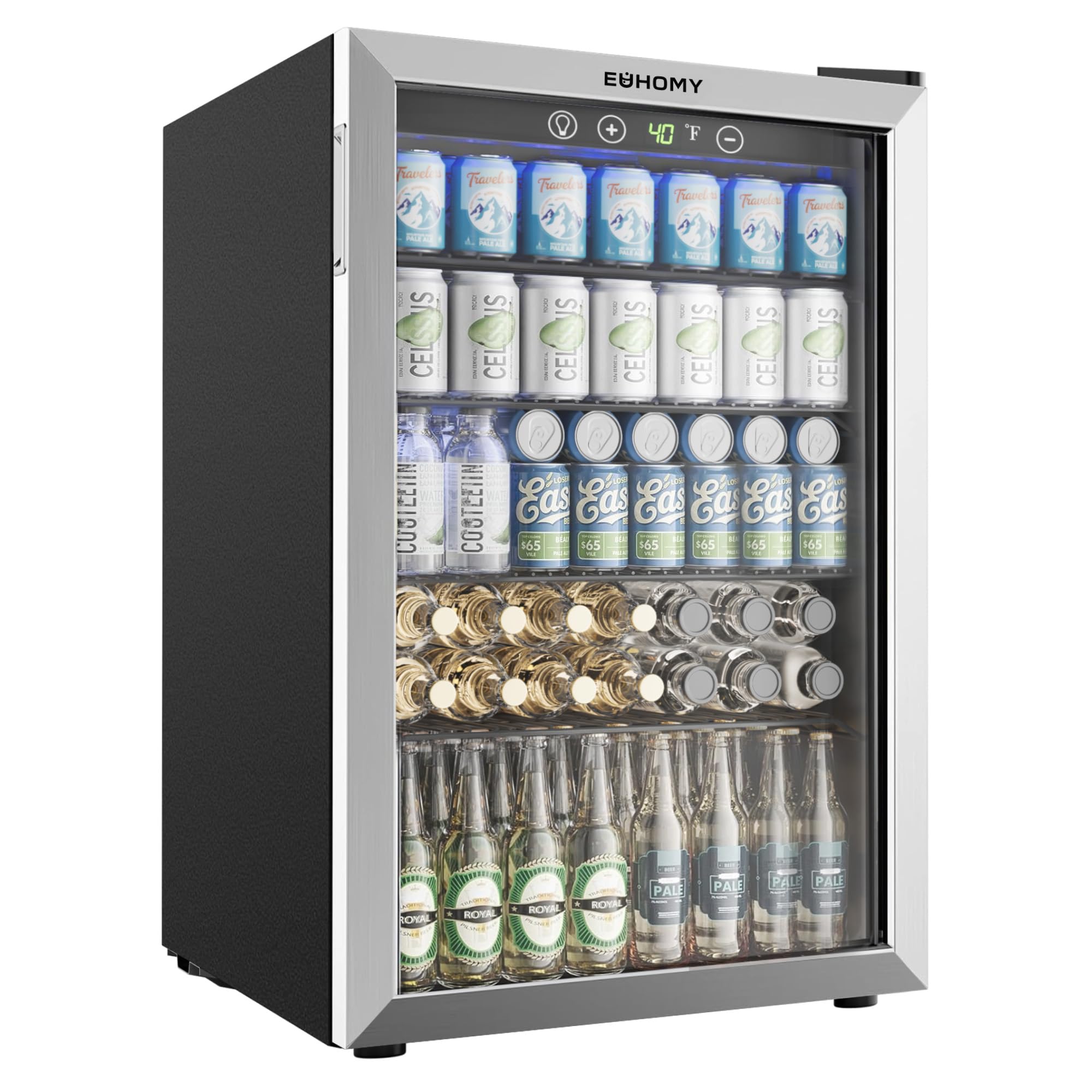
EUHOMY BR-145 145 Can
Key Features
- Capacity: 145 cans
- Temp Range: 32°F–61°F
- Installation: Built-in or freestanding
- Cooling Method: Compressor
- Price: $
The EUHOMY beverage fridge packs 145 cans into a 4.5 cu ft footprint, making it one of the largest capacities you’ll find at this price. Buyers consistently praise how quickly it chills drinks and how well it holds temperature, and the gun-metal grey finish with glass door and interior light adds a clean, modern look that works in a bar or kitchen.
That value-oriented design comes with trade-offs. The compressor emits a low hum that will be noticeable in a quiet room — a non-issue in a garage, basement, or busy kitchen. A smaller number of owners have reported the unit developing an error beep or losing cooling performance after several months, so checking the unit early and keeping it in a well-ventilated spot helps.
This fridge suits budget-conscious buyers who need high can capacity for parties, bars, or backup drink storage. It is not ideal for quiet living spaces or long-term wine storage that demands exact, stable temperatures. If you value raw capacity and low cost over whisper-quiet operation and long-term precision, the EUHOMY is a strong match.
Pros
- Holds 145 cans in a compact 24-inch wide footprint
- Cools drinks quickly and maintains temperature well
- Attractive glass door with interior light and metallic trim
- Outstanding value for the capacity and features offered
Cons
- Compressor hum may be noticeable in very quiet rooms
- Some units may develop error beeping or stop cooling after months of use
Best for Near-Silent Cooling
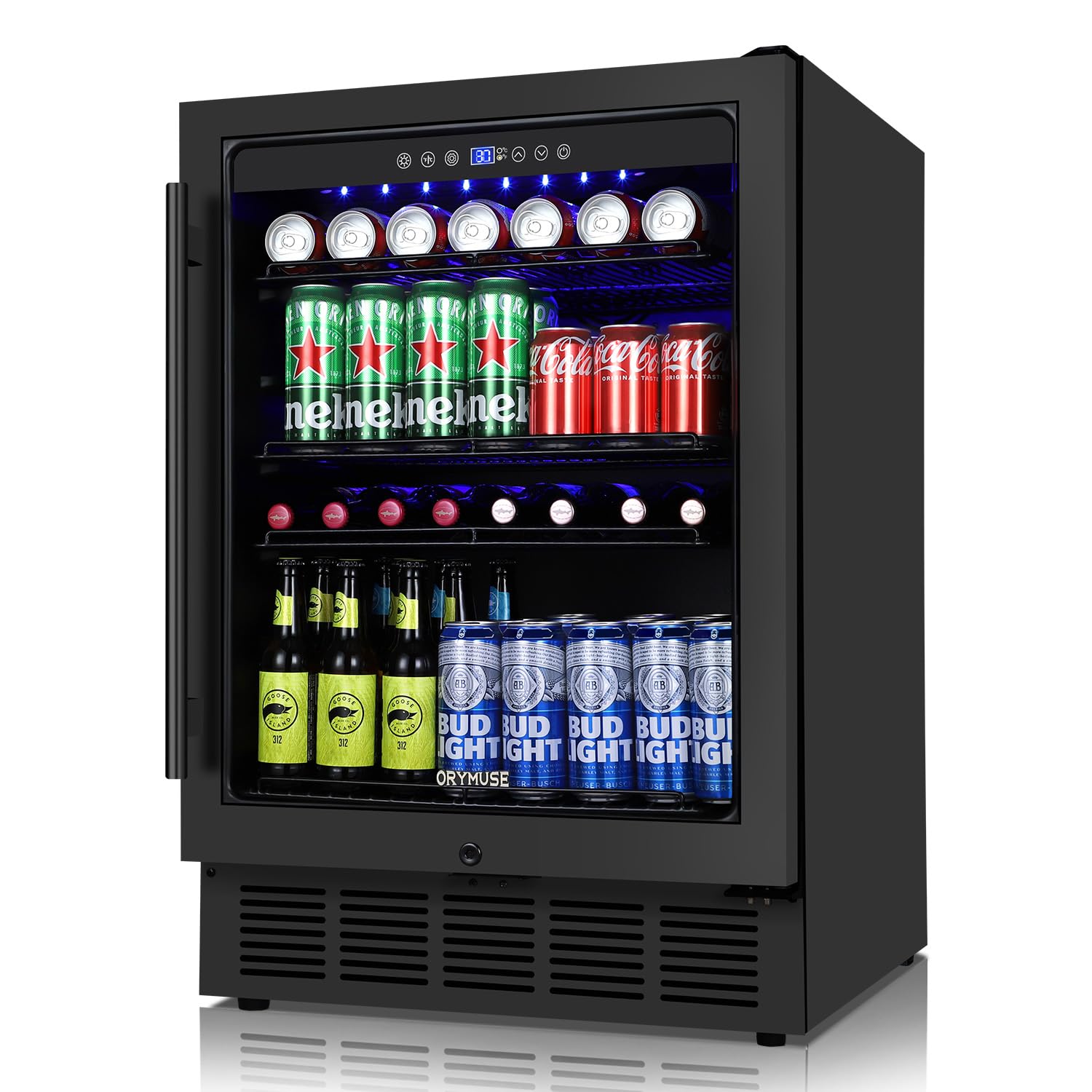
ORYMUSE HXYC150A 180 Can
Key Features
- Capacity: 180 cans
- Temp Range: 37°F–65°F
- Installation: Built-in or freestanding
- Cooling Method: Compressor
- Price: $$
While the top pick in this guide offers dual-zone flexibility for wine and drinks, the ORYMUSE focuses on single-zone beverage cooling with exceptional temperature stability. Owners describe it as nearly silent — a meaningful advantage in open-plan kitchens or home bars — and its compressor reaches set temperature quickly, holding it accurately for consistently cold cans.
This fridge suits buyers who primarily store cans and want quiet operation in a living space. If standard wine bottles are a regular part of your rotation, the shelf spacing may be too tight — consider a dual-zone model instead.
Pros
- Exceptional temperature control and quick cooling
- Very quiet operation
- High-quality build and attractive design
Cons
- Inspect upon delivery — cosmetic scuffs may appear, and the unit can scratch hard floors when moved
- Shelf spacing too tight for regular wine bottles; removing a shelf may be needed to fit standard bottles
Best for Dual Zone Trusted
Velivi KMYL120B Dual Zone

Key Features
- Capacity: 18 bottles+68 cans
- Temp Range: 35°F–64°F
- Installation: Undercounter or freestanding
- Cooling Method: Compressor
- Price: $$
The Velivi dual-zone design offers a practical split: a left zone for cold drinks (35°F–50°F) and a right zone for wine or slightly warmer beverages (41°F–64°F). This flexibility is what single-zone fridges can’t provide — you can store chilled beer alongside a bottle of Chardonnay at serving temperature, all in a 24-inch under-counter footprint. The lock on the glass door adds peace of mind in shared spaces.
Best suited for a home bar where both wine and canned drinks are regularly consumed. The capacity balance is thoughtful — 18 bottles and 68 cans — so neither side feels wasted. Build consistency, however, isn’t uniform across units. In some cases shelves may feel less sturdy or slide stiffly, and the dual-zone thermostat can show minor temperature drift between compartments. These are boundaries worth noting if you expect precision climate control or heavy-duty shelving.
The compressor runs quietly enough for a kitchen or den, and most units hold set temperatures steadily over months of use. The stainless steel and glass front earns consistent praise for its clean look. For buyers who want dual-zone capability without upgrading to a premium brand, this model delivers the core function with acceptable trade-offs.
Pros
- Balanced capacity fits 18 bottles and 68 cans in a 24-inch footprint.
- Operates quietly and holds temperature well in normal conditions.
- Stainless steel door finish suits modern kitchens and bars.
- Many owners find it works well over extended periods without issues.
Cons
- Shelves in some units may feel flimsy or be difficult to slide.
- Dual-zone temperature can drift slightly between sections in a minority of units.
Best for Mid-Range Budget
Feelfunn BR002-150SI 180 Can

Key Features
- Capacity: 180 cans
- Temp Range: 37°F–65°F
- Installation: Undercounter or freestanding
- Cooling Method: Compressor
- Price: $$
The Feelfunn 24-inch beverage refrigerator delivers an appealing design and sturdy construction at a mid-range price, with 180-can capacity that fits standard under-counter openings. Temperature retention can vary between units, making this a better fit for casual beverage storage where minor drift is acceptable rather than precise wine cellaring. Its temperature consistency is less reliable than the top single-zone model in this guide, and compressor noise reports are mixed. For buyers on a budget who want good looks and generous capacity without demanding tight temperature control, this remains a reasonable choice.
Pros
- Sturdy build and clean appearance complement kitchen or bar settings.
- Cost-effective option for a 24-inch, 180-can beverage fridge.
Cons
- Compressor hum may be noticeable in very quiet rooms; less of an issue in kitchens or bars.
Best for Low Temp Needs
Yeego YG-BS24R 180 Can

Key Features
- Capacity: 180 cans
- Temp Range: 34°F–54°F
- Installation: Built-in or freestanding
- Cooling Method: Compressor
- Price: $$
The Yeego YG-BS24R delivers on its core promise: a 180-can beverage fridge that reliably reaches 34°F, making it one of the coldest options among under-counter units. The glass door looks clean, and the price undercuts many similar-capacity models. That low-temperature capability comes with a tradeoff: the compressor hum can be noticeable in quiet kitchens or living spaces, making this a better fit for basements, garages, or rooms where ambient noise is already present.
Pros
- Consistently reaches 34°F for drinks that need extra-chill.
- Stylish glass door and stainless finish at a cost-effective price.
- 180-can capacity suits medium-sized households and home bars.
Cons
- Compressor noise can be distracting in silent environments.
Best for Narrow 20" Space
Weili SC-88F 120 Can 20"

Key Features
- Capacity: 120 cans
- Temp Range: 34°F–50°F
- Installation: Built-in or freestanding
- Cooling Method: Compressor
- Price: $
At 20 inches wide, this Weili model fills a slot most beverage fridges can’t — built-in or free-standing in a narrow pantry, kitchen island, or dorm setup. The build feels solid for a budget unit, and the compressor runs quietly enough for a living space.
Cooling consistency and shelf hardware, however, show some unit-to-unit variation. A few buyers note that the temperature doesn’t always hold below 38°F, which matters if you need truly cold soda. The plastic shelf clips can also pop loose when sliding cans in and out — a minor annoyance in a fridge you access often.
Pros
- Narrow 20-inch width fits pantries and islands where standard fridges won’t.
- Solid build quality for a budget-priced unit.
- Very quiet operation in a living space.
Cons
- Shelf support clips can dislodge when sliding cans in or out — a nuisance in a frequently accessed fridge.
- If you need consistent sub-38°F temperatures for drinks, temperature retention may vary between units.
Best for Aesthetic Choice
Icyglee BRU-04-IG 180 Can

Key Features
- Capacity: 180 cans
- Temp Range: 37°F–65°F
- Installation: Undercounter
- Cooling Method: Compressor
- Price: $$
This Icyglee beverage refrigerator combines a premium stainless and glass front with a 180-can capacity and quiet compressor operation. The solid build and attractive design make it a good fit for kitchens or home bars where appearance matters. Some units have shown cooling or lighting issues after a few months, so long-term dependability is uncertain. Best suited as a secondary fridge or for buyers who are willing to accept that risk in exchange for the look and initial performance.
Pros
- Attractive stainless and glass front elevates the look of any space.
- Solid build quality feels sturdy and well-constructed.
- Good cooling performance with quiet operation suitable for living areas.
Cons
- Some units may stop cooling or have light issues after a few months of use.
How to Choose
Most listings exaggerate can capacity by 10–15% because they don’t account for shelf spacers and bottle shapes, so subtract that margin when comparing models.
Capacity vs. Usable Space
Capacity numbers (cans or bottles) assume you’ll stack cans tightly without any wire shelf gaps. In reality, each shelf loses about one row of cans due to supports, and wider bottles like Champagne or Pinot Noir may require removing a shelf entirely.
Measure the inner width and depth of the fridge you’re considering. A 24-inch wide unit often has only 22 inches of usable interior width after the frame and door seal are subtracted.
Temperature Range and Stability
A compressor fridge’s advertised lowest temperature (e.g., 34°F) is achieved only under ideal ambient conditions. In a warm kitchen (80°F+), many units plateau 5–10°F higher than their minimum setting.
Temperature stability matters more for wine than for beer or soda. If you store wine for weeks, look for units with a fan-forced circulation system and consistent reviews about ‘steady temps’ rather than ‘quick cooling’.
Noise Levels in Practice
Compressor noise is measured in dB, but the real test is whether it’s audible from a few feet away. A fridge rated at 40 dB in a quiet room can still emit a low hum that’s distracting during conversation or sleep.
For a home bar or living area, prioritize models where the compressor is wrapped in sound-dampening material and the fan is brushless. Reviews mentioning ‘whisper quiet’ or ‘can’t hear it’ are more reliable than spec sheets.
Installation Types
Built-in (front-venting) fridges require a ventilation gap at the front kickplate; freestanding units need rear clearance or they overheat. Measure your cutout depth—many ’24-inch’ fridges are 23.5 inches wide with handles that add another inch.
If you plan to slide a freestanding fridge under a counter without a front vent, expect reduced cooling efficiency and a shorter compressor lifespan. Check the manual for minimum clearance before buying.
Door Type and Insulation
Glass doors look great but lose more cold air than solid doors unless they have double-pane argon-filled glass. Single-pane glass doors can cause condensation in humid climates and force the compressor to cycle more often.
A stainless steel door with a thermal break between inner and outer layers reduces temperature fluctuation. For wine storage, solid doors are best, but glass doors with UV coating are acceptable for short-term display.
FAQ
Why does my under-counter beverage fridge only cool to 50°F when I set it to 38°F?
This typically happens when the ambient room temperature is above 80°F or when the fridge lacks sufficient ventilation. Most compressor fridges lose 5–10°F of cooling capacity in warm kitchens. Check that the front or rear vent is clear, and move the fridge away from heat sources. If the unit still underperforms, the thermostat or compressor may be defective.
Can I install a freestanding beverage fridge under a counter without ventilation issues?
Freestanding models require at least 2–4 inches of rear clearance for heat dissipation. Sliding one into a sealed under-counter cavity without front ventilation will cause the compressor to overheat and fail prematurely. If you need a built-in look, buy a model specifically designed for built-in installation with a front vent.
How quiet should a compressor beverage refrigerator be for a home bar or wine cellar?
For a living area or home bar, aim for a fridge that measures under 40 dB from three feet away. In practice, any fridge that buyers consistently describe as ‘whisper quiet’ or ‘can’t hear it’ will work. Models with a sound-dampened compressor and brushless fan are your best bet; avoid units where reviews mention a constant hum or rattling.
Will a dual-zone wine and beverage refrigerator keep reds and whites at different temperatures properly?
Dual-zone fridges use separate cooling coils or a single compressor with baffles to split airflow. In well-designed units, the temperature difference between zones stays within 2–3°F of the set points. However, some budget dual-zone models allow the bottom zone to drift warmer because cool air sinks; check reviews for complaints about zone drift before buying.