This post contains affiliate links. We may earn a small commission when you buy through our links — at no extra cost to you.
Most wine fridges advertise a bottle count that only works for slim Bordeaux bottles. Pop in a Champagne or a fat Pinot Noir, and that number drops by 20–30%. The same gap shows up in temperature claims: many single‑zone units can’t chill whites to the 45–50°F range most red drinkers expect.
The real differentiator isn’t specs on paper but compressor quality, noise isolation, and shelf design. The market is full of rebadged units that share the same internals; the winners are the ones that actually keep their promised temperature without keeping you up at night.
This guide focuses on models that balance quiet operation, accurate dual‑zone control (if you need it), and honest capacity. Whether you’re storing 8 bottles on a counter or 150 in a basement cellar, the right fridge matches your wine’s shape and your space.
Top Picks
Best for Dual‑zone Wine
Ca’Lefort 52 Bottle

Key Features
- Bottle Capacity: 52 bottles
- Temperature Zones: Dual
- Cooling Type: Compressor
- Noise Level: Moderate
- Install Type: Built-in / Freestanding
- Price: $$$
The Ca’Lefort 52 delivers consistent dual-zone temperature control across 52 bottles, all within a standard 24-inch width that fits built-in or freestanding setups. The wood shelves and adjustable 3-color LED lighting add a polished look that matches well in a kitchen or bar.
For daily use, the compressor runs quietly enough for most living spaces – occasional hum may be more noticeable in a very quiet room. The real tradeoff comes with shelf design: the shelves do not pull out fully, so reaching bottles at the back requires some maneuvering. This matters most if you frequently rotate your collection.
This fridge suits buyers who want dual-zone storage in a compact built-in or freestanding unit, value aesthetic appeal with LED lighting, and don’t plan to rearrange bottles often. If you regularly access rear bottles, the shelf limitation is worth factoring in before purchase.
Pros
- Customizable 3-color LED lighting that enhances the visual appeal of a wine collection.
- Quiet compressor operation that won’t dominate a kitchen or bar environment.
- Solid build quality with consistent temperature control across both zones.
- 52-bottle capacity in a 24-inch width, offering good storage density for a dual-zone unit.
Cons
- Shelves do not slide out fully, making rear bottles harder to access without shifting front bottles.
Best for Compact Dual‑zone
Antarctic Star 28

Key Features
- Bottle Capacity: 28 bottles
- Temperature Zones: Dual
- Cooling Type: Compressor
- Noise Level: Loud
- Install Type: Built-in / Freestanding
- Price: $$
At 15 inches wide, this Antarctic Star is the narrowest dual-zone wine fridge that can be built in under a counter. The upper zone holds reds at 54–68°F and the lower zone stores whites at 41–54°F, with temperature control that holds setpoints accurately. The Ca’Lefort 52 offers a quieter compressor and smoother shelving, but at 24 inches wide it won’t fit in a 15-inch gap. The tradeoff here is a compressor that hums audibly when it cycles on and sliding shelves that sometimes catch on the door gasket.
This unit is a solid fit for small kitchens, home bars, or any built-in space where every inch counts and dual-zone storage is non-negotiable. The stainless steel front and blue LED lighting give it a polished look. Buyers who need a quiet refrigerator for a living area may find the compressor hum distracting, and those loading wide Burgundy bottles will need to be careful with shelf placement.
Pros
- 15-inch width fits under standard counters and allows built-in installation
- Dual-zone temperature control keeps reds and whites at separate setpoints
- Temperature accuracy is consistent across both zones
- Stainless steel door and blue LED lights look clean and modern
Cons
- Compressor noise is noticeable when it cycles on; less an issue in a garage or busy kitchen
- Sliding shelves can catch on the door gasket, so bottle placement needs attention
Best for Wine & Cans
Tylza Dual Zone

Key Features
- Bottle Capacity: 20 bottles + 88 cans
- Temperature Zones: Dual (French doors)
- Cooling Type: Compressor
- Noise Level: Moderate
- Install Type: Built-in / Freestanding
- Price: $$$
The Tylza 24-inch unit combines a French door design with dual-zone cooling for both wine and beverages, a rare combination in this form factor. Unlike pure wine fridges, the left zone handles cans and bottles in a wider temperature range (35–50°F) while the right zone adjusts from 41–64°F for reds and whites. The 4.2 cu.ft capacity holds 20 wine bottles and 88 cans, making it a natural fit for a home bar where quick access to both beer and wine is a priority.
This cooler suits buyers who want the look of French doors and the flexibility to store wine alongside soda, beer, or other drinks in a built-in or freestanding setup. The compressor cooling delivers consistent temperatures for most users, though a small number of units have shown noise or minor temperature drift — worth checking in a quiet kitchen or bar rather than a bedroom. The stainless steel finish and tempered glass doors give it a premium appearance that matches modern kitchen appliances.
Build quality feels solid for the price, with stainless steel handles and a charcoal filter. The unit runs quietly in most environments, and the digital thermostat is intuitive to set. At under $700, it undercuts many dedicated dual-zone wine fridges while adding beverage capacity.
Pros
- French door design adds style and convenient access for a bar setting
- Dual-zone cooling allows separate temperatures for wine and beverages
- Good value for a combo unit with solid build
- Quiet enough for open-plan living for most users
Cons
- In quiet spaces, compressor hum may be present – better for kitchen or basement placement
- Temperature consistency can vary between units – advisable to monitor with an external thermometer
Best for Large Collections
Velieta KMHJ408D

Key Features
- Bottle Capacity: 179 bottles
- Temperature Zones: Dual
- Cooling Type: Compressor
- Noise Level: Moderate
- Install Type: Freestanding
- Price: $$$$
The Velieta KMHJ408D packs 179 bottles in a dual-zone layout, supported by strong compressor cooling that hits target temperatures quickly. Its stainless steel build and blue LED interior give it a high-end presence that matches a dedicated wine room, not a kitchen counter. Compared to the top-pick Ca’Lefort 52 — which balances capacity, quiet operation, and price for typical home use — this unit sacrifices some refinement for raw volume and visual impact.
Serious collectors with 100+ bottles and a budget for a centerpiece unit will appreciate the Velieta’s capacity and look. It fits best in a basement or separate cellar where occasional compressor hum and possible temperature drift between units won’t disrupt daily life. Those planning to age wine long-term should monitor performance closely during the first few weeks, as cooling consistency can vary.
Owners find the cooling effective and the noise level acceptable for a large compressor fridge — most can carry on a conversation near it without issue. A minority note that in dead-silent rooms the compressor cycle is audible, and a small number experience temperature swings that require a thermometer check. Neither issue affects all units, but both are worth knowing before committing at this price.
Pros
- 179‑bottle capacity supports large collections, including magnum formats
- Premium stainless steel and blue LED interior add a showpiece aesthetic
- Powerful compressor reaches set temperatures quickly and maintains them well
- Operates quietly for a unit of this size, suitable for most home settings
Cons
- In very quiet rooms, the compressor hum may be noticeable — better placed in a basement or cellar
- Temperature consistency can vary between units; worth verifying during the initial return window
Best for Mixed Beverage
Kalamera Dual Zone

Key Features
- Bottle Capacity: 21 bottles + 75 cans
- Temperature Zones: Dual (separate)
- Cooling Type: Compressor
- Noise Level: Quiet
- Install Type: Built-in / Freestanding
- Price: $$$
This 24-inch unit combines wine and beverage storage in a single footprint with separate temperature zones and a clean, blue-LED design. The compressor runs quietly enough for most home environments. However, the stated bottle count is optimistic – expect to fit fewer bottles than advertised, especially with larger Burgundy shapes.
Pros
- Dual-zone design keeps wine and cans at separate optimal temperatures.
- Attractive blue LED lighting adds a premium look to the interior.
- Compressor operates quietly in typical kitchen or bar settings.
Cons
- Sliding can racks replace some wine shelves, reducing pure wine-storage capacity.
- Compressor hum may be noticeable in very quiet rooms; temperature consistency can vary between units.
Best for Budget Multi‑use
Electactic JC-90

Key Features
- Bottle Capacity: 37 bottles
- Temperature Zones: Single
- Cooling Type: Compressor
- Noise Level: Loud
- Install Type: Freestanding
- Price: $
With 37-bottle capacity and a budget-friendly price, this Electactic fridge combines an attractive glass door with blue LED lighting. It can store both wine and cans, and cooling performance is consistent for everyday use. The compressor hum may be noticeable in quieter spaces, and temperature consistency can vary between units—so it suits a garage or basement better than a living room. For casual drinkers who want large capacity without a large investment, it’s a solid option.
Pros
- Spacious 37-bottle capacity for wine and cans at a budget price
- Attractive glass door with blue LED lighting
Cons
- Compressor hum may be noticeable in quiet rooms—best placed in a garage or basement
- Temperature consistency can vary between units; checking with a separate thermometer is wise
Best for Entry‑level 25
EUHOMY 25 Bottle

Key Features
- Bottle Capacity: 25 bottles
- Temperature Zones: Single
- Cooling Type: Compressor
- Noise Level: Loud
- Install Type: Freestanding
- Price: $
The EUHOMY 25-bottle wine cooler offers generous capacity for under $250 and a clean glass-door look with blue LED. Storage space is a clear strength: it holds standard wine bottles and cans with room to spare. Temperature range spans 41–64°F, enough for most reds and whites. However, compressor noise can be audible in quieter rooms, and temperature consistency may vary between units — some owners note it doesn’t always hold the set point. This makes it a practical choice for a garage, workshop, or basement where ambient noise is already present and precise cellar conditions aren’t required. The gamble on noise and temp control limits its appeal to serious collectors or living-area placement.
Pros
- Good storage capacity for the price – holds many bottles and cans.
- Attractive and compact design with blue LED lighting.
- Good value – solid features under $250.
Cons
- In a quiet living room, the compressor hum will be present – less of an issue in a garage or basement.
- Temperature consistency can vary between units – worth checking with a thermometer after setup.
Best for Budget Dual‑zone
WE 32 Dual Zone

Key Features
- Bottle Capacity: 32 bottles
- Temperature Zones: Dual
- Cooling Type: Compressor
- Noise Level: Loud
- Install Type: Freestanding
- Price: $$
The Wine Enthusiast 32-Bottle delivers separate temperature zones for red and white wines in a space-saving design that fits under counters or in a home bar. Its compressor cooling can maintain different climates for each side. However, noise from the compressor may be noticeable in quieter rooms, and temperature consistency has been noted to vary between units. These tradeoffs make it a better fit for short-term storage or utility areas where ambient noise is less of a concern, rather than for a quiet living space or long-term cellaring.
Pros
- Dual-zone temperature control for red and white wines
- Compact footprint fits many spaces
Cons
- In quiet environments, the compressor hum may be present
- Temperature control may not hold steady over time
Best for Budget Large Cap
Icyglee 45 Bottle

Key Features
- Bottle Capacity: 45 bottles
- Temperature Zones: Single
- Cooling Type: Compressor
- Noise Level: Loud
- Install Type: Freestanding / Under‑counter
- Price: $
The Icyglee 45-bottle fridge offers the largest capacity under a budget-friendly price, with reliable cooling and an attractive black glass front. In exchange for that value, you get a single temperature zone (40–61°F) and a compressor that can produce a noticeable hum – a tradeoff that disappears in a garage or bar area but would stand out in a quiet living room.
This fridge suits casual wine drinkers who don’t need separate red and white zones and have a basement, garage, or man cave to house it. The noise tradeoff is manageable in those spaces, and the 45-bottle capacity handles parties or weekly restocks without breaking the bank.
Temperature consistency is solid for the price – the fridge holds its set point well, and the door seal feels sturdy. The blue LED interior and black finish give it a polished look that belies its budget price, making it a strong visual addition to a utility space.
Pros
- Holds up to 45 bottles without crowding typical Bordeaux or Burgundy shapes
- Keeps drinks at a consistent serving temperature once set
- Sleek black door and blue LED give a polished look for the price
- Delivers generous capacity and usable features at a budget-friendly price
Cons
- In very quiet rooms, the compressor hum will be present – less of an issue in a garage or basement
Best for Countertop Casual
Cuisinart CWC-800C

Key Features
- Bottle Capacity: 8 bottles
- Temperature Zones: Single
- Cooling Type: Thermoelectric
- Noise Level: Quiet
- Install Type: Countertop
- Price: $
The Cuisinart CWC-800CEN stands apart from compressor-based wine fridges with its near-silent thermoelectric cooling. It sacrifices the dual-zone flexibility and larger capacity of the Ca’Lefort 52 for a compact, whisper-quiet countertop footprint. Owners consistently praise its intuitive touchscreen and sleek matte black design. However, thermoelectric cooling cannot chill wines below about 46°F, making it unsuitable for serving very cold whites.
This cooler fits casual drinkers who keep a few reds and whites at a single serving temperature on a countertop under cabinets. The 8-bottle capacity only accepts slim standard bottles — Pinot Noir or Champagne shapes may not fit. For those who need dual zones or larger capacity, the top pick remains a better fit.
Pros
- Quiet even in near-silent environments — thermoelectric cooling produces no compressor hum.
- Compact 8-bottle footprint fits neatly under kitchen cabinets or on a counter.
- Intuitive touchscreen and digital display make temperature adjustment straightforward.
- Matte black finish with blue interior light looks clean in any setting.
Cons
- Bottle slots are narrow — Pinot Noir and Champagne bottles may not fit.
- Minimum temperature around 46°F may not satisfy drinkers who prefer very cold whites.
- Single-zone design limits serving both reds and whites at ideal temperatures simultaneously.
Best for Premium Combo
Ca’Lefort 20 Bottle
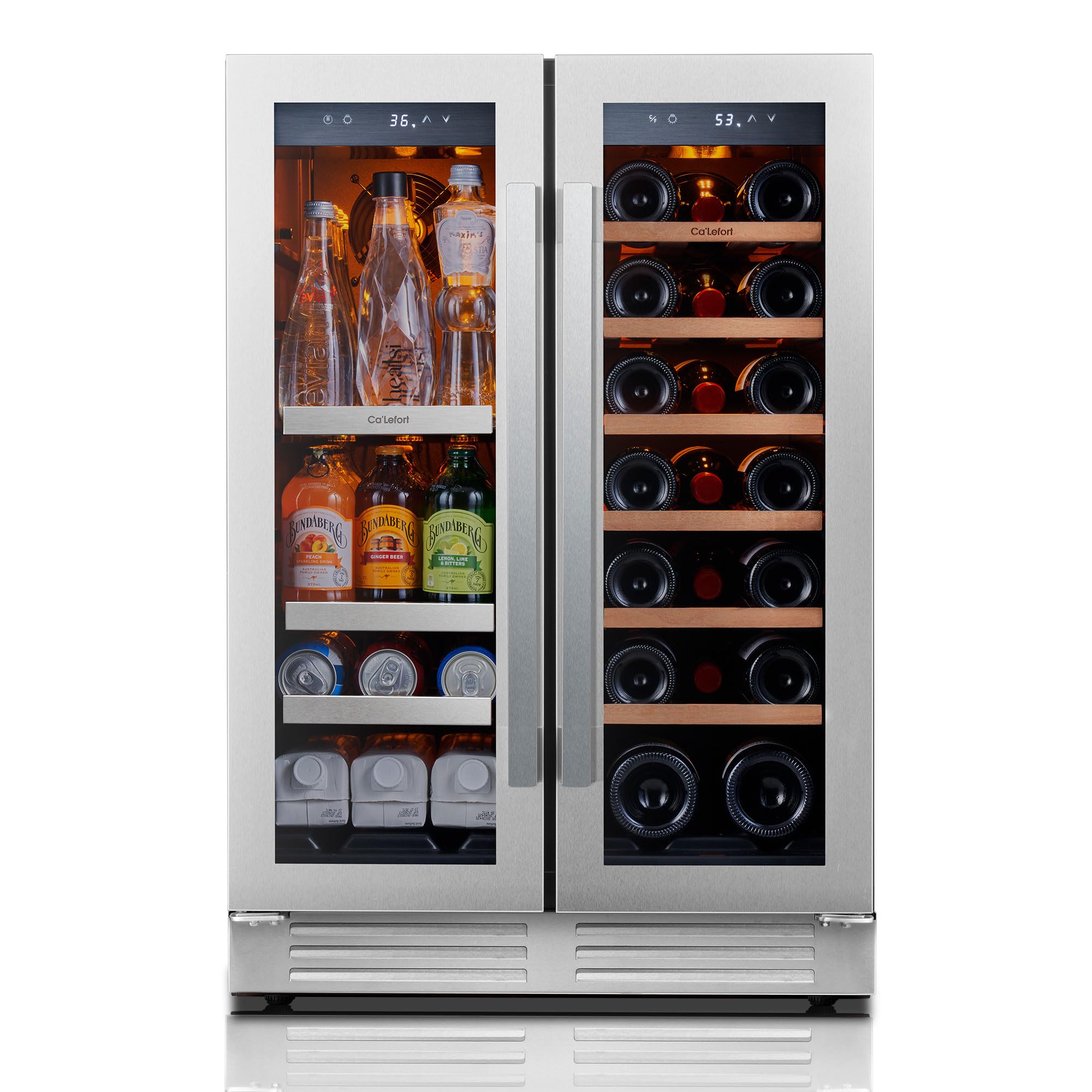
Key Features
- Bottle Capacity: 20 bottles + 60 cans
- Temperature Zones: Dual (French doors)
- Cooling Type: Compressor
- Noise Level: Quiet
- Install Type: Built-in / Freestanding
- Price: $$$$
Ca’Lefort’s 24-inch French door unit stands out with its stainless steel and glass design and three-color LED lighting — a clear step above most dual-zone options in appearance. The compressor runs quietly and cools reliably for both wine (36–72°F) and beverages. However, this is a premium-priced unit; you pay a significant premium per bottle compared to Tylza’s dual-zone offerings. Additionally, occasional cooling consistency has been noted, so it’s worth buying with a flexible return window in mind. This fridge is best suited for buyers who value design over sheer value and don’t mind the higher cost for a statement piece in their kitchen or bar.
Pros
- Exceptional build quality and design
- Beautiful appearance with three-color LED lighting
- Quiet compressor operation
Cons
- Premium cost per bottle reduces overall value compared to dedicated wine fridges – best for buyers prioritizing design over price
- Temperature consistency can vary between units – worth buying with a flexible return window in mind
Best for Large Single‑zone
Yeego YG-WS24

Key Features
- Bottle Capacity: 52 bottles
- Temperature Zones: Single
- Cooling Type: Compressor
- Noise Level: Quiet
- Install Type: Built-in / Freestanding
- Price: $$
The Yeego YG-WS24 stands out for its near-silent compressor and sturdy construction — wooden shelves and a stainless steel frame give it a higher-end feel than its mid-range price suggests. This single-zone unit holds 52 bottles, including wider Pinot and Riesling shapes, and maintains a steady 40–65°F range without the temperature swings that can plague cheaper models.
In a living area or open kitchen, the low noise level is a genuine advantage: the compressor hum is barely audible even when it kicks on, which is rare at this price point. Bottle access is straightforward thanks to smooth-sliding shelves, though the rear row requires a reach because shelves don’t pull out fully.
This fridge suits buyers with a sizable collection who prefer a single serving temperature — ideal for those who keep mostly reds or mostly whites, or who serve all wine at cellar temperature. It is not the right pick for anyone who needs separate zones for reds and whites at the same time; the Ca’Lefort 52 dual-zone is the better fit there.
Pros
- Exceptionally quiet compressor — barely noticeable in silent rooms
- Solid wood shelves and stainless steel trim give a premium look and feel
- Reliable temperature holding across the 40–65°F range
- 52-bottle capacity accommodates standard and oversized bottles without cramming
Cons
How to Choose
Advertised bottle counts are almost always based on slim standard bottles — measure your largest Pinot or Champagne before choosing a capacity.
Bottle Capacity
A 52-bottle fridge rarely holds 52 bottles if you drink Burgundy, Champagne, or any oversized format. The shelves have fixed spacing; a 3-inch-diameter bottle takes up more width than the 2.8-inch Bordeaux standard used in marketing. Subtract 20–30% from the claim for realistic capacity.
Also check shelf depth. Some units have a lip that prevents the second row from sliding in, turning a 52-bottle claim into 35 usable spots. If you often store magnums or sparkling wine, look for removable or adjustable shelving.
Temperature Zones
Dual-zone fridges have two separate cooling compartments (or a divider with independent controls) so you can store reds at 55–65°F and whites at 45–50°F in the same unit. Single-zone models force a compromise: set it for whites and your reds drink warm; set it for reds and your whites are too warm.
The trade-off is cost and complexity. Dual-zone compressor models typically run $150–$300 more than single-zone of similar size. If you mostly drink one type or don’t mind chilling white wine in a bucket, single-zone saves money and often runs quieter.
Cooling Type
Compressor cooling is the standard for any fridge over 12 bottles. It can reach 40°F and maintain it against warm ambient temps, but it vibrates and hums. Thermoelectric coolers use a Peltier chip — nearly silent and vibration-free, but they struggle to drop below 50°F in warm kitchens and can’t handle large capacities.
For serious wine storage (especially long-term aging), compressor is the only reliable choice. Thermoelectric works fine for a casual countertop unit that lives in a climate-controlled room and only holds 8–12 bottles.
Noise Level
Compressor noise comes from two sources: the compressor itself and the cooling fan. Well-insulated units like the Yeego use premium fans and rubber mounts to keep the hum below 32 dBA. Budget models often skip sound dampening, resulting in a constant buzz that’s noticeable in a quiet living room.
If the fridge will go in a bedroom, office, or open-plan kitchen, prioritize models with “quiet” or “low noise” in reviews — and expect to pay more. For basements or garages, noise is less of a concern and budget compressors become viable.
Installation
Freestanding units need clearance on all sides for heat dissipation. Built-in models have front ventilation so they can sit flush in a cabinet. Under-counter fridges are typically front-vented but may still require a few inches above for airflow.
The wrong installation type can shorten compressor life or cause overheating. A freestanding unit shoved into a closed cabinet without ventilation will fail early. Always check the manual’s required clearances — 2–3 inches on the sides and back is common for freestanding, while built-ins need less.
FAQ
Why is my wine fridge making a loud buzzing or clicking noise?
That’s typically the compressor cycling on or the fan hitting a loose panel. Some noise is normal, but if it’s constant or rattling, check if the unit is level and has proper ventilation. If the noise started after a few months, a loose fan blade or failing compressor may need service. Models with higher noise complaints (like the Electactic or Icyglee) are more prone to this.
How long should you let a wine cooler sit before plugging it in?
At least 24 hours upright. During shipping, refrigerant oil can migrate into the compressor lines. Plugging it in too early can cause oil slugging, which damages the compressor and voids the warranty. This is the number one cause of early failures in budget compressor fridges.
Can a thermoelectric wine cooler keep white wine cold enough?
Only if the room is cool. Thermoelectric coolers typically max out at about 50–55°F under ideal conditions, and they struggle in kitchens above 75°F. If you want proper white wine serving temperature (45–50°F) or need to chill Champagne, a compressor model is the safer choice.
Do wine fridges really hold the number of bottles they advertise?
Almost always fewer. Advertised capacity uses slim standard 750ml bottles (like Bordeaux) stacked tightly. Oversized bottles, Burgundy, Champagne, or those with higher shoulders reduce that number by 20–40%. Always measure your largest bottle’s diameter and check the shelf height before buying.