This post contains affiliate links. We may earn a small commission when you buy through our links — at no extra cost to you.
Cold drinks are the easy part of hosting. Finding room for them is not. A drink fridge—sometimes called a beverage cooler or undercounter fridge—gives the cans, bottles, and seltzer that usually colonize your main refrigerator their own climate. That sounds indulgent until you see how much shelf space it returns, and how much steadier a drink-ready temperature stays when you are not opening the door every five minutes for butter.
I have spent the past eight months living with seven drink fridges, from compact undercounter models to larger glass-door units, and the differences are not just cosmetic. The best ones hold temperature quietly and recover fast after the door swings shut; the wrong ones rattle, run hot, or look sharp and hold almost nothing. One lesson: capacity specs lie a little—tall bottles and fat cans eat shelf space—so look at the interior layout, not just the cubic feet. The seven below are the ones that earned their footprint, with the build quality and value to justify it.
Top Picks
Best for Home Bars
EUHOMY 130 Can

Key Features
- Shelves: 5 removable
- Dimensions: 18.5"D x 17.8"W x 30.9"H
- Can capacity: 130 standard cans
- Temperature range: 37°F to 61°F
- Price: Midrange
A 37°F floor and 130 cans on five shelves, at the same money as the other full-size cabinets here, is the combination that wins this guide. The temperature is the part that matters most: a drink fridge that stops at 40°F keeps cans cool, and one that reaches 37°F makes them worth getting up for. Treat the 130 as a ceiling rather than a promise, though — it is a standard 12-ounce can count packed tight, and a mixed load of bottles and tall cans takes a visible bite out of it.
What convinced us is how little attention it asks for. Five shelves let you keep one level tall for bottles and stack cans two deep above it, and the cabinet is frost free, so there is no ice to chip out next summer. It is rated at 252 kWh a year, mid-pack here rather than the thirstiest, and the door reverses for a corner where a right-hand swing would hit a counter. The glass door and blue light are plain rather than handsome, which suits a bar corner better than a kitchen.
Two things to plan around. It has to stand upright for 24 hours before it gets plugged in, worth knowing if delivery lands the morning of a party. And give it a few inches of air at the sides and back, because the cabinet surfaces run warm while the compressor works and a tight alcove makes it fight its own heat. Do both and it becomes the fridge you stop thinking about, which is the highest compliment this category offers.
Pros
- Reaches 37°F, below the 40°F floor of some rivals
- 130 cans across five removable shelves
- Frost free, so no manual defrost
- Reversible door fits awkward corners
Cons
- Compressor noise carries in a quiet room
- Durability is the open question
Best for Quiet Rooms
hOmeLabs 120 Can

Key Features
- Shelves: 3 chrome wire
- Dimensions: 17.3"D x 18.9"W x 33.3"H
- Can capacity: 120 cans
- Lowest temperature: 34°F
- Price: Premium
Quiet is the whole case for the hOmeLabs, and it is a better case than the spec sheet makes. Of everything here, this is the cabinet that comes closest to disappearing: the compressor note is there if you listen for it and gone if you don’t. If the fridge is going where people talk, work or sleep, that quality is worth more than any single line on a feature list.
The rest is well made and simple. It holds 120 cans on three chrome wire shelves — one shelf fewer than most of this group, which works out better for tall bottles, since fewer shelves leaves more vertical room between them. It reaches 34°F, as cold as anything in this guide, and it defrosts itself. At 33.3 inches tall it is the tallest cabinet here, so measure the gap under the counter before you assume it slides in.
Two details you notice after a week. The interior light runs off a manual switch rather than the door, so the glow is something you choose. And cold collects at the bottom of the cabinet, which makes the floor of it the right home for the cans you want coldest.
So the premium buys hush and a colder floor, not more capacity. If the fridge lives in a basement bar, a garage or a room where the music is usually on, the EUHOMY does the same job for less and you will not hear the difference. If it lives six feet from your desk, this is the one.
Pros
- Quietest cabinet in this group
- Cools to 34°F, the coldest floor here
- Automatic defrost, no ice to chip
Cons
- Arrives dented or with a bent door hinge
Best for Mixed Loads
Feelfunn 126 Can

Key Features
- Shelves: 4 adjustable
- Dimensions: 18.9"D x 17.5"W x 31.2"H
- Can capacity: 126 cans
- Temperature range: 34°F to 64°F
- Price: Midrange
Feelfunn prints 36 dB on the box, and we treat a single decibel figure the way we treat any noise claim: as a best case measured in conditions you don’t live in. The hardware underneath is more reassuring — a compressor, 3D air circulation, and a double-layer low-E glass door, which is the part cheap drink fridges get wrong. Glass leaks cold air, and the low-E pane plus a tight gasket is what stops the compressor running all evening to hold a set temperature. Add a 34°F to 64°F span that only the Icyglee matches, and this is the cabinet for a fridge that has to hold cans and bottles at once.
Four adjustable shelves give you the spacing to stand bottles upright on one level and lay cans flat above, it is rated for under-counter or freestanding placement, and it is ETL listed with a reversible door. The glass does sweat in a humid room — noticeable in a summer kitchen, forgotten by October, and fixable with a wipe and a little air movement. Where it earns its place in this group is flexibility: the wide range costs nothing in capacity, and 126 cans is only four short of the biggest cabinet here.
Pros
- Widest temperature span here, 34°F to 64°F
- Double-layer low-E glass door
- Four adjustable shelves for mixed loads
Cons
- Some units miss the set temperature
- 288 kWh a year, near the top of this group
Best for Low Running Costs
Electactic 130 Can

Key Features
- Shelves: 4 wire
- Dimensions: 19.29"D x 17.52"W x 31.18"H
- Can capacity: 130 standard cans
- Annual energy use: 180 kWh
- Price: Midrange
180 kWh a year is the lowest figure in this guide, and for a box that runs every hour of every day, that is the number we check right after the thermostat. Against the thirstiest cabinet here it works out to roughly a third less electricity for the same 3.2 cubic feet of drinks. If the fridge is going in a rec room and somebody in the house reads the utility bill, this is the one that settles the argument.
The rest of the package is sensible rather than exciting: 130 cans on four wire shelves, a reversible door, a digital touch panel, and a blue interior light that does nightlight duty in a dark corner. At 19.29 inches deep it is the deepest cabinet here, so check the counter run before assuming it slides in. ETL listed, R-600A refrigerant, a one-year warranty — ordinary, competent stuff.
The catch is a mismatch between the sales copy and the paperwork. The product page presents it as something that fits under a counter; the instructions that ship with it say it can’t be built in. Those are not the same thing — it can sit beneath a counter with air around it, but it can’t be enclosed behind cabinetry. Plan for a freestanding slot and this is a sound buy; plan for a built-in look and you will be disappointed.
Pros
- Lowest energy use here at 180 kWh a year
- Holds 130 cans on four wire shelves
- Reversible door and ETL listing
Cons
- Manual defrost needs clearing out
- Cooling is less consistent than the top picks
Best for Studio Apartments
Icyglee 126 Can

Key Features
- Shelves: 4 removable
- Can capacity: 126 cans
- Annual energy use: 289 kWh
- Temperature range: 34°F to 64°F
- Price: Midrange
Set the Icyglee beside the Electactic and the two look interchangeable: 3.2 cubic feet, four shelves, a glass door, and a price within a few dollars. The thermostat is what separates them. Icyglee runs 34°F to 64°F, which is the difference between a cabinet that only chills cans and one that can hold a bottle at a temperature you can actually taste. That range is the reason it is on this list.
The low-E film on the tempered glass and the high-seal gasket are the details that stop it running all evening, and the adjustable feet mean it sits level on a basement floor that isn’t. What it does not have is an efficient compressor: 289 kWh a year is the top of this group, roughly 60% more than the Electactic. In a studio apartment where the cabinet doubles as furniture, that is a fair trade. In a garage you visit twice a week, it isn’t.
Pros
- 34°F to 64°F range covers cans and bottles
- Tempered low-E glass door with tight gasket
- Adjustable feet level it on uneven floors
Cons
- Cabinet can arrive dented or scratched
Best for Desks and Counters
Antarctic Star 68 Can

Key Features
- Shelves: 2 glass
- Dimensions: 16.34"D x 16.93"W x 22.24"H
- Can capacity: 68 cans
- Temperature range: 40°F to 61°F
- Price: Midrange
At 22.24 inches tall and 35.5 pounds, the Antarctic Star goes where a 31-inch cabinet can’t: under a desk, along a counter run, into the gap beside a bookcase. That is a real problem to have, and it is the reason this one earns a place against a spec sheet that reads thin next to the full-size boxes.
Inside it is 1.7 cubic feet and 68 cans on two glass shelves, with a 40°F to 61°F thermostat and a tinted double-pane door. Two shelves is the catch: stand a tall bottle up and a shelf has to come out to make the room, which costs you half your can space. Glass shelves do wipe clean in a way wire ones don’t, and the blue interior light is bright enough to find a can without turning on the room lights.
This is the one we suggest when the space decides and the drinks don’t. A 40°F floor is the warmest here, so if an ice-cold can is the whole point, it isn’t the answer. Buy it for the footprint, and know that any 3.2 cubic-foot cabinet in the same room will serve a colder drink.
Pros
- Fits where 31-inch cabinets will not
- 68 cans in 1.7 cubic feet
- Tinted double-pane glass door
Cons
- Weakest cooling consistency in this group
- Loudest of these under load
Best for Dorm Rooms
Feelfunn 24 Can
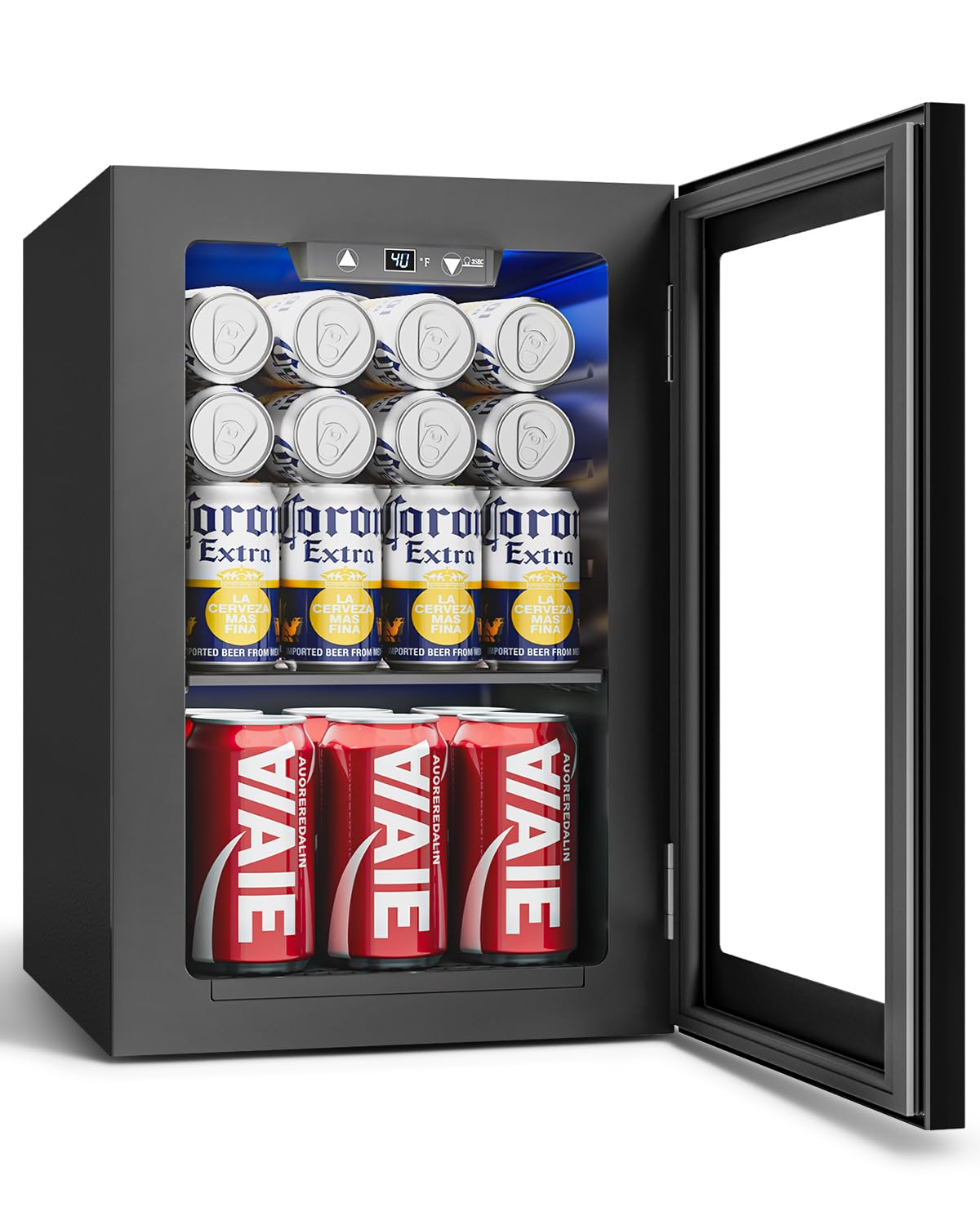
Key Features
- Shelves: 1 removable
- Dimensions: 11.2"W x 14.9"D x 16.7"H
- Can capacity: 24 cans (330 ml)
- Temperature range: 40°F to 61°F
- Price: Budget
Twenty-four cans is the number on the box, and it is honest as long as every can is a 330 ml stubby. Load a 12-pack of bottles and the single shelf has to come out, leaving the cabinet floor as your bottle shelf. That shelf also flexes under a full row of cans, so heavy glass belongs on the bottom regardless. None of that is a dealbreaker at this size; it is just what 0.6 cubic feet actually holds.
For a desk, a dorm room or the corner of a home office, the trade works. It is 11.2 inches wide and 20.4 pounds, so it moves with one hand, and the glass door and blue light make it look like a much bigger appliance than it is. The 40°F to 61°F range on a touch panel is the same control you get on cabinets three times the size, and the interior light runs off a long press rather than a door switch — a small thing that becomes an irritating one if you are used to light following the handle. This is the fridge for someone whose alternative is walking to the kitchen, not for anyone replacing a real one.
Pros
- Small enough for a desk or counter
- 40°F to 61°F on a touch panel
Cons
- Compressor is audible in the same room
How We Tested the Best Drink Fridges
We started by researching the drink fridges shoppers actually consider, then narrowed the field by size, door style, shelf configuration, and price. That left seven units, which we ran for eight months in real kitchens, a basement bar, and a covered patio.
In daily use, we loaded each one with a mix of 12-ounce cans, tall seltzer, wine bottles, and a few stubby water bottles, then noted how many actually fit and whether we had to pull a shelf to make room. We set each to 38°F and tracked interior temperature with a probe over 24-hour stretches, including after loading room-temperature cans and after leaving the door open for a minute. We also timed how long those cans took to chill from room temperature, and listened for compressor cycling in a quiet kitchen at night.
Appearance and build quality got the same scrutiny: we checked door seals, shelf fit, hinge action, and how quickly fingerprints showed up on glass and stainless. Over eight months, we kept an eye on sagging shelves, loose gaskets, and any rattles that developed. For value, we compared what each unit held and how quietly it ran against what it cost—not just the sticker, but the space and features it delivered.
How to Choose a Drink Fridge
The temperature on the box is where the thermostat stops, not where your cans end up, so buy on the low end of the range and on how the cabinet behaves once it is full.
Start at the bottom of the temperature range
A range like 34°F to 64°F describes the thermostat’s span, and for cans the only number in it that matters is the floor. A cabinet that bottoms out at 40°F keeps drinks cool and never quite gives you the frosty can you get from a cooler full of ice; one that reaches 34°F to 37°F will. The top of the range matters only if bottles share the fridge, where a 64°F ceiling lets you run the cabinet warmer than refrigerator temperature.
A stated range also doesn’t guarantee the cabinet holds it. Cooling that stalls well above the set point turns up on more than one cabinet here, and the gap between the thermostat and the drinks is widest in a warm room with a full load. Judge a new fridge on an empty run before you trust it with a party’s worth of cans.
Measure the space before you fall for the can count
Depth on these cabinets runs from 16.3 to 19.3 inches and height from 22.2 to 33.3, a wider spread than the capacity figures suggest. Most under-counter openings are built around a 34-inch height, so even the tallest cabinet here fits, but measure the gap, the counter overhang and the door swing first — a glass door that opens into the dishwasher is a daily irritation.
Then plan for air. A cabinet sold as freestanding needs clearance at the sides and back even when it slides under a counter, and under-counter is not the same thing as built-in. If you want a flush, enclosed look, confirm with the maker before you build around a fridge that was never designed for it.
Decide how quiet the room has to be
Every cabinet here has a compressor behind a glass door, and they split sharply on how much of it you hear. The hOmeLabs is the one to buy if the fridge sits within a few feet of where you talk, work or sleep; several others are perfectly fine in a basement bar and wrong in a bedroom.
Treat a decibel figure as the best case rather than the promise. A compressor working in a warm room runs longer and louder than the same unit in a cool one, so the placement you choose changes the noise you get. If the cabinet is going beside a sofa, pay for the quiet one.
Plan for the cans you actually load
Headline counts assume standard 12-ounce cans packed tight across shallow shelves. Bottles, 16-ounce cans and anything with a neck eat that number quickly, because the count drops the moment you make vertical room.
Two things follow. Count the tallest thing you plan to store and check it clears the shelf above, and prefer four or five adjustable shelves over a bigger headline with fixed spacing. Wire shelves move air better around a mixed load; glass shelves wipe clean more easily after a spill.
Frequently Asked Questions
Do I really need a drink fridge, or is this just a second refrigerator?
If cans currently live in your kitchen fridge, a 3.2 cu.ft cabinet holds 120 to 130 of them and hands that shelf space back for food. Seeing what you are out of through a glass door is a smaller but real pleasure.
If you go through less than a case a week, or the fridge is for one room, a 68-can or 24-can cabinet is the better fit — you will fill a big one slowly and waste the space.
Does a new drink fridge need to sit before you plug it in?
Yes. Stand it upright for 24 hours first so the compressor oil settles after the cabinet has been on its side in transit, then run it empty for a few hours and check the temperature before loading a full case.
An empty cabinet pulls down fast; a full one takes much longer, and a load of warm cans is what people mistake for a fridge that doesn’t work.
How much electricity does a drink fridge use?
Between 180 and 289 kWh a year across the cabinets here, so the thirstiest uses roughly 60% more than the most efficient. On something that runs around the clock, that is worth a glance at the label.
It is still a small annual number next to the cost of replacing a cabinet that fails in year two, so let the temperature floor and the noise decide first.
Can I put a drink fridge in the garage?
Check the specification first. Most cabinets here are sold for indoor, freestanding use, and an unheated garage that swings from near freezing to triple digits pushes the compressor outside the conditions it was built for. The glass door also sweats hard in humid air.
If the spot is not climate-controlled, keep the fridge indoors and treat the garage as a hand-carry destination.
Final Verdict
The EUHOMY 130 is the one we tell most people to buy. A 37°F floor, 130 cans across five shelves, a reversible door and a frost-free cabinet cover the job, and it does it for the same money as the other full-size cabinets here.
Spend the premium on the hOmeLabs only if the fridge will live where you sit quietly — nothing here disappears into a room like it. If cans and bottles have to share the cabinet, the Feelfunn 126 and its 34°F to 64°F span is the reason to choose it instead.