This post contains affiliate links. We may earn a small commission when you buy through our links — at no extra cost to you.
The first time I hosted a backyard birthday party, I spent the hour before guests arrived transferring cans of seltzer from the kitchen fridge to a borrowed cooler, then back again when the ice ran out. A beverage refrigerator fixes that exact problem: it keeps a dedicated stash of drinks at serving temperature without giving up shelf space you need for food. But the wrong one can rattle like a lawn mower, frost your cans solid, or look so smudged after one party that you wish you’d bought a plain stainless door.
Over the past nine months, my team and I have lived with seven beverage refrigerators, from compact under-counter models to larger freestanding units. We loaded them with room-temperature cans, wine bottles, and the occasional growler, then watched how quickly they cooled and how steadily they held temperature. What we learned: the dial setting is a suggestion, not a promise, and a glass door that looks gorgeous in the showroom will show every fingerprint by Saturday. The picks below are the ones that earned their floor space.
Our Top Picks


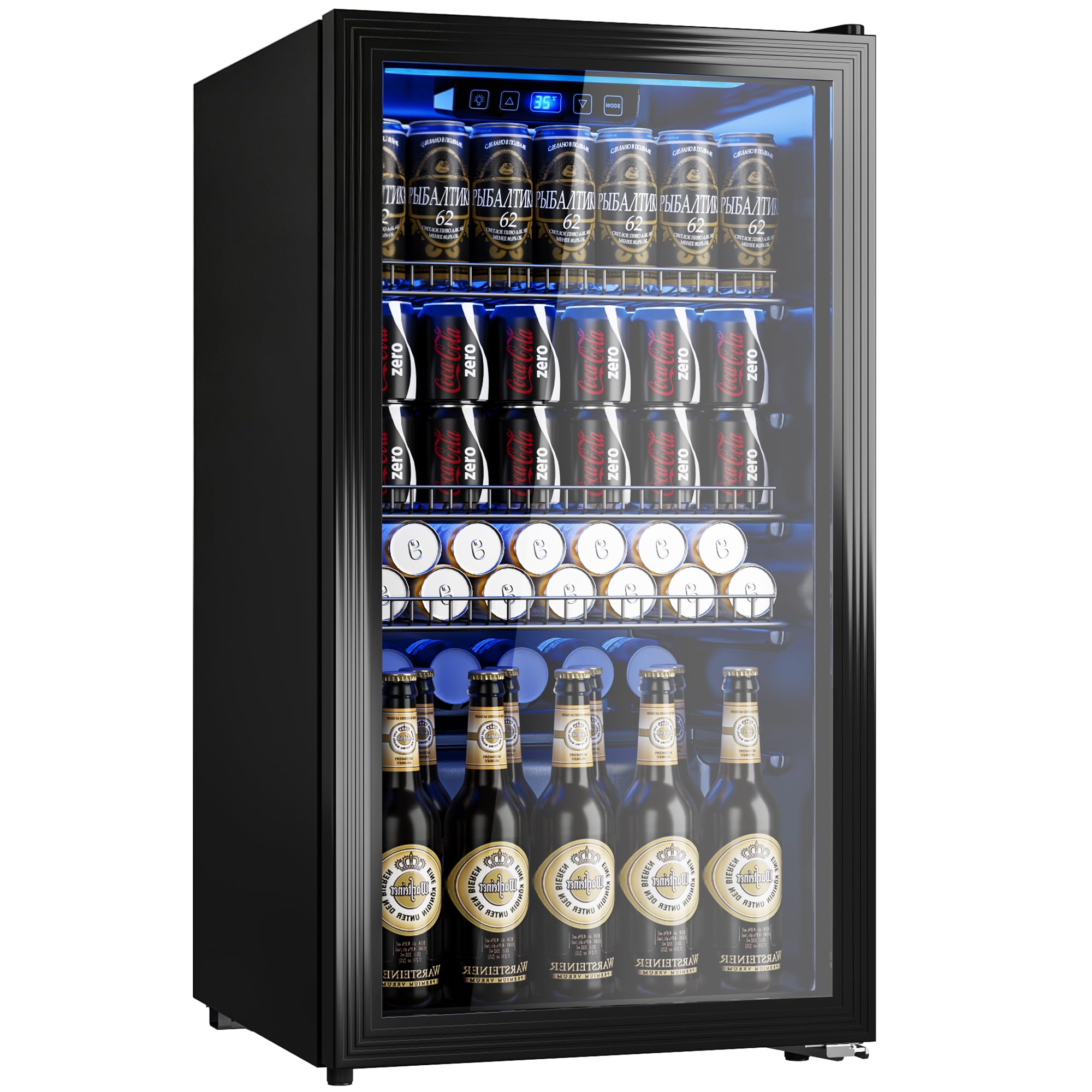
The Best Beverage Refrigerators, Reviewed
hOmeLabs 120-Can Beverage Cooler – Best Overall
Key Features
- Capacity: 3.2 cu ft (120 cans)
- Dimensions: 17.3 D x 18.9 W x 33.3 H in
- Annual energy: 288 kWh per year
- Temperature range: Down to 34F
- Price: Midrange
At 17.3 inches deep, this is the shallowest body in the set, which is most of why it is our top pick: it slides into a bar nook, the end of a galley kitchen or a hallway alcove where the deeper units sit proud of the wall. It is also the tallest here at 33.3 inches, and it earns that shallow footprint by stacking upward. Measure the underside of your counter before you order, because 34 inches of clearance is the usual figure and this one leaves you about an inch.
The cooling is where it earns the rest of the recommendation. The thermostat bottoms out at 34F, cold enough that a can comes out properly refreshing rather than merely cool, and the three chrome wire shelves lift out when you want to stand bottles upright. It carries a UL listing, and the matte silver frame around the glass door reads as furniture rather than dorm appliance.
Noise is what we paid closest attention to, since most of these end up somewhere people sit. The compressor settles into a low hum you stop noticing, and the loud stretch is the initial pull-down after you plug it in. The interior light runs off a button rather than a door switch, which we minded more than expected: you either leave it on as a display light or feel around for a can in the dark.
Cold air settles, so the bottom shelf runs coldest; keep seltzer and anything you do not want slushy higher up. Dented cabinets and bent hinges are the arrival problems worth catching, so unbox it while the delivery is still in front of you and check the hinge side before you sign. The Feelfunn undercuts it on height and the Icyglee on capacity, but neither is as easy to live with in a narrow room.
Pros
- Shallowest body here at 17.3 inches deep
- Cools to 34F for properly cold cans
- Quiet compressor that fades into the background
- Removable chrome shelves free up bottle space
Cons
- Heaviest unit here at 68.3 lb
- Dents and hinge damage can arrive with delivery
Icyglee 145-Can Beverage Cooler – Best for a Full House
Key Features
- Capacity: 4.5 cu ft (145 cans)
- Dimensions: 21.7 D x 20.3 W x 31.5 H in
- Door glass: Double-pane tempered
- Temperature range: 32-61F
- Price: Premium
If the hOmeLabs is the cooler for a normal kitchen, this is the one for the garage that has to hold everything: 4.5 cubic feet, 145 cans, or about 37 bottles if you would rather keep wine and growlers cold. It is the largest capacity in this set and, at 32F, it also goes the coldest.
That pairing is what earns it the extra money. Cans come out with frost on them, a full restock for a party disappears into it, and the double-pane tempered glass stays clear in a way single-pane doors in a humid room do not. The blue interior light is the touch we appreciated most, because it makes a basement bar look deliberate instead of improvised.
One thing worth knowing: the shell runs properly warm on the sides while the compressor works. That is normal, since it is where the heat goes, but it means this one wants a couple of inches of air around it and does poorly boxed into a cabinet. It is also the most expensive cooler in this group, which is the price of the capacity.
Noise is the least predictable part. A 4.5-cubic-foot compressor in a cool basement is unobtrusive; the same unit in a warm, quiet bedroom is not, and a hot room makes it work harder and sound worse. Run it empty for a day before you stock it and keep the packaging until you are sure, because shipping dents and a compressor that quits early are the failures to catch while returning it is still easy.
Pros
- 145 cans in 4.5 cu ft, the biggest capacity here
- 32F floor is the coldest setting in this set
- Double-pane tempered glass resists fogging
- Blue interior light lifts the whole look
Cons
- Most expensive cooler in this group
- Noise climbs in a warm, quiet room
Feelfunn 2.6 cu ft Beverage Cooler – Best under a Low Counter
Key Features
- Capacity: 2.6 cu ft (95 cans)
- Dimensions: 18.8 D x 17.5 W x 24.8 H in
- Annual energy: 168 kWh per year
- Temperature range: 40-61F
- Price: Budget
Height decides more of these purchases than capacity does, and 24.8 inches is what makes this Feelfunn useful. A full-height cooler wants about 34 inches of clearance; this one goes under a 30-inch wall cabinet, into the dead space beside a basement stair, or on a bar cart that nothing else here fits. It is our pick for tight spots, and the reversible door means it can hang either way in a corner.
Forty degrees is the compromise. It is the only cooler here that will not go below that, so drinks come out fridge-cold rather than bar-cold, and if you want cans that frost, the hOmeLabs and the Icyglee go lower. For white wine, sparkling water and juice boxes, 40F is a sensible place to sit anyway, and you are less likely to freeze something you meant to drink.
The rest is well judged. Three removable shelves, a stated 24-bottle fit, and 45.9 pounds, which makes it the lightest unit here and light enough to carry upstairs without help. At 168 kWh a year it is also the most efficient in this group on paper, and that matters when the thing runs around the clock in a garage.
The shelves are the weak part of the build: load five or six cans onto one and it bows in the middle, so keep bottles low and spread the weight. And 38 dB is a best case. Coolers this size are near-inaudible in a busy kitchen and obvious at 2 a.m. beside a bed, and this one lands on both sides of that line depending on the unit you get. If it is going in a bedroom, buy it where returns are easy.
Pros
- Fits under 25 inches of clearance
- Reversible door suits either corner
- Lightest here at 45.9 lb
- Lowest energy draw at 168 kWh a year
Cons
- Won’t go below 40F
- Shelves bow under a full load
Manastin 130-Can Beverage Cooler – Best for Shared Spaces
Key Features
- Capacity: 3.2 cu ft (130 cans)
- Door lock: Key lock
- Dimensions: 18.5 D x 17.5 W x 32.7 H in
- Temperature range: 35-65F
- Price: Midrange
One cooler in this group has a key lock, and it changes who the Manastin is for: a shared garage, a break room, a rental where the last tenant’s friends still have a key. Turn it and the door stays shut; leave the key out and it behaves like any other cooler in this list.
The rest is sensible. Three shelves on five mounting slots give you more positions than the other three-shelf units here, so one high bay for wine bottles and the rest packed with cans, 130 of them in 3.2 cubic feet, which is more than the hOmeLabs manages from the same capacity. Double-layer low-E glass and adjustable feet are the details that matter on an uneven garage slab.
Where we hesitate is the cooling. On paper 35F is fine and the range matches the rest of the group, but this is the least consistent unit in the set at holding a set point: plenty run straight down to temperature, and some never get there or leave the shell hot to the touch while trying. Buy it for the lock and the layout, then run it empty for a day before you stock it, while returns are still easy.
The door is right-hinged with no way to swap it, so plan the corner before it arrives. The soft blue interior light is one of the nicer touches in this set, and it is bright enough to work as a nightlight in a room with no windows.
Pros
- Only key lock in this set
- Five shelf positions for mixed loads
- 130 cans from a 3.2 cu ft body
- Adjustable feet sit level on a slab
Cons
- Noise varies noticeably between units
- Right-hinged door can’t be reversed
Tehanld 96-Can Beverage Cooler – Best for Budget Setups

Key Features
- Capacity: 2.5 cu ft (96 cans)
- Dimensions: 18.5 D x 17.5 W x 26.6 H in
- Annual energy: 178 kWh per year
- Temperature range: 35-65F
- Price: Budget
This is the least expensive way into a glass-door cooler here, and at 26.6 inches tall it fills a slot the others do not: shorter than the full-height units, taller than the compact Feelfunn, so it drops under a 30-inch wall cabinet or beside a desk.
For a first apartment, a dorm or the overflow fridge in a garage, the arithmetic is easy. You give up the 32F floor and some fit and finish, and you keep a glass door, three wire shelves, an interior light and 96 cans of capacity in 2.5 cubic feet, plus an ETL listing and 178 kWh a year.
The compromise shows up in the thermostat. The 35-65F range matches the Manastin’s on paper, but this set point wanders more: it can hold a steady chill for weeks, or run cold enough to freeze a row of cans on the top shelf no matter where you set it. Put an inexpensive fridge thermometer on the middle shelf for the first week, and if drinks start freezing, step the setting up a few degrees instead of trusting the display.
Ninety-six cans is the tight-stack figure, too: the first time you stand a bottle of wine upright, you lose a shelf of cans. The interior light is the pleasant surprise, bright enough that a basement corner stops feeling like a cave.
Pros
- Least expensive glass-door cooler here
- Fits a 26-inch gap
- ETL listed, 178 kWh a year
- Bright interior light doubles as a nightlight
Cons
- Set point wanders and can freeze drinks
- Audible cycling in a quiet room
How We Tested Beverage Refrigerators
We started by researching the market, scanning specs for capacity, shelving flexibility, temperature range, and door style, then filtering out models with vague cooling claims or a price that didn’t match their features. That left seven units, which we ran for nine months in the places people actually put them: my kitchen during a heat wave, a basement bar during football season, and a rotating cast of dinner parties for eight to twelve people.
To test cooling performance, we loaded each unit with a case of room-temperature seltzer and a mix of wine bottles, set the thermostat to 38°F, and checked the actual temperature at the top and bottom shelves with a calibrated thermometer after 12, 24, and 48 hours. We noted which units pulled everything down quickly and which left the top shelf warmer than the bottom, then watched for temperature swings over a week of constant opening and closing.
Capacity got measured, not guessed: we counted how many standard 12-ounce cans fit after adjusting the shelves, then repeated the count with wine bottles and tall growlers. We loaded and unloaded each unit dozens of times, played with the controls, and checked whether the shelves slid smoothly when full. Noise was judged with a decibel meter at three feet and, more practically, by whether we could hear the compressor over a normal conversation in the next room. We wiped the glass and stainless doors after every gathering to see how badly they showed fingerprints, and we ran each unit continuously for nine months, watching door seals, condensation, rattles, and any drift in cooling performance. Value came last: we compared what each fridge offered — dual zones, locks, glass doors, metal shelves — against what it cost, and asked whether we’d spend our own money on it.
How to Choose a Beverage Refrigerator
The most useful thing you can do before buying is measure the gap the cooler has to live in, not the cooler.
Measure the opening, not the can count
Compact on a listing means it will fit in a car trunk, not that it will fit your gap. Height and depth settle more purchases than capacity: a standard kitchen counter leaves about 34 inches of clearance underneath, which is where the 31-to-33-inch coolers here belong, while a 30-inch wall cabinet or a bar shelf wants something nearer 25 inches. Base cabinets are 24 inches deep, so a 17-inch body sits close to flush and a 21-inch one juts into the walkway. Then look at the hinge side, because a right-hinged door needs room to swing.
Pick a temperature floor you will actually use
The advertised ranges look alike until you find the floor. Coolers here stop between 32F and 40F, and the difference is real: 32-34F gives a can a bite, while 40F is ordinary fridge temperature. If you stock for parties, pay for the lower floor, since the hOmeLabs holds 34F and the Icyglee goes to 32F. If the cooler is mostly white wine, sparkling water and juice, 40F is already at the cold end of pleasant, and the Feelfunn that stops there happens to be the easiest fit under a low cabinet. Treat any set point as an intention rather than a promise.
Decide what the room can hear
A compressor in a basement is background noise; the same compressor beside a bed is why coolers get returned. The decibel figures on the box are best cases, and any 3-to-4.5 cubic foot unit makes itself known when it works hard in a warm room. Two things help before you buy. Put the cooler as far from the pillow or desk as the cord allows, and leave a few inches of air on the sides and back, because a cabinet that traps heat makes the compressor run longer and louder. Buy where returns are simple.
Glass doors, condensation and light
Single-pane glass is fine in a dry, air-conditioned room and a nuisance in a humid basement, where it beads up and drips onto whatever sits below. Double-pane construction, such as the Icyglee’s tempered door, the Manastin’s low-E panel or the Feelfunn’s sealed double layer, insulates better and stays clearer. Interior lighting matters less but lives in the same decision: on several units here the LED runs off a button rather than a door sensor, so it is either a display light you leave on or something you stop touching by the second week.
Count cans, then count bottles
Every capacity figure assumes 12-ounce cans in tight rows with the shelves flat. Bottles are the variable: one row of wine bottles can eat an entire shelf, and a tall seltzer bottle rules out the top position. Three removable shelves is the working minimum, and more mounting slots are better, which is why the Manastin’s five positions let you build a single tall bay for bottles and pack the rest with cans. If almost everything you chill comes in cans, buy on cubic feet. If it is a mix, buy on shelf flexibility.
Frequently Asked Questions
Is a beverage refrigerator worth it compared with a second full-size fridge?
Only when floor space is the constraint. A full-size refrigerator is cheaper per cubic foot and holds far more, but it wants roughly 30 inches of width and 30 of depth. The coolers here run 17 to 21 inches deep, and a glass door lets you see what is cold without opening anything. If you have an empty garage corner, a second full-size fridge wins. If you have a 20-inch gap beside a bar, this is the category that solves it.
Do I need to let it stand before plugging it in?
Yes, if it traveled on its side or spent the day in a delivery truck. Stand it upright in its final spot and let it settle before you switch it on, so oil that ran into the cooling lines can drain back to the compressor. Then let it pull down empty before you load it. A cooler packed with warm cans takes far longer to reach its set point, and you want to know it gets there at all.
Can I keep wine in a beverage cooler?
Yes, but treat it as a serving fridge rather than a cellar. These are single-zone units with no humidity control, and their coldest settings sit well below wine temperature: white shows best around 45-50F, and red nearer 60F. Set the cooler to about 46F and it handles whites and sparkling well, then pull reds out half an hour before pouring. For months of storage, a humidity-controlled wine fridge is the right tool.
What does one of these cost to run?
Less than a second refrigerator. The annual figures here run from 168 kWh for the compact Feelfunn to 288 kWh for the hOmeLabs, and over years of continuous running that gap adds up. Multiply the figure on the label by your electricity rate to get the yearly cost. A colder set point, a warm room and a glass door all push consumption up, so a garage that hits 90F in summer is the expensive place to run one.
Final Verdict
The hOmeLabs is the one we point most people to: 34F, quiet enough for a den, and shallow enough at 17.3 inches that it does not swallow the floor space around a bar. Go to the Icyglee when capacity is the whole point, since 145 cans and a 32F floor are worth its place at the top of this group’s price range. If your gap is under 25 inches tall, nothing here beats the Feelfunn 2.6, as long as a 40F floor suits what you drink.