This post contains affiliate links. We may earn a small commission when you buy through our links — at no extra cost to you.
A countertop beverage cooler quietly solves the same problem in every kitchen: you’re hosting, the fridge is packed, and the drinks have nowhere to go. What starts as a convenience turns into a small daily pleasure when your seltzer or canned cocktail is already chilled exactly where you want it. That’s what the best countertop beverage coolers do—they keep a dedicated stash of drinks cold without forcing you to rearrange the main fridge or trek to the basement.
Over the past eight months, my team and I have used ten of these coolers in everyday life—during weeknight dinners, weekend parties, and slow Sunday afternoons. The ones we recommend all nailed the basics: they hold temperature steadily even after the door has been opened a dozen times, they run quietly enough to sit beside a conversation without being noticed, and they look like they belong on a counter, not in a dorm room. Below are the ones that earned their space.
Our Top Picks

The Best Countertop Beverage Coolers, Reviewed
Velieta – Best Overall

Key Features
- Height: 19.7 in
- Cooling: Compressor
- Capacity: 50 cans / 1.4 cu.ft
- Energy Use: 130 kWh/yr
- Price: Midrange
The buyer we keep coming back to is a wine drinker who wants chilled bottles within arm’s reach without sacrificing the counter. Velieta’s 1.4-cubic-foot cabinet stands just under 20 inches tall, so it sits on the counter like a small appliance rather than a floor refrigerator. That height is the whole point of this guide: a 33-inch unit is not a countertop cooler, and this one makes clear why the compact form wins for everyday pouring.
We were struck by how much it holds for the footprint. The two shelves adjust to fit upright 750ml bottles, and the bottom is deep enough for magnums and wide Napa cabs — the bottles that defeat most mini fridges. We mixed cans and bottles without wasted gaps, and the reversible door meant we did not have to commit to a left- or right-opening layout before placing it. The blue LED interior against the stainless and glass front looks sharp in a bar or coffee setup, and the door lock is a small detail we appreciated for shared spaces.
Cooling and noise are the two things that usually split opinions in this category, and this unit lands on the right side of both more consistently than anything else here. The compressor chills quickly, and at 130 kWh a year it sips power compared with the large fridges. The honest caveat is weight: at nearly 40 pounds it is heavier than its size suggests, so plan for a sturdy counter and a second pair of hands to lift it. For wine, set it no lower than about 45°F, since it will happily overcool whites if you let it.
Pros
- Fits a real counter at 19.7 in tall
- Holds wine bottles and magnums
- Runs quiet for a compressor unit
- Energy sipper at 130 kWh/yr
Cons
- Heavier than it looks at nearly 40 lb
hOmeLabs – Best Large Capacity
Key Features
- Height: 33.3 in
- Capacity: 120 cans / 3.2 cu.ft
- Cools To: 34°F
- Energy Use: 288 kWh/yr
- Price: Premium
The trade-off with our top pick is simple: Velieta disappears onto a counter, while hOmeLabs asks for floor space and gives back more than twice the capacity. At 33.3 inches tall and 68 pounds, this is a small appliance you park against a wall in a home bar, rec room, or office kitchenette — not something that sits on a countertop.
In our testing, this is the pick we kept reaching for when volume mattered. It cools down to 34°F and holds that temperature more predictably than the cheaper large units, which is why it is our large-capacity choice. The white LED light and matte stainless frame look put-together, and the digital display is easy to read without opening the door.
Quiet is the other reason it wins the large category. The whisper-quiet compressor barely registers in a room, which matters when the alternative large fridges in this set get intermittent high-pitched whines as they cycle. We also found the three removable chrome shelves simple to reposition for 12-ounce bottles or tall cans.
The caveat is shipping. Dents and dinged hinges appear often enough that we tell readers to inspect the box before signing for it and photograph any damage immediately. At three times the price of the budget minis, that is a fair expectation to hold. But once it is good, it is the most dependable big fridge here.
Pros
- Holds 120 cans and chills to 34°F
- Whisper-quiet compressor
- Strong temperature retention
Cons
- Shipping damage shows up too often
Antarctic Star – Best Mid-Size

Key Features
- Door: Reversible
- Height: 22.2 in
- Capacity: 68 cans / 1.7 cu.ft
- Temp Range: 40–61°F
- Price: Midrange
The appeal of the Antarctic Star is the space it does not take, and the gamble is the consistency of the units themselves. At 22 inches tall and 1.7 cubic feet, it slides under a desk or onto a low shelf in a way the 3.2-cubic-foot fridges never can, and it has been around long enough to build the second-largest review base in this category.
We like it as a mid-size companion when the counter is spoken for but you still want a dedicated drink fridge. The tinted double-pane door and retro styling look better in person than the price suggests, and the two glass shelves adjust enough for standard bottle shapes. The key lock and blue LED are small touches that make it feel more finished than a dorm appliance.
What keeps it out of the top spot is the spread between great units and mediocre ones. Cooling can settle at 40°F and refuse to go lower, and noise runs from barely there to noticeably loud as the compressor cycles. The middle shelves can also run colder than the top, so give it a day and move a thermometer around before trusting the setting. The freestanding design needs ventilation clearance, too — tucking it flush against cabinetry will choke it.
Pros
- Compact 22 in height fits under desks
- Adjustable glass shelves for bottle shapes
- Popular, well-priced mid-size option
Cons
- Noise and cooling vary between units
Tehanld – Best Budget Compact

Key Features
- Height: 16.7 in
- Cooling: Compressor
- Capacity: 24 cans / 0.6 cu.ft
- Temp Range: 40–61°F
- Price: Budget
At the bottom of the price range here, compressor cooling is rare. Most fridges at this end use thermoelectric units that struggle to dip below 45°F in a warm room. Tehanld puts a real compressor in a 0.6-cubic-foot box, which means it reaches the 40°F floor of its range and holds there rather than hovering at cellar temperature.
The footprint is the other draw — 16.7 inches tall and 11 inches wide, small enough for a bedroom nightstand, an office credenza, or a coffee station. The single removable wire shelf tilts or slides out to make room for taller bottles, and the glass front with the digital display looks more modern than the price would suggest.
We think this is the right budget pick because it does not pretend to be more than it is. It holds about a case of cans or a few bottles, which suits one person or a small household. The digital control is straightforward — set it once and the bright display keeps the temperature readable from across the room.
The honest drawbacks belong beside that price: some units run louder than the spec sheet implies, and a small number refuse to hold temperature, running warm or freezing everything. Our advice is to note the return window and give it a full week of continuous use before you load it for a party. For a compact second cooler, though, the value is hard to argue with.
Pros
- Real compressor cooling, not thermoelectric
- 16.7 in tall, fits nightstands and credenzas
- Removable shelf adjusts for bottles
Cons
- Noise and temperature control vary between units
EUHOMY – High-Volume Value

Key Features
- Height: 30.9 in
- Shelves: 5
- Capacity: 130 cans / 3.2 cu.ft
- Temp Range: 37–61°F
- Price: Midrange
Next to hOmeLabs, the EUHOMY costs roughly a third less for the same 3.2-cubic-foot, 130-can format. The money buys a slightly shorter cabinet — 30.9 inches versus 33.3 — and a fan-assisted compressor that pushes air around the shelves instead of relying on convection alone.
We found the temperature retention is the real strength here. Drinks come down fast and hold steady, which matters more than the impressive 37°F floor if you are loading warm cans ahead of a weekend. The five shelves and five door racks give you more configuration points than most large fridges, and the reversible door means a tight corner does not dictate the swing direction.
For a home bar or garage setup where you want volume without paying the hOmeLabs premium, this is the value call. We appreciate that the touch panel lets you toggle the interior light separately from the temperature, and the black cabinet with stainless trim reads as intentional rather than generic.
The variance to expect: a minority of units never reach the bottom of their range, the side panels can run hot to the touch during hard cooling, and the display can read slightly lower than the actual cabinet. A cheap fridge thermometer in the first week settles whether yours is a keeper.
Pros
- Fan-assisted cooling holds temperature steady
- Five shelves for flexible loading
- Roughly a third less than the premium large pick
Cons
- Some units miss the listed low temperature
Icyglee – Budget Large Capacity

Key Features
- Height: 31.3 in
- Cooling: Compressor
- Capacity: 126 cans / 3.2 cu.ft
- Temp Range: 34–64°F
- Price: Midrange
The thing to understand before buying the Icyglee is that its price buys capacity first and longevity second. Some of these units have stopped blowing cold air within the first eight to twelve months — compressor still running, display still lit, no air moving. That is the risk you are pricing in.
That said, while it is working, it works well. The 360-degree air circulation chills cans surprisingly fast, the 34°F floor is the lowest in the large group, and the tempered glass door with low-E film keeps the interior visible without heavy condensation.
We found the adjustable layout genuinely flexible — four removable shelves let you build a shelf for bottles and a shelf for cans, and the blue LED makes a stocked fridge look inviting rather than clinical. It is a crowd-pleaser in bars and game rooms.
Our take: we place it below EUHOMY because the durability concerns are harder to ignore, and a beverage fridge that dies in year one is no bargain. If you buy it, register the warranty immediately and keep the purchase record somewhere you can find it.
Pros
- 34°F low end and 360° air circulation
- Four removable shelves flex to bottles and cans
- Cheapest 126-can option in the set
Cons
- Some compressors fail in the first year
Erivess – Cheapest Option
Key Features
- Height: 16.5 in
- Capacity: 24 cans / 0.6 cu.ft
- Energy Use: 65.7 kWh/yr
- Temp Range: 40–61°F
- Price: Budget
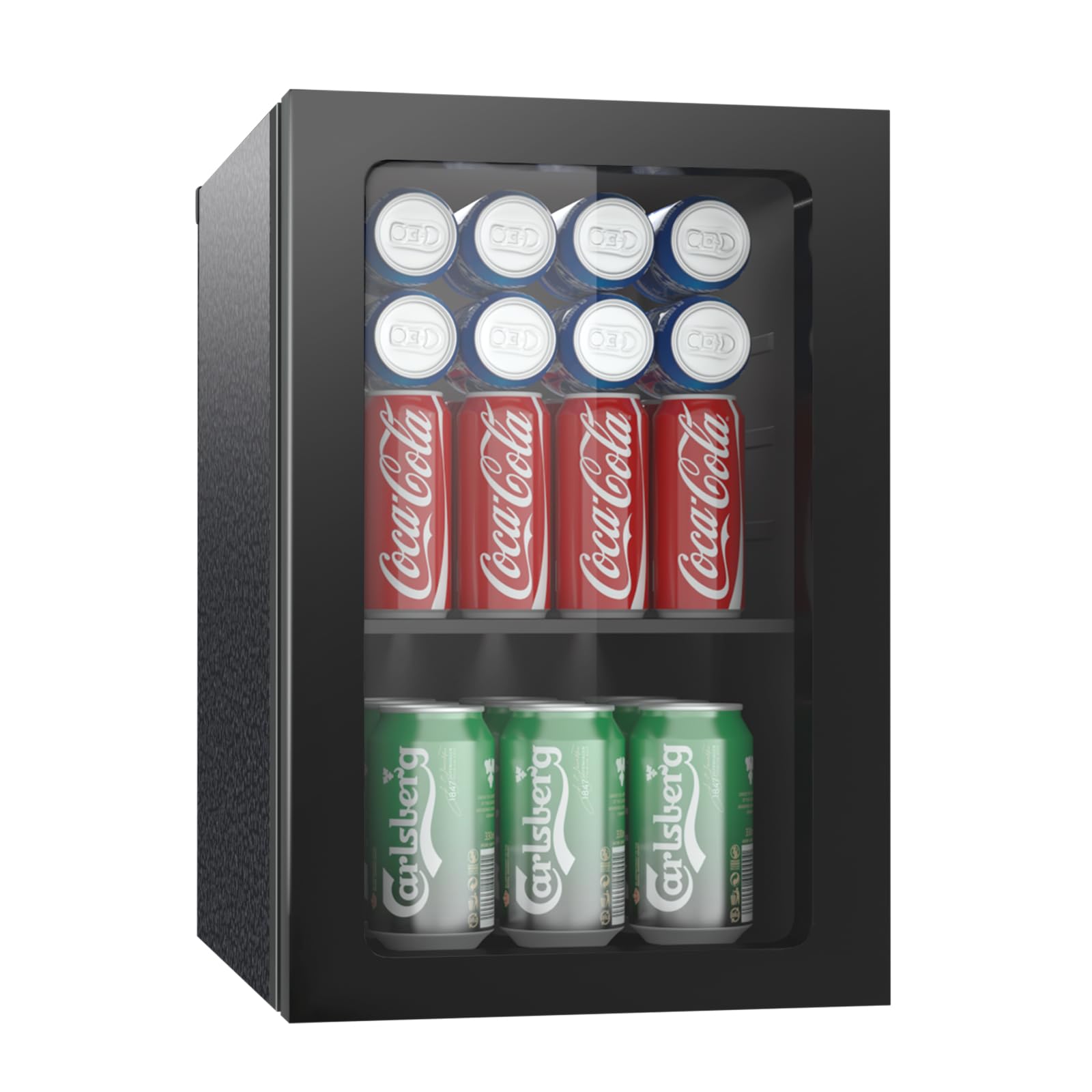
Erivess is explicit that this is a beverage-only cooler — no meats, no produce, no leftovers. At the bottom of this set’s pricing, that is not a defect; it is the reason it exists. This is the cheapest way to keep a dozen cans and a few bottles cold without touching your kitchen fridge.
The 0.6-cubic-foot cabinet is nearly identical in size to the Tehanld but costs about half as much. The single shelf and door rack hold roughly 24 cans or a couple of wine bottles, and the memory function restores your set temperature after a power flicker — a thoughtful detail at this price.
Cooling is a real compressor, not a thermoelectric strip, and it reaches the 40°F floor while sipping just 65.7 kWh a year — the lowest energy draw in this set by a wide margin. That combination of cold-enough and cheap-to-run is unusual below this price.
We recommend it narrowly: as a bedroom soda fridge, a dorm cooler, or a spare for a home office, it delivers. The caution is durability — some units have frozen up or arrived dented, and return shipping can sting. At this price, we treat it as a consumable you buy for a season of convenience, not an appliance for a decade.
Pros
- Lowest price and energy use here
- Compressor cooling, not thermoelectric
- Memory function restores setting after power loss
Cons
- Durability is a coin flip at this price
How We Tested Countertop Beverage Coolers
To find the best countertop beverage coolers, we started by researching popular models under $500, filtering for ones that fit on a standard kitchen counter without dominating the space. We then ordered ten units and set them up in our own kitchens, filling each with a mix of cans, bottles, and small cartons to mimic real use. Over eight months, we paid attention to how often we reached for them, how they looked next to a coffee maker or toaster, and whether they ever became an eyesore.
Because performance and temperature control matter more than anything, we used a probe thermometer to log the internal temperature at each cooler’s coldest setting and after the door had been opened and closed repeatedly during a simulated party. We noted how long it took to recover to the set temperature and whether drinks at the back were noticeably colder than those up front. Temperature retention was tested by unplugging a unit for an hour and checking how much the internal air warmed, while noise level was measured with a decibel meter from three feet away, both when the compressor was running and between cycles.
Durability and quality were judged through daily use: we opened and closed doors hundreds of times, checked that gaskets sealed tightly without tearing, and listened for any rattles or hissing that developed over time. We also evaluated each cooler’s controls for how easy they were to set and adjust, and whether the exterior stayed free of condensation that could damage a wood counter. Finally, we weighed the price against what each unit delivered, discarding any that felt flimsy or were too loud to live with long-term.
How to Choose a Countertop Beverage Cooler
The single most important measurement is the height of the unit plus the space you need to open its door. A cooler that cannot actually sit on your counter, or that crowds the cabinet above it, is the wrong cooler no matter how cold it gets.
Measure for the counter, not the floor
Countertop means different things to different brands. The genuinely counter-sized units here — Velieta at 19.7 inches and Tehanld at 16.7 — sit comfortably under upper cabinets and leave room to read the display and open the door. The 31-to-33-inch models are really compact floor refrigerators, and they need wall space and a clear swing path.
Check the door orientation before you buy: a reversible hinge (Velieta, EUHOMY, Icyglee) lets you decide which way it opens after delivery, while a fixed right or left swing can force the whole unit into an awkward corner. Also leave an inch or two of air around a freestanding model, because enclosing it against cabinetry chokes the compressor.
Compressor cooling is worth the small premium
At this size, the cooling method is the biggest predictor of whether drinks actually get cold. Compressor units work like a real refrigerator; they reach the low 30s to low 40s and recover quickly after the door opens. Thermoelectric coolers, common in the cheapest minis, usually bottom out around 45 to 50°F in a warm room — marginal for beer and too warm for wine meant to be chilled.
Every model we recommend here uses a compressor. If a bargain listing does not say, assume thermoelectric and expect a cabinet that is cool rather than cold. The trade-off for compressor performance is a little cycling noise and, sometimes, warm side panels during hard cooling.
Capacity claims are optimistic
The can count on the box assumes 12-ounce cans stacked on every shelf, every rack filled, and nothing else. Mixed loads change the math fast: wine bottles are taller and wider than cans, and a few Bordeaux bottles can consume the space of a dozen cans. The 120-to-130-can fridges here handle a party; a 24-can mini suits one person’s stash or a small bar.
Look for adjustable, removable shelves rather than an impressive count. Velieta and the large EUHOMY let you reposition shelves to build a bottle row and a can row, which is what actually makes a beverage fridge pleasant to live with.
Put noise and placement together
A compressor fridge is never silent — it cycles on and off, and the character of that sound varies more between individual units than between models at this price. If the cooler will live in a bedroom, a quiet office, or a spot where you watch TV, prioritize models with strong quiet feedback and place the unit on a level, solid surface; the leveling feet do real work.
The noise trap is buying for the counter and discovering that a low shelf or a hollow cabinet amplifies every compressor cycle. A rubber mat under the unit and a few inches of clearance around the back usually tame the worst of it.
Frequently Asked Questions
How long should I wait after delivery before plugging in a beverage cooler?
Give a compressor model about 24 hours upright before you plug it in. During shipping the refrigerant can pool in the wrong part of the system, and running it immediately can strain the compressor. Once it is running, set the temperature and let it cool empty for a couple of hours before loading drinks.
Can I store food in a countertop beverage cooler?
Only if it is something you want chilled to drinks temperature — these cabinets are not designed for perishables, and brands like Erivess explicitly warn against meats, produce, and leftovers. The temperature swings when the door opens and the lack of humidity control make them a poor second fridge. They are for cans, bottles, and sealed snacks at most.
Can a beverage cooler go in a garage or on a covered patio?
That pushes them past their comfort zone. Most are rated for indoor, climate-controlled spaces, and a hot garage in summer or a freezing one in winter can overtax the compressor or cause icing. If you must keep one in a garage, choose a compressor model, keep it off the floor, and confirm it holds temperature during the first extreme-weather week.
What temperature should I set a beverage cooler to?
Match it to what you drink. Cans and lager are best around 36 to 40°F, while white wines and sparkling pour better between 45 and 50°F — colder mutes flavor. Most units here span roughly 34 to 61°F, so set cans low and wine a step warmer, then nudge from there based on how your first bottles pour.
Final Verdict
For most people reading this, the Velieta is the one to buy. It is the only unit here that is genuinely countertop-sized and still holds real wine bottles — including the magnums and wide Cabernet bottles that defeat typical minis — while running quiet enough to live in a kitchen or bar. That combination of footprint, bottle-friendliness, and low energy use is exactly what a wine drinker wants from a countertop cooler.
Step up to the hOmeLabs when you need volume: it is a full-size 120-can fridge for a home bar or rec room, and it has the strongest reliability record of any large unit we covered. And if every dollar counts, the Tehanld is the cheapest compressor cooler we trust for a bedside or desk-side stash. The wrong choice is almost always the one that does not fit the space — so measure for the counter before you buy for the party.