This post contains affiliate links. We may earn a small commission when you buy through our links — at no extra cost to you.
Every winter my sourdough starter goes quiet. Same flour, same schedule, same jar — the only variable is my kitchen, which drops about ten degrees and takes the yeast’s enthusiasm with it. A fermentation heater solves that by holding your jar, crock, or bucket in the 70s and low 80s where cultures actually work, so bread rises on schedule and kombucha doesn’t stall into sweet tea.
For years I got by with a towel and the warmest corner of the counter, which works until it doesn’t. Over the past six months, my team and I tested 12 heaters — wrap belts, flat mats, and warming plates with probes and timers — through sourdough, kombucha, and a few beer batches, in a kitchen that runs cold overnight and a basement that’s colder still.
The surprise was how much fit matters: a belt hugs a carboy and does nothing for a wide starter jar, and wattage means little if the dial won’t hold a number. A few genuinely changed how my winter goes. The picks below are the ones that stayed steady and were worth the money.
Our Top Picks


The Best Fermentation Heaters, Reviewed
Hemlock Kombucha Heating Wrap – Best Overall
Key Features
- Weight: 11.3 oz
- Vessel fit: 1-gallon brewing vessels
- Heat settings: 3 levels
- Price: Midrange
Three heat settings are why this wrap sits at the top of our list. The belts and plain pads in this group give you one output: plug in, get warmer, unplug when the kitchen heats up. Low, medium and high turn a heater into something you can tune to the season instead of a switch you babysit.
The wrap is cut for a 1-gallon vessel, which is the shape it handles best. It hugs the jar, holds without a strap digging into the glass, and leaves a gap so the temperature strip stays readable while it is on. That gap sounds like a small thing until you have peeled a heater off a full jar just to check the reading.
Splash resistance earns its keep in a hobby built around open jars and wet SCOBY hands. The wrap is also rated to stay on through both the first and second fermentation, so it lives on the vessel between stages instead of going into a drawer.
What it will not do is climb the size ladder. This is a gallon-jar heater, not a carboy heater, and a 6-gallon bucket needs one of the pads or belts instead. For the vessel most kombucha, kefir and small test batches live in, it is the one we reach for first.
Pros
- Three heat levels instead of on/off
- Wraps a gallon jar without straps
- Stays on through both fermentations
Cons
- No set temperature, just three levels
Propagate Pro Kombucha Heater Belt – Best Budget
Key Features
- Included: Adhesive thermometer
- Heat lift: 5-20°F above ambient
- Attachment: Rubber bands
- Heat settings: Fixed output
- Price: Budget
A belt does not hold a number; it adds heat. This one is rated to raise a vessel 5 to 20°F above room temperature, and how much of that you get depends on how much of the band touches the glass. In a kitchen that dips into the mid-60s in winter, that is the difference between a stalled jar and a steady ferment.
The stick-on thermometer in the box is the part we appreciate most. Tape it to the jar, watch it for a day, and you will know whether the band belongs high, low, or doubled around the vessel, which is how you tune a heater with no dial. The rubber bands hold it snug on a gallon jug, and the same band is rated for kefir, sauerkraut and yogurt.
Adjusting it is manual work, and a warm afternoon means moving the band or pulling the plug. That is a two-minute habit rather than a burden, and it is a fair swap for the lowest price in this group. For a jar that never moves, we still prefer the Hemlock’s three levels.
Pros
- Adds 5-20°F above room temperature
- Includes a stick-on thermometer
- Rubber bands hold it on gallon jars
- Least expensive heater here
Cons
- No timer or automatic shutoff
Propagate Pro Round Heat Pad – Best for Carboys
Key Features
- Wattage: 25 watts
- Heat lift: 5-20°F above ambient
- Placement: Sits under the vessel
- Safety cutoff: 100°F
- Price: Midrange
Ferment in something too wide to wrap and the choice narrows quickly. This is a round pad that sits flat on the counter with the carboy or bucket on top: nothing to strap on, nothing to line up, and no band between you and the airlock.
It runs at 25 watts and lifts the vessel 5 to 20°F above ambient, with a thermal cutoff at 100°F so it can stay plugged in without a separate controller. That suits beer and wine, where a modest, steady nudge is usually what you are after rather than a warm spot.
The catch is where the heat starts. Warmth comes off the pad’s footprint and rises, so a tall carboy runs warmer at the base than at the top, and a wide bucket only gets heat under its middle. Set the pad on a board rather than cold stone and drape a towel over the vessel, and it holds far more evenly. Of the picks here, it is the one for setting a vessel down and walking away.
Pros
- Sits under carboys and buckets
- 100°F thermal cutoff for unattended use
- Silent, with nothing to strap or adjust
Cons
- Heat concentrates under the vessel’s base
- Fixed output with no set point
FastRack Brew Heating Belt – Best for Large Fermenters
Key Features
- Run time: Up to 8 days
- Vessel fit: 6- to 8-gallon plastic fermenters
- Heat settings: Fixed output
- Held temperature: 75-80°F
- Price: Budget
This belt is built for a 6- to 8-gallon plastic fermenter, and that single fact decides whether it is for you. On a wide bucket it wraps the way it should and holds 75-80°F for up to eight days, which is the whole job for a beer or a big batch of kombucha. On a quart jar it has nothing to grip.
It holds that range without a controller, a timer, or a display to fiddle with, and it draws little enough that a week of continuous use is not a worry. The band wipes clean, and there is no element hot enough to scorch the side of a plastic bucket.
What it does not have is a set point, so a hot week means unplugging it and a cold snap means accepting the top of its range. For a big plastic fermenter in a basement, that is a fair trade, and it is the only pick here rated specifically for vessels that size.
Pros
- Holds 75-80°F for up to eight days
- Fits 6- to 8-gallon plastic fermenters
- Low draw and easy to wipe clean
Cons
- Rated for large plastic fermenters only
- No thermostat or timer
SourKeeper Sourdough Warmer Pro – Best for Sourdough
Key Features
- Timer: 24-hour
- Sensor: Stainless dough probe
- Precision: 1°F steps
- Temperature range: 70-110°F
- Price: Midrange
The wraps and belts here heat a vessel and leave you guessing what happened inside. This one drops a stainless probe into the starter or dough and holds 70-110°F in one-degree steps, which is a different idea: you set the temperature of the ferment, not the temperature of the hardware.
That is what makes it our pick for sourdough. A cold kitchen does not chill a starter evenly, and the middle of the jar is the last part to warm, so a probe sitting in the dough is the only reading that tells you the truth. The timer and memory function mean a bulk rise can start before bed and finish without you.
It is also the pick with the most caveats in this group. The plate and the probe do not always agree with the number you dialed, and some units run well above their set point. Some also stop heating within months, so keep the receipt and test it early.
Check it in the first week: put a probe thermometer in the jar beside the unit’s own probe and compare the two. If they agree, you have a warmer that will hold a levain steady through February. If they do not, you have a return to make while the window is open.
Pros
- Probe reads the dough, not the plate
- 1°F settings from 70 to 110°F
- Timer and memory for overnight rises
Cons
- Some units run above the set temperature
- Can stop heating within a few months
Fermentaholics Kombucha Heater – Tightest Budget

Key Features
- Included: Adhesive thermometer
- Heat lift: 5-20°F above ambient
- Heat settings: Fixed output
- Maximum temperature: 85°F
- Price: Budget
This is the least expensive way to warm a jar, and it is a perfectly serviceable one: a band that adds 5 to 20°F over room temperature, an adhesive thermometer in the box, and instructions printed on the heater itself so they cannot go missing. For a first batch of kombucha in a cool apartment, that covers the basics.
It is rated for other ferments too, from kefir to sauerkraut to sourdough, and the 85°F ceiling is tuned to cultures that do not want to be cooked. We found the printed instructions genuinely useful in the first week, while you are still working out how far up the jar the band belongs.
The band is the weak point. It is narrow, so it heats a stripe of the jar rather than the whole circumference, and the included rubber band does not always hold it against smooth glass. A second band or a strip of tape fixes that. Given that the Hemlock wraps further around the vessel and gives you three levels, this is the one for the smallest outlay rather than the best result.
Pros
- Least expensive heater here
- Stick-on thermometer included
- 85°F ceiling suits cultured ferments
Cons
- Narrow band heats a stripe, not the jar
- Rubber band can slip on smooth glass
MENGBEI Sourdough Warmer Mat – Best for Timed Overnight Proofing
Key Features
- Timer: 0-24 hours
- Wattage: 12 watts
- Precision: 1°F steps
- Temperature range: 70-110°F
- Price: Midrange
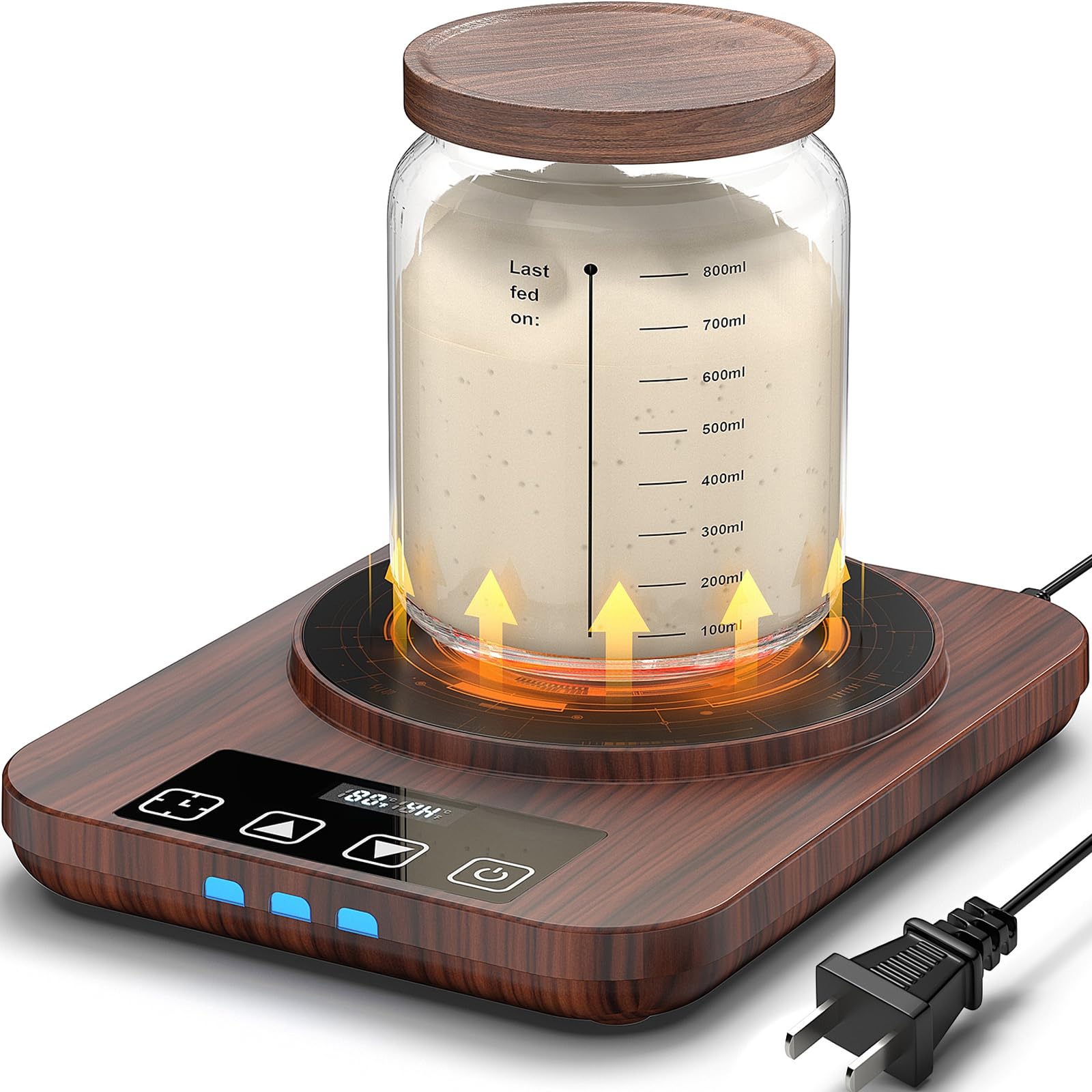
The timer is the feature we ended up using most. Set it before bed, let it run, and the mat shuts itself off instead of holding a starter at temperature until morning, which is the failure mode of doing this with an oven light and hope.
It is a flat plate with a graphene heating film, adjustable from 70-110°F in one-degree steps, with a memory function that picks up where you left off and a wood-grain finish that does not look like lab equipment on the counter. Twelve watts does not amount to much on the electric bill.
It regulates its own plate rather than the dough, since there is no probe, so the number you set is the surface temperature and the contents of the jar sit somewhat below it. Give it an hour to settle, then judge by the jar rather than the display.
Heat across the plate is not perfectly even, so a starter wants rotating or a warm side accepted. Against the NICOFPHY dome it has room for wider jars; against the SourKeeper it lacks a probe reading the ferment itself. For a beginner who wants a timer and a number to set, that is a sensible middle.
Pros
- 1°F steps from 70 to 110°F
- Timer and memory for unattended rises
- Small footprint with a wood-grain finish
Cons
- No probe; regulates the plate, not the dough
- Uneven heat across the plate
NICOFPHY Sourdough Warmer with Dome – Best for Countertop Starter Setups

Key Features
- Timer: 0-12 hours
- Footprint: 7.1 x 5.5 inches
- Precision: 1°F steps
- Temperature range: 70-100°F
- Price: Midrange
The glass dome is what you notice first: a thick cloche over the warming plate that turns a starter jar into something you do not mind leaving on the counter. It also does real work, trapping warm, humid air around the jar so the plate does not have to run as hard to keep the contents warm.
Underneath it is a 10-watt plate with one-degree settings from 70-100°F, a timer up to 12 hours, and automatic shutoff. The whole thing is roughly seven inches across and under eight inches tall, so it tucks against a backsplash without claiming a corner of the counter.
The dome sets the limits as much as the plate does. The jar has to fit under it, and while a Weck tulip jar goes in neatly, a wide crock will not. Worth knowing before you trust the display: the plate and the jar do not read the same.
In this group it is the one for a counter where the starter is on display and the jar is small and consistent, a quart mason or a tulip jar you feed on a schedule. If your starter lives in a wide crock, the MENGBEI mat gives you the same control without a lid to work around.
Pros
- Glass dome holds heat and humidity
- 1°F settings from 70 to 100°F
- 12-hour timer with automatic shutoff
Cons
- Dome only fits small jars
- Display reads the plate, not the jar
How We Chose and Tested the Best Fermentation Heaters
We started with research rather than shopping: we pulled every fermentation heater we could find, sorted them by what vessel they actually fit — belts for carboys and wide jars, round pads for buckets and crocks, plates with probes for starter jars — and cut anything that was a fixed-wattage pad with no way to check temperature. That left 12 units spanning the price range and all four formats.
Testing ran six months, most of it through the cold stretch, with heaters on a kitchen counter that drops into the mid-60s overnight, a basement floor near 60, and a closet shelf holding a five-gallon bucket. We fermented sourdough starters, kombucha, and a couple of beer batches, and every vessel got a calibrated probe thermometer alongside the culture; we logged readings morning and night instead of trusting the dial.
For temperature accuracy and heat distribution, we taped probe thermometers at the center and edges of each mat and wrap and watched how far the readings drifted apart — the wraps ran noticeably hotter against the glass than their setting suggested. We timed how long each took to lift a 65°F jar into the mid-70s, then tracked the set temperature against the probe for a week to see whether it held or wandered. Belts went around glass, plastic, and a bucket to check whether they stayed put or slid.
On reliability and value: timers ran full 24-hour cycles to confirm they actually shut off, we unplugged and replugged to see if settings survived, and we wiped up overflow to find out which covers came off for cleaning. Ease of use came down to whether we could set a number and walk away; value to whether the thermometer, probe, or timer was in the box.
How to Choose a Fermentation Heater
The first decision is not wattage or a temperature range — it is what shape your ferment lives in, because a belt built for a bucket will never hug a quart jar.
Start With the Vessel
A wrap or belt works by pressing heat against the side of a jar; a heat mat works by sitting under a carboy or bucket. Neither is better in the abstract, and the wrong one is close to useless. A belt rated for a 6- to 8-gallon plastic fermenter has nothing to grip on a quart mason jar, and a sit-under pad beneath a narrow jar heats a small circle of glass and very little else.
Buy for the vessel you use most, then check that it also handles your second one. If you split time between a gallon jar and a bucket, a wrap can be set beside the bucket; a bucket belt cannot be made small. That is why our top pick is a wrap cut for gallon jars rather than a universal band.
A Fixed Lift or a Set Point
Most heaters here add 5 to 20°F above room temperature and adjust by position, if at all. That works when the room stays consistently cool and you ferment the same thing in the same vessel, because the heater’s job becomes routine.
A thermostat with one-degree settings is the better answer when your room swings, when the ferment sits in a cold basement, or when a particular yeast wants a particular number. The catch is that a set point is only as good as the thing it measures, which is the next decision.
What the Thermostat Is Reading
A warming plate with a display is measuring its own surface. A stick-on strip reads the glass. Only a probe in the ferment reads the ferment. For beer and kombucha that distinction matters less, because a liquid evens out over a day; for sourdough, where a few degrees change how fast a starter peaks, it matters a great deal.
Settle the question in the first week: put a separate thermometer in the jar next to the unit’s own sensor and compare the two. Readings that agree are worth more than any display, and a disagreement you find early is a return you can still make.
Timers, Shutoff, and Unattended Runs
A ferment runs for days, so the real question is what happens at hour twelve while you are at work. A timer and automatic shutoff separate a heater you can start and forget from one you keep walking back to check. The under-vessel pads add a thermal cutoff, which is a backstop rather than a control.
If you buy one of the simpler belts, put it on an outlet timer. An inexpensive timer turns a fixed band into something you can run overnight without thinking about it.
Frequently Asked Questions
Do I need a fermentation heater if my kitchen stays around 70°F?
Not for everything. Most ale yeasts are happy in the mid-60s, so a steady 70°F kitchen can already be too warm for beer. Kombucha and sourdough are the opposite — both slow down below the mid-70s. Track your kitchen for a week, including the overnight low, and buy a heater only for the ferments that spend those cold hours under their target.
What temperature should I hold for kombucha, beer, and sourdough?
Kombucha wants roughly 75-85°F. Most ale yeasts want 65-70°F, which is cooler than people expect. A sourdough starter is happiest around 75-80°F. Pick the middle of the range, let the heater settle for a full day, and correct by a few degrees rather than chasing an exact number — a stable 76°F beats a 78°F that swings.
Will a fermentation heater work in a cold garage or basement?
It will work better than nothing, but the lift matters more than the setting. A heater rated to add 5-20°F over ambient cannot hold 78°F in a 50°F garage, so insulate first: set the vessel on a board rather than concrete, drape a towel over it, and box it in if you can. Check the room’s overnight low before you order, not its daytime average.
How much does it cost to run a fermentation heater?
Very little. The units here draw 10 to 25 watts, which is light-bulb territory rather than space-heater territory, and running one continuously adds a few dollars a month at typical U.S. electric rates. The expensive mistake is buying twice: a fixed-output belt that cannot hold temperature in a cold room tends to get replaced.
Final Verdict
For most people, the Hemlock wrap is the answer. It fits the gallon jar that kombucha, kefir and starter experiments actually live in, and three heat levels give you more control than any fixed-output band here.
Fermenting in a carboy or a bucket instead? The Propagate Pro round pad sits under the vessel and needs no straps. And if sourdough is the whole reason you are shopping, the SourKeeper’s dough probe justifies its quirks — test it against a separate thermometer in the first week and return it quickly if the two disagree.