This post contains affiliate links. We may earn a small commission when you buy through our links — at no extra cost to you.
A refractometer does one job very directly: a couple drops of wort or juice go onto the prism, you hold it to a light, and the shadow line tells you the sugar content. The reading is only as good as the instrument, though — a fuzzy line or a prism that’s drifted out of calibration will hand you a confident number that’s flat wrong.
I started using one for homebrew and never went back to pouring out hydrometer samples. Two things I wish I’d known sooner: automatic temperature compensation isn’t a frill, because samples come off the boil or out of the fridge, and range matters more than shoppers expect — a meter sized for beer pegs out the first time you test honey or a reduced syrup.
We spent six months with 12 refractometers, from basic optical tubes with dual Brix and specific gravity scales to pocket digital meters, and the field sorted itself out fast. Some read cleanly but drift; others zero more slowly and stay honest through a full brew day. The picks below are the ones we kept reaching for.
Our Top Picks


The Best Brix Refractometers for Wine, Beer, and Syrup, Reviewed
Tiaoyeer Brix Refractometer – Best Overall
Key Features
- Brix range: 0–32%
- Brix accuracy: ±0.2%
- Specific gravity: 1.000–1.130
- Temperature compensation: 10–30°C
- Price: Budget
A refractometer earns its place on brew day when it lets you skip the hydrometer jar and check gravity from a few drops. The Tiaoyeer does that with a 0–32% Brix scale, a 1.000–1.130 specific-gravity scale, automatic temperature compensation from 10°C to 30°C, and a stated Brix accuracy of ±0.2%. The eyepiece is large enough to read in ordinary kitchen light, which matters more than the spec sheet suggests: you are looking for a fine line, not just a number.
We recommend it first because it covers the two jobs home winemakers and brewers actually have: checking sugar in must or wort and tracking specific gravity as fermentation starts. The dual scale saves a step, and the ATC range covers a normal indoor or garage setup. We also like that calibration is a simple screwdriver adjustment with distilled water, not a menu you have to relearn each season.
The limits are built into the design. Once alcohol is present, we still confirm final gravity with a hydrometer; the optical SG scale is best for starting gravity and rough progress. Cloudy samples need a clean prism and a second look, especially when the line is faint. The body is light, and the case is basic, but the whole package feels like a tool rather than an instrument.
That is fine by us. Calibrate at the start of each session, rinse the prism, and keep it in the case between samples. It is the one we reach for when we want a fast answer without a beaker, and the one we recommend to a friend who is setting up a first wine or beer kit.
Pros
- Dual Brix and specific-gravity scales
- Readable eyepiece in normal light
- ATC from 10°C to 30°C
- Strong value for home brewing
Cons
- 0–32% range stops before honey
- SG scale is tight to read
Milwaukee MA871 Digital Refractometer – Best Digital for Brewing and Syrup
Key Features
- Brix range: 0–85%
- Sample well: Stainless steel
- Brix accuracy: ±0.2%
- Response time: 1.5 seconds
- Price: Premium
The Milwaukee MA871 is the digital refractometer we reach for when a sample is too dark, too hot, or too precious to waste on a hydrometer. It reads 0–85% Brix to ±0.2% in about 1.5 seconds, and the stainless-steel well wipes clean with a soft cloth. That speed and cleanability are why it earns a runner-up spot: it turns a measurement into a quick habit instead of a small project.
We like the two-button operation. One button zeros with distilled water, the other takes the reading, and the result appears before you have a chance to second-guess it. The sealed prism and stainless well are easier to clean than an optical prism and cover plate, especially with syrup or wort. The display is clear, and the body feels like a bench instrument rather than a toy.
The 0–85% range handles maple syrup, high-sugar fruit, and concentrated juices as well as wine must. For a home winemaker checking one sample, the optical picks are simpler and less expensive. The MA871 makes more sense when you take readings often, need a clear digital number, or work with samples that stain or cloud an optical window. We keep it within reach for syrup season.
Pros
- Fast 1.5-second readings
- ±0.2% Brix accuracy
- Easy-clean stainless-steel well
- Wide 0–85% range
Cons
- Heavier than pocket optical units
Atago PAL-1 Digital Refractometer – Best Premium Digital
Key Features
- Weight: 3.2 oz
- Display: Digital
- Brix range: 0.0–53.0%
- Ingress protection: IP65
- Price: Premium
The Atago PAL-1 is the premium choice here, and the case for it is not luxury. It is a sealed, pocket-size digital refractometer: 3.2 ounces, 4.6 inches long, IP65-rated, and ready to read 0.0–53.0% Brix after a drop and a button press.
We like that it is a true pocket instrument. A rinse and a wipe do not feel risky, and the digital display removes the squint-and-guess of an optical scale. Calibration is just distilled water and the zero key. The 0–53% range covers wine must, wort, juice, and many fruits.
For a small winery, a lab, or anyone who checks Brix often, the sealed body and one-button readout earn their place. For a home winemaker making a few gallons, an optical model will do the same core job. It is a focused instrument, and that focus is the point.
Pros
- Sealed IP65 body
- Pocket-size 3.2-ounce design
- One-button digital readout
- Simple water-zero calibration
Cons
- 0–53% range stops before honey
- Premium cost
Flagfront Digital Brix Refractometer – Best Budget Digital
Key Features
- Brix range: 0–55%
- Sample tank: Stainless steel
- Brix accuracy: ±0.1%
- Response time: About 3 seconds
- Price: Budget
Digital Brix meters usually split into two unsatisfying groups: cheap units with vague accuracy claims and lab meters with lab prices. The Flagfront sits in the middle with a stated ±0.1% accuracy, a 0–55% range, and a two-button readout that settles in about three seconds. It is the digital pick we hand to someone who wants a number on a screen without paying lab money.
What we like most is the combination of resolution and simplicity. The stainless-steel sample tank wipes clean, the body feels sealed, and the display is easy to read without a shadow line. We did not expect a meter at this price to feel this tidy. Calibration is still the job that decides whether you can trust it: zero with distilled water, then check a known sample before a batch.
The 0–55% range covers wine must, beer wort, juice, coffee, and many fruits. For wine alone, an optical 0–32% model is lighter and less expensive; the Flagfront makes sense when you want digital speed and finer resolution across a wider range of kitchen projects. Keep the dropper and cleaning cloth with it, and it becomes a quick countertop tool.
Pros
- Digital readout in about 3 seconds
- Fine ±0.1% resolution
- Easy-clean stainless sample tank
- Good value for a digital meter
Cons
- 0–55% range stops before honey
aichose 0-80% Brix Refractometer – Best for Honey, Maple Syrup, and Fruit
Key Features
- Power: No battery
- Weight: 8.8 oz
- Brix range: 0–80%
- Temperature compensation: Automatic
- Price: Budget
Honey, maple syrup, and concentrated fruit juices sit well above the 0–32% range of a brewing refractometer. The aichose 0–80% model is built for that end of the scale, with automatic temperature compensation and no battery to chase. We reach for it when the sample is thick and the reading matters: a drop of syrup, a pressed grape, or a spoonful of honey.
The 0–80% scale is easier to read at the high end than a dual-scale brewing unit because the whole window is devoted to Brix. We also like the no-battery design for field use, and the included case, pipette, cloth, and screwdriver cover the basics. It is a simple tool, and simple is what we want when our hands are sticky.
This is an optical tool, so give it good light and a clean prism. Calibrate with distilled water and check a known sample before you trust a season’s syrup. For beekeepers, syrup makers, and fruit growers, the wide range is the point. For wine alone, a 0–32% model is simpler.
Pros
- Wide 0–80% Brix range
- No battery required
- Automatic temperature compensation
- Case and pipette included
Cons
- Coarse low-end scale
- Optics are not lab-sharp
LAFMATE BM-310Y Digital Refractometer – Best High-Range Digital
Key Features
- Brix range: 0–95%
- Resolution: 0.05%
- Battery life: Up to 12 hours
- Brix accuracy: ±0.2%
- Price: Midrange
A 0–95% Brix range and a rechargeable battery are the two reasons the LAFMATE BM-310Y stands out here. It covers everything from dilute juice to honey, and the backlit TFT screen is readable without hunting for a window with good light. The stated accuracy is ±0.2%, with 0.05% resolution.
We like the idea of a digital meter that does not eat disposable batteries. The built-in 750mAh cell is rated for up to 12 hours, and USB-C charging is one less cable standard to carry. The IP65 body can be rinsed, and the sample well is easy to wipe between sticky samples. At 8.4 ounces, it is still a handheld tool, though not a pocket one.
For high-sugar work, the combination of range, fine resolution, and a bright screen is genuinely useful. The Milwaukee MA871 is the better brewing-focused alternative, and the BM-310Y is the one we point to when honey, syrup, and fruit all share a bench and you want one digital tool to cover them. It is a specialty meter, and that is how we treat it.
Pros
- 0–95% Brix range
- Rechargeable USB-C battery
- Backlit TFT display
- IP65-rated body
Cons
- More range than wine alone needs
- Less proven than the digital leaders
aichose Dual-Scale Refractometer – Best for Budget Brewing
Key Features
- Weight: 3.7 oz
- Brix range: 0–32%
- Specific gravity: 1.000–1.120
- Temperature compensation: Automatic
- Price: Budget
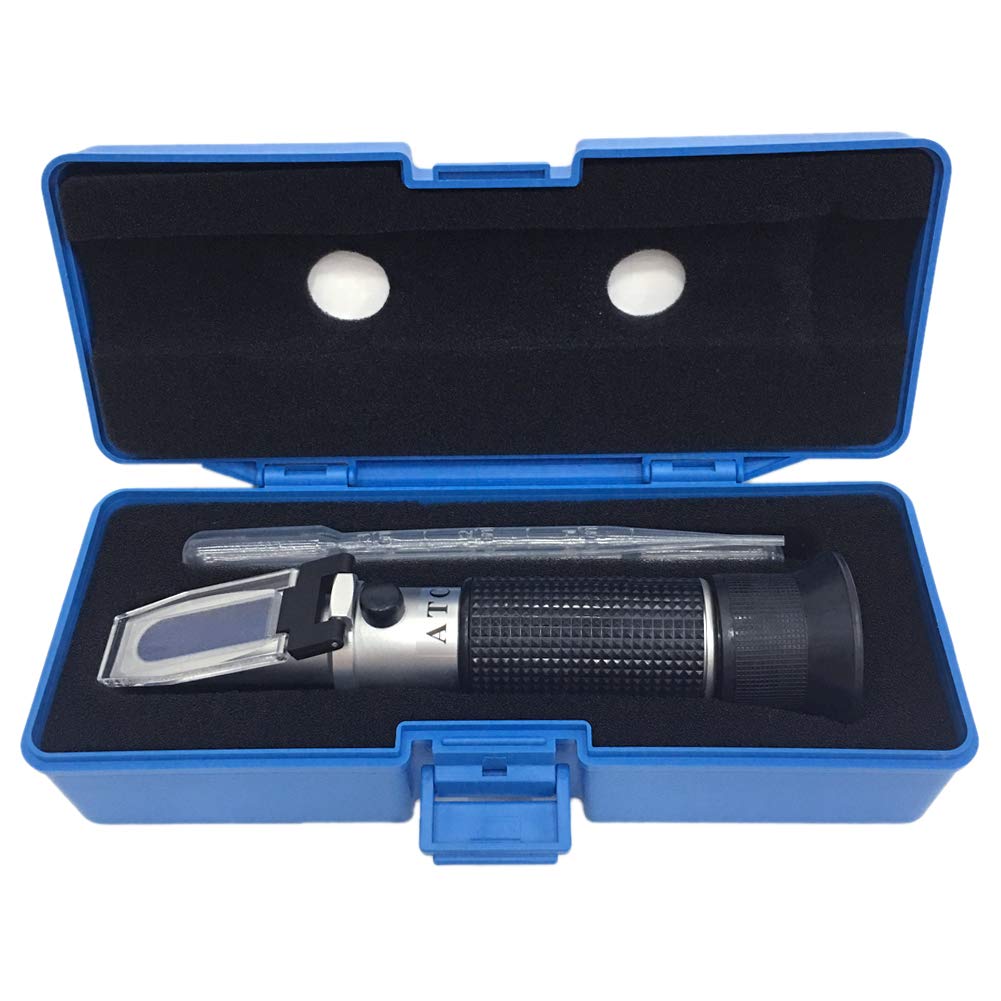
The aichose dual-scale model is the familiar budget workhorse of this group: 0–32% Brix, 1.000–1.120 specific gravity, automatic temperature compensation, and a body that weighs just 3.7 ounces. It is the kind of tool that lives in a brew bag and comes out when you need a quick number.
We like the light body and the dual scale. For starting gravity on wine must or wort, it gives you Brix and SG in one look, and ATC takes some of the temperature guesswork out of a sample. The eyepiece is usable in good light, and the chromium body feels light but not fragile.
The dual scale is the reason to consider it over a single-scale optical model. It is a wine and beer tool, and it rewards a careful sample: a few drops, a level prism, and a minute for the reading to settle. For high-sugar work, the aichose 0–80% is the better fit.
This is the spare brewer’s refractometer, not the one we reach for when a reading has to settle a decision. The Tiaoyeer is the easier default, with a wider SG range and a stronger record for holding calibration. The aichose still earns a place for a second brew bag or a garage kit.
Pros
- Light 3.7-ounce body
- Dual Brix and SG scales
- Automatic temperature compensation
- Budget dual-scale option
Cons
- SG scale is tight to read
- 0–32% range stops before honey
How We Tested Brix Refractometers on Brew Days and in the Kitchen
We built the shortlist by pulling every refractometer with a published measurement range and a real spec sheet, then narrowing to 12 that covered the spread of what people actually buy: narrow-range optical tubes aimed at brewers, dual-scale models that also read specific gravity, and wide-range digital meters built for honey, syrup, and concentrated juice. Then we lived with them for six months.
Every session started the same way — distilled water on the prism, zero the instrument, then confirm against a calibration solution before trusting anything. On brew days we read wort straight off the chiller and again at pitch, and we ran the same drop of liquid across every unit in the house to see whether they agreed. In the kitchen we tested orange juice, simple syrup, honey, and maple syrup, which is where range stopped being a spec and started being a limitation; several meters simply ran out of scale. We also left honey on a prism for ten minutes to see how badly it gummed up and how much rinsing it took.
Ease of use came down to counting steps: how many drops, how long until a stable number, and whether we still needed the manual after a week. For readability we took readings in a dim garage with only a phone flashlight and noted whether the shadow line was crisp or a smeared gradient, and whether the display was legible at arm’s length. Quality showed up later — scratched prisms, fogged optics, batteries that quit mid-brew. Throughout, we asked whether the extra money bought a measurement we’d actually trust, because a refractometer that’s easy to use and wrong is worse than no refractometer at all.
How to Choose a Brix Refractometer
The right Brix refractometer is the one whose range matches your samples and whose calibration you will actually check; the rest is convenience.
Match the Range to What You Measure
The first decision is range, because a brewing refractometer and a honey refractometer are not interchangeable. A 0–32% Brix scale covers wine must and beer wort, while 0–55% digital meters add juice, coffee, and many fruits. Honey and concentrated syrup need a 0–80% or 0–90% optical model, or a digital meter that reaches 95%. We prefer to buy the range we actually use rather than a wider scale that makes the low end harder to read.
If you make wine and keep bees, two tools or a high-range digital meter makes more sense than one compromised optical unit. The title on a listing can promise more than the scale delivers; check the Brix range before you buy.
Choose Optical or Digital
Optical refractometers are battery-free, light, and usually less expensive; they rely on good light and a steady eye. Digital Brix meters put a number on a screen, read faster, and are easier to use with dark or cloudy samples, but they need a battery or charging and generally cost more. We reach for optical for a quick must check and digital when we are taking many readings.
Do not assume digital is automatically more accurate. Stated accuracy and calibration matter more than the display type. A well-zeroed optical unit can be more trustworthy than a digital meter that has never been checked against a known sample.
Calibration and Temperature Compensation
Automatic temperature compensation helps, but it is not a substitute for zeroing the instrument. Calibrate with distilled water at the start of a session, then check a known sample if the reading will guide a batch. ATC ranges differ, and outside that range the reading can drift. A refractometer that will not zero is not a bargain.
We treat calibration as part of the tool’s routine, not an occasional repair. Keep distilled water and the cleaning cloth with the meter, and zero again after a big temperature change or a long storage gap.
Read the Gravity Scale Correctly
Dual-scale models add specific gravity, usually 1.000–1.130, which is useful for starting gravity in beer or wine must. The catch is alcohol: once fermentation begins, a refractometer’s SG reading is skewed and needs a correction formula or a hydrometer check. We use the refractometer for the quick must or wort reading and keep a hydrometer for final gravity.
If you only need Brix, a single-scale model is simpler. If you brew, the dual scale earns its keep, but only when you treat the SG number as a starting-gravity tool rather than a final-gravity verdict.
Frequently Asked Questions
How much liquid does a refractometer need?
One or two drops are enough to cover the prism or sample well. More liquid does not improve the reading and can run into the body. For cloudy must, strain the sample first or let it settle, then take a thin, representative drop. Wipe the prism dry between samples so the next reading is not diluted.
Can a refractometer handle dark red wine must?
An optical refractometer can struggle with very dark or cloudy must because you are reading a shadow line through the sample. Use a thin layer, bright light, and a clean prism; if you check red must often, a digital Brix meter is easier. The Flagfront’s digital readout is a practical step up for dark samples without lab-meter cost.
How should I clean the prism or sample well?
Rinse with distilled water and wipe with the soft cloth that came with the instrument, then dry the surface before closing the cover. Avoid paper towels that shed or anything abrasive on the prism. Clean before sugar dries, especially after syrup or honey; a sticky film will throw off the next reading. Do not submerge a model unless its listing says it is waterproof.
Final Verdict
The Tiaoyeer is the one we recommend first. It covers wine must and beer wort with a readable dual scale, automatic temperature compensation, and a level of accuracy that suits home production without turning a sample into a project. If you take readings often or work with syrups, the Milwaukee MA871 is the better digital step up; for honey and concentrated syrup, choose the aichose 0–80% instead. The right choice is the one whose range matches your bench and whose calibration you will actually check.