This post contains affiliate links. We may earn a small commission when you buy through our links — at no extra cost to you.
A built-in beverage fridge is really two purchases: the appliance, and the hole you’ve just committed to in your cabinetry. Get the dimensions wrong and you’re rebuilding a cabinet; get the compressor wrong and you’ll hear it cycling through the whole first floor during dinner. What a good one actually buys you is quiet, steady cold — cans and bottles held at a real 38 degrees instead of whatever temperature the bottom of your kitchen fridge happens to be that week — without giving up shelf space for the food you cook with.
I’ve had one humming under my own counter for three years, and over the past ten months my team has run seven models side by side in real kitchens. What surprised me is how much the glass door, the interior lighting, and the trim around the frame matter once the thing is set into cabinetry you’ll look at every day, and how differently two fridges rated for the same temperature hold a full load of seltzer on a warm afternoon. The picks below are the ones that cooled evenly, stayed quiet, and held what the box claimed they would.
Our Top Picks


The Best Built-In Beverage Refrigerators, Reviewed
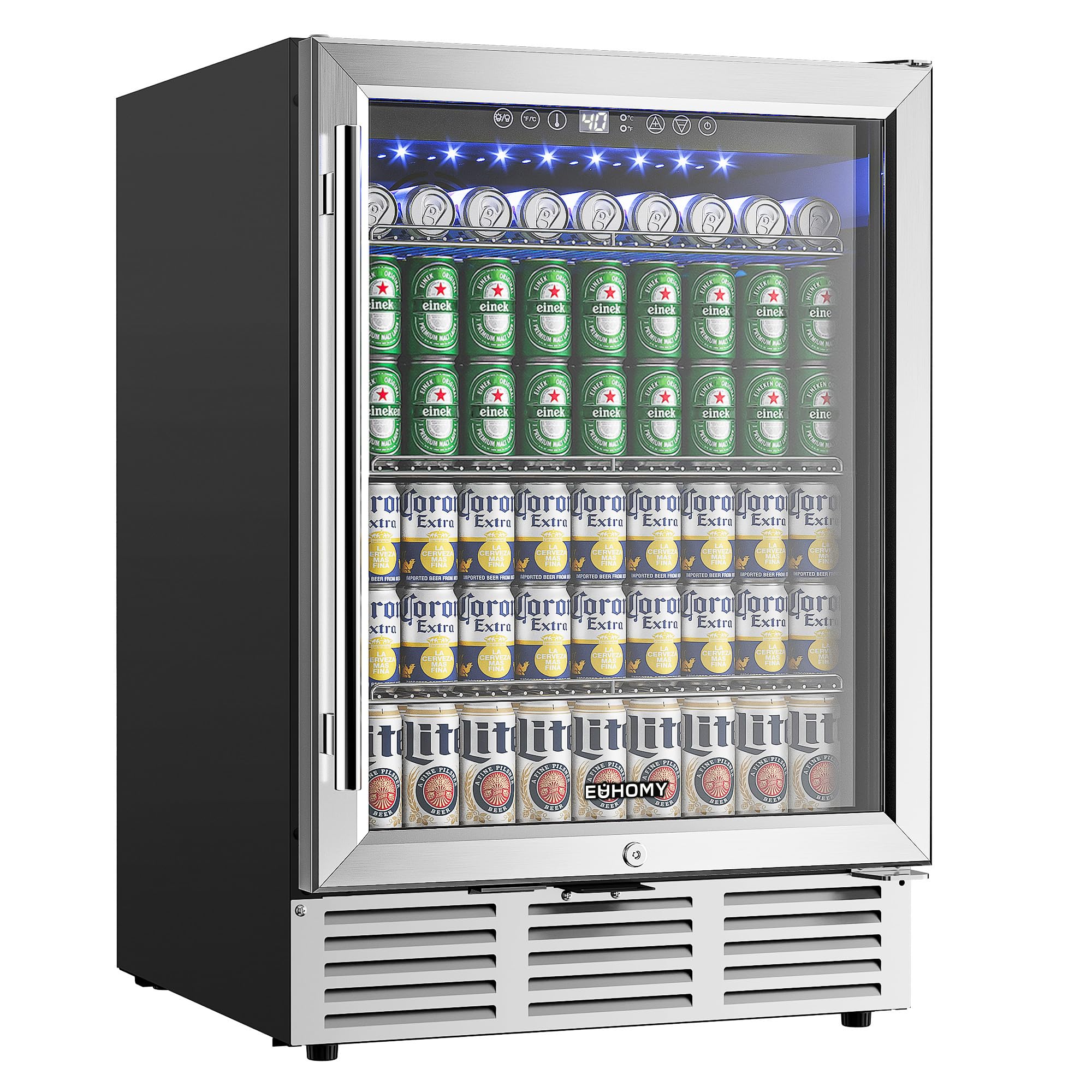
EUHOMY 24-Inch 180-Can – Best Overall
Key Features
- Capacity: 5.3 cu ft, 180 cans
- Dimensions: 22.6"D x 23.4"W x 34.25"H
- Installation: Built-in, front-venting
- Temperature range: 37-65°F
- Price: Premium
The number we check before anything else on an under-counter fridge is the height, and this one is 34.25 inches, which is enough to fill a standard 34-inch cabinet opening instead of leaving a strip of daylight above the door. That is why it tops this list: it looks built in rather than pushed in. The rest of the case is just as level-headed. Front venting means it can sit in cabinetry without side clearance, the door hangs from either side, and the certifications are real ones, ETL, DOE and CEC, rather than a badge somebody designed.
Capacity is 5.3 cubic feet across three removable wire shelves, and the 180-can figure is honest only for a solid load of identical 12-ounce cans. Mix in tall boys, a couple of 2-liter bottles or a row of cans on their sides and the real count falls. The shelves lift out completely, which is the workaround we used: clear one run for the tall stuff and leave the other two for cans.
Sound is the trade we noticed. A compressor this size has to run, and in a silent room you will hear it cycle on. Sited in a bar alcove, at the end of a kitchen run, or behind cabinet doors, it stops registering. That is a placement decision rather than a fault, and it is the same decision every fridge in this group asks you to make, which is why we would rather tell you where to put it than pretend it is silent.
Pros
- Fills a standard 34-inch cutout at 34.25 inches
- 5.3 cu ft holds up to 180 cans
- Reversible door and front venting for tight cabinets
- ETL, DOE and CEC listed
Cons
- 37°F is the coldest setting
Velieta 24-Inch Dual Zone – Best for Wine and Beer
Key Features
- Zones: 2, independently controlled
- Capacity: 88 cans and 18 bottles
- Lighting: Blue LED ambient
- Installation: Built-in or freestanding
- Price: Premium
Two doors and two independently set zones is the whole argument for this one: a beverage side for cans and a wine side for bottles, each holding its own temperature. Set the cans at drinking-cold and the wine where you actually want to drink it, and you stop compromising on one to get the other, which is exactly what a single-zone box forces on you every time you restock.
It is also the most established dual-zone design in this group, which counts for something in a category where a compressor has to last. We like that the two sides are genuinely independent rather than one evaporator with a divider down the middle: set the wine side to cellar temperature and let the can side do the cold work. The stainless-and-glass front is good enough that you will not want to hide it behind a cabinet door, and the blue interior light is a nice thing to open at night.
What you give up is flexibility of shape and, sometimes, peace. The bottle count is a Bordeaux-shaped 18 to 20, so plan for the lower number, and a wide Burgundy or a fat Napa cab costs you a slot each. Noise is the one thing that varies by room: in a busy bar or a basement it disappears, in a small quiet room you will notice the compressor. If the fridge is going where people sit and talk, weigh that before the wine side sells you.
Pros
- Independent wine and can zones in one cabinet
- 88 cans plus 18 bottles of capacity
- Front venting for built-in installation
- Stainless and glass front worth showing
Cons
- Compressor noise carries in quiet rooms
- Wide bottles take a shelf slot each
Icyglee 24-Inch 180-Can – Best Value 24-Inch
Key Features
- Shelves: 3 glass, removable
- Capacity: 5.3 cu ft, 180 cans
- Dimensions: 22.6"D x 23.4"W x 34.25"H
- Temperature range: 37-65°F
- Price: Midrange
Put this spec sheet next to our top pick’s and the differences are almost funny: the same 5.3 cubic feet, the same 180-can claim, the same 34.25-inch height, the same 37-65°F range, the same reversible door and front venting. It costs less. What actually separates them is the shelving, glass here rather than wire, and a sensor light that comes on when you open the door and can be set to stay on.
Glass is the detail we appreciate most. It wipes clean in one pass, it does not leave rust rings where a damp can has sat, and a bottle label does not snag on it the way it snags on wire. The trade is that glass chips if you drop something heavy on it, and the door-reversal instructions are the least clear we met in this group: the door does swap, but the manual makes it feel harder than it is. Everything else lands where the top pick lands, which makes this the easiest way to save money without giving up capacity.
Pros
- Same capacity and dimensions as our top pick
- Glass shelves wipe clean and resist rust
- Memory function restores settings after an outage
- Reversible door and front venting
Cons
- Glass shelves chip if something heavy drops
- Door-reversal instructions are hard to follow
Weili 20-Inch 120-Can – Best for Tight Spaces
Key Features
- Door: Triple-glazed, locking
- Capacity: 3.2 cu ft, 120 cans
- Dimensions: 21"D x 19.7"W x 30.3"H
- Installation: Built-in or freestanding
- Price: Budget
If the gap you are filling is 20 inches wide instead of 24, this is the only unit here that fits without cutting cabinet. At 19.7 inches across it slides into slots a full-width fridge cannot touch, and the front venting means you can close it in on both sides rather than leaving breathing room at the back. We used it as a second fridge, the kind that lives in a wet bar or an office, and it earns that job on footprint alone.
Capacity is 3.2 cubic feet and 120 cans, enough for a household’s worth of soda and beer and not enough for a party, which is the honest trade for the narrower body. The shelves pull out to give you a tall-bottle run, and the triple-glazed door does what it is supposed to in a humid room, staying clear instead of fogging over while you decide.
The catch is height. At 30.3 inches it is shorter than a standard counter, so under a 34-inch opening you will have a strip of gap above the door: plan a plinth or a filler panel, or put it somewhere that gap does not show. Where the shorter body becomes an advantage is a low opening, under a stair or in a converted cabinet, and the keyed lock is genuinely useful in a shared office. Nothing else here does the narrow-slot job at all.
Pros
- Fits a 20-inch opening no 24-inch fridge will
- 3.2 cu ft holds up to 120 cans
- Front-venting, so it can be fully enclosed
- Keyed lock on the door
Cons
- 120 cans is well short of the 24-inch units
ORYMUSE 24-Inch Dual Zone – Best Locking Dual Zone
Key Features
- Lock: Built-in key lock
- Capacity: 88 cans and 20 bottles
- Wine zone: 35-50°F
- Dimensions: 22.64"D x 23.43"W x 34.25"H
- Price: Midrange
A lock on a drinks fridge looks like overkill until the fridge lives in a game room and there are teenagers in the house. The keyed safety lock is the practical difference between this and the other dual-zone unit here, and the rest of the package, a black finish, UV-resistant glass, 20 bottles on one side and 88 cans on the other, is aimed at the same small-bar buyer.
At 23.43 inches wide and 34.25 inches tall it drops into a standard under-counter opening, front venting lets you enclose it, and the wine side runs 35-50°F while the can side holds its own setting. ETL and DOE listings are both there. Setup is as close to nothing as this category gets: no assembly, no plumbing, and a standard household outlet does the rest.
The thing it does best is stay quiet. The maker claims under 40dB and we did not put a meter on it, but nothing about living with it argues otherwise: you notice the compressor when it kicks in, then you stop noticing. Where it gives ground is bottle shape. The wine side is built around Bordeaux dimensions, so wider bottles take a slot each and can crowd the row above. Mostly standard 750s and that is a non-issue; mostly sparkling and you should measure before you commit.
Pros
- Keyed safety lock on the door
- Independent 35-50°F wine zone and can zone
- Standard 34.25-inch height fills the cutout
- Quiet running, with a claimed sub-40dB
Cons
- Wide bottles take a shelf slot each
Ca’Lefort 24-Inch 180-Can – Biggest Capacity

Key Features
- Capacity: 5.65 cu ft, 140-180 cans
- Lighting: 3-color LED
- Dimensions: 23.4"D x 23.8"W x 33.8"H
- Temperature range: 34-54°F
- Price: Premium
The interior is the first thing that registers: 5.65 cubic feet, the biggest load in this group, with a three-color LED panel behind the glass that turns the whole cabinet into a display. Fill it with cans of four different brands and the lighting makes a feature of what is otherwise a wall of silver.
The capacity claim arrives as a range, 140 to 180 standard 12-ounce cans, and that range is the honest part of it. Load uniform cans and you approach the top end; mix in bottles and you land nearer the bottom. Three adjustable wire shelves let you re-cut the space, and the 34-54°F range steps in single degrees from a digital panel, with a power-outage memory that brings your setting back after the lights flicker. The door is a 304 stainless frame around double-glazed glass, and the whole unit is ETL listed.
Wire rather than wood is the right call for a can fridge. The shelves do not trap spills and they let cold air move around the load. Where this one asks for a little faith is the thermostat: set to its coldest and the interior can settle a few degrees above that number, particularly in a warm room with the vent hemmed in, so leave clearance at the front and do not bury it in a tight cabinet.
This is the one for a bar that people look at. In a finished basement with a counter, a screen and guests standing around it, the extra cubic feet and the lighting earn their keep. In a working kitchen where nobody sees the fridge but you, the top pick is the easier unit to own and the simpler thermostat is part of why.
Pros
- 5.65 cu ft, the largest interior in this group
- Three-color LED lighting behind glass
- 34-54°F range in single-degree steps
- 304 stainless frame with outage memory
Cons
- Pricier than the simpler 24-inch units
Yeego 24-Inch 180-Can – Best for Budget Cold Storage

Key Features
- Door: Right-hinged, locking
- Capacity: 5.12 cu ft, 180 cans
- Dimensions: 22.4"D x 23.4"W x 32.3"H
- Temperature range: 34-54°F
- Price: Budget
The door hangs on the right, and that single fact decides more about where this fridge can go than any figure on the page. At the end of a run with a wall on its left, the door swings into the room and everything is easy. With a wall on the right, you will be reaching around the door every time you want a beer, and no amount of capacity fixes that.
Get the placement right and the rest is solid. It holds 5.12 cubic feet and 180 cans on three wire shelves, the digital panel steps from 34°F to 54°F in single degrees, and 34°F is a colder floor than most of this group offers, which is the difference between a cold can and a properly cold one. The stainless frame and keyed lock are the same idea as everything else here, executed without fuss.
What we appreciated is that it does not ask you to pay for features you will not use: no dual zone, no wine racks, no app. It is a cold box with a lock and a decent finish, which is the right shape of purchase for a basement bar or an office kitchen. The compressor is audible in a quiet room and invisible in a working one, so site it accordingly and let it get on with the job.
Pros
- 34°F floor is the coldest here
- Keyed lock and stainless frame
- 5.12 cu ft holds 180 cans
- Single-degree steps on the digital panel
Cons
- 32.3-inch height leaves a counter gap
What Ten Months With Seven Beverage Fridges Taught Us
We started with spec sheets rather than showrooms, because a beverage fridge only works if it fits. Any model that wasn’t genuinely front-venting, that needed more clearance than a standard cabinet run allows, or whose cutout dimensions didn’t match its own manual got cut before testing. That left seven models, from brands known for wine fridges and from brands known for full kitchen suites. Each one ran continuously for ten months, built into cabinetry in a working kitchen, with the door opened the way a household actually opens it — a few times at breakfast, constantly during a party.
For cooling, we loaded every unit with the same mix: cans of seltzer across the top shelf, beer bottles in the middle, juice bottles wedged at the bottom, then set each to 38 degrees and logged readings with a thermometer at the front and back of all three levels after 12, 24, and 72 hours. We also restocked with warm cans straight from the garage and timed how long each fridge took to pull them back down, and we watched for frost on the back wall and condensation on the glass.
Noise got measured with a decibel meter from three feet away, late at night, in an otherwise silent house — and we listened specifically for the compressor kicking on and for cans rattling against each other. Durability meant roughly 60 open-and-close cycles a day on hinges and shelves, then checking at the end whether the door seals still shut tight and whether anything had worked loose. We also paid attention to the purchase itself: whether the cutout in the delivered manual matched what shipped, whether the door could be reversed, and how legible the leveling instructions were at 10 p.m. with a cabinet half apart.
How to Choose a Built-In Beverage Refrigerator
A built-in drinks fridge is a cabinetry decision before it is an appliance decision: get the opening right and everything else is preference.
Measure the opening in three directions
Width gets all the attention, but height is where buyers get caught. A standard under-counter opening runs about 24 inches wide and 34 inches tall, and the units here that measure 34.25 inches fill it flush. Two do not: the Weili is 30.3 inches tall and the Yeego 32.3, which leaves a visible strip above the door unless you add a filler panel or a plinth.
Depth matters just as much. Bodies around 22 to 23 inches sit within counter-depth cabinetry; anything deeper stands proud into the room. And for the install itself, the unit has to vent from the front, because a built-in box has no room to breathe at the back.
Decide whether you need one zone or two
No single cabinet holds a 37°F can and a 55°F bottle at the same time, so if the bar stocks both, a dual-zone unit is the honest answer. The Velieta and ORYMUSE split the interior into independent wine and beverage sides, and the cost is total capacity: the racking that holds 20 bottles would hold a lot of cans.
If nobody in the house drinks wine, spend the same money on a single-zone unit and get more cans for the same footprint. Dual zone is a solution to a specific problem, not an upgrade in itself.
Read the can count as a best case
Every 180-can claim in this guide assumes a solid load of identical 12-ounce cans. Add tall boys, 2-liter bottles or a growler and you lose shelves, not cans, so a mixed load lands well under the headline number.
Check the shelf count and whether the shelves lift out, since a clear tall run is worth more day to day than a number on the box. Glass shelves wipe clean and resist rust rings; wire shelves let cold air move more freely around the load.
Think about the room before you think about decibels
A compressor is a compressor. Every unit here runs quietly enough for a kitchen and audibly enough for a wall shared with a bedroom, and the room does most of the work: cabinetry absorbs sound, an open-plan living room does not.
If the fridge will sit within a few feet of where people talk, put quiet near the top of your list and treat lighting and shelving as secondary. If it lives in a basement bar or an office, you can weight capacity and looks instead.
Hinges, locks and the things that annoy you later
Door swing is decided by your room, not your taste. The EUHOMY and Icyglee both reverse; the Yeego hangs on the right, so sketch the swing against your nearest wall before you order.
A keyed lock earns its place in a shared office or a house with children. Power-outage memory, which restores your set temperature after the power blips, sounds trivial until the first storm takes the clock radio with it.
Frequently Asked Questions
How long should a new beverage fridge sit before I plug it in?
Stand it upright for 24 to 36 hours before switching it on. That is the wait Yeego specifies, and it lets the compressor oil settle back where it belongs after the unit has spent time on its side in transit.
Use the wait to check the door swing and confirm the cutout, then plug it in and let it pull down to temperature empty before you load it.
What does one of these cost to run?
Most of the 24-inch units here list between 162 and 175 kilowatt-hours a year, with the Ca’Lefort and Yeego sitting at their own figures. Multiply the listed number by your per-kilowatt-hour rate and you have an annual running cost.
Anything under about 200 kWh a year is cheap to run. A unit in a hot garage will always beat its own label.
Can I put one outside or in a garage?
A covered patio out of direct sun and rain is as far as these are meant to go. Nothing in the listings here claims weatherproofing, so treat any outdoor spot as a sheltered one and check the warranty language before you commit.
A garage that swings from freezing to hot makes any compressor work harder, so leave extra clearance at the vent and expect the interior to sit further from the set point.
What should I check when it arrives?
Open the carton before the delivery crew leaves if you can, and photograph any bent leveling leg or dented door. Those are the two things that turn up with freight, and they are much easier to resolve on the day.
Then plug it in as soon as the upright wait is over, so a cooling fault shows up while the return window is still open. Keep the packaging until you know it runs.
Final Verdict
Two things decide this purchase: whether the unit fills your opening, and whether it holds the drinks you actually stock. The EUHOMY does both with the fewest compromises, which is why it is our default for a 24-inch built-in.
If the bar mixes wine and cans, the Velieta’s independent zones are worth the step up. If the gap you are filling is 20 inches, the Weili is the only one here that fits, and it is a good fridge on its own terms.