This post contains affiliate links. We may earn a small commission when you buy through our links — at no extra cost to you.
Shopping for a can fridge often means sorting through inflated capacity claims and cooling systems that can’t keep up. Thermoelectric models promise silence but rarely deliver icy drinks, while compressor fridges bring their own trade-offs in noise and size.
This guide focuses on the models that actually chill beer and soda to the low 30s°F and hold their advertised count within reason. You’ll get straight answers about what works for a home bar, office, or dorm room — without the spec-sheet optimism.
Top Picks
Best for Home Bar
Icyglee 126-Can

Key Features
- Cooling Method: Compressor
- Temp Range: 34°F–64°F
- Capacity: 126 cans (real ~100)
- Noise: 36 dB claimed
- Dimensions: 18.9D x 17.5W x 31.3H in
- Price: Mid-Range
The Icyglee 126-Can delivers a rare combination: quiet 36 dB operation and a sleek glass door with blue LED lighting that shows off your drinks. It undercuts the top pick on price while offering similar capacity and compressor-based cooling down to 34°F. For buyers who prioritize aesthetics and low noise over a decade-long track record, this fridge holds its own.
This mini fridge suits style-conscious owners placing it in a home bar, living room, or office where the ambient glow looks intentional. The compressor hum stays minimal but may be audible in a silent bedroom. Temperature accuracy varies between units—some run warmer than the set point—so it’s less ideal for wine storage at exact 55°F. Noise inconsistency has also been noted in a minority of units, making location choice important.
Pros
- Quiet operation at 36 dB – few compressor fridges are this unobtrusive.
- Sleek design with a crystal-clear glass door and blue LED lighting.
- Effective cooling that chills drinks quickly even in humid conditions.
- Strong value for the price – delivers key features at a lower cost than comparable models.
Cons
- In very quiet rooms, some units produce a high-pitched hum or drone – placement matters.
- Set temperature may not match actual interior temperature; some units run warmer than expected.
Best for Small Spaces
EUHOMY 24-Can

Key Features
- Cooling Method: Compressor
- Temp Range: 40°F–61°F
- Capacity: 24 cans
- Noise: <40 dB claimed
- Dimensions: 14.9D x 11W x 16.7H in
- Price: Budget
The EUHOMY 18L is the rare mini fridge that packs a real compressor into a 0.6 cu. ft. footprint — small enough for a desk or nightstand. Unlike the top pick in this category, it doesn’t target large capacity or sub-40°F performance; it stays within 40–61°F, which suits keeping canned drinks chilled rather than ice-cold. The compressor cooling means it can actually cool drinks, unlike thermoelectric models that struggle to get below 42°F.
This fridge is designed for dorm rooms, small offices, or bedside tables where every inch counts. The glass door and LED light give it a neat appearance, making it a conversation piece for a home bar or game room. But the trade-offs are real: some units have been known to stop cooling or show error codes after a few months, and the compressor hum is present — not loud, but in a quiet bedroom you’ll notice it. If you need something that runs silently or must hold sub-40°F temps, this isn’t it.
Despite these limitations, the EUHOMY delivers solid value for its size. It cools drinks quickly upon initial setup and maintains temperature consistently once settled. For someone who wants a few cold sodas or beers within reach without spending much, it does the job.
Pros
- Fits on desks, nightstands, and countertops — barely takes up any space.
- Cools quickly and holds temperature well within its 40–61°F range.
- Clean design with a glass door and LED light for a polished look.
- Cost-effective for a compressor mini fridge under $100.
Cons
- Compressor hum can be noticeable in quiet rooms like bedrooms or offices.
- Some units may stop cooling or display error codes within the first few months of use.
Best for Large Capacity
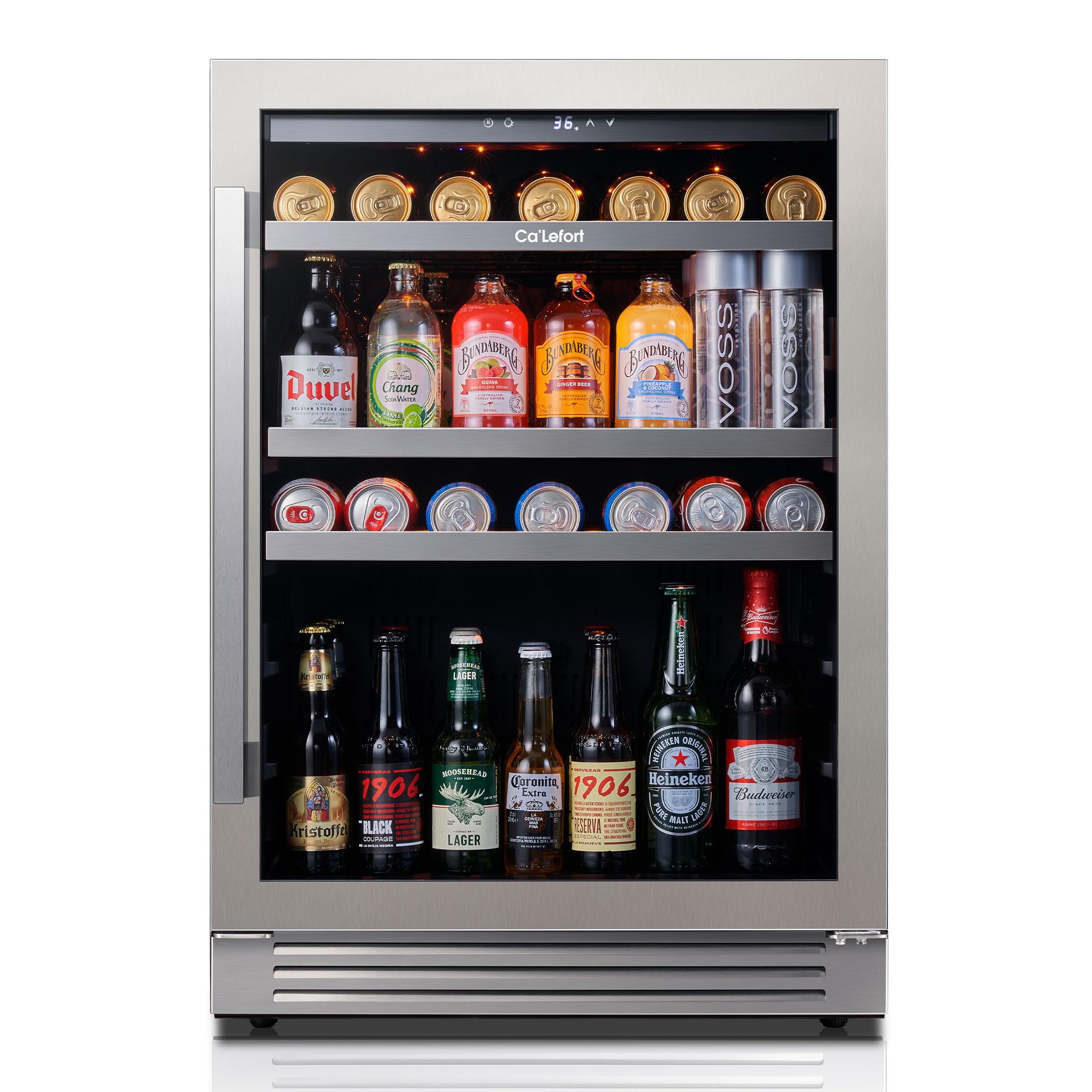
Ca’Lefort 180-Can
Key Features
- Cooling Method: Compressor
- Temp Range: 34°F–54°F
- Capacity: 180 cans (5.65 cu.ft)
- Noise: Quiet (compressor hum)
- Dimensions: 23.4D x 23.8W x 33.8H in
- Price: Premium
The Ca’Lefort holds 180 cans — about 30 more than typical 5 cu.ft. models — in a package that fits flush into cabinetry for a built-in look. Its compressor runs quietly enough for a kitchen island or home bar, and the three-color LED lighting (amber, blue, white) adds a polished touch behind the glass door.
This fridge suits households that regularly stock 150+ drinks and want a seamless built-in appearance. The stainless steel finish and ambient lighting dress up the space. But the nearly $800 price tag and right-hinged-only door limit where it can go — plan ahead. Also, a small number of units may emit a faint whine; if that happens, contact support.
Cooling performance is consistent, reaching 34°F and holding temperature evenly, so sodas and beers come out properly cold. Build quality feels solid, with modern metal edging and a glass door that resists fingerprints.
Pros
- Holds 180 cans — one of the largest capacities in a 24-inch footprint
- Three-color LED lighting (amber, blue, white) with a sleek stainless steel front
- Ultra-quiet compressor operation suitable for open living areas
- Powerful cooling reaches 34°F quickly and maintains temperature
Cons
- Premium price — nearly double that of comparable capacity competitors
- Right-hinged door only, cannot be reversed — limits placement to left-opening layouts
- Some units may emit a faint whine that can be noticeable in quiet rooms
Best for Garage Use
Electactic 130-Can

Key Features
- Cooling Method: Compressor
- Temp Range: 32°F–61°F
- Capacity: 130 cans (3.2 cu.ft)
- Noise: Claimed quiet
- Dimensions: 19.3D x 17.3W x 30.8H in
- Price: Mid-Range
The Electactic holds up to 130 cans (3.2 cu. ft.) with adjustable temperature control and a sleek black finish, at a mid-range price. It cools quickly and maintains a consistent 40°F for soda and beer.
Where it falls short of the top pick is noise and reliability: the compressor hum can be noticeable in quiet rooms, and a minority of units have experienced cooling failure within weeks. For a garage, basement, or game room where occasional hum won’t matter, this delivers good value, but those needing whisper-quiet or long-term certainty should look at the hOmeLabs.
Pros
- Cools drinks quickly and holds steady 40°F.
- Sleek black body with blue LED fits well in a home bar.
- Flexible shelves accommodate up to 35 cans without crowding.
Cons
- Compressor hum can be distracting in a quiet bedroom or office.
- A small number of units may stop cooling after several weeks of use.
Best for Game Rooms
Feelfunn 126-Can

Key Features
- Cooling Method: Compressor
- Temp Range: 34°F–64°F
- Capacity: 126 cans (3.2 cu.ft)
- Noise: 36 dB claimed
- Dimensions: 18.9D x 17.5W x 31.2H in
- Price: Mid-Range
The Feelfunn Beverage Refrigerator stands out with its attractive silver finish, blue LED lighting, and quiet operation – a solid choice for a game room or home bar. However, cooling consistency varies: some units may not reach the low temperatures needed for truly cold drinks, and the compressor hum can be more audible than expected in very quiet settings. This makes it a better fit for decorative beverage storage than for those who demand precise 34°F performance.
Pros
- Quiet enough for shared spaces – many users confirm it’s as quiet as a mouse.
- Silver finish with blue LED gives it a sleek, modern look that fits game rooms well.
- Interior holds plenty of drinks – fits cans and bottles with adjustable shelves.
Cons
- Cooling temperature consistency can vary between units, with some not reaching the low 30s as intended.
- In quiet spaces, the compressor noise may be more present than the claimed 36 dB suggests.
How to Choose
For ice-cold beer and soda, compressor cooling is non-negotiable — thermoelectric fridges rarely reach the 34–38°F range needed for truly cold drinks.
Capacity: Real vs. Advertised
Manufacturers count cans in ideal stacking configurations that ignore shelf spacing and door storage. Most 3.2 cu. ft. models actually hold 85–100 standard cans, not the 120–130 on the box.
If you need to stock for a party, assume 20% less capacity than claimed and verify with real-world user photos. The extra shelf space you lose often means fitting bottles or tall cans is also tighter than expected.
Cooling Method: Compressor vs. Thermoelectric
Compressor fridges work like a full-size home refrigerator: a pump cycles refrigerant to pull heat out, reliably reaching 34°F even in warm rooms. Thermoelectric units use a Peltier chip that moves heat away but cannot overcome high ambient temperatures — they level off around 42–50°F in summer.
The trade-off is noise: compressors hum and click, while thermoelectric models are nearly silent. If you prioritize absolute quiet for a bedroom but only need cool (not ice-cold) wine or soda, thermoelectric works. For any drink meant to quench thirst on a hot day, go compressor.
Temperature Range and Precision
Digital controls that go down to 34°F give you the widest utility: crisp beer, soda, and even short-term wine storage if you dial up to 55°F. Models that bottom out at 40°F leave you with lukewarm cans on a summer afternoon.
The hidden detail is consistency. Some thermoelectric units fluctuate by 5–8°F because they rely on ambient airflow. Compressor fridges with a thermostat hold within 2°F, which matters if you’re storing anything beyond basic cans.
Noise Level in Practice
Compressor noise varies by brand and individual unit — some hum at 36 dB (about the level of a quiet conversation), while others produce a higher-pitched whine that becomes annoying in a bedroom. Thermoelectric fridges are fan-cooled and rarely exceed ambient noise.
Check user reviews for specific noise descriptions like “drone” or “click”. If the fridge will sit in a living area or open-plan office, look for models consistently described as “quiet” rather than relying on spec sheet dB ratings.
Dimensions and Installation
Most full-size can fridges are 33 inches tall and 18–19 inches deep — they won’t slide under a standard 34-inch counter unless you leave a gap for ventilation. Built-in models like the Ca’Lefort require a cutout and cannot reverse their door swing.
Measure twice: include clearance for door hinges and handle. Freestanding units need 2–3 inches of rear airflow, so a tight cabinet fit may suffocate a compressor and shorten its life.
FAQ
Why does my beverage fridge not get cold enough?
Most likely it’s a thermoelectric model that cannot overcome warm room temperatures. Thermoelectric coolers plateau around 42–50°F and struggle in garages or unairconditioned spaces. Compressor fridges easily reach 34°F, so if ice-cold drinks are the goal, choose a compressor model with a digital thermostat that bottoms out below 38°F.
How many cans does a 3.2 cu ft beverage fridge actually hold?
Real-world capacity is 85–100 standard 12 oz cans, not the 120–130 often advertised. Shelf spacing, can diameter, and door storage reduce the count. If you need to fit exactly 120 cans, look for a 5 cu ft model or one with adjustable shelves that let you squeeze in more.
Is it normal for a mini fridge to make a humming or clicking noise?
Yes, compressor fridges naturally hum and click as the thermostat cycles. The sound level varies: some are barely audible in a living room, others produce a drone that bothers light sleepers. Thermoelectric fridges are silent but can’t get as cold. If noise is a dealbreaker, test the unit in the intended room before committing.
Can I install a beverage refrigerator under a counter without ventilation?
Most freestanding can fridges need 2–3 inches of rear clearance for compressor airflow. Built-in models (like the Ca’Lefort) are designed for tight spaces, but even they require a front grille or side gaps. Blocking ventilation leads to overheating, reduced cooling, and early failure. Always check the manual’s clearance requirements.