This post contains affiliate links. We may earn a small commission when you buy through our links — at no extra cost to you.
Most 24-inch dual-zone wine and beverage fridges are assembled from the same handful of OEM components. The real differentiation isn’t in the cooling system—it’s in noise dampening, accurate capacity labeling, and the manufacturer’s willingness to stand behind the product.
Compressor noise is highly subjective and placement-dependent. A fridge that hums in an open-plan kitchen may go unnoticed in a basement bar, but the same unit can be annoying when installed under a counter in a living area. And nearly every listing overstates bottle count: standard Bordeaux bottles and 12-oz cans take up more space than the slim profile assumed in the marketing.
This guide cuts through the marketing by focusing on what real owners report: which models stay quiet, hold their set temperature, and offer reliable support when something goes wrong. The best dual-zone fridge for you depends on where it goes and what you store—not the numbers on the spec sheet.
Top Picks
Best for Premium Quiet Performer
ORYMUSE 24" Dual Zone

Key Features
- Dual Zone Range: 35-50 / 41-64°F
- Real Capacity: 20 bottles, 88 cans
- Noise Level: <40 dB
- Installation Type: Built-in/Freestanding
- Price: $$
The ORYMUSE dual-zone refrigerator stands apart for its combination of quiet operation and consistent cooling. The compressor pulls the left zone down to 35–50°F for wine and the right zone to 41–64°F for beverages, and it holds those targets with minimal drift. Build quality is a step above what you typically see at this price point — the stainless steel finish and solid door hinges feel substantial, not flimsy. For a home bar or kitchen island, this is the unit that disappears into the background: it cools fast and stays quiet enough that you forget it’s running.
French doors open smoothly, giving access to adjustable shelves that accommodate a mix of standard Bordeaux bottles and 12-ounce cans without gymnastics. The claimed capacity of 20 bottles plus 88 cans is realistic — you can load it as a dual-purpose fridge without sacrificing either side. In daily use, the digital controls are intuitive, and the interior LED lighting makes it easy to find what you need. The right zone’s minimum temperature of 41°F means it won’t get soda as cold as a dedicated beverage fridge that hits 34°F, but for most wine-and-cola setups, the range is perfectly functional.
This fridge suits discerning buyers who want near-premium quality without stepping into luxury pricing. If your priority is maximum can capacity, the FoMup alternative holds 90 cans and costs less, but it runs louder and shows more temperature variability. The ORYMUSE is the right call when consistent temperature, quiet operation, and a premium look matter more than squeezing every last can. The occasional compressor hum in dead-silent rooms is the only tradeoff — in a typical kitchen or living room, it’s a non-issue.
Pros
- Build quality and finish that feel more premium than the price suggests.
- Dual-zone cooling that chills quickly and holds set temperatures with minimal fluctuation.
- Very quiet in normal use — barely audible even when the compressor cycles.
- Honest capacity rating: 20 wine bottles and 88 cans fit as advertised.
Cons
- In very quiet rooms, the compressor hum may be noticeable during cycling.
- The beverage zone only goes down to 41°F, so it won’t chill cans as cold as some dedicated beverage fridges.
Best for Budget Dual-Zone
Velieta 24" Dual Zone

Key Features
- Dual Zone Range: 35-50 / 41-64°F
- Real Capacity: 18 bottles, 88 cans
- Noise Level: Moderate
- Installation Type: Built-in/Freestanding
- Price: $
What sets the Velieta apart from quieter alternatives like the top pick is its price — it offers genuine dual-zone temperature control (beverage side 35–50°F, wine side 41–64°F) without crossing into premium territory. That budget-friendly positioning comes with a clear tradeoff: the compressor hum is more noticeable than in pricier models, especially in quiet rooms. For buyers willing to accept that, the Velieta is a cost-effective way to get separate cooling zones for wine bottles and beverage cans.
This refrigerator is best suited for garages, basements, or open kitchens where ambient noise already exists — not for noise-sensitive living spaces. The cooling performance is solid in most setups, though a small number of units have required compressor service; customer support has been responsive in those cases. The sleek black finish and blue LED lighting give it a more expensive look than the price suggests.
Pros
- Genuine dual-zone cooling at a budget-friendly price
- Sleek, high-end appearance with blue LED lighting
- Effective temperature maintenance for both wine and beverages
Cons
- Compressor hum will be present in quiet spaces — better suited for garages or basements
- Cooling performance may vary between units; some have required service, though support is responsive
Best for Whisper-Quiet Compact
Yeego 24" Dual Zone
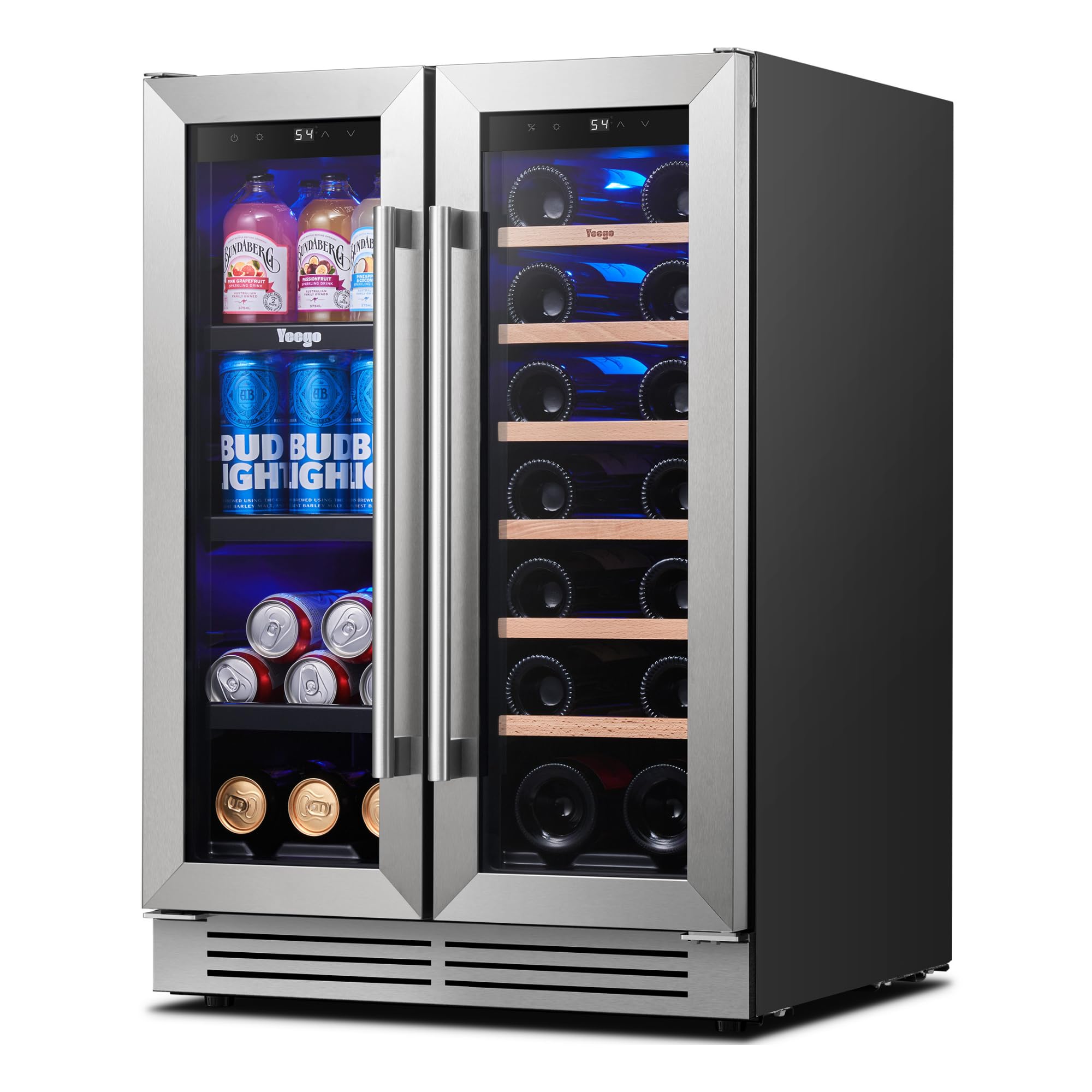
Key Features
- Real Capacity: 20 bottles, 60 cans
- Noise Level: Very quiet
- Installation Type: Built-in/Freestanding
- Price: $$
The Yeego 24-inch dual zone refrigerator is consistently praised for its whisper-quiet operation — the compressor is barely audible even in open kitchens. Build quality feels premium, with a glass door and stainless steel trim that look more expensive than the mid-range price suggests. Temperature control is steady across both zones, so wine and beverages stay at their intended temps without fuss. The tradeoff for this near-silent performance is a smaller can capacity: 60 cans plus 20 bottles, compared to the 88–90 cans offered by some similarly sized competitors.
This unit suits small households or kitchens where 60 cans are enough for daily use and occasional entertaining. If you regularly stock for parties needing 80+ cans, the capacity will feel tight. The dual-zone layout is straightforward: left side for beverages (36–50°F), right for wine (46–72°F), each with independent digital controls. Some owners have needed to request door reversal parts separately — a minor process friction worth planning for if your installation requires left-hand opening.
Pros
- Compressor is nearly silent – barely noticeable in quiet rooms
- Sturdy construction with a premium look that punches above its price
- Maintains consistent temperatures across both zones reliably
Cons
- Holds only 60 cans – falls short for regular large gatherings
- Door reversal parts may need to be ordered separately rather than included
Best for Max Can Capacity
FoMup 24" Dual Zone

Key Features
- Dual Zone Range: 35-50 / 41-64°F
- Real Capacity: 20 bottles, 90 cans
- Noise Level: Fairly quiet
- Installation Type: Built-in/Freestanding
- Price: $$
The FoMup’s 90-can capacity is unmatched among 24-inch dual-zone fridges. Where the top pick balances noise and temperature consistency, the FoMup trades a small degree of thermal precision for significantly more beverage storage. The dual-zone layout (left 35–50°F, right 41–64°F) handles wine and drinks separately, but the right zone can swing about 4°F from its set point — fine for serving a mix of whites and reds, less suited for aging delicate bottles.
This fridge fits buyers who need to stock a bar or media room with lots of cans and a moderate wine selection, and who are comfortable with minor temperature variance. The build quality feels solid, and most owners find the compressor quiet enough for living spaces. The occasional 4°F temperature fluctuation has been noted in some units, which matters primarily for long-term wine storage — not for beverages or wines consumed within a few months.
Owners consistently praise the sturdy construction and the straightforward setup — it works freestanding or built-in with front ventilation. The glass door and interior LED lighting make it easy to see your stock. If your priority is maximizing can count in a standard-width undercounter space, this is a direct, honest option.
Pros
- Highest can capacity in its width — 90 cans plus 20 bottles
- Sturdy build quality and robust feel
- Quiet enough for most settings; compact noise footprint
Cons
- In a very quiet room, the compressor hum may be noticeable
- Temperature can fluctuates up to 4°F from the set point, affecting long-term wine aging
Best for Stylish Quiet Pick
Kalamera 24" Dual Zone

Key Features
- Dual Zone Range: 38-50 / 40-66°F
- Real Capacity: 21 bottles, 75 cans
- Noise Level: Moderate
- Installation Type: Built-in/Freestanding
- Price: $$
Kalamera’s 24-inch dual-zone fridge blends a high-end stainless steel look with quiet compressor operation, making it a visually appealing addition to a kitchen or bar. Temperature retention is solid once set. However, the advertised capacity of 21 bottles and 75 cans is optimistic — standard Pinot noir bottles may not all fit, and some units can struggle to reach the set temperature. This makes it a good fit for buyers who prioritize aesthetics and don’t need exact bottle counts or precise wine storage.
Pros
- Temperature stays steady once set.
- Premium stainless steel finish matches kitchen appliances.
- Quiet compressor operation suits open living spaces.
Cons
Best for Large Capacity Collector
Tylza 24" Large Capacity

Key Features
- Dual Zone Range: 41-72 / 37-64°F
- Real Capacity: 120 bottles, 160 cans
- Noise Level: Mixed
- Installation Type: Built-in/Freestanding
- Price: $$$$
The Tylza 24” holds 120 wine bottles and 160 beverage cans — more than any other unit in this width. When operating correctly, its dual-zone compressor cooling maintains separate temperature ranges for wine and drinks, and the black stainless finish looks substantial. However, the compressor noise is loud enough that this unit belongs in a basement or garage rather than a quiet living area. Some units have also shown cooling reliability issues after weeks or months, so buying with a flexible return window is sensible. This is a specialist choice for collectors or businesses that need maximum capacity and can accommodate a tall, noisy appliance.
Pros
- 120-bottle wine capacity plus 160 cans — unmatched storage density in a 24-inch footprint.
- Black stainless steel and glass door give a professional, commercial-grade appearance.
- Dual-zone temperature range from 37°F to 72°F covers both beverage and wine storage needs.
Cons
- In a quiet home interior, the compressor hum will be present — much less of an issue in a basement, garage, or commercial bar.
- Temperature consistency can vary between units; a minority may require a replacement within the first months.
Best for Smart Budget Pick
BODEGA 24" Dual Zone

Key Features
- Real Capacity: 19 bottles, 57 cans
- Noise Level: 42 dB
- Installation Type: Built-in/Freestanding
- Price: $
The BODEGA 24-inch dual-zone fridge brings app-based temperature control and a lock to the budget segment, a combination rarely seen at this price. It runs quietly and looks the part with glass doors and LED lighting, fitting well in a bar or kitchen when placed freestanding. The catch is that the actual height can reach 34.2 inches — nearly an inch over the listed 33.4 — which makes built-in installation a gamble if your opening is tight. Long-term performance under daily use is less established than more reviewed competitors, so this suits buyers who prioritize features upfront and are comfortable with a bit of uncertainty.
Pros
- App and lock controls let you adjust temperatures and secure the unit from your phone.
- Quiet compressor and attractive glass-door design suit a living area or home bar.
Cons
- Actual height may exceed the listed 33.4 inches by nearly an inch — measure your opening before ordering.
Best for Extra Wine Storage
Velivi 30" Dual Zone

Key Features
- Dual Zone Range: 35-50 / 41-64°F
- Real Capacity: 30 bottles, 90 cans
- Noise Level: <38 dB
- Installation Type: Built-in/Freestanding
- Price: $$$
With space for 30 wine bottles and 90 cans, this 30-inch-wide refrigerator doubles the wine storage of typical 24-inch dual-zone models while keeping noise under 38 dB, making it barely audible in a kitchen or bar area.
The dual-zone system holds beverages between 35 and 50°F and wine between 41 and 64°F, maintaining consistent temperatures without frequent adjustments. Warm LED lighting highlights bottles clearly, and the LCD touch panel responds quickly with no learning curve.
Compared to a towering 76-inch freestanding unit with 120-bottle capacity, this Velivi trades extreme volume for a manageable built-in depth and a compressor that doesn’t broadcast noise throughout the home.
The 30-inch width is the key requirement — it won’t fit a standard 24-inch under-counter cutout. It’s a deliberate choice for homeowners who have that 30-inch opening and want extra wine capacity, silent operation, and a seamless built-in look.
Pros
- Holds 30 wine bottles and 90 cans — significantly more wine storage than most 24-inch dual-zone fridges.
- Runs nearly silent under 38 dB, suitable for open-plan living spaces and quiet kitchens.
- LCD touch panel and warm LED lighting give it a clean, high-end look.
Cons
- Needs a 30-inch cutout — can’t fit a standard 24-inch under-counter opening.
Best for Reliable Dual-Zone
Tylza 24" Dual Zone

Key Features
- Dual Zone Range: 35-50 / 41-64°F
- Real Capacity: 20 bottles, 88 cans
- Noise Level: <38 dB
- Installation Type: Built-in/Freestanding
- Price: $$
Dual-zone temperature control holds reliably, and the black cabinet with wooden shelves gives it a distinctive presence under a counter. It doesn’t match the top pick’s near-silent compressor or refined aesthetics, but the price stays competitive. The temperature-memory feature restores settings after a power outage, which adds peace of mind for areas with occasional interruptions. This fridge suits buyers who want the wood-accented design and solid cooling performance, and who can tolerate a low hum that blends into kitchen or bar background noise.
Pros
- Maintains stable dual-zone temperatures, keeping wine and cans at their ideal settings.
- Wooden shelves and black finish elevate the look compared to typical all-metal fridges.
- Quieter than many compressor-based fridges, blending into the background in active spaces.
Cons
- In very quiet rooms, the compressor hum can be more noticeable than some buyers expect.
- Temperature may occasionally drift from the set point, requiring a quick check.
How to Choose
The most important insight for buying a wine and beverage fridge: advertised bottle counts are almost always optimistic, and compressor noise varies more between models than spec sheets suggest.
Dual-Zone Temperature Ranges
The beverage side needs to stay below 50°F for sodas and beer, while the wine side should sit between 41°F and 64°F depending on varietal. A wider range gives you flexibility, but may come with slightly less precision at the extremes.
If you primarily drink reds and canned beverages, a narrower range unit will still work. For white wine and craft beer drinkers, ensure the beverage zone can hold 38–45°F consistently.
Real Capacity vs. Advertised
Most fridges assume slim 750ml Bordeaux bottles when stating capacity. Standard Burgundy and Champagne bottles, plus 12-oz cans, take up significantly more space. Expect to fit 20–25% fewer bottles than claimed.
Measure your most common bottle diameter before buying. If you regularly stock large-format wine or thick craft beer cans, look for models with adjustable shelves that accommodate taller items.
Noise Levels in Your Space
Compressor noise is subjective and heavily placement-dependent. A fridge on tile or near a wall can amplify vibrations, while one on a rubber mat or isolated from cabinetry runs quieter. Always read noise-related user reviews for the specific model.
If the fridge will sit in an open kitchen, living room, or near a bedroom, prioritize models with dB ratings below 40 and multiple user reports of quiet operation. For basement or garage use, moderate noise is often acceptable.
Installation Type and Fit
Built-in units require front ventilation and precise cutout dimensions. Even among 24-inch models, actual height can vary by 0.5–1 inch from listed specs. Measure your opening carefully, including clearance for door swing and handle depth.
Freestanding installations give more flexibility, but still need ~2 inches of rear airflow. If you plan to install under a counter, confirm the model’s height matches your space before ordering.
Shelving Design and Access
Wooden shelves look premium and are gentler on bottles, but they are often fixed in place. Wire shelves allow better airflow and can sometimes be adjusted, but may scratch labels or tip unstable bottles.
Full-extension pull-out shelves make it easy to reach rear bottles without rearranging the entire fridge. Glide-type shelves are a major convenience feature—check photos and reviews to confirm the mechanism.
FAQ
How long should I wait to plug in a new wine cooler after unboxing?
Let the fridge stand upright for 24 hours before plugging in. This allows the compressor oil to settle back into the system. Plugging in sooner can cause the compressor to seize or run noisily, and it’s the leading cause of early failures.
Why does my dual-zone wine fridge say it holds 30 bottles but I can only fit 21?
Advertised capacity is based on slim 750ml Bordeaux bottles. Standard bottles, Champagne, and thicker craft beer bottles take up more space. Expect 20–25% fewer bottles than claimed. Measure your own bottles before buying to avoid disappointment.
Is a 30-inch wine fridge noticeably quieter than a 24-inch model?
Not inherently. Noise depends on compressor quality and insulation, not physical width. Some 30-inch models, like the Velivi, are praised for quiet operation, but other large units can be louder. Always check noise reviews for the specific model.