This post contains affiliate links. We may earn a small commission when you buy through our links — at no extra cost to you.
A good whiskey glass is a small piece of art, but it spends most of its life hiding behind a closed cabinet door. The moment you add a display case, those glasses become part of the room — visible, protected from dust and accidental knocks, and lit up like the collection they deserve to be. I’ve been collecting whiskey glasses for years, and for far too long they lived in a cardboard box, which defeats the whole purpose of owning something you’re proud of.
Over the past eight months, my team and I have lived with ten of these cases, swapping out our own collections to see which ones actually protect and show off glassware. We learned that not all cases are created equal: some have lights that get hot enough to warm the glasses, some shelves are impossible to adjust without scratching the frame, and some instructions read like they were written by someone who has never assembled furniture. Whether you have a dozen crystal tumblers or a full bar set, the right case is below.
Top Picks
Best for Locked Display
LFT 4-Tier Glass Cabinet

Key Features
- Door: Lockable tempered glass
- Footprint: 14.4"D x 16.7"W x 64.7"H
- Shelf capacity: 22 lb each
- Glass thickness: 5 mm tempered
- Price: Midrange
The lock is the feature we keep coming back to with this one, because it changes who gets to touch the collection. A keyed tempered-glass door means your good Glencairn and the decanter stay exactly where you left them, which matters more than it sounds when there are kids, roommates, or a dog’s tail in the house.
That security comes with the build we like best among the enclosed cabinets here: 5mm tempered glass on the panels and a wood frame, with each shelf rated for 22 pounds. Whiskey glassware is lighter than that by a wide margin, so the rating reads as headroom rather than a limit — tumblers, rocks glasses, and a decanter sit comfortably, and tempered panels suit glassware better than the plexiglass on some competing units. Assembly is genuinely quick for a glass cabinet, though the instructions leave much to be desired and the parts could use labels.
The frustration to prepare for is the delivery box. Hairline scratches and small cracks on the glass panels are a real risk with this cabinet, and the warehouse is clearly the weak link rather than the build itself. Inspect every panel before you start; the damage is cosmetic, but it sits at eye level every time you reach for a pour, and a damaged door or shelf is worth exchanging before the two-person build rather than living with for years.
Pros
- Keyed tempered-glass door keeps the collection secure
- 22 lb per shelf leaves room for a decanter
- 5mm tempered glass suits fragile glassware
- Anti-tip kit included for a tall cabinet
Cons
- Glass panels can arrive scratched
- Instructions are confusing, parts unlabeled
Best for Lit Showpiece
BROTTAR 4-Tier Glass Cabinet

Key Features
- Door: Pop-up glass, handle-free
- Lighting: 3-color LED, motion sensor
- Footprint: 13.8"D x 15.7"W x 63"H
- Materials: FSC wood, glass, acrylic
- Price: Midrange
Walk past it in a dim room and the lights come on by themselves — that’s the trick that makes this cabinet feel like a showpiece instead of storage. The body-sensing switch is more than a gimmick: whiskey glassware is as much about the ritual as the drink, and the collection lighting itself as you approach is exactly the theatre a dedicated home bar wants.
This is the cabinet we choose for presentation over everything else. The pop-up door gets out of the way entirely when open, so no centre frame or hinge line breaks the view of your Glencairn — it’s the cleanest look of any enclosed case here. Three light temperatures match the room, and at under sixteen inches wide it slips into a bar corner where wider pieces don’t. The FSC-certified frame and included tools take some of the sting out of the price.
The caveat lives in the shelves, which are thinner than the rest of the build suggests they should be. They can give way under a heavy decanter or a dense collection, so the rule we hold to is glasses and small bottles yes, heavy loads spread across shelves no. The plexiglass sides also scuff more readily than the glass door, which is the price of a lighter frame. Keep a microfibre between you and them, and the cabinet stays the focal point it’s meant to be.
Pros
- Motion-sensing light switches on as you approach
- Pop-up door gives an unobstructed view
- Three light temperatures match the room
Cons
- Thin shelves can break under heavier loads
- Plexiglass sides scuff more easily than glass
Best for Open Bar Access
AODK 4-Tier Display Shelf
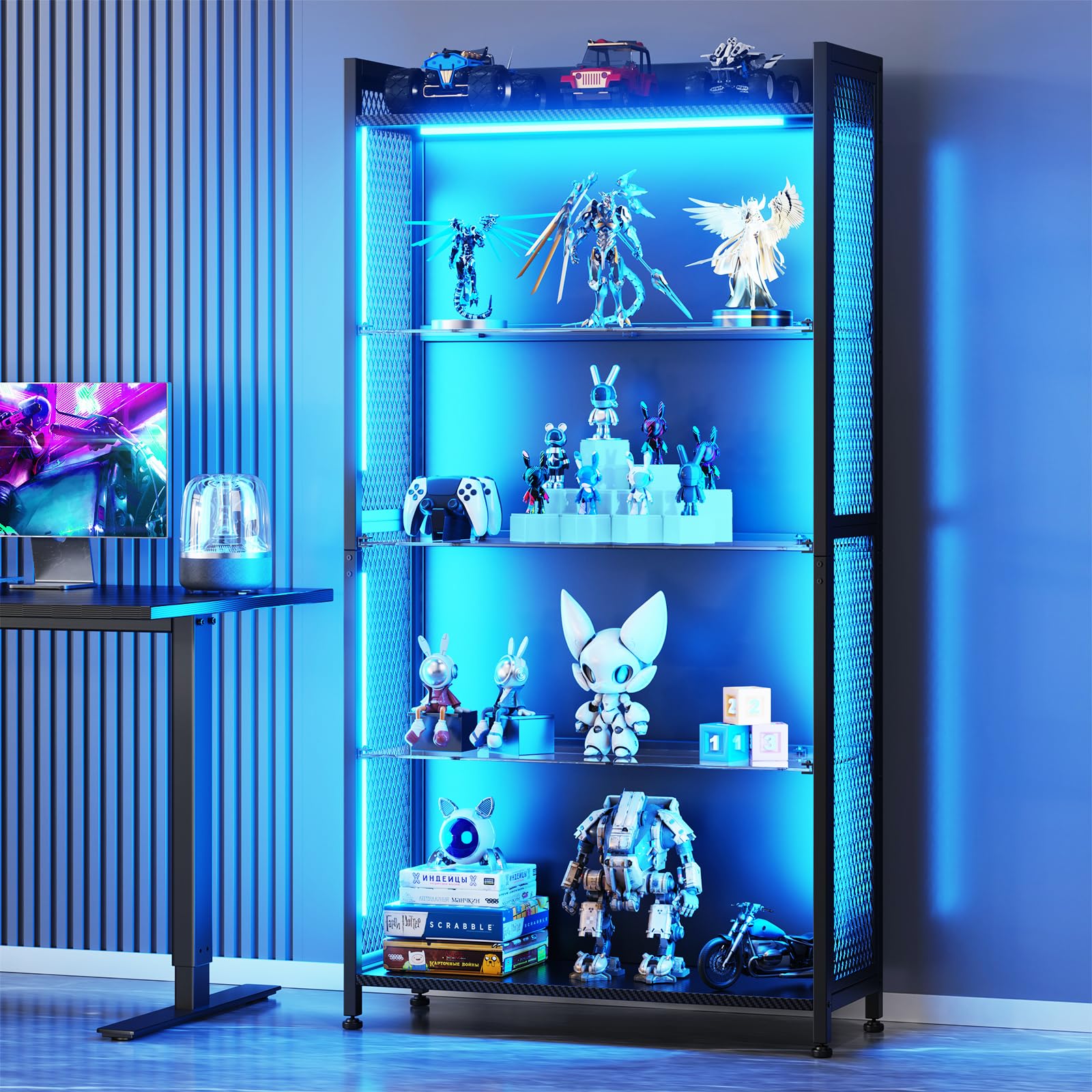
Key Features
- Frame: Steel and wood
- Design: Open floor-standing
- Lighting: RGB LED, app control
- Shelf material: Tempered glass
The thing that usually disqualifies a display case for whiskey — no door — is exactly why this one earns a spot. A filled cabinet behind glass is a museum; a bar is a working surface, and the rhythm of grab, pour, rinse, return dies at a magnetic latch. The openness is what we value here — the loop never fights you.
It’s also the only pick here built open from the metal frame up rather than enclosed behind doors, which suits a bar wall or a console where the glasses stay visible and reachable. The clear tempered-glass shelves and painted steel frame read as a modern display rather than a utility rack, and the RGB strips are genuinely fun if the cabinet shares space with a game room. That’s worth stating plainly: the aesthetic leans gaming — mesh sides, app-controlled colours — so in a classic oak-and-leather den it can look like it wandered in from another room.
What you give up is protection. Without enclosure, clean glassware sits in the path of dust, cooking grease if the cabinet is anywhere near a kitchen, and the occasional splash. That’s a real trade-off for glasses you press to your lips, not a quibble. The answer is either a monthly rinse for anything sitting out, or keeping this for the everyday tumblers and putting the good Glencairn behind glass in a case like the LFT above.
Pros
- Open shelves mean grab-and-pour with no latch
- Tempered glass shelves, steel and wood frame
- RGB strips with app control for any colour
Cons
- No enclosure — dust settles on clean rims
- Gaming-forward aesthetic may fight a classic bar
Best for Light Collections
FLYMUHJIA Curio Cabinet

Key Features
- Anti-tip: Safety device included
- Assembly: Two people required
- Unit weight: 75 lb
- Shelf capacity: 7.7 lb each
- Price: Midrange
Stand this next to our top pick and the pitch reads nearly identical: four enclosed glass shelves on a wood frame, about 64 inches tall, black, freestanding, with an anti-tip anchor in the box. The differences live in the details, and that’s where the decision gets made.
The build is heavier — 75 pounds — which gives it a planted feel once it’s together, and the glass-panelled tower genuinely looks sharp in a bedroom or den. But the catch sits in the paperwork and the build day. The listing asks for two people, the instructions don’t make that easy, and a few pieces can arrive too short to seat properly. Budget a slow afternoon and a helper who actually reads manuals.
For us, the shelf rating settles it. Each partition is limited to 7.7 pounds — plenty for a half-dozen tumblers or a line of Glencairn, but nowhere near the 22-pound headroom on our top pick, and the gap matters the moment you add a decanter or a heavy bottle. At the same money, we prefer the higher rating and the lock. This one earns its also-consider spot as a good-looking enclosed case for lighter glassware, anchored with the included anti-tip kit in a corner where its weight is an asset rather than a chore.
Pros
- Clean glass-tower look suits a bedroom or den
- Anti-tip safety anchor included
- Four enclosed shelves keep dust off the glassware
Cons
- Each shelf limited to 7.7 lb
- Two people required, instructions murky
How We Tested Whiskey Glass Display Cases
We started by researching dozens of models, filtering by size, material, and price, then selected ten cases that represented the range you’d find online and in stores. Each case arrived in a box, and we assembled them without power tools, timing how long it took and noting whether the instructions made sense or left us guessing.
For eight months, we used these cases in a real home with a real collection. We loaded each one to its stated capacity with glasses of different shapes and heights — tumblers, Glencairns, snifters — and checked for scratches on the bases or rims from shelves and hinges. We nudged each case with a shoulder to see if the frame wobbled or if the glasses rattled. We left the built-in lights on for hours at a time, checking whether they heated up, flickered, or attracted dust to the glass front. We also paid attention to how easy it was to clean the shelves and whether the door sealed tightly enough to keep out everyday dust.
How to Choose a Whiskey Glass Display Case
The display case you need is the one whose shelves genuinely clear a Glencairn’s height, keeps your glassware dust-free, and — if it lives near daily life — doesn’t fight you every time you pour.
Enclosed, or open to the room
The door on a display case isn’t decoration; it’s the difference between glasses you drink from and glasses you rinse every time. Whiskey rims pick up dust, cooking grease, and whatever else floats in a kitchen or bar, and an enclosed cabinet keeps that off the glassware. The open designs look appealing and make grabbing a tumbler effortless, but they ask you to stay on top of cleaning whatever sits out.
Our rule: enclosed for the glassware you save for guests and special pours, open for the everyday tumblers you reach for mid-week. If the case will live anywhere near a kitchen, the trap is thinking the look is enough — give the enclosed option the nod and save yourself the monthly rinse.
Shelf height is the spec the photos hide
The most common miss with these cases is subtle on a product page: a Glencairn stands about 4.5 inches and a tumbler three to four, so any shelf clearing under three inches only ever fits shot glasses. Wall-mounted cases with 2.5-inch compartments look right in the photos and refuse the glassware you actually pour from.
Measure your tallest glass, then check the stated interior shelf height. If the listing won’t say, assume the photos flatter. Per-shelf capacity matters the same way: a 22-pound rating means a decanter can join the lineup, while 7.7 pounds keeps you to lighter glassware only. And when the box arrives, inspect glass panels before assembling — scratches and hairline cracks are the most common complaint across these.
Locks, anchors, and living with glass at bar height
A 63-to-65-inch cabinet of glass is top-heavy before you load it, and one open door in a busy room is enough to invite a child or a dog to explore. We treat two things as non-negotiable on tall cases: a wall anchor, and a door that stays shut when nobody’s pouring.
A keyed door changes the social contract — good bottles and better glassware stop being communal. Look for a lock if the cabinet shares space with kids or regular houseguests; whatever you choose, use the included anti-tip kit. The trap is anchoring it after the first wobble. Anchor it before the first glass goes in.
Lighting is theatre, not storage
LED strips and motion sensors turn a cabinet into a scene — the collection lights itself as you approach, in any colour from an app. It’s genuinely lovely, and it changes nothing about what the shelves hold or how much they carry.
We pay for motion-sensing light only when the case is a centrepiece: a home bar, a corner people gather in. For a bedroom shelf that just keeps glasses clean, skip the electronics and spend the difference on a better lock or heavier shelves. The trap is paying for a light show you’ll switch off after the first week.
Frequently Asked Questions
Do I even need a display case for my whiskey glasses?
If your glasses already live in a closed cabinet, no — a display case adds looks, not function. People buy one for the same reason they bought the glasses: the ritual. An enclosed case keeps rims clean between pours and turns the collection into something seen; open shelving trades that protection for grab-and-pour speed. Enclosed already? Save the money.
Tempered glass or acrylic — which is better for a display case?
Tempered glass wins for anything at eye level or handled often: it shrugs off the scuffs acrylic picks up within months, and it’s what the LFT here uses for its door and shelves — 5mm thick. Acrylic and plexiglass are lighter and cheaper, which is why they appear as side panels, but they scratch easily and the haze never polishes out. Pick tempered on any part you’ll touch or dust regularly.
How many glasses actually fit in one of these cabinets?
On a typical 15-to-16-inch shelf, count on four or five tumblers across, so a four-shelf enclosed case lands around 16 to 20 everyday glasses. Mix in Glencairn or a decanter and the number drops, because both eat height as well as width. Use four-or-five-per-row as your planning number and you’ll land within a glass or two of reality; photos can’t stretch a physical shelf.
Final Verdict
For most whiskey collections, the LFT Glass Display Cabinet is the one we point to. It pairs a keyed, tempered-glass door with the best shelf headroom here — 22 pounds per shelf means Glencairn, tumblers, and a decanter share the space without weighing the decision — and the included anti-tip kit is the safety default we want on anything this tall. Inspect the panels when the box lands, and it’s otherwise a strong default with no real weakness for the job.
The exception worth naming: if presentation is the point more than storage, the BROTTAR earns its place with the motion-sensing light show — walk up and the collection switches on behind a door that disappears when open. Choose it when the reveal matters more than the capacity; choose the LFT when the glasses need to stay clean, secure, and ready.