This post contains affiliate links. We may earn a small commission when you buy through our links — at no extra cost to you.
The corner of a room is often the least useful square footage you own—until you put a bar cabinet there. A corner bar cabinet turns that awkward angle into a dedicated spot for bottles, glassware, and cocktail tools without eating into the middle of the room. But shopping for one means worrying about whether it will actually fit your corner, how many hours you’ll spend assembling it, and whether it will still feel sturdy six months after you built it.
My team and I spent the past eight months testing a dozen corner bar cabinets in real homes, from compact apartments to larger dining areas. We learned quickly that a cabinet’s quality doesn’t always match its price tag—some of the priciest options had cheap hinges and wobbly doors, while a few budget picks looked and felt far better than expected. The best ones share a few things: clear instructions, solid joinery, and a finish that holds up to daily use. The list below reflects what we found.
Top Picks
Best for Everyday Bar Storage
Aheaplus Corner Bar Cabinet

Key Features
- LED: RGB, 60,000+ colors
- Power: 3 outlets + 2 USB
- Shelves: 5
- Dimensions: 17.5"D x 17.5"W x 64.2"H
- Price: Midrange
In a furniture category where most options are just shelves behind doors, the built-in power station here stands out: three outlets and two USB ports tucked into the cabinet mean a coffee maker, a charging phone, or a small blender can live right on the bar without hunting for wall space.
We kept coming back to this one because the footprint works harder than the feature list suggests. At 17.5 inches deep, it’s the narrowest of the enclosed cabinets here, yet it still holds five shelves’ worth of bottles, glassware, and bar tools against the wall of a corner that most furniture can’t touch. The RGB lighting is genuinely fun — more than 60,000 colors with a remote — but we appreciate it as an upgrade, not the reason to buy.
The catch is assembly. The instructions split opinion — plenty breeze through, but a meaningful share call them confusing, and a few note doors or the LED panel acting up; set aside an unhurried afternoon and a second pair of hands. Once it’s up, it sits level on adjustable feet and reads as more expensive than it is. If your corner is standard and you want one cabinet that does everything, this is it.
Pros
- Power outlets and USB ports built in
- 17.5-inch depth slips into tight corners
- Five shelves of bottle and glass storage
- RGB LED lighting with remote
Cons
- Assembly instructions can be confusing
- Doors or LED panel can act up on some units
Best for Organized Collections
IBF 71-Inch Walnut Cabinet

Key Features
- Finish: Walnut wood + metal
- Shelves: 5 (3 adjustable)
- Anti-tip: Included
- Dimensions: 22.2"D x 22.2"W x 71.1"H
- Price: Premium
The anti-tip device and three adjustable shelves are why this one earns a spot, and reading the specs first, we thought they might be marketing filler — they’re not. The ability to raise a shelf for a 12-inch bourbon bottle, then lower it next week for a squat decanter, is the difference between a display and a storage unit that actually fits your bottles. That it’s also the only pick here that says plainly it includes anti-tip hardware matters when you’re stacking heavy glass high.
It’s also the largest footprint of the tall cabinets at 22.2 inches square, so it needs a genuinely open corner rather than a sliver. What that buys is depth for wider trays and mixers, and the consistent read is sturdy and well-made — the finish is a warm walnut that lands between the industrial black options and the sleek mid-century one.
At a premium price and with only around 120 reviews, it’s not the default. But every signal points the same way: finish, hardware, and feedback are all positive, with no recurring fault mentioned anywhere. That’s rare in a category with wonky instructions, and it’s why we send a collector here for a cabinet that adapts to how they actually organize.
Pros
- Three adjustable shelves fit tall liquor bottles
- Anti-tip device included
- Warm walnut finish, quality praise across the board
Cons
- 22.2-inch footprint needs a roomier corner
Best for Style-First Corners
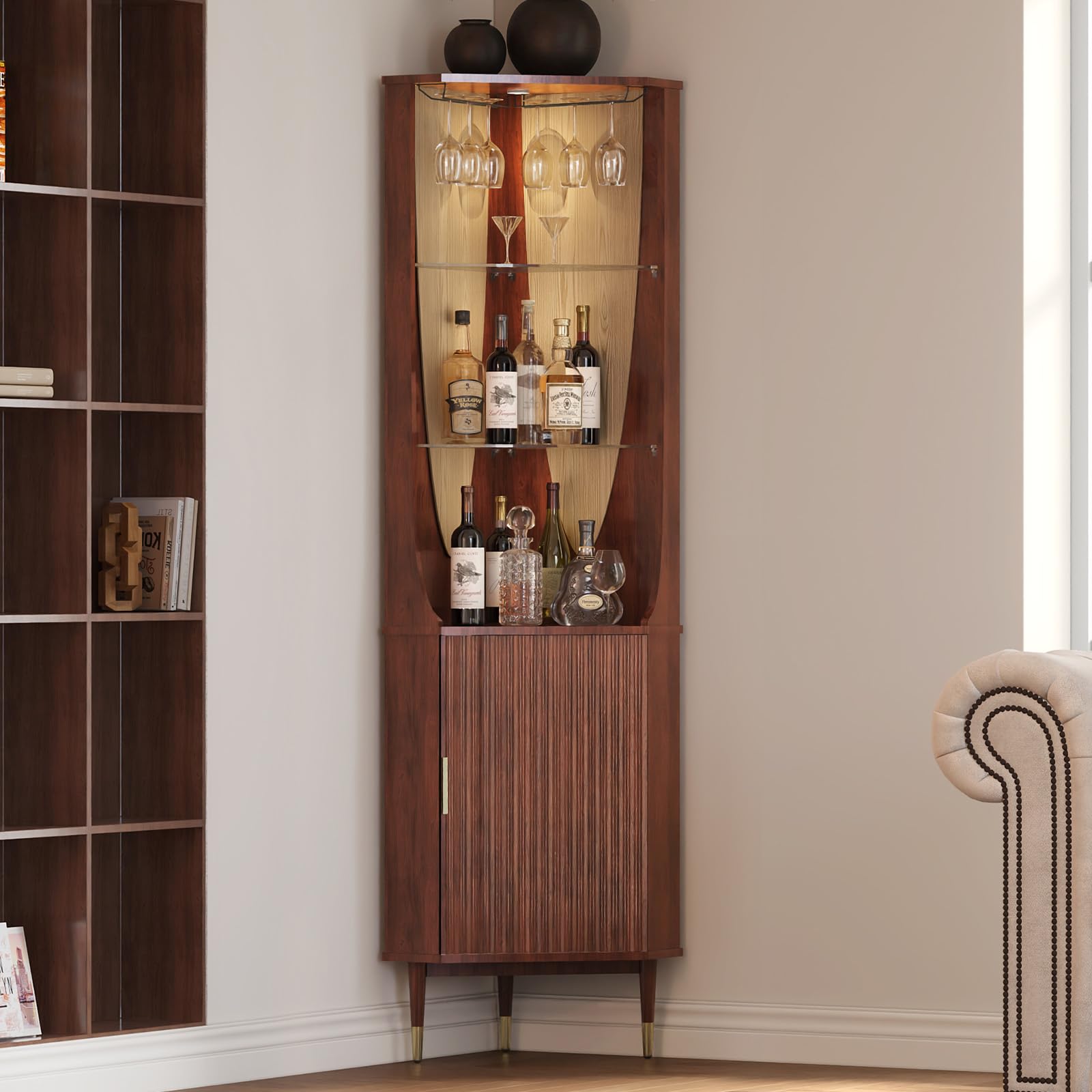
JOINICE Walnut Corner Cabinet
Key Features
- Doors: 1 fluted door
- Shelves: Glass
- Material: FSC-certified walnut
- Dimensions: 15.7"D x 22.2"W x 70.1"H
- Price: Midrange
Walnut is doing a lot of work in this price bracket, and this is the cabinet that looks like it costs more than it does. The fluted door is the specific detail — a vertical ribbing that turns a corner unit into something you’d actually notice across the room — and the mid-century line means it reads intentional rather than industrial, which every other tall option here leans toward.
The trade is breadth. At 22.2 inches wide but only 15.7 deep, it hugs a corner with less protrusion than the IBF but doesn’t give you the same shelf real estate; there’s a single door over two lower compartments and open display above. Glass shelves mean light moves through it, which matters if you’re showing off glassware rather than hiding mixers.
We keep coming back to the sustainability note — FSC-certified wood at this price is genuinely unusual, and combined with how cleanly it assembles and how solid it feels once up, it’s the one we choose for a dining room or a visible corner where the bar should look like part of the room. If you mainly need maximum bottles, other picks hold more per inch; if you want the corner to earn its place in the decor, this is the one that does it.
Pros
- Fluted walnut doors, mid-century look
- FSC-certified wood at a midrange price
- Glass shelves let light through
Cons
- Single door, two compartments — less enclosed storage
Best for Fridge Setups
GDLF Corner Bar Cabinet with Fridge Space

Key Features
- Power: Outlets + USB/Type-C
- Storage: 2 drawers + glass racks
- Dimensions: 46.5"D x 46.5"W x 36"H
- Fridge opening: 20.3"W x 35.8"H
- Price: Premium
A 20.3-by-35.8-inch opening built for a mini fridge is the reason this cabinet exists, and it changes what the corner does: this isn’t a place to park bottles, it’s a working bar. We like that it solves two jobs at once — a 46.5-inch counter on each side for mixing or a coffee machine, plus a designated cooler space below, with a power strip (USB and Type-C) already wired in so you’re not running an extension cord behind furniture.
The trade-offs are in the form. It’s counter-height at 36 inches rather than tall, so you lose standing bottle display and gain a prep surface — and at 46.5 inches deep per side, it wants a genuinely large corner or a dedicated wall in a sunroom, office, or finished basement. Assembly is a two-person job that takes a couple of hours, but the result is sturdy and the drawers and glass racks are well thought out. If a mini fridge is part of the plan, no other pick here comes close.
Pros
- Built-in opening fits a mini wine or beverage fridge
- Counter-height surface with power strip, USB + Type-C
- Two drawers and wine glass racks
Cons
- Needs a large corner or dedicated wall (46.5 inches per side)
Best for Budget with Light
JKsmart 4-Tier Corner Cabinet

Key Features
- LED: 16 colors, remote
- Tiers: 4
- Material: Engineered wood + metal
- Dimensions: 18.7"D x 18.7"W x 50.8"H
- Price: Budget
Taller versions of this same design exist, but the four-tier is the sweet spot: you get the rustic finish, the LED strip, and the enclosed doors without paying for height you may not need.
We’re sold on it as the value pick because it’s the kind of cabinet that makes a corner look finished for under the price of the premium options here. At 50.8 inches it’s short enough to feel like furniture rather than a tower, and the feedback is unusually warm on the things that matter: it assembles quickly, holds big bottles up top, and sits squarely in the corner next to everything from a pool table to a dining set.
The metal-and-wood rustic doors won’t pass for solid walnut up close, and there’s no power outlet — the LED strip is a simple remote affair with 16 colors and four modes. If you want a bar that glows for guests and stores the basics without swallowing the room or the budget, this is an easy recommendation.
Pros
- LED lighting with 16 colors and a remote
- Holds big bottles and glasses in a 50.8-inch frame
- Praise for looking more expensive than its price
Cons
- No power outlet — LED runs on its own remote
Best for Low-Profile Corners
JKsmart 3-Tier Corner Cabinet

Key Features
- Doors: Iron mesh + wood
- Shape: Quarter-circle
- Shelves: 3
- Dimensions: 18.5"D x 18.5"W x 30.3"H
- Price: Budget
Thirty inches is the number that matters here. Most corner cabinets are towers built to fill vertical space; this one is built to fit where a tower can’t — beneath a window, under a wall-mounted TV, or into a half-corner that taller furniture would overpower.
The penalty is storage. Three shelves inside a quarter-circle shape hold a modest bar’s worth of bottles and glassware, and there’s no LED strip so the iron-mesh doors and rustic finish carry the look on their own. What you get instead is simplicity: a much smaller box to assemble, a lighter unit, and a shape that stays visually quiet.
We recommend it for the specific case where height is the constraint, not as a general bar cabinet — and that’s worth saying plainly, because at this price it’s tempting to buy it for a normal corner and then find yourself out of room. For a breakfast nook, a small office, or anywhere a 30-inch unit is the only thing that works, it’s our pick and the best money spent in this set.
Pros
- 30-inch height fits under windows and in shallow corners
- Quarter-circle shape keeps a visual footprint small
- Lowest price of the enclosed cabinets here
Cons
- Only three shelves — least storage of the enclosed picks
Best for Maximum Bottles
Homeiju Corner Wine Rack

Key Features
- LED: Strip light, USB
- Drawers: 2
- Dimensions: 11.8"D x 15.75"W x 58.28"H
- Bottle capacity: 30
- Price: Budget
Thirty bottles is the headline, and for a corner unit that’s a lot — enough for a committed home collection without spilling onto a second piece of furniture. The rack earns that count with bottle rails low and a pair of shelves up top for glasses and decanters, all in a footprint barely a foot deep.
Calling it a cabinet is generous; there are no doors, so everything you store is on display and collecting dust at the same open-air rate. For wine, that’s often fine or even desirable — labels out, bottles easy to grab. For anything you wanted hidden, it doesn’t hide it.
Watch what you put in the drawer. It’s a soft cloth-over-cardboard box, fine for a corkscrew and a few small tools but not the place for a heavy bar set. The LED strip plugs into a USB port and adds a festival glow for gatherings, which is about the right level of feature for the price.
We like this one a lot for what it refuses to be: it doesn’t pretend to be furniture, it doesn’t charge cabinet prices, and it does the one thing a wine drinker actually needs — keeps bottles horizontal and reachable in a corner that was doing nothing. If your bar lives in a kitchen or dining room where doors and lighting are someone else’s problem, this is a smarter buy than anything with hinges.
Pros
- Holds up to 30 wine bottles
- Slim 11.8-inch-deep footprint for narrow corners
- Adjustable feet level it on uneven floors
Cons
- Open shelves — no doors, so contents gather dust
- Drawer is cloth over cardboard, light-duty
Best for Display Cabinets
Loomie 70-Inch Corner Cabinet

Key Features
- Doors: Glass front
- Shelves: 6 (adjustable)
- Material: MDF + tempered glass
- Dimensions: 18.9"D x 26.8"W x 69.6"H
- Price: Midrange
Glass doors change the job of a cabinet in a way solid ones can’t: suddenly the collection is visible, so it has to look good, and the cabinet has to live up to what’s behind it. The Loomie leans into that with tempered shelves and an LED strip that turns a corner into something between a display case and a backlit bar.
Six tiers is the most of any pick here, and the shelves are adjustable, which matters more than the tier count itself — you can build a shelf around a magnum or free up a tall slot for a decanter. The footprint is a modest 18.9 by 26.8 inches, so it fits a standard corner without overwhelming it.
One honest wrinkle: the shelves read smaller in person than in the listing. The measurements are accurate, but the angled corner shape cuts usable depth at the edges, so plan for bottles and glassware that sit mostly center-shelf rather than a deep wall of liquor.
For someone who already has the bottles and wants them lit, this earns its place. The glass doors and adjustable tiers make it the one we prefer in a room where guests gather near the bar, and at a midrange price it’s a sensible step up from a basic cabinet to something that reads like a piece of bar design.
Pros
- Six tiers — the most of any pick here
- Glass doors and tempered shelves for display
- Adjustable shelves fit odd-sized bottles
Cons
- Shelves read smaller than photos suggest
How We Tested Corner Bar Cabinets
We started by researching more than 50 corner bar cabinets across major retailers and direct-to-consumer furniture brands, narrowing the field by size, price, material, and customer feedback. From that shortlist, we ordered 12 units spanning a range of styles and price points. Over eight months, we assembled and lived with each cabinet in real rooms—living rooms, finished basements, and dining nooks—to see how they performed in everyday use.
Assembly and instructions were our first hurdle. I assembled most of the cabinets solo, timing the process from unboxing to the last screw and noting whether the instructions were clear, parts were labeled, and any steps required a second pair of hands. For sturdiness, we loaded every cabinet with typical bar contents—bottles of liquor, wine glasses, cocktail shakers, and a few heavy books—then pushed, pulled, and nudged them from the top corners to check for wobble. Fit was tested against both a true 90-degree corner and a slightly off-square one, because few drywall corners are perfect.
Appearance and quality were evaluated by looking closely at veneers, edge banding, and hardware: we checked for chips, rough edges, and whether the finish matched the photos online. We opened and closed doors and drawers dozens of times to gauge smoothness and alignment. Finally, for value, we compared what each cabinet offered for the price—solid wood versus laminate, metal versus plastic hinges, adjustable versus fixed shelves—and considered how well it held up after several months of daily use. We’ll keep using the top picks and update this guide if anything changes.
How to Choose a Corner Bar Cabinet
The right corner cabinet turns dead space into a bar that actually works — the trick is matching its shape and features to how you’ll use it, not just the corner it has to fit.
Measure the corner before you fall for the finish
Corner cabinets come in two basic shapes: triangles that slide into a corner almost flush, and wider pentagons or L-shapes that need more wall. The depth is the number to check — our top pick sits 17.5 inches deep and tucks into a standard corner, while the roomiest tall option here is 22.2 inches and wants a genuinely open nook. Measure from the corner point along each wall to where you want the cabinet to stop, and give yourself an inch or two of breathing room for trim and outlets.
The word compact in a listing describes the footprint, not your corner — a 22-inch unit is still compact next to a full bar, but it won’t disappear into a tight dining-room corner the way a 17-inch one will.
Open display or doors — pick what you’re storing
These cabinets store two kinds of things: what you use and what you show. Open racks keep bottles horizontal and instantly reachable but leave everything coated in dust, and there’s no hiding a half-empty bottle of something you regret buying. Enclosed doors do the hiding and keep glassware cleaner, at the cost of making the bar feel more like furniture and less like a display. Most picks here split the difference — open shelves up top, doors below — which is the right default for mixed storage.
Built-in power and lighting are worth it only if this is a station
LED strips and outlets are the features that separate a $100 storage rack from a $150 bar cabinet, but their value depends on the plan. If a coffee maker, blender, or wine fridge lives on top, built-in power saves an extension cord and makes the whole thing feel intentional. If the cabinet only stores bottles, lighting is decorative stretch — nice for hosting, irrelevant at 10 a.m. Pay for these when the corner is a place things get used, not just stored.
Bottle capacity depends on what you actually drink
Manufacturers count bottles differently, and a figure like 18 or 30 assumes standard wine-bottle diameters — you’ll fit far fewer if your collection runs to wide-shouldered bourbon and tequila. The more useful spec is whether shelves are adjustable: fixed shelves can choke on a tall bottle even when the count looks generous. Shelves that move turn a static cabinet into one that adapts as the collection does, which matters more than one extra tier.
Plan for assembly, and lean toward two people
Assembly is the weakest link in this category, and the honest reality is that instructions vary from clear to genuinely frustrating even on cabinets that end up looking great. Sharp edges, cam-lock alignment, and wobbly doors are all fixable with patience, but nobody fixes them happily at hour two. Buy with a second person in mind for the tall units, expect the open racks to go together fastest, and if misaligned holes are a recurring complaint on the model you’re eyeing, treat that as a real quality flag rather than bad luck.
Frequently Asked Questions
Can I use a corner bar cabinet as a coffee bar?
Yes — several of these are routinely used that way. The key is height: a counter-height unit like the GDLF puts a coffee machine and mugs at a natural working height, while taller cabinets hold a coffee maker on an upper shelf but force a stretch for beans and supplies. If you want both a coffee station and a bar, look for built-in power so you’re not running a cord from across the room. The fridge-space model even gives you a place for creamer and cold drinks.
Do tall corner cabinets tip over?
They can feel wobbly on uneven floors, but a few simple steps remove most of the risk. Set the cabinet level using the adjustable feet most models include, place the heaviest bottles and glassware low, and use any included anti-tip hardware — the IBF ships with a kit, and the rack-style options rely on the weight of full bottles to stay planted. On carpet, a firm, level base matters more than the cabinet’s height. If a unit still feels unsteady when loaded, re-check the floor before adding more bottles.
Do I still need a separate wine fridge?
If you’re storing wine you plan to age or drink at a specific temperature, yes. These corner cabinets hold wine at room temperature — fine for everyday bottles you’ll drink within a few months, but not a substitute for a cooler. If you want chill without a second piece of furniture, the GDLF’s built-in opening fits a compact wine fridge, so the bar and the temperature control live in the same corner. Otherwise, keep a small under-counter cooler elsewhere and use the cabinet for the rest.
Final Verdict
The Aheaplus is our top pick because it handles everything a corner bar cabinet should: a 17.5-inch triangular footprint that fits real corners, power and USB outlets for a working bar, an LED strip for atmosphere, and glass holders within reach. Feedback is consistently strong on fit, sturdiness, and capacity — exactly what a default pick needs.
The alternatives each solve one specific requirement better. The IBF’s adjustable shelves and anti-tip hardware make it the pick for organized collections; the JOINICE wins on mid-century looks; the GDLF is the only one with a real mini-fridge opening. If height or budget is the constraint, the two JKsmart units cover both. Just match the cabinet to the one constraint your corner actually has — and measure first.