This post contains affiliate links. We may earn a small commission when you buy through our links — at no extra cost to you.
Soda fridge specifications look generous on paper—130 cans, 34°F minimum—but the reality is often different. Advertised can counts rely on slender 12-ounce cans with all shelves removed; load your own mix of bottles, tallboys, and standard cans, and you’ll fit 20-30% fewer.
Temperature numbers can be just as optimistic. Many digital displays show one thing while the interior stays several degrees warmer, especially in a warm kitchen or garage. The result: drinks cool enough, but never truly ice-cold.
This guide zeroes in on beverage fridges that deliver usable capacity and genuine cold performance, whether you’re chilling soda for a game room, keeping white wine at serving temperature, or building a home bar that can handle both. No fantasy numbers—just what works.
Top Picks
Best for Quiet Daily Use
hOmeLabs HME030065N

Key Features
- Advertised Can Capacity: 120 cans
- Min. Temp. (Advertised): 34°F
- Cooling Technology: Compressor
- Price: $$
This fridge runs quietly enough for a shared office or bedroom, and its glass door with stainless steel trim looks at home next to a home bar or kitchen counter. A digital thermostat and compressor cooling bring cans down to serving temperature quickly and keep them there without much fluctuation.
Cooling consistency is generally good, but the advertised 34°F minimum isn’t always reached — actual interior temperature can settle around 40°F. For most soda, beer, and wine drinkers that’s plenty cold enough; only those who insist on near-freezing drinks will need to check with a thermometer and may want to adjust expectations.
Where this fridge shines is daily use over years — many owners report theirs still running without issues well past the two-year mark. The compressor hum is mild, not silent, but rarely intrusive. Combine that with a 120-can capacity, adjustable shelving, and a footprint that fits standard counters, and you get a versatile unit for casual entertaining or keeping workday drinks cold.
Best suited for buyers who value appearance and long-term dependability over absolute temperature precision. If you need guaranteed 34°F performance or require dead-silent operation, this may not be the right fit. But for a home bar, office break room, or garage where cold drinks and good looks matter, it covers the bases comfortably.
Pros
- Quiet compressor operation suitable for open-plan spaces and bedrooms
- Attractive glass door with brushed stainless steel trim complements most interiors
- Cools drinks quickly and maintains a steady temperature once set
- Many units continue working without issues after two or more years of daily use
Cons
- May not reach the advertised 34°F — actual temperature can hover around 40°F
- Compressor emits a low hum that may be noticeable in extremely quiet rooms
Best for Budget Large Capacity
EUHOMY BR008-110SI

Key Features
- Advertised Can Capacity: 130 cans
- Min. Temp. (Advertised): 34°F
- Cooling Technology: Compressor
- Price: $$
The EUHOMY BR008-110SI puts 130-can capacity within mid-range reach, trading a bit of hush for sheer storage volume. While the top pick in this set emphasizes whisper-quiet operation, this model focuses on keeping as many drinks cold as possible per dollar. A clear glass door, digital touch controls, and a silver finish give it a clean, modern look that fits casual entertainment spaces.
Compressor-based cooling pulls temperatures down to 34°F, chilling cans quickly after loading. The adjustable shelves hold tall cans and bottles with minor rearranging, and the interior light makes it easy to scan your stock through the glass door. Temperature retention keeps drinks cold during steady use, making it a practical sidekick for game-night refills.
Budget-conscious party hosts and garage or game room setups absorb the slight noise best. The compressor hum is present—noticeable in a quiet bedroom or office—but that hum is the concession for storing 130 cans at this price. For spaces where a low mechanical sound blends into the background, the capacity becomes the real win.
Pros
- Packs 130-can storage at a budget-friendly price, maximizing fridge space per dollar.
- Sleek silver front with clear glass door and bright interior lighting.
- Digital compressor drops temperature quickly and holds drinks cold.
- Adjustable shelving and reversible door fit varied placement needs.
Cons
- Compressor hum may be noticeable in very quiet rooms—less bothersome in a garage.
Best for Quiet Spaces
Danby DBC117A1BSSDB-6

Key Features
- Advertised Can Capacity: 117 cans
- Min. Temp. (Advertised): 35.6°F
- Cooling Technology: Fan-forced Compressor
- Price: $$
Fan-forced compressor cooling circulates air evenly, holding 117 cans at a steady chill while running noticeably quieter than the average compressor fridge. Where competing models chase digital precision, Danby opts for a simple mechanical thermostat — turn the dial, set the temperature, and forget it. The result is a fridge that hums at a background level low enough for a library-quiet living room or open-plan office without interfering with conversation. The blue LED interior light adds a neat display-quality look, and the fan-forced system helps prevent warm spots across shelves.
This fridge suits buyers who rank silence above ultra-cold temperatures. The thermostat spans 36°F–50°F, but some units may not reach the coldest mark; drinks end up refreshingly cool rather than icy. If you need cans stored just above freezing, a digital compressor model will deliver more aggressive cooling. For everyday soda, beer, and water in a quiet den or rec room, the Danby’s appliance-brand durability and gentle fan noise make it a low-drama, long-haul companion.
Pros
- Whisper-quiet compressor stays unobtrusive in living spaces
- Blue LED interior light makes drink selection easy and looks great
- Even cooling thanks to fan-forced air circulation; cans stay uniformly chilled
- Stable long-term performance with units running 24/7 for years
Cons
- Some units may not reach the coldest dial setting; drinks stay cool but not icy
Best for Entertaining & Built-In
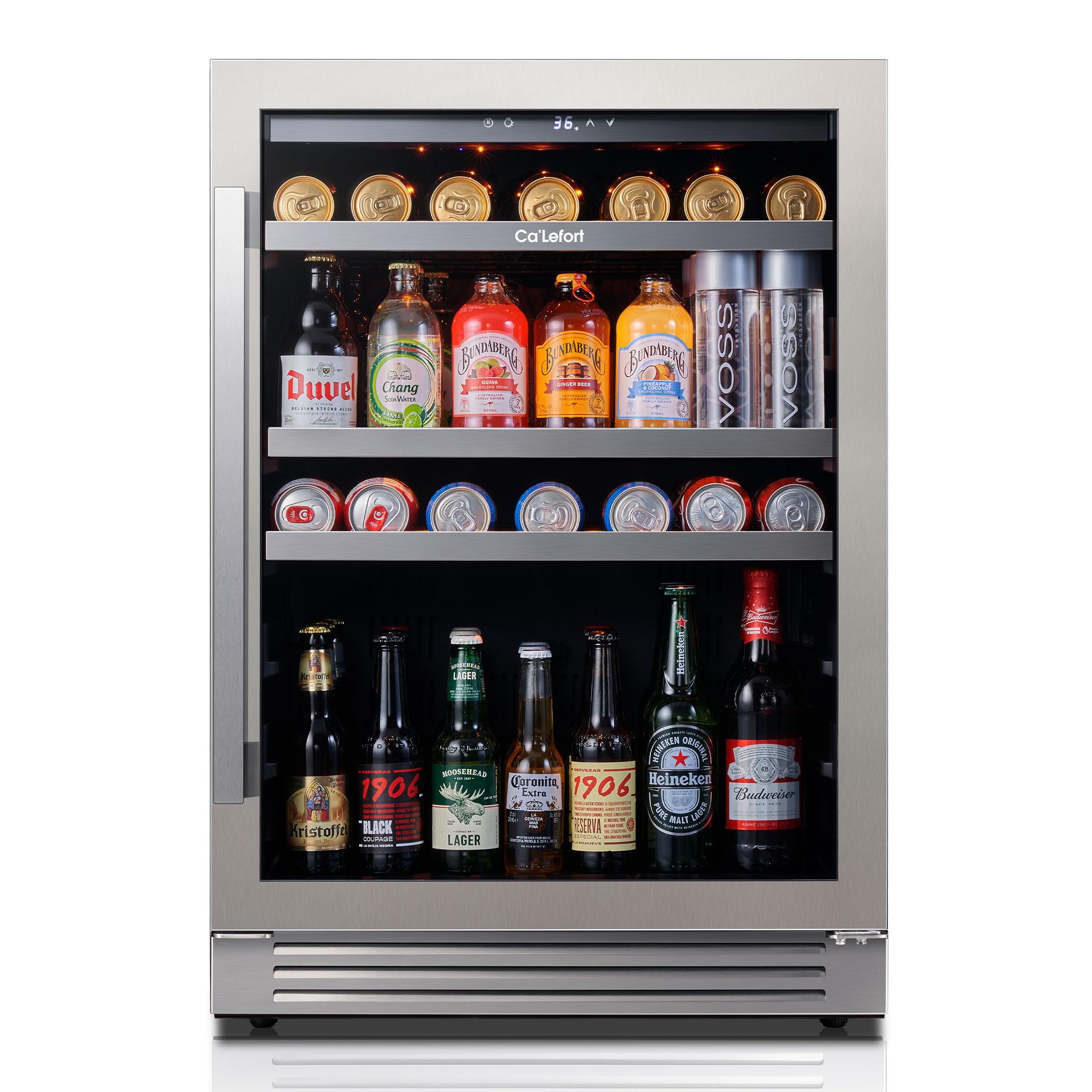
Ca’Lefort CLF-BS24-A
Key Features
- Advertised Can Capacity: 180 cans
- Min. Temp. (Advertised): 34°F
- Cooling Technology: Compressor
- Price: $$$$
The Ca’Lefort 24 Inch Beverage Refrigerator stands apart with its 180-can capacity and triple LED lighting options (amber, blue, white), turning a drink cooler into a design centerpiece. The compressor-based cooling and glass door deliver a polished built-in look that fits neatly under counters or as a freestanding piece.
This fridge targets entertainers and design-conscious homeowners who prioritize visual appeal and high volume over placement flexibility. The door is hinged on the right only and cannot be reversed — confirm your space allows for right-side opening before purchase. Long-term durability shows some variation; a small number of owners have reported cooling issues after two years, though most units perform well within that period.
Build quality earns high marks for its solid materials and elegant finish, and the unit runs quietly enough for a kitchen or bar setting. The digital temperature control adjusts from 34°F to 54°F, keeping sodas and beers sufficiently cold for everyday entertaining.
Pros
- Exceptional build quality with an elegant, premium appearance
- Customizable amber, blue, and white LED lighting for mood setting
- Quiet operation that fits seamlessly into a living space
- Massive 180-can capacity holds everything for a large party
Cons
- Door hinge is fixed on the right side, limiting where it can be installed
- Cooling performance may degrade after a couple of years in some cases
Best for Stylish Budget Pick
Icyglee BR-110H-IG-02X

Key Features
- Advertised Can Capacity: 126 cans
- Min. Temp. (Advertised): 34°F
- Cooling Technology: Compressor
- Price: $$
Where many budget beverage fridges default to a plain, functional shell, the Icyglee puts looks first. The crystal-clear glass front and soft blue interior LED give it a boutique cooler presence that punches above its price tag. Build quality holds up well too—the door closes with a solid feel, and the black cabinet resists scuffs better than some glossy alternatives at this price.
Inside, the 3.2 cubic foot layout fits up to 126 cans across adjustable, removable wire shelves. The flexibility means you can clear space for tall bottles, growlers, or awkwardly shaped craft brews without sacrificing all your standard can storage. Compressor cooling pulls the interior down to 34°F, and the freed-up room in the main kitchen fridge quickly becomes the feature owners comment on most.
The temperature display is where expectations need calibration. The digital readout can show a reading noticeably colder than the actual interior air, so the set temperature and screen number don’t always match the true chill inside. For anyone grabbing a cold soda or lager, this rarely turns into a complaint—the drinks still come out satisfyingly cold. It’s a minor friction only if you need tight temperature control for wine or delicate beverages. A separate fridge thermometer instantly resolves the blind spot, and for the price, that’s a reasonable accommodation.
Pros
- High-end styling with a crystal-clear glass door and vivid blue interior lighting.
- Solid overall build quality that feels more premium than the price suggests.
- Excellent value—gets you a compressor-based glass-door fridge for a budget-friendly cost.
- Adjustable and removable shelves let you store tall bottles and odd-shaped containers while still holding up to 126 cans.
Cons
- Temperature display can read colder than actual interior—don’t rely on the digital readout alone for precise chilling.
Best for Casual Garage Use
Antarctic Star W5899H-1

Key Features
- Advertised Can Capacity: 120 cans
- Min. Temp. (Advertised): 40°F
- Cooling Technology: Compressor
- Price: $$
The Antarctic Star W5899H-1 delivers a compact, 120-can storage footprint with a playful blue LED accent that adds style to any space. Behind the glossy door, a mechanical thermostat keeps temperatures between 40°F and 61°F—enough for most canned drinks but short of the icy chill some prefer. More notably, the compressor can be loud; its hum and occasional thump are best suited to garages, workshops, or areas where background noise is already present. This is why it didn’t earn a higher recommendation: lacking a digital display and delivering inconsistent cooling, it falls short for bedrooms or quiet offices. But for casual, budget-minded buyers who prioritize appearance and price, it’s a fair deal.
Pros
- Compact 120-can capacity fits comfortably in small rooms or under counters.
- Blue LED accent light adds a tidy, modern look to any setting.
- Mid-range price offers solid value for casual drink storage.
Cons
- Compressor hum can be intrusive in quiet spaces; best placed where noise is already present.
- Temperature consistency can vary; drinks may not reach or hold the coldest settings.
Best for Tight Spaces
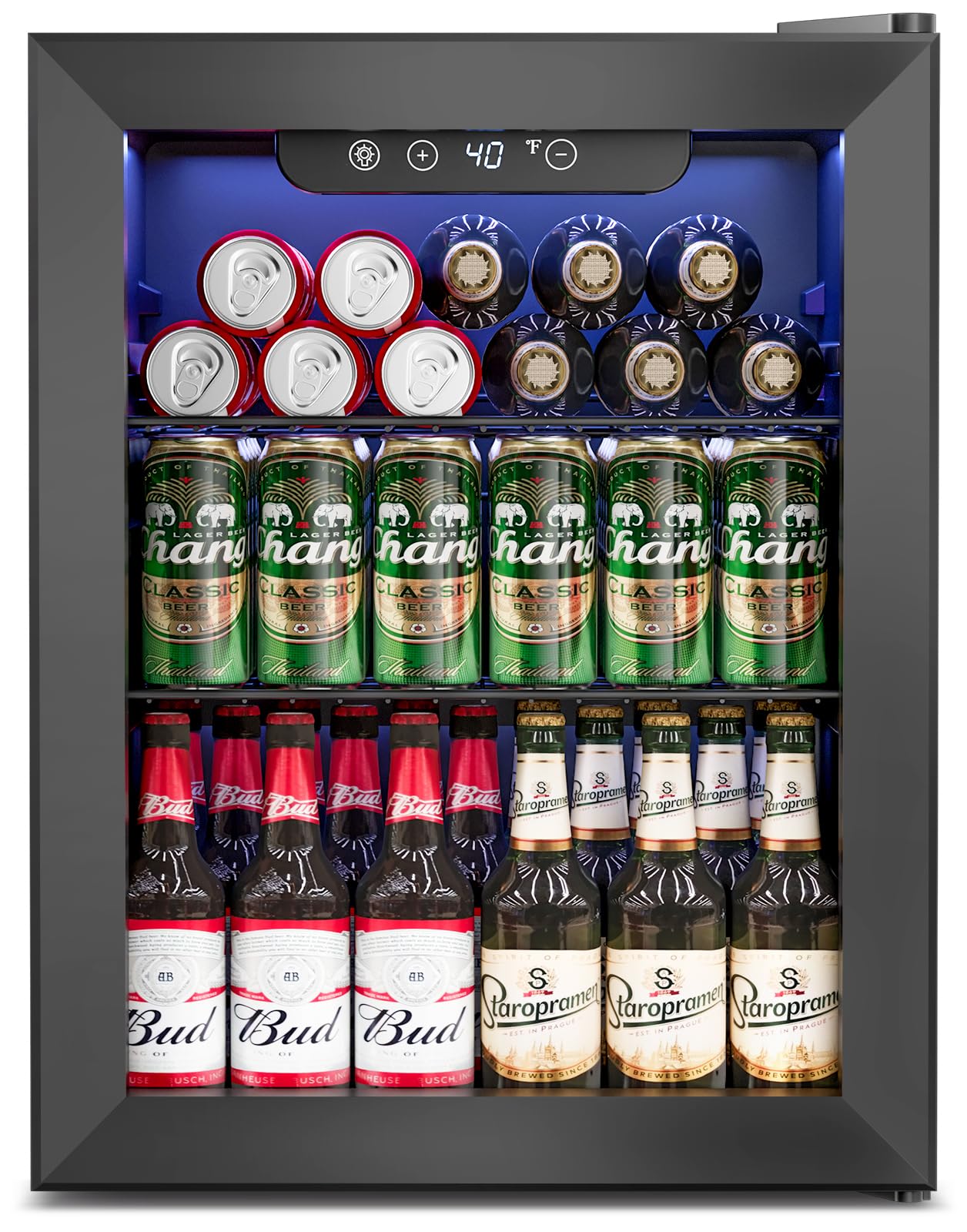
Feelfunn BR001-60BL-USZX
Key Features
- Advertised Can Capacity: 68 cans
- Min. Temp. (Advertised): 40°F
- Cooling Technology: Compressor
- Price: $
This Feelfunn fridge carves out a niche for tight spaces where a full-size beverage cooler won’t fit. The 68-can capacity and glass door give it a modern bar feel without dominating a dorm desk. Temperature control holds reliably within its range, keeping beverages cool for daily use. However, the 40°F minimum means sodas and beers won’t reach that icy-cold bite some expect from a fridge, and the compressor hum—while tolerable in a busy room—can become more pronounced over time, which may be a tradeoff for quiet bedrooms.
Pros
- Tiny footprint fits under desks, on dorm counters, or in tight corners where larger coolers can’t go.
- Sleek glass door and black finish look more upscale than typical utilitarian mini fridges.
- Holds beverages at a steady, drinkable cool—consistent within its digital set point.
Cons
- In quiet bedrooms or offices, the compressor hum can be present and may become louder over time.
- Temperature cannot dip below 40°F, so drinks stay cool rather than reaching ice-cold temperatures.
Best for Wine & Cans
Antarctic Star W5899H-ASZ

Key Features
- Advertised Can Capacity: 130 cans
- Min. Temp. (Advertised): 40°F
- Cooling Technology: Compressor
- Price: $
The Antarctic Star W5899H-ASZ marries a wine cellar and beverage fridge in one compact unit. Horizontal racks hold 26 bottles correctly, while the upper and lower shelves fit up to 130 cans — a flexibility single-purpose coolers miss. The black cabinet and clear glass door give it a more expensive appearance than its price suggests. Temperature bottoms out at 40°F, which keeps wine in a proper range but leaves sodas and beer merely cool. A simple mechanical thermostat dial controls settings, and the compressor hum fades into kitchen or bar background noise but can stand out in a quiet home office or bedroom. This model suits households that want one appliance for both wine and casual beverages without demanding near-freezing chill.
Pros
- Holds wine bottles horizontally and up to 130 cans in one unit
- Attractive design that looks more expensive than its price
- Compact 3.2 cu ft footprint offers generous storage density
Cons
- Minimum temperature of 40°F keeps drinks cool but never ice-cold
- Compressor hum can be intrusive in quiet rooms like bedrooms or offices
How to Choose
Most soda fridges fall short of their advertised can counts and temperature claims—what you actually load and how you measure will determine your real-world satisfaction.
Advertised Can Capacity vs. Reality
Manufacturers calculate capacity using 12-ounce standard cans with all shelves removed, meaning you can fit 120 only if you skip bottles and dispense with shelving entirely. The actual count drops 20-30% once you mix in stubby bottles, tallboys, or wine bottles, because these items occupy more vertical space and break the neat row arrangement.
The life scenario: if you stock a variety, look for adjustable shelf arrangements that let you reclaim space for your typical mix. A model with reversible or removable racks lets you store tall cans upright and still squeeze in bottles. Always expect to store fewer than the printed number.
Noise Level and Quiet Operation
Compressor fridges cycle on and off, producing a hum or clicking that’s normal, but the volume varies by unit and installation. Thermoelectric models are quieter in theory, but they sacrifice cooling power. The hidden trade-off: a fridge that runs near-silently in a cool basement may become intrusive in a quiet bedroom when ambient temperature rises.
If the fridge will live in a living room, office, or bedroom, seek models repeatedly praised for whisper-quiet performance (like Danby’s fan-forced compressor). For a garage or game room where a hum won’t matter, you can prioritize capacity or price instead. Check recent reviews for noise complaints—even within the same model, some units can be louder than others.
Minimum Temperature and Consistency
A spec sheet promising 34°F doesn’t mean the fridge will reach that temperature in your 78°F kitchen. Compressor-based units can fall 4–6°F short of their lowest setting due to insulation limits, sensor placement, or refrigerant charge. Thermoelectric models struggle to go much below 40°F if the room is warm.
Don’t rely on the built-in display—use a separate fridge thermometer to know what’s really happening. If you must have ice-cold soda or beer, prioritize compressors with a track record of hitting the low 40s or high 30s, and be prepared to lower the setpoint further than the number you want.
Compressor vs. Thermoelectric Cooling
Compressor coolers use a vapor-compression cycle identical to your kitchen fridge, providing strong cooling and the ability to function in warm garages. The trade-off: they’re typically noisier and slightly heavier. Thermoelectric units use a heat pump with no moving parts except a fan, which makes them extremely quiet but limits cooling depth—they rarely get below 40°F and lose effectiveness above 75°F ambient.
Choose compressor if you need reliable cold in a hot environment or want sub-40°F drinks. Reserve thermoelectric for climate-controlled rooms and casual chilling, where silence matters more than frigid temperatures. Only one model in our review set (Honeywell) uses thermoelectric cooling, and it trades off cooling power.
Build Quality and Shelf Sturdiness
Plastic shelves can sag under a full load of cans over time, and widely spaced wire shelves tip narrow bottles. Adjustable metal racks with coated wire or tempered glass offer better support. Also check the door—dual-pane glass resists condensation better than single-pane and feels more solid.
When unboxing, inspect for shipping damage (dents, cracks) and ensure shelves lock into place. A fridge that works silently for years often starts with a sturdy frame and good seals. Stainless steel trim isn’t just for looks—it also protects edges from bumps.
FAQ
Why does my beverage fridge not hold as many cans as advertised?
Ratings use slim 12-ounce cans with all shelves removed. Real mixed drinks—bottles, tallboys, and wine—create gaps and need more vertical clearance, cutting effective capacity 20-30%. Maximize space by using adjustable shelves and eliminating dead zones; if you need dual wine-and-can storage, a model like the Antarctic Star with horizontal racks uses space efficiently.
Why is my glass door beverage refrigerator sweating on the outside?
Condensation forms when warm, humid air hits the cold glass surface. This is common in basements, garages, or during humid seasons. Reduce room humidity, keep the door closed, and check that the door seal is intact—it’s not a defect, just physics.
How can I make my mini fridge colder if it won’t go below 40°F?
First, confirm the actual interior temperature with a separate thermometer. If it’s truly stuck above 40°F, move the fridge out of direct sunlight or hot spots—ambient temperatures above 75°F choke cooling. Thermostats are imprecise; turning the dial to maximum won’t make it colder if the unit’s minimum temperature is 40°F. For ice-cold drinks, choose a compressor model rated for 34°F.
Why is my new beverage cooler making loud noises?
Compressor cycling produces a normal hum or clicking, but excessive vibrating can mean the floor isn’t level or internal packing foam remains. A whistling or thumping could point to a bent fan blade. Some models are just inherently noisier—check recent reviews for that specific unit. If noise persists, contact support; a replacement may be quieter.