This post contains affiliate links. We may earn a small commission when you buy through our links — at no extra cost to you.
A small beverage fridge with a glass door sounds like the perfect addition to a home bar or office. But too many buyers discover after unboxing that their new fridge can’t reach a proper chill, hums louder than expected, or holds far fewer cans than advertised.
The gap between marketing and real-world performance is wide in this category. Compressor fridges deliver consistent cold, but noise and temperature control vary wildly between models. And that ‘120-can capacity’ often becomes 85 once you account for shelf dividers and odd-shaped bottles.
This guide cuts through the claims to find the fridges that actually deliver cold drinks quietly and reliably — without the surprises that turn a purchase into a return.
Top Picks
Best for Home Bar/office
hOmeLabs HME030065N

Key Features
- Cooling Method: Compressor
- Temperature Range: Down to 34°F
- Capacity: 120 cans / 3.2 cu ft
- Noise Level: Whisper-quiet (claimed)
- Door Type: Reinforced glass
- Price: $$
The hOmeLabs beverage fridge reaches and holds temperatures in the low 30s°F, cold enough for soda and beer even on warm days. The reinforced glass door and digital display give it a clean, intentional look for a home bar or office setting.
Operation is quiet enough for a living space – the compressor hum is present but unobtrusive in most environments. Some units may produce a more noticeable hum in very quiet rooms, but that’s atypical. The interior fits 120 cans with adjustable shelves, making organization straightforward.
This fridge suits home bars, offices, and dorms where steady cooling and quiet operation matter more than absolute precision. A small number of units show temperature fluctuation of a few degrees, so buyers who need exact set-and-forget control should confirm with an external thermometer after delivery. Wine collectors requiring precise aging temperatures will want a dedicated wine fridge instead.
Pros
- Reaches temperatures in the low 30s°F, cold enough for soda and beer.
- Glass door and digital display give a polished, premium appearance.
- Quiet operation – the compressor is barely audible in most rooms.
- Good value for the 120-can capacity and features at a mid-range price.
Cons
- Temperature may drift a few degrees from the set point in some units – worth verifying with a thermometer.
- Compressor hum becomes noticeable in very quiet spaces, such as a bedroom or silent office.
Best for Large Capacity Value
Feelfunn ZX-BR-110H

Key Features
- Cooling Method: Compressor
- Temperature Range: 34°F – 64°F
- Capacity: 126 cans / 3.2 cu ft
- Noise Level: ≤36 dB (claimed)
- Door Type: Double-layer glass w/ LOW-E
- Price: $$
With 126 cans of storage at a price that undercuts the top pick by a notable margin, the Feelfunn offers the strongest capacity-per-dollar in this set. The glass door with blue LED gives it a clean, modern look that fits home bars and game rooms well. It lacks the massive review base of the hOmeLabs, but for buyers focused on budget, the trade-off is straightforward.
Buyers who need a large beverage fridge for a home bar, entertainment room, or garage will get the most value here. The compressor is relatively quiet — noticeable in a silent bedroom but fine in a busy living space. However, cooling consistency varies between units; some may not reach the lowest end of the 34–64°F range, so it’s best suited for casual drink storage rather than precise wine cellaring.
The LOW-E coated glass door helps maintain temperature and reduces condensation. Adjustable shelves accept standard cans and bottles up to tall beer bottles. The claimed 36 dB noise level is plausible — the compressor hum is present but not disruptive in most settings. A small number of units have been noted with louder compressor noise, worth checking if your setup is particularly quiet.
Pros
- Strong value – large capacity at a competitive price
- Attractive design with blue LED and clear glass door
- Good size for home bars and game rooms
Cons
- Cooling consistency can vary between units — some may struggle to reach the lowest temperature setting
- In very quiet environments, the compressor noise may be more apparent than some expect
Best for Countertop/dorm
EUHOMY WC-6B

Key Features
- Cooling Method: Compressor
- Temperature Range: 40°F – 61°F
- Capacity: 24 cans / 0.6 cu ft
- Door Type: Plastic (UV-protected)
- Price: $
At 24 cans and 21 pounds, this is the smallest compressor beverage fridge you can buy that still uses actual mechanical cooling rather than thermoelectric. It sits comfortably on a desk, countertop, or nightstand, and the LED-lit glass door makes drinks easy to spot. The digital temperature control is responsive, and reviews note that the unit reaches set temps quickly — a clear advantage over similarly priced thermoelectric alternatives.
The tradeoff for that size and price is acoustic: the compressor produces a noticeable hum that stands out in a quiet bedroom or home office. For a dorm common room or a kitchen counter, it blends into background noise. The other limitation is temperature floor — it won’t go below 40°F, so if you need soda near freezing or wine at cellar temps, look elsewhere. For everyday chilled drinks at 40–50°F, it works fine.
This fridge suits anyone with a shoebox-sized space — a dorm desk, a bedside table, a cramped office corner — who wants a dedicated drink cooler without spending much. It’s also a good backup for a bar cart or a second fridge for snacks and bottles. If you need silent operation or sub-40°F temperatures, this isn’t the one; but for basic beverage storage on a tight budget, it checks the boxes.
Pros
- Compact size fits on countertops, desks, and nightstands
- Cools quickly and holds temperature well for a small unit
- Attractive appearance with LED interior light
- Exceptional value for an entry-level compressor fridge
Cons
- Compressor hum may be noticeable in quiet rooms like bedrooms or libraries
- Temperature range stops at 40°F, so very cold drinks below that aren’t possible
Best for Entertainment
EUHOMY BR001-110

Key Features
- Cooling Method: Compressor
- Temperature Range: 32°F – 61°F
- Capacity: 128 cans / 3.2 cu ft
- Noise Level: 36 dB (claimed)
- Door Type: Glass w/ low-E coating
- Price: $$
The EUHOMY BR001-110 delivers strong cooling performance, reaching the low 30s°F quickly, and offers a spacious 128-can interior with adjustable shelves. It also sports a sleek silver finish with a low-E glass door that looks more premium than many competitors at its price. While the top pick benefits from a larger body of real-world feedback, the EUHOMY matches its capacity and shows competitive temperature retention.
This fridge works well in home bars, entertainment areas, or busy kitchens where ambient noise easily masks the compressor hum. It’s less suited for a quiet bedroom or office where the compressor sound may be noticeable. Some units run louder than expected, so it’s wise to place it in a space where noise won’t be an issue.
Priced in the mid-range, the EUHOMY offers a strong set of features for the cost, including a glass door, adjustable shelving, and rapid cooling. It’s a practical choice for buyers who want a large beverage fridge without spending a premium, as long as they can accept the occasional compressor hum.
Pros
- Strong cooling holds low 30s°F temperatures consistently.
- Spacious 128-can interior with adjustable shelves fits various bottle sizes.
- Sleek silver finish and glass door enhance any bar or entertainment area.
- Solid value for the capacity and cooling performance at a mid-range price.
Cons
- Compressor hum can be noticeable in quiet environments — less of an issue in kitchens or bars.
- Some units may have cooling inconsistencies or control panel quirks — check promptly after delivery.
Best for Undercounter Built-In
Feelfunn ZX-BRU-03

Key Features
- Cooling Method: Compressor
- Temperature Range: 37°F – 65°F
- Capacity: 126 cans / 2.9 cu ft
- Door Type: Double-layer glass w/ LOW-E
- Price: $$$
The Feelfunn ZX-BRU-03 stands out in a crowded category by being one of the few compressor beverage fridges narrow enough to fit a 15-inch undercounter opening while still offering front venting. The double-layer glass door with LOW-E coating looks polished in a kitchen or wet bar, and the built-in safety lock adds peace of mind in shared spaces. With a claimed 126-can capacity, it makes efficient use of its slim footprint.
Performance is generally good, though buyer experiences vary. The compressor cools adequately for most beverage storage needs, but some owners find the temperature doesn’t consistently hold at the lowest set point. The unit can also produce a noticeable hum – less of a concern in a busy kitchen or bar, but something to consider if the fridge will be in a quiet home office or living area.
This fridge is best for buyers who need a narrow, built-in solution for a dedicated undercounter spot. If you have the space for a standard-width model, the top pick (hOmeLabs) offers more consistent cooling at a lower price for a similar capacity. The Feelfunn is a premium choice that trades away some temperature precision for a form factor that fits where few others do.
Pros
- Premium build quality with a sleek, modern glass door
- Good 126-can capacity in a narrow 15-inch cabinet
- Front venting and safety lock for undercounter installations
Cons
- Compressor hum may be noticeable in very quiet rooms – better suited to kitchens or bars
- Temperature consistency can vary between units; some do not cool to the lowest set level
Best for Large Capacity Alt
Electactic JC-90

Key Features
- Cooling Method: Compressor
- Temperature Range: 32°F – 61°F
- Capacity: 130 cans / 3.2 cu ft
- Noise Level: Low (claimed)
- Door Type: Glass
- Price: $$
This fridge holds 130 cans with room to spare, and the adjustable shelves make it easy to mix soda cans with taller wine bottles. Once the temperature stabilizes, it keeps drinks consistently cold within its range. The black body and blue interior light give it a clean, modern look. But the compressor and fan hum can be noticeable in quiet spaces, and cooling consistency varies between units — some have been reported to stop working after a few months. That makes this a better fit for a garage, basement, or party room where background noise is expected and long-term dependability isn’t the top requirement.
Pros
- Spacious interior with adjustable shelves for mixed drink storage
- Sleek all-black body with blue interior lighting
- Maintains set temperature well once it settles
Cons
- Compressor and fan noise may be disruptive in quiet rooms
- Some units may stop cooling after a few months; long-term dependability varies
Best for Compact Style
Antarctic Star W5848H

Key Features
- Cooling Method: Compressor
- Temperature Range: 40°F – 61°F
- Capacity: 68 cans / 1.7 cu ft
- Noise Level: Quiet (claimed)
- Door Type: Tinted double-pane glass
- Price: $$
This 1.7 cu ft fridge offers an attractive tinted glass door and blue LED lighting at a mid-range price, fitting neatly on countertops or in small spaces. The compressor can generate noticeable hum in quiet rooms, and cooling performance may vary – some units do not reach the lower 40°F range, and a few have been noted to lose cooling capability after several months of use. For noise-tolerant areas like garages or basements, it works as a display-friendly drink cooler. If consistent low temperatures or silence are required, other options suit better.
Pros
- Blue LED lighting highlights drinks through the glass door, adding visual appeal.
- Compact dimensions fit easily on countertops or in tight spaces.
- Mid-range price for a glass-door compressor fridge.
Cons
- Compressor hum may be noticeable in quiet rooms – less of an issue in garages or basements.
- Cooling can be inconsistent – some units may not reach the lower end of the 40°F range, and temperature stability has been noted as unreliable.
Best for Budget Alternative
Feelfunn FWC008-11
Key Features
- Cooling Method: Compressor
- Temperature Range: 40°F – 61°F
- Capacity: 24 cans / 0.6 cu ft
- Noise Level: ≤38 dB (claimed)
- Door Type: UV-protective glass (claimed)
- Price: $
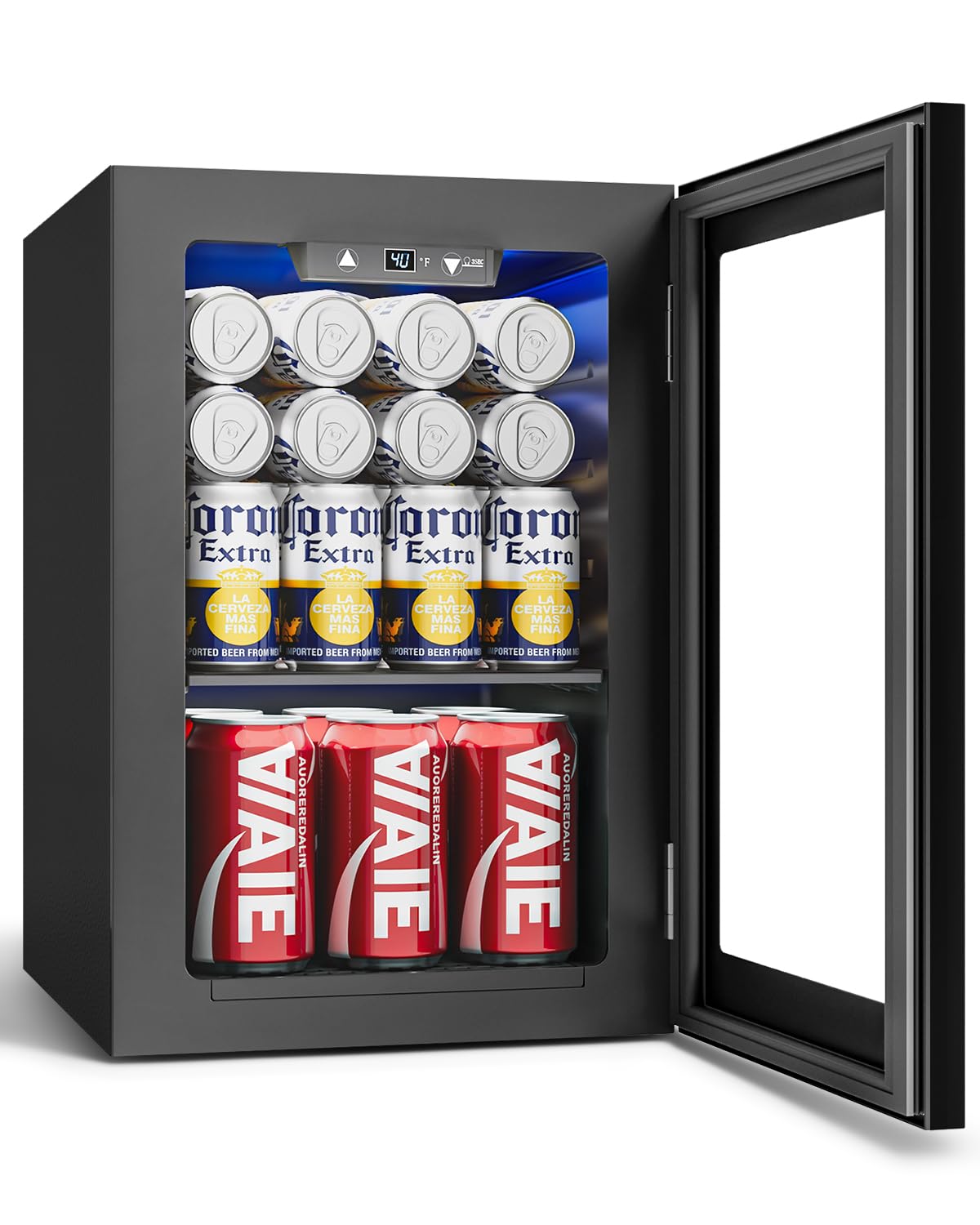
The Feelfunn 24-can fridge delivers solid build quality and a sleek glass-door look for a budget-friendly price. Cooling performance is adequate for keeping drinks cold, though the compressor may not reach the lowest temperatures desired by some. The real tradeoff is noise: the compressor hum and fan can be noticeable, making this a better fit for a garage, basement, or bar area than a bedroom or quiet office. For buyers who can tolerate the sound, it’s a cost-effective way to chill beverages.
Pros
- Build uses solid materials and feels well-constructed for the price.
- Sleek appearance with UV-protective glass door and LED lighting.
- Cools drinks effectively for a small fridge, maintaining what you need.
Cons
- Compressor and fan noise can be noticeable in quiet rooms – more suited to garages or basements.
- Temperature may not drop into the low 40s°F range, limiting use for wines or certain beverages.
How to Choose
Compressor noise is the most overlooked factor when buying a beverage fridge — a quiet rating on paper can be very different from real-world hum in a living room.
Cooling Method
A compressor-based fridge is the only reliable choice for consistently cold drinks below 40°F. Thermoelectric units, often found in budget models, can only cool to about 42°F and struggle in warm rooms. The compressor itself generates noise and vibration — trade-offs that matter if the fridge shares your space.
Actual Capacity vs. Advertised
Manufacturers count cans in a perfect grid without shelf supports or door constraints. In real use, dividers, bottle necks, and tall cans reduce usable space by 20-30%. A 120-can fridge typically holds 85-100 cans once you account for shelving and wine bottles.
Measure your intended drinks before buying. If you primarily store 750ml wine bottles, a model with adjustable or removable shelves becomes essential to fit the larger diameters.
Temperature Range and Precision
For drinking, 38-42°F is ideal for beer and soda; wine service requires 50-55°F. Many beverage fridges advertise a range down to 34°F but only maintain that temperature near the cooling element. Digital controls with integrated thermostats provide better precision than analog dials.
If long-term wine aging matters, look for a dual-zone fridge with stable humidity — most single-zone beverage fridges fluctuate too much for proper cellaring.
Noise Level
Compressor noise is measured in decibels (dB), but that spec alone doesn’t tell the full story. A fridge rated at 36 dB can still produce an annoying high-pitched whine or vibration through a wooden floor. Real-world feedback from buyers reveals that some models are far louder than their spec sheet suggests.
If the fridge will sit in a bedroom, library, or open-plan living area, prioritize models with explicit low-noise compressor designs (under 38 dB) and check recent reviews for noise complaints. For garages or basements, decibel level is less critical.
Door Type and Insulation
Glass doors let you see contents without opening, but they leak more heat than insulated solid doors. Low-E (low-emissivity) coating on double-pane glass reduces that heat transfer significantly. A tinted or UV-protective glass also helps maintain stable internal temperatures and protects wine from light damage.
For wine storage, UV protection is non-negotiable — light exposure degrades wine quality within weeks. Standard clear glass without UV coating can shorten the aging potential of your bottles.
FAQ
Why does my beverage fridge not get cold enough?
Most often the issue is a thermoelectric cooling system, which cannot chill below about 42°F. Compressor models can reach 34-36°F but may struggle if the ambient room temperature is very high (above 85°F) or if the fridge is placed in direct sunlight. Always allow 24 hours for temperature stabilization after delivery.
Can a small beverage fridge maintain proper wine storage temperature?
Yes, but only if it uses a compressor and has a temperature range covering 50-55°F. Many beverage fridges bottom out at 40°F, which is fine for serving but too cold for long-term aging. For wine storage, look for models with a dedicated wine mode or dual-zone capability that stays within that ideal range without large fluctuations.
Is UV-protected glass necessary for a wine fridge?
Absolutely — light exposure, especially UV rays, accelerates wine oxidation and spoilage. A fridge intended for wine storage should have either UV-coated glass or a solid door. Standard clear glass offers no protection, so avoid those if you plan to keep bottles longer than a few weeks.
How noisy is a compressor beverage fridge compared to a thermoelectric?
Compressor fridges produce a consistent hum and occasional click from the compressor cycling on and off. Thermoelectric models are nearly silent in normal operation, but they lack cooling power. For living spaces, a well-reviewed compressor model rated at 36 dB or lower can be acceptable, but always check recent buyer noise complaints — some units are far louder than their spec suggests.