This post contains affiliate links. We may earn a small commission when you buy through our links — at no extra cost to you.
Many buyers assume any beverage fridge will keep drinks cold in a hot garage, only to find cans barely chilled. Thermoelectric coolers, despite their silence, can’t cope when ambient temperatures climb above 80°F. Compressor units actually deliver cold, but their hum varies wildly — one person’s ‘silent’ is another’s distraction.
For wine, a garage cooler faces even higher stakes. Temperature swings or a fridge that can’t hold 55°F will compromise your bottles. This guide zeroes in on models that combine compressor cooling with manageable noise, so you can trust your cabernet or IPA is ready, even when the garage hits 90°F.
We skipped units that can’t handle garage heat and focused on picks that prove their chill in real-world conditions. From whisper-quiet performers to large-capacity workhorses, each option is chosen to keep your beverages cold without the noise gamble that plagues this category.
Top Picks
Best for Quiet Garage
hOmeLabs HME030065N

Key Features
- Cooling Type: Compressor
- Capacity: 120 cans / 3.2 cu ft
- Min Temp: 34°F
- Installation: Freestanding
- Price: Mid-Range
This beverage cooler runs nearly silently, which sets it apart from many compressor models that hum loud enough to notice in a quiet garage. The reinforced glass door and matte silver frame give it a look that fits both home bar setups and kitchen counters. Because it uses a compressor rather than a thermoelectric system, it handles the temperature swings of an attached garage without losing cooling capacity on hot days.
Most units hold a steady cold temperature, but the digital controls don’t always align with the actual interior temperature. Occasional units may not drop below 38–40°F even when set lower. This doesn’t mean the fridge fails to keep drinks cold — it just means that if you need a specific temperature for wine storage or near-freezing soda, a separate thermometer is a wise addition to confirm conditions.
The sweet spot for this cooler is the buyer who wants a quiet, low-hassle garage fridge that looks good and doesn’t require constant monitoring. It’s not for anyone who needs guaranteed sub-34°F performance — that calls for a chest freezer. And if budget is the primary concern, cheaper compressor models exist, though they tend to trade away noise control and build quality. The hOmeLabs sits at a mid-range price that reflects its solid materials and long-term performance record.
Build quality holds up well over years of use, and the adjustable shelves accommodate a mix of cans, bottles, and even small wine bottles if you remove a shelf. The blue interior lighting adds a clean glow without being garish. For a garage bar or home office, this is the kind of appliance you can set up and forget about — except when restocking for the weekend.
Pros
- Runs quietly — little compressor noise even in a quiet environment
- Keeps drinks cold and maintains a steady temperature in normal use
- Appearance rivals higher-priced beverage centers with glass door and stainless frame
- Long-term reliability backed by a large number of satisfied owners
- Build quality exceeds what the mid-range price suggests
Cons
- In a dead-silent room the compressor hum may be noticeable to sensitive ears
- Temperature consistency can vary between units; some may not reach the lowest setting
Best for Large Capacity
EUHOMY BR001-145
Key Features
- Cooling Type: Compressor
- Capacity: 145 cans / 4.5 cu ft
- Min Temp: 32°F
- Installation: Freestanding
- Price: Mid-Range
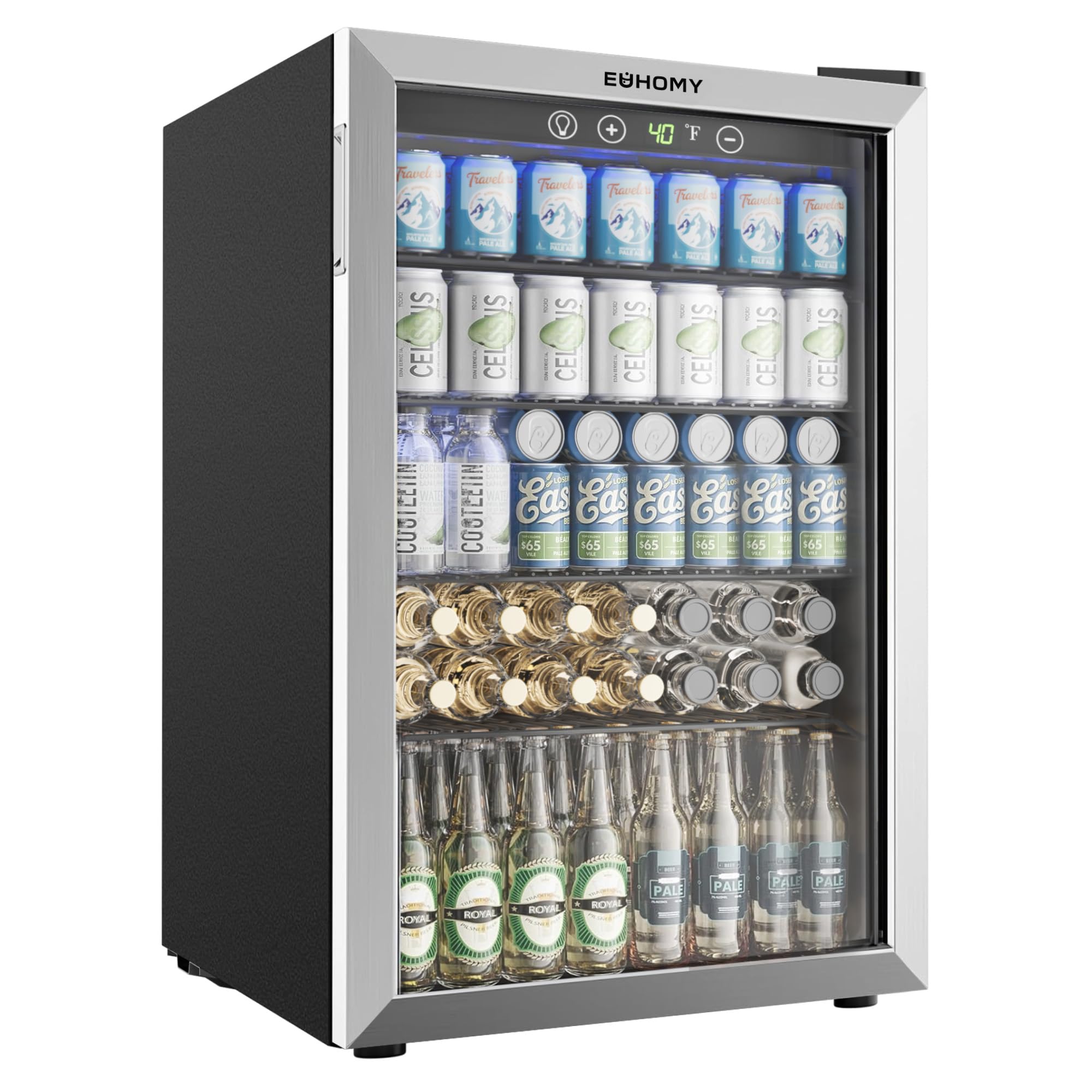
Holds 145 cans and cools down to 32°F, making it the go-to for large families or party garages. The compressor-powered design handles warm garage ambient temps far better than thermoelectric units, though the tradeoff is a noticeable hum during operation. Some units may produce a low rattle that sensitive ears will pick up in quiet rooms.
This fridge suits anyone stocking a busy garage, workshop, or game room where a few cans every hour is the norm. The near-freezing minimum temperature means drinks come out ice-cold even on hot days. However, if your garage doubles as a quiet retreat or you plan to store it near a bedroom, the compressor noise may become a nuisance. The temperature display can also read a few degrees off from the actual interior — a separate thermometer removes any guesswork.
The gunmetal grey door and tempered glass give it a clean look that fits alongside typical garage shelving. Adjustable shelving accommodates tall cans and bottles. For the mid-range price, you get a 4.5 cu ft footprint that holds over 140 standard soda cans.
Pros
- Holds up to 145 standard cans — plenty for parties or weekly stock.
- Attractive gunmetal grey border and tempered glass door complement most garage or office setups.
- Chills beverages quickly and maintains consistent cold in warm environments.
- Offers strong capacity per dollar spent, with a mid-range price.
Cons
- Compressor hum may be noticeable in quiet garages or bedrooms — some units emit a low rattle.
- Temperature can be inconsistent; the display may not reflect the actual interior temperature.
Best for Budget Quiet
Feelfunn BR-110H

Key Features
- Cooling Type: Compressor
- Capacity: 126 cans / 3.2 cu ft
- Min Temp: 34°F
- Installation: Freestanding
- Price: Budget
The Feelfunn BR-110H pairs a genuinely quiet compressor with an attractive glass door and interior blue LED glow, undercutting most rivals on price. Compared to a similarly affordable compressor model that generates persistent hum and display inaccuracy, this unit maintains a lower noise profile without sacrificing the spacious 126-can layout.
Temperature consistency is the tradeoff. Some units may not hit the advertised 34°F low, and the digital readout can drift from actual internal temperature, leaving drinks warmer than expected. The compressor hum stays subdued, but the cooling capability can fluctuate and is better suited to maintaining a steady drinking temp rather than rapid deep chilling.
This cooler fits climate-controlled garages, finished basements, offices, or dorm rooms where ambient heat stays moderate. It is not the right pick for an uninsulated garage in peak summer; under high heat, the compressor will struggle to hold low temperatures, and the display inaccuracy becomes more noticeable. If your garage sees extreme temperatures, a model with stronger cooling headroom will serve you better.
Pros
- Attractive design with blue LED lighting gives a premium look at a budget price.
- Quiet compressor operation makes it suitable for shared spaces like offices or dorms.
- Spacious 126-can capacity with four adjustable shelves accommodates a variety of can and bottle sizes.
- Great value for a compressor-based cooler with glass door and LED lighting.
Cons
- Cooling performance can vary; in some cases, drinks may not feel as cold as the set temperature suggests.
- Digital temperature display may show a reading that deviates from actual internal temperature.
Best for Wine Storage
EUHOMY BR001-110

Key Features
- Cooling Type: Compressor
- Capacity: 128 cans / 3.2 cu ft
- Min Temp: 32°F
- Installation: Freestanding
- Price: Mid-Range
Tuned for precise wine serving, this cooler spans 32–61°F, a wide band that keeps reds at cellar warmth and whites near crisp chill without freezing. That same compressor-driven range lets it double as a can chiller when you need icy beverages — a flexibility many dedicated wine coolers lack. The interior wire racks are arranged to cradle standard 750ml bottles, but they remove and adjust to fit tall cans or stubby bottles, so you aren’t locked into a single format.
Cooling holds steady even in a warm garage, pulling down to 32°F for near-freezing cans or dialing up to that 55°F sweet spot for reds. The glass door and silver cabinet give a clean look that blends into a finished garage or bar area without screaming appliance. The compressor hum will be present — in a garage with a running fridge or street noise it’s unlikely to dominate, but in a completely sealed, silent space it can become noticeable. For most mixed-use settings, the trade-off is an acceptable price for true cold retention.
This cooler fits the wine enthusiast who also rotates craft cans and wants a single appliance that handles both without sacrificing serving accuracy. With 3.2 cu ft of space, it suits a curated collection rather than bulk party stock, so large families or entertainers may need a bigger unit. The refrigerator-level cold and adjustable shelving are assets, but the compressor hum means it’s best placed in a moderately active garage where silence isn’t the goal.
Pros
- Wide 32–61°F range keeps reds, whites, and sparkling at ideal serving temperatures, while also chilling cans.
- Sleek glass-door design with silver finish looks at home in a kitchen, bar, or finished garage.
- Adjustable removable shelves make it easy to reconfigure for wine bottles, tall cans, or a mix of both.
- Compressor-based cooling delivers strong cold retention without the markup of premium wine refrigeration.
Cons
- With 3.2 cu ft, it can’t double as a bulk storage solution — capacity suits a curated wine and can collection.
- The compressor hum can be audible in a completely silent garage; in a busy kitchen or garage with ambient noise, it may fade into the background.
Best for Premium Built-In
Ca’Lefort CLF-BS24-A
Key Features
- Cooling Type: Compressor
- Capacity: 180 cans / 5.65 cu ft
- Min Temp: 34°F
- Installation: Freestanding/Built-In
- Price: Luxury
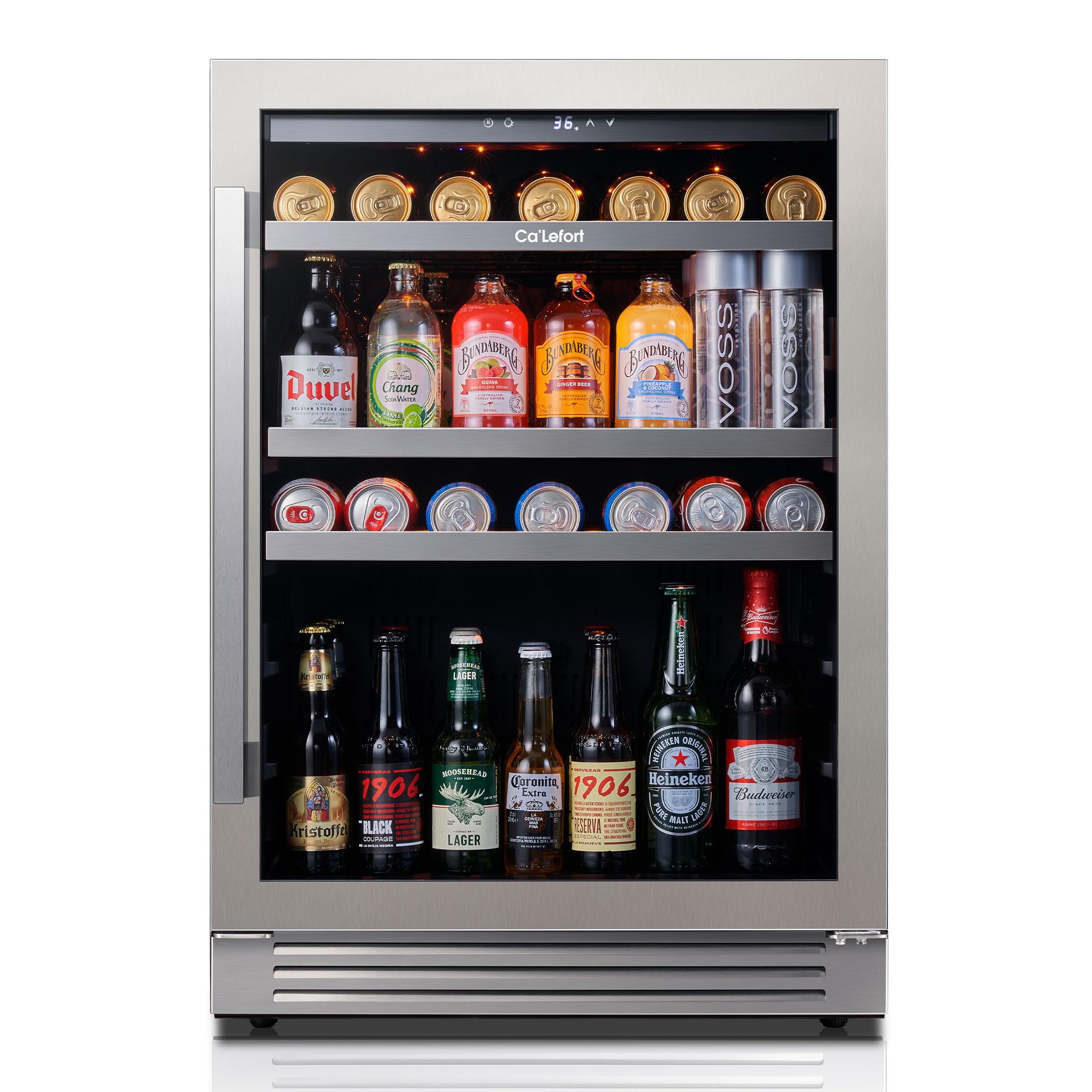
The Ca’Lefort CLF-BS24-A stands out by blending a true built-in aesthetic with near-silent compressor cooling, making it feel at home under a garage counter rather than shouting from the corner. Where many compressor coolers trade noise for cold, this unit keeps the hum almost imperceptible — the kind you’ll only notice if you lean in close. Stainless steel and gray tempered glass form a door that looks custom-installed, not dropped into a space.
Cooling precision is handled by a digital thermostat that holds within 1°F, and it remembers your setting after a power outage — a practical detail for garage circuits. Three LED colors (amber, blue, white) let you match the bar mood. With 180 can capacity and adjustable shelving, it swallows a mixed load of tall bottles and standard cans without fuss.
This cooler is for the upscale garage bar or finished kitchen where silence and appearance justify the premium. It thrives in setting drinks to 34–54°F, but won’t drop below 34°F, so if your routine involves near-freezing beverages, a model with a 32°F floor will fit better. Budget-conscious shoppers will find similar capacity for less, but the quiet, built-in look comes at a cost only you can decide to absorb.
Pros
- Premium materials and solid construction give it a furniture-grade feel that outclasses many beverage fridges.
- Customizable amber, blue, or white LED lighting creates a striking display that elevates any bar setup.
- Whisper-quiet compressor operation ensures the cooler blends into a calm garage, not disturbs it.
- Precise 1°F digital control and power-failure memory keep drinks at your set temperature without re-tweaking after outages.
Cons
- The door hinge is not reversible, so right-side clearance is required — a limitation in tight garage corners.
Best for Mid-Size Value
Manastin MRBRN2
Key Features
- Cooling Type: Compressor
- Capacity: 130 cans / 3.2 cu ft
- Min Temp: 35°F
- Installation: Freestanding
- Price: Mid-Range
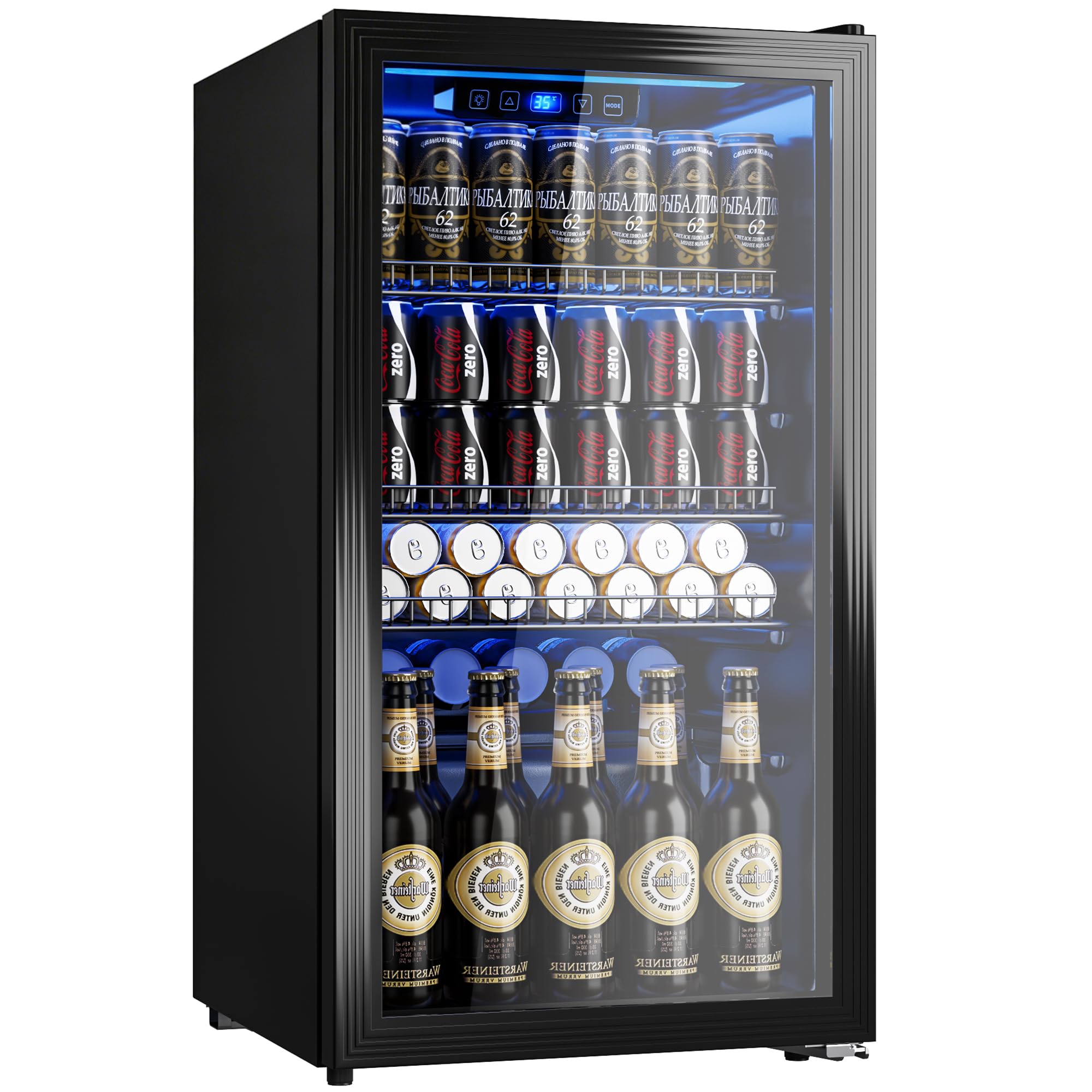
The Manastin beverage refrigerator stands out with its eye-catching blue LED interior and double-layer Low-E glass door, giving a premium look that the quieter top pick in this category doesn’t match. It holds 130 cans with adjustable shelving, making it a strong choice for a garage that sees regular use.
This fridge suits buyers who prioritize style and capacity over whisper-quiet operation. In a garage where ambient noise from tools or activity is already present, the compressor hum will blend in – but in a dedicated quiet space, it may be more noticeable than expected. Temperature consistency can vary between units, so keeping an external thermometer is a practical step.
The double-layer glass reduces condensation and improves insulation, and the digital temperature display provides a clear readout. At a mid-range price point, it offers compelling value for those who want a showpiece cooler without paying premium.
Pros
- Striking appearance with clear glass and blue LED lighting that elevates any garage setup.
- Generous 130-can capacity with adjustable shelves to fit a variety of can and bottle sizes.
- Compact yet spacious footprint fits easily on countertops or under workbenches.
- Strong value for the price compared to other compressor coolers with similar features.
Cons
- Temperature consistency can vary between units; some may not hold the set temperature accurately.
Best for Commercial Display
PremiumLevella PRF36DX

Key Features
- Cooling Type: Compressor
- Capacity: 7.1 cu ft / ~21 six-packs
- Min Temp: 32°F
- Installation: Freestanding (wheels)
- Price: Premium
The PremiumLevella PRF36DX sets itself apart with 7.1 cu ft of accessible storage, a lockable glass door, and integrated wheels—enough to hold over 20 six-packs and roll where you need it. Unlike the even larger 12.5 cu ft industrial option, this unit balances imposing display presence with a footprint that still fits a typical garage. The bright LED interior turns any stock into a visual feature, and the compressor cooling holds a steady chill even when the garage warms up.
The PRF36DX is built for a garage that doubles as a party prep station or a commercial breakroom—places where sheer capacity and grab-and-go visibility matter more than silence. Compressor hum is a real presence; in a still garage it will be audible, and the cooler relies on a manual defrost cycle that means occasional downtime to wipe out ice. If you need whisper-quiet, set-and-forget operation, the top pick’s quieter compressor and auto-defrost will serve you better.
Pros
- Holds over 20 six-packs, making it easy to stock for large gatherings or commercial use.
- Bright interior LED lighting and a lockable glass door create a striking display that mimics commercial coolers.
- Compressor cooling keeps beverages reliably cold even in warmer garage temperatures.
- Priced competitively for a commercial-style unit that merges storage with merchandising appeal.
Cons
- Compressor hum is noticeable in a silent garage; less of a concern if the space already has ambient noise from a workshop or HVAC.
- Manual defrost means you must power down and clear ice periodically—not a maintenance-free appliance.
Best for Wine Combo
Electactic JC-90

Key Features
- Cooling Type: Compressor
- Capacity: 145 cans / 4.5 cu ft
- Min Temp: 32°F
- Installation: Freestanding
- Price: Mid-Range
The Electactic JC-90 packs 4.5 cubic feet of space, holding up to 37 wine bottles or 145 cans with a stainless and glass door that gives a garage bar a modern finish. Its compressor-driven temperature range of 32–61°F handles near-freezing drinks and proper wine serving temps. Compressor hum is present and may be noticeable in very quiet garages — a use-case tradeoff rather than a defect. Some units show temperature drift or may not hit the lowest settings, so an extra thermometer is a sensible precaution. This cooler fits buyers who prioritize generous, mixed storage over absolute silence, and who can place it where occasional hum won’t distract.
Pros
- Sleek stainless and glass door design blends into modern garages and kitchens
- Massive dual-purpose capacity for 145 cans or 37 wine bottles
- Wide temperature range from 32°F to 61°F suits both ice-cold drinks and wine
Cons
- Compressor hum can be audible in very quiet garages — ambient noise helps mask it
- Temperature consistency may vary; some units struggle to reach the lowest settings
Best for Indoor Only
Honeywell H115BCS
Key Features
- Cooling Type: Thermoelectric
- Capacity: 116 cans / 3.2 cu ft
- Min Temp: ~42°F
- Installation: Freestanding
- Price: Budget
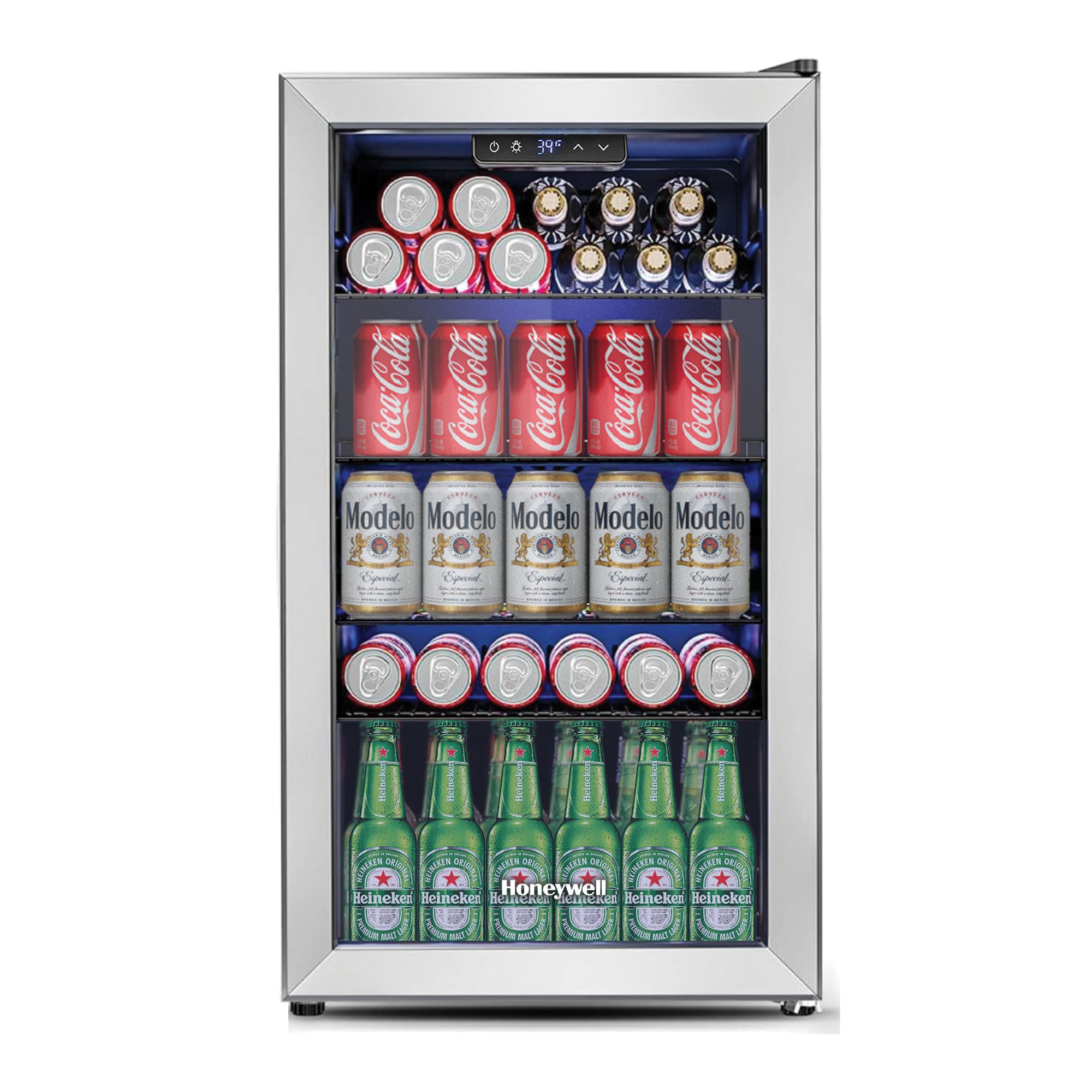
The Honeywell H115BCS leverages thermoelectric cooling to run quietly — no compressor hum — and the tempered glass door gives visibility without opening. At 3.2 cubic feet, it holds up to 116 cans on adjustable shelving, fitting comfortably on a counter or under a desk. The trade-off is that thermoelectric units rely on room temperature; this model cannot cool below about 42°F and struggles when ambient temperatures exceed 80°F. That makes it unsuitable for garages or patios. For an air-conditioned office, den, or indoor bar, it offers silent, budget-friendly storage that keeps drinks presentable.
Pros
- Clear glass door and sleek design suit an office or bar.
- Thermoelectric cooling operates silently with no compressor hum.
- Fits 116 cans with adjustable shelves for flexible bottle and can storage.
Cons
- Cannot cool below about 42°F and struggles in ambient temperatures above 80°F — not suited for garages.
Best for Budget Pick
Icyglee BR-110H-IG

Key Features
- Cooling Type: Compressor
- Capacity: 126 cans / 3.2 cu ft
- Min Temp: 34°F
- Installation: Freestanding
- Price: Budget
The Icyglee BR-110H-IG delivers a glass-door compressor cooler with adjustable shelves and a 126-can footprint at a budget-friendly price. Build quality and appearance earn consistent praise, and it chills drinks effectively for casual garage use. However, the compressor hum can be noticeable in a quiet space — less an issue in a bustling garage or rec room. The digital temperature display may also read lower than the actual internal temperature, so drinks could end up warmer than the set point suggests.
Pros
- Attractive, well-built design with a clear glass door
- Cools beverages reliably for everyday garage use
- Generous 126-can capacity with adjustable shelves at a budget-friendly price
Cons
- In a quiet garage or bedroom, the compressor hum can be distracting
- The temperature display may read lower than actual temperature, causing drinks to be warmer than expected
How to Choose
For a garage that sees hot summers, a compressor-based cooler with a minimum temperature of 32°F is non-negotiable—thermoelectric units simply cannot overcome high ambient heat.
Cooling Type: Compressor vs. Thermoelectric
Thermoelectric cooling uses a solid-state heat pump that typically lowers temperature about 20°F below the room. When a garage hits 85°F, your drinks sit at a lukewarm 65°F—fine for reds, but useless for cans of beer. Compressor refrigeration, like a kitchen fridge, actively removes heat and can maintain 34°F even as the garage bakes.
The trade-off is sound: thermoelectric units are nearly silent, while compressors produce a low hum. For a garage where ambient noise already exists, a compressor’s hum is rarely a dealbreaker, but in a dead-quiet sleeping area it can be grating. Choose compressor for any space without air conditioning.
Capacity: Real-World Can Count
Advertised can counts assume every shelf is packed perfectly with standard 12oz cans, ignoring bottlenecks, tall craft cans, or wine bottles. A 120-can cooler often holds about 90 cans when loaded realistically. Prioritize cubic feet (cu ft) over can numbers: 3.2 cu ft comfortably handles a couple cases plus a few bottles, while 4.5 cu ft suits a party-ready garage bar.
Also consider shelf adjustability. Removable or wire shelves let you fit thicker bottles by removing a shelf entirely, while fixed racks lock you into specific configurations. If wine storage is part of the plan, check whether the shelves accommodate standard 750ml Burgundy or Champagne bottles standing up.
Minimum Temperature: Why 32°F Matters for a Garage
The difference between a 34°F and a 42°F minimum isn’t subtle in a hot garage. A unit that can reach 32°F or 34°F will fight through 90°F ambient heat and still deliver crisp, cold drinks. A unit that bottoms out at 40°F or higher will only feel slightly cool on a summer afternoon, leaving you with disappointing beer.
For wine, the ideal serving temperature varies: whites and sparkling benefit from 40–50°F, while reds often shine at 55–65°F. A cooler with a range of 32–61°F gives you the flexibility to store both cans near freezing and a bottle of Pinot at cellar temperature. Just be aware that many digital displays overstate how cold the interior really is—a separate fridge thermometer is cheap insurance.
Noise Level: The Compressor Hum Reality
Every compressor beverage cooler hums, but the pitch and volume vary dramatically even between identical models. One buyer’s ‘barely audible’ can be another’s ‘constant drone.’ Rubber isolation pads under the feet can dampen rattles, and positioning the fridge away from bedroom walls helps.
There’s no standard noise meter in this category, so expect a soft hum similar to a dorm fridge. If complete silence is necessary, a thermoelectric unit might tempt you, but recall that it won’t cool in a hot garage. For most garages, the hum blends into background noise and is well worth the trade for genuinely cold drinks.
Installation Type: Freestanding or Built-In
Most garage coolers are freestanding, meaning they vent heat from the back and need several inches of clearance on all sides. Cramming a freestanding unit flush against a wall traps heat, stresses the compressor, and raises energy use. A few premium models are rated for built-in installation, allowing you to slide them under a counter with front-venting.
If you plan to integrate the cooler into cabinetry, confirm the model’s ventilation requirements. Built-in rated fridges often cost more but deliver a seamless custom look. For a typical garage, a freestanding cooler with a couple inches of breathing room is simpler and cheaper.
FAQ
Can a thermoelectric beverage fridge keep drinks cold in a hot garage?
No. Thermoelectric cooling can only reduce temperature about 20°F below the room. In a 90°F garage, drinks will hover around 70°F. Save thermoelectric units for air-conditioned offices or rooms that never exceed 80°F. A compressor cooler is the only reliable choice for garage use.
Why is my beverage refrigerator not reaching the set temperature?
Common culprits are a garage that’s hotter than the unit’s design tolerance, blocked vents, or an inaccurate thermostat. Even new compressors can struggle if ambient heat overpowers the insulation. Always verify internal temperature with a separate thermometer; if it’s off by more than 8°F, consider repositioning the fridge or exchanging a defective unit.
How noisy are compressor beverage coolers compared to thermoelectric ones?
Thermoelectric coolers are essentially silent, moving heat via a fan and semiconductor plate. Compressor coolers produce a low mechanical hum, similar to a dorm fridge, that ranges from barely noticeable to moderately intrusive depending on the unit. In a garage with typical background noise, most people find the hum acceptable, but for a sleeping area it can be grating.
Do I need a garage-ready beverage fridge, or can I use a regular one?
A garage-ready unit needs a powerful compressor and insulation to handle temperature swings. Many compact fridges are designed for kitchens and basements and may overwork or fail to chill in a hot garage. Look for a dedicated beverage cooler with a minimum temperature of 32–34°F and a proven track record in warm environments, rather than repurposing a dorm fridge.
Will a beverage cooler keep wine at the right serving temperature?
Yes, provided the cooler has a wide enough range. For white and sparkling wine, 40–50°F is ideal; for reds, 55–65°F. Most compressor beverage coolers reach 32–34°F minimum, so you can dial up to wine-friendly temperatures. If wine storage is a priority, choose a model with wine-specific racks and a temperature range that extends to at least 61°F.