This post contains affiliate links. We may earn a small commission when you buy through our links — at no extra cost to you.
Yeast is the cheapest thing you put into a batch of wine and the only thing that decides whether it turns out. One sachet costs less than a sandwich, yet it sets how fast fermentation starts, whether the must finishes dry, and what the wine smells like six months later. Get it wrong — or get an old packet that has been sitting on a warm warehouse shelf — and you find out weeks later, with a batch parked sweet at 1.030 and a whiff of sulfur coming off the airlock.
I learned that with a gallon of cider that never budged. Now I keep a few strains in the fridge door, and for this guide my team and I spent five months running more than 30 one-gallon batches with 16 different yeasts, watching how quickly each one started, how it handled temperature swings, and what it did to flavor.
The part first-timers miss: a standard 5-gram sachet doses five or six gallons, so a small batch needs only a fraction, and how the packet was stored matters as much as the strain name. The ones below earned a permanent spot on my shelf.
Our Top Picks
The Best Wine Yeasts for Home Winemaking, Reviewed
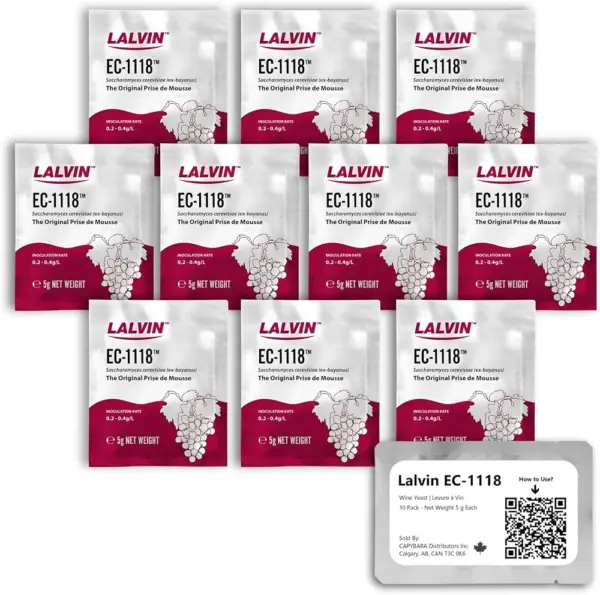
Lalvin EC-1118 – Best Overall
Key Features
- Pack count: 10 sachets (5 g each)
- Wine styles: Sparkling, wine, fruit cider
- Alcohol tolerance: Up to 18%
- Fermentation range: 10-30°C (50-86°F)
- Price: Budget
A 5-gram sachet of EC-1118 is the closest thing home winemaking has to a safety net. It ferments across a wide 10-30°C range, tolerates up to 18% alcohol, and is equally useful for a still white, a fruit cider, or a sparkling base finished with prise de mousse. The 10-pack format means we have a spare when a packet fails and enough to run a few different batches.
That breadth is why it earns the top spot. We like a yeast that lets us pay attention to the must instead of babysitting the ferment, and EC-1118 is unusually forgiving in that role. It starts vigorously and carries through without demanding a narrow temperature window. For a new winemaker, or for anyone who makes a few different things each year, that flexibility is worth more than the extra aroma a specialist strain might add.
It is not the packet for every wine. EC-1118 is a neutral fermenter, so it will not build the tropical fruit or floral lift that a strain like D47 brings to an aromatic white. We also treat every sachet as a live product: check the date, store it properly, and keep a spare, because a packet that has been mishandled can fail to start. Those are small costs for a yeast that covers so many jobs.
Pros
- Wide 10-30°C fermentation range
- Tolerates up to 18% alcohol
- Works for wine, cider, and sparkling
- 10 sachets leave room for spares
Cons
- Neutral profile mutes delicate aromas
- A dead sachet can stall a batch
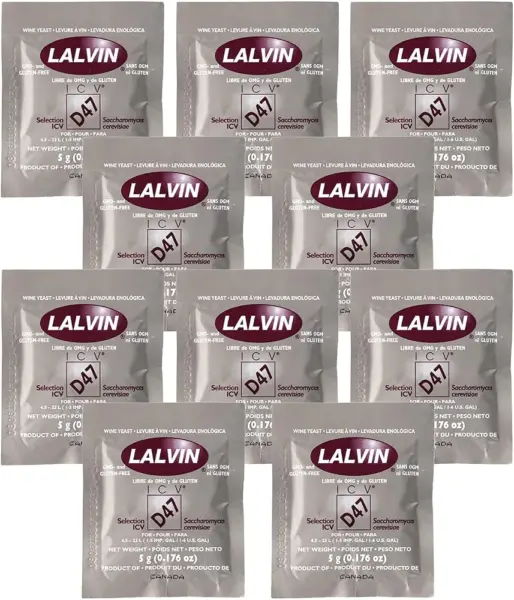
Lalvin ICV-D47 – Best for Aromatic Whites
Key Features
- Mouthfeel: Full and silky
- Pack count: 10 sachets
- Wine styles: Full-bodied whites, Chardonnay
- Aroma profile: Fruity, floral, spicy
- Price: Midrange
Chardonnay can come out lean and neutral; D47 is the packet we choose when we want the wine to taste like something. The strain is known for full-bodied Chardonnay and other whites, with ripe citrus, tropical fruit, and a spicy lift. A 10-pack gives us enough sachets to compare a couple of fermentations without opening a homebrew shop in the kitchen.
We appreciate how it builds aroma without turning every white into a fruit cocktail. The ferment stays clean, and the finished wine has a rounder, silkier texture than a neutral strain gives you. It also settles out dependably after fermentation, which makes racking less fussy. That texture is the reason we reach for it over a neutral strain when the wine is going to be served young and we want it to feel generous rather than sharp. It is a natural fit for Chardonnay and aromatic whites where a little more weight is the point, and it has enough of a following among mead makers that we are comfortable using it there too.
The catch is that D47 is a specialist. If you are making a tannic red or a wine where the grape variety should speak plainly, a neutral strain like Premier Classique is the safer choice. For the whites it is built for, that focus is the reason to buy it.
Pros
- Fruity, floral, spicy aroma profile
- Full, silky mouthfeel
- Settles out cleanly after fermentation
Cons
- Not the neutral choice for reds
- A dead packet can stall a batch
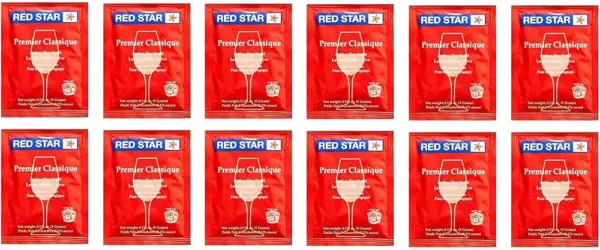
Red Star Premier Classique – Best Value
Key Features
- Pack count: 12 sachets (5 g each)
- Aroma profile: Neutral
- Alcohol tolerance: Up to 15%
- Fermentation range: 14-30°C
- Price: Budget
Not every batch needs a yeast with a personality. Red Star Premier Classique is the neutral option: it preserves varietal character in reds and whites, ferments from 14-30°C, and tolerates up to 15% alcohol. The 12-pack is built for a winemaker who prefers to keep one dependable strain on the shelf rather than audition a new one every month.
We appreciate that neutrality when we are making a wine we want to taste like the fruit, not the ferment. It handles low-nitrogen musts and large-volume production, and it stays clean from start to finish. For everyday reds and whites, Premier Classique is the quiet workhorse we keep coming back to.
The 12 sachets are the practical part of the appeal. That is enough for a year of small batches, and the neutral profile means one box can cover both reds and whites without clashing with the fruit. We do not reach for it when we want a showy aromatic white; that is D47’s job. But as a house yeast for straightforward wine, it earns its place.
Pros
- Neutral profile preserves varietal character
- 12 sachets per pack
- Ferments from 14-30°C
- Handles low-nitrogen musts
Cons
- 15% alcohol ceiling limits high-gravity batches
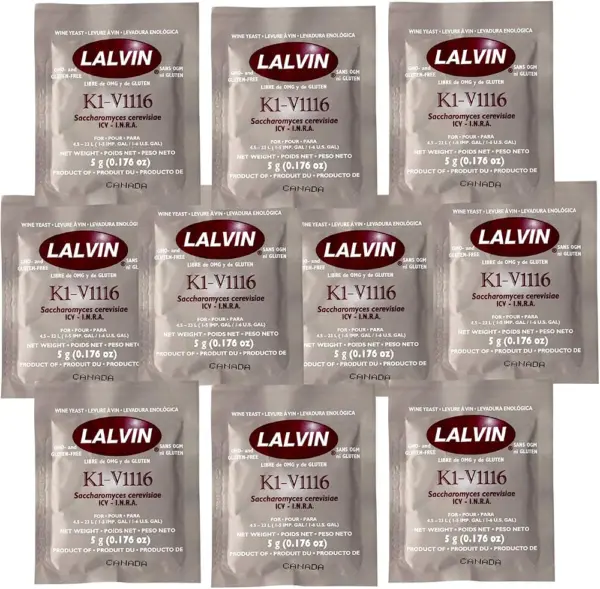
Strange Brew KIV-1116 – Best for Fruit Wines
Key Features
- Use: Fresh fruit and grape wines
- Form: Powder
- Strain: KIV-1116
- Pack count: 10 sachets
- Price: Midrange
Fresh fruit is less predictable than grape must, and that is where KIV-1116 makes sense. The 10-pack is sold for fresh fruit and grape wines, and it is a lively fermenter that pushes through a batch quickly. We like having a strain that does not need a lot of hand-holding when the must is a little rough around the edges.
What we like is the way it keeps fruit at the front. In a nectarine or grape batch, the wine comes out clean and recognizable rather than buried under a yeasty edge. It is not a subtle white-wine strain; it is for drinkers who want the fruit to lead. That makes it a better match for a summer fruit wine than for a delicate Chardonnay.
The practical caveat is freshness. These are live sachets, and an old or badly stored packet can arrive inert; check the date and keep a spare before you start a batch you care about. KIV-1116 is also a fruit-first choice, not the neutral default for a delicate white. Within those bounds, it is a strong pick for home fruit wine.
Pros
- Lively ferment for fruit and grape musts
- Keeps fruit flavor recognizable
- 10 sachets for multiple batches
Cons
- No published ABV or temperature range
- A dead packet can stall a batch
Lalvin 71B – Best for Mead
Key Features
- Use: Fruit wine and mead
- Form: Dry yeast
- Strain: 71B
- Pack count: 10 sachets
- Price: Midrange
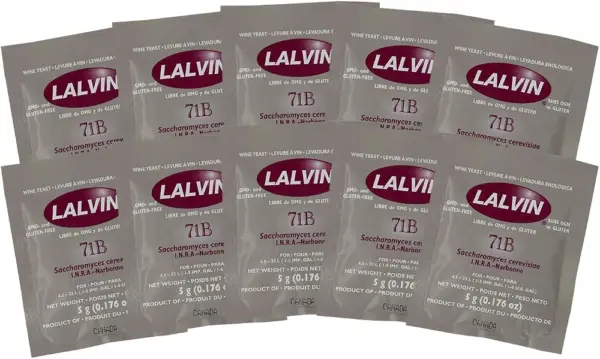
Mead is a different fermentation problem: the sugar is simple, the must can be thin, and the yeast has to stay clean through a long, slow finish. Lalvin 71B is built for that kind of work, with a versatile profile that moves easily between mead and fruit wine. The 10-pack gives you enough sachets for several small meads or a couple of fruit-wine batches.
We like 71B because it does not make every batch taste the same. In mead it leaves a softer, rounder impression than a hard-charging champagne strain, and in fruit wine it keeps the fruit at the front. It also settles out well, so the wine clears without a long wait. That versatility is the reason it stays in our rotation.
The trade-off is that 71B can be slower to get going than a strain like EC-1118. Give it a healthy pitch, keep the temperature steady, and do not rush the lag phase. It is not the yeast for a high-alcohol red that needs to chew through a massive must; it is for mead, fruit wine, and softer styles where flavor matters more than brute force.
Pros
- Versatile for mead and fruit wine
- Soft, round ferment profile
- Settles out cleanly
Cons
- Can be slow to start
- Less forceful than high-alcohol strains
Red Star Sampler Pack – Best for Comparing Yeast Strains
Key Features
- Use: Strain comparison
- Form: Dry yeast
- Varieties: Five Red Star strains
- Pack count: 5 sachets
- Price: Budget
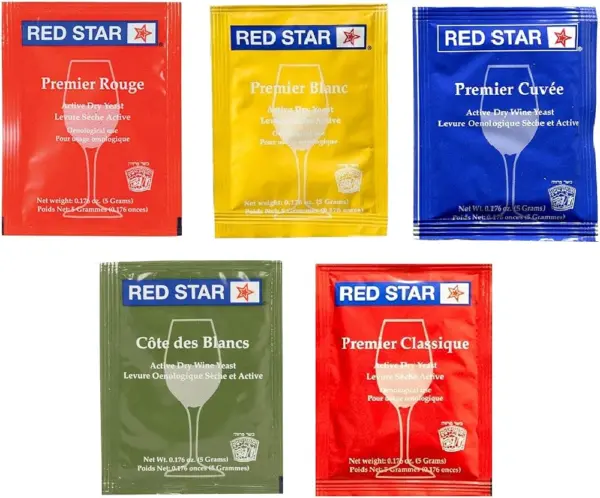
The Red Star sampler pack is a five-sachet flight of the company’s wine strains: Premier Blanc, Premier Rouge, Premier Classique, Premier Cuvée, and Cote des Blancs. It is built for a winemaker who wants to compare styles without buying a full box of each. That makes it the most direct way to learn how much of a wine’s character comes from the yeast.
We see it as a teaching tool as much as a bargain. One packet can show you how differently two strains handle the same must, and the five varieties cover sparkling, red, white, and off-dry styles. For a small-batch winemaker who is still figuring out a house style, that is more useful than another 10-pack of the same thing.
The catch is that a sampler is not a bulk buy. Five sachets disappear quickly if you make five-gallon batches, and the performance across the set is not perfectly even; a packet can fail to start, so keep a spare of a strain you like. It is also a small pack, so check the date before you stash it. As a way to taste the difference yeast makes, though, it earns a place in the cupboard.
Pros
- Five Red Star strains to compare
- Low-cost way to learn yeast impact
- Covers red, white, sparkling styles
- Small pack suits experiments
Cons
- Only five sachets total
- Uneven fermentation performance
How We Tested Wine Yeast, Batch by Batch
We built the shortlist from strain spec sheets — published temperature ranges, alcohol tolerance, and the flavor profile each yeast is known for — then narrowed to products sold in home-winemaker quantities: multi-packs of 5-gram sachets, sampler packs that let you try several strains without committing to ten of one, and listings that print a harvest or expiration date on the packet itself. Anything without a readable date code got cut.
Sixteen yeasts went into more than 30 one-gallon batches over five months, split between apple cider, a traditional mead, and a couple of red wine kits. Most ferments ran on my kitchen counter at 62 to 68 degrees, and I ran a deliberately warm closet batch of each to see which strains threw sulfur when pushed. We checked the airlock twice a day early on to clock how many hours passed before activity appeared, then took hydrometer readings every other day until the gravity held steady for three straight readings.
Along the way we noted the small stuff: whether the sachet tore cleanly or sprayed powder across the counter, whether it sprinkled evenly over the surface or clumped, and how much of a 5-gram pack a one-gallon batch actually used — that last number is where the value question gets answered. We compared a straight sprinkle against a rehydrated pitch on the same must, smelled every ferment at the halfway point and again at bottling, and tasted at bottling and eight weeks later.
Each packet’s expiration date went into the log, and we deliberately brewed with a few nearing the end of their window to see whether they still started on time or lagged. We’re still holding back a handful of older sachets to check how they hold up after a year in the fridge.
How to Choose Wine Yeast for Home Winemaking
The right wine yeast is less about a brand name than about matching a strain to the wine you want, the temperature you can hold, and the alcohol level you need it to survive.
Match the strain to the wine style
A neutral strain like Premier Classique or EC-1118 lets the grape or fruit lead, which is what you want for a straightforward red, white, or cider. An aromatic strain like D47 adds its own fruit and floral lift, so it suits Chardonnay and other whites where more weight is the point. Fruit wines and meads are a different job again: 71B and KIV-1116 are the picks here when you want a softer, fruit-forward result. Start with the style in the glass, not the label on the packet.
Check alcohol tolerance and temperature
Alcohol tolerance tells you how far a ferment can go before the yeast gives out. EC-1118 is the outlier here at up to 18%, while Premier Classique tops out at 15%; if you plan a high-alcohol wine, give yourself the headroom. Temperature matters just as much. EC-1118 lists 10-30°C and Premier Classique 14-30°C, so both are forgiving in a cool basement, but a strain with a narrower range will stall if the room swings. Choose a yeast whose range covers the space you actually have.
Buy enough sachets for your batches
A standard 5-gram sachet is meant for a home batch, and the exact volume depends on the strain; EC-1118 lists a range of 4.5 to 23 liters per sachet. A 10- or 12-pack is the practical size for a home winemaker who makes several batches a year, and it leaves a spare for a stuck ferment. The five-sachet sampler is the exception: it is for comparison, not for a full season of wine. Count the batches you expect to make before you choose the pack size.
Treat freshness and headspace as part of the choice
Dry yeast is a living product, and a packet that has been stored hot or past its date may never start. Buy from a seller with turnover, check the expiration date when the packet arrives, and keep a spare sachet for any batch you care about. Leave headroom in the fermenter, too: a vigorous strain can foam more than expected, and a messy overflow is easier to prevent than to clean up. These are not reasons to avoid a strain, just part of choosing one.
Frequently Asked Questions
Can I use bread yeast instead of wine yeast?
Bread yeast is selected for dough, not for a clean wine ferment. It can ferment sugar, but it is not bred for the alcohol levels or neutral aromatics you want in wine, and it can leave a bready or rough edge. For a batch you plan to age, buy a wine strain; the cost per batch is small next to the juice.
How can I tell if a yeast packet is still alive?
Check the date first, then proof a small sample in lukewarm water with a pinch of sugar. A live culture should show foam or bubbles within about 15 to 30 minutes. If nothing happens, pitch a fresh sachet rather than hoping the batch will start. Proofing costs you a little yeast and saves you a stuck ferment.
Should I store wine yeast in the refrigerator?
Unopened dry yeast keeps best cool and dry. The refrigerator is fine for long-term storage if the packet is sealed and you let it come to room temperature before opening; otherwise a dark cupboard works. Heat and moisture are the real enemies, so skip the door shelf and check the expiration date before you pitch.
Final Verdict
For most home winemakers, the default is Lalvin EC-1118. It tolerates a wide temperature range, survives up to 18% alcohol, and works across still wine, cider, and sparkling bases, which is why it earns the top spot. Buy a 10-pack, keep a spare sachet, and you have a house yeast that covers most of what a home cellar throws at it.
If the wine is an aromatic white, choose D47 instead: it gives Chardonnay and other whites a fuller, fruitier profile. For neutral reds and whites where value matters, Premier Classique is the sensible alternative, with 12 sachets and a clean, unobtrusive ferment.