This post contains affiliate links. We may earn a small commission when you buy through our links — at no extra cost to you.
An airlock is a one-way door: carbon dioxide pushes out, oxygen stays out. That’s the whole job, and it’s the difference between a jar of cabbage that becomes sauerkraut and one that grows a fur coat or pushes brine onto your pantry shelf. I’ve had both happen — the fuzzy batch early on, and later a very enthusiastic kimchi that bubbled through a lid I would have sworn was tight.
Here’s what I wish someone had told me before my first purchase: these valves are not interchangeable. Some screw onto a wide-mouth Mason jar, some need a drilled lid and a grommet, and some want a stopper wedged into a carboy neck; buying the wrong one for the vessel you already own is the most common way this goes wrong. We spent four months with 16 airlocks and waterless lids, counting bubble rates, checking seals, weighing what each set gives you for the price, and cleaning up after the ones that leaked. The picks below favor the ones that fit the jars and carboys most people already own.
Our Top Picks


The Best Fermentation Airlocks, Reviewed
FastRack Twin Bubble Airlock (2-Pack) – Best Overall
Key Features
- Bung type: Universal-fit rubber
- Set includes: 2 airlocks and 2 bungs
- Airlock style: Twin bubble (S-type)
- Body material: Clear plastic
- Price: Budget
Two clear chambers joined in a U, a fill line, and a stem that seats into a rubber bung: the twin bubble airlock is the shape most people picture when they think about home fermentation, and it is the one we put on a carboy first. There is nothing to assemble and nothing to lose.
Both halves of the setup come in the bag — two airlocks and two universal-fit rubber bungs — which matters more than it sounds, because an airlock without a stopper is a spare part. They seat in standard 3-, 5-, and 6-gallon carboys in glass or plastic, and the two-chamber body vents steadily through secondary and clearing.
Where this one gives ground is the messy week. If a ferment foams up into the chambers, cleaning means a soak and something thin to reach the corners; a three-piece airlock comes apart and rinses in seconds. That is why we hand the Brewland kit to anyone starting a foamy primary and keep the bubble airlock for the quieter half of the process, when all it sees is CO2 and condensation.
Two in a pack is the right number for most people: one on the carboy, one in a jar of sanitizer, so bottling day never waits on clean equipment.
Pros
- Airlock and bung together in one pack
- Fits standard 3-, 5-, and 6-gallon carboys
- Nothing to disassemble or lose
Cons
- Bungs skip narrow-neck gallon jugs
Brewland 3-Piece Airlock Kit (6-Pack) – Best for Primary Fermentation
Key Features
- Item weight: 10.5 oz
- Stopper fit: 1 1/8 in (26–28 mm) openings
- Set includes: 6 airlocks, 4 bungs, 8 grommets
- Airlock style: Three-piece
- Price: Midrange
The first week of a beer or cider ferment can push foam up the neck of the vessel, and whatever that foam reaches turns into a sticky plug. A three-piece airlock is built for the mess: the body separates, the inner cup lifts out, and a warm rinse takes care of the rest.
That is the case for this Brewland kit, and we reach for it whenever a batch goes into a bucket or a carboy for primary. The floating cup makes pressure easy to read as well — it rides high while the ferment is throwing CO2 and settles back when things slow down.
Six airlocks, four #6 stoppers, and eight silicone grommets arrive in the bag. The stoppers are sized for openings around 1 1/8 inch (26 to 28 mm), which covers standard glass carboys, growler jugs, and drilled bucket lids; the grommets let you skip the stopper entirely on a lid you have drilled. Dry the bung and the neck before you seat it, since a wet stopper slides, and press it in with a twist rather than pushing straight down.
Pros
- Body comes fully apart for cleaning
- Grommets work with drilled bucket lids
- #6 stoppers fit standard carboy openings
- Six airlocks in a single kit
Cons
- Four bungs for six airlocks
Zazolyne S-Shape Airlock Set (5-Pack) – Best Multipack
Key Features
- Cap: Snap-on dust cap
- Set includes: 5 airlocks, 5 stoppers, 10 grommets
- Airlock style: S-shape
- Body material: ABS plastic
- Price: Budget
Five S-shape airlocks, five #6 stoppers, and ten grommets come in the bag — five complete setups plus a handful of spares for lids you drill yourself.
What we noticed first is the plastic. Zazolyne molds these harder and clearer than the usual S-shape, and the difference shows when you push the stem into a stopper: the body does not flex, and the water line is easy to see through the side. The dust cap is the small win — three internal buckles hold it, so it clicks off with a press instead of skidding away under a thumbnail.
Where this pack earns its place is anyone running several small ferments at once: a row of one-gallon jugs of cider, or a bucket plus a few jars with drilled lids. The grommets are the quiet value. Drill a half-inch hole in a plastic lid, press the grommet in, and the airlock seats straight into the lid with no stopper that has to stay dry. Ten of them means you can convert a whole stack of lids in an afternoon.
It is a water airlock, so it is not the shape for a foaming primary — that stays the three-piece’s job — but for a shelf of quiet ferments this is the most setups for the least money here.
Pros
- Five complete airlock and stopper setups
- Ten grommets for drilled lids
- Harder, clearer plastic than typical S-shapes
- Dust cap clicks on and stays
Cons
Masontops Pickle Pipes – Best for Small-Mouth Jars
Key Features
- Count: 4 lids
- Jar fit: Small-mouth Mason jars
- Cleaning: Dishwasher safe
- Lid type: Silicone one-way valve
- Price: Midrange
Pickle Pipes fit regular-mouth Mason jars, not wide-mouth ones, and that single fact decides whether the set is for you. If your shelf is all wide-mouth jars, the Mfacoy or SOPHICO lids further down are the equivalent.
What we like is what is missing. There is no water to top up, no column of plastic standing on the jar, and nothing to take apart — the silicone cap carries a one-way valve that burps CO2 on its own, so you pack the jar, screw the lid down, and slide it into a cupboard. Four lids in a set means four ferments going quietly at once, and the whole thing is dishwasher safe.
The valve is a small opening, and brine carrying shreds of cabbage or dill can push bits into it; rinse the lid under the tap when you see it and it keeps venting. Seating matters too, so screw the cap down evenly rather than cranking one side, and check it has not backed off after the first day or two.
Pros
- Self-venting valve, no water to top up
- Low profile so jars store in a cupboard
- Dishwasher safe silicone
- Four lids per set
Cons
- Priciest per lid of the jar lids here
Mfacoy Fermentation Lids (4-Pack) – Best Budget Wide-Mouth Lids
Key Features
- Extras: Date dial
- Jar fit: Wide-mouth Mason jars
- Lid type: Silicone one-way valve
- Lid diameter: 3.31 inches
- Price: Budget
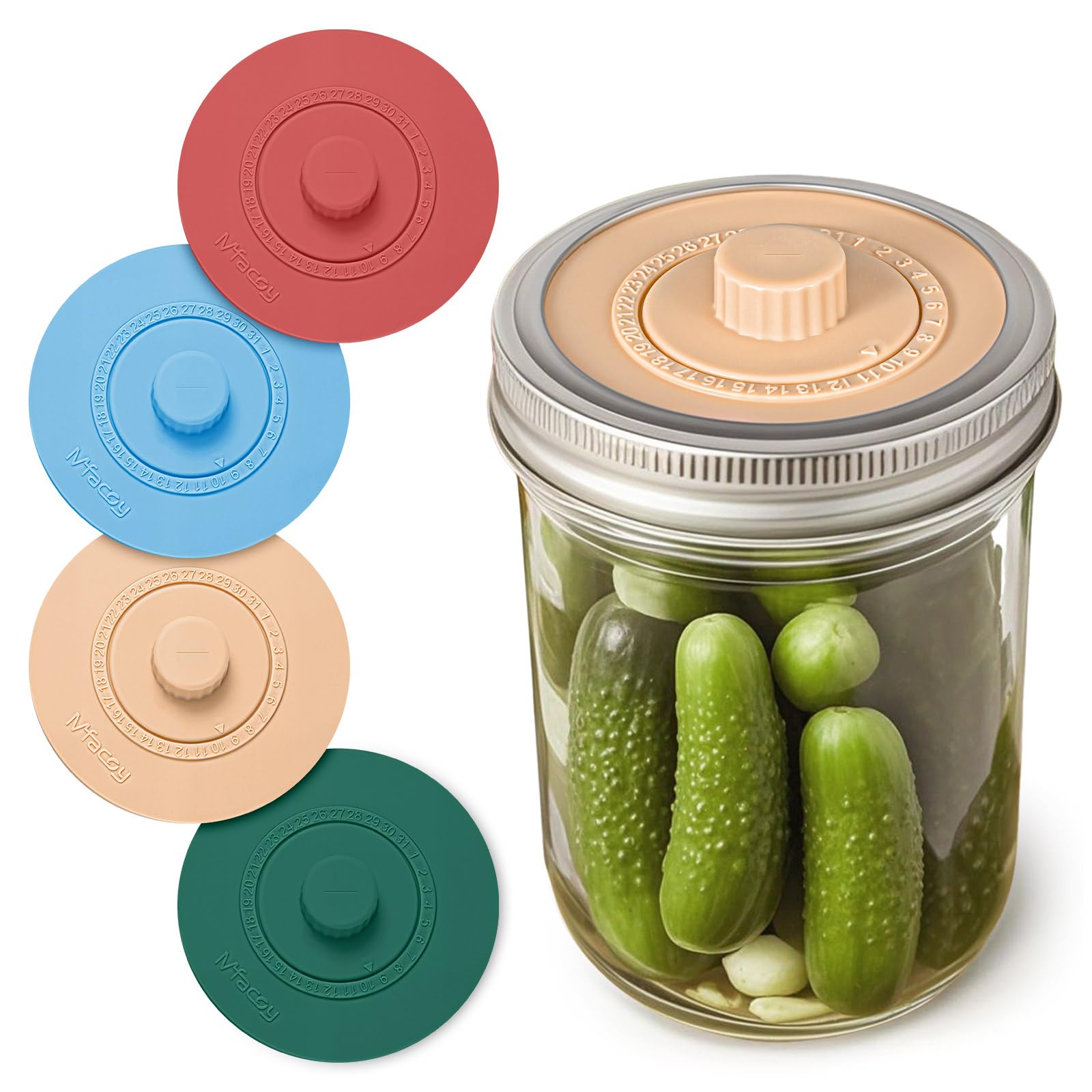
A date dial looks like a gimmick on the listing and turns out to be the thing you use every time: set the ring to the day the jar was packed and a glance tells you which of the three jars on the counter is ready to taste. That dial, on a set that costs as little as anything here, is why these are the wide-mouth lids we suggest to someone starting out.
Four food-grade silicone lids come in the pack, each with a one-way valve that vents CO2 with no water to top up. They are dishwasher safe, so cleaning is a rinse and a shake rather than a soak.
The Brillenti kit does a similar job with a pump and a much larger outlay; the Mfacoy covers the venting half of that without the extra equipment. For a counter full of small ferments, the venting half is the half that matters.
Pros
- Date dial tracks each batch
- Among the least expensive wide-mouth sets here
- Dishwasher-safe silicone
- Four lids per pack
Cons
- Won’t seat on every wide-mouth jar
Brillenti Fermentation Lid Kit – Best for Oxygen-Free Starts

Key Features
- Extras: Date tracker ring
- Jar fit: Wide-mouth Mason jars
- Lid type: Auto-venting waterless
- Set includes: 4 lids and hand pump
- Price: Premium
A small hand pump comes in the box with these four lids, and it does something no other pick here does: it pulls air out of the jar before you leave it to ferment.
The lids are the auto-venting sort — a silicone valve releases CO2 without burping, four easy-grip tabs break loose more easily than a plain band, and a date ring saves you a strip of tape. Every other lid here vents; this is the only set that also lets you pull a vacuum before fermentation starts.
We wish the pump felt sturdier. It is a small plastic assembly, and a vacuum that does not hold makes the whole feature pointless, so test it on an empty jar before the first ferment and send it back if it will not hold. The lids themselves handle the everyday work; it is the extra that is fussy.
Pros
- Only set here with a vacuum pump
- Auto-venting valve, no burping
- Date ring and easy-grip tabs
- Four lids per kit
Cons
- Costs the most of any pick here
SOPHICO Silicone Ferment Lids (4-Pack) – Best for Everyday Jar Ferments

Key Features
- Count: 4 lids
- Jar fit: Wide-mouth Mason jars
- Cleaning: Dishwasher safe
- Lid type: One-piece silicone valve
- Price: Budget
One molded piece of silicone, a valve built into the center, and no ring to hunt for: SOPHICO’s lids are the simplest thing here to own and the easiest to wash.
They seat in wide-mouth Mason jars and in store-brand jars that share the same mouth, and the mixed colors turn out to be more useful than they look — four ferments on a shelf, each with its own lid, and no sticky tape labels to scrape off later. They are dishwasher safe and they do not need a band to hold them down.
The behavior to know about comes at the start. A silicone lid holds by its own seal, and when a jar is at its most active the pressure can lift the lid rather than pass only through the valve. Keep the brine up to the top of the vegetables and stand the jar on a plate for the first few days; once the ferment settles, the lid sits still.
We were surprised by how much the colors help, and by how little these ask of you — no water, no cap, no gasket to lose. If you want a date on the jar, pay a little more for the Mfacoy set; if you want a lid you can throw in the dishwasher and forget, this is the one.
Pros
- One-piece silicone, nothing to disassemble
- Dishwasher safe
- Colors keep batches straight
- Fits jars beyond Mason
Cons
- Lid can lift during the most active ferment
How We Tested Fermentation Airlocks (and What Leaked)
We gathered every airlock, stopper, grommet, and waterless lid we could find from homebrew suppliers and kitchen-gear brands, then narrowed by what each one actually fits: #6 carboy openings, small-mouth and wide-mouth Mason jars, and drilled bucket lids. Price per usable piece and whether the stoppers came in sizes you can actually use cut the list down further. Sixteen units made it.
Testing ran four months, split between a kitchen counter, a pantry shelf, and one cool garage shelf. We fermented sauerkraut and kimchi in quart and half-gallon jars, a mash for hot sauce, and a gallon of cider and a mead in carboys, so every style of valve got a batch with real sugar working under it.
Bubble rate was our first read: we counted bubbles per minute at peak fermentation to see whether a valve vented steadily or stalled and then burped all at once. Sealing and leakage got a rougher test. We loaded jars and carboys, set them on a sheet pan, tipped each one onto its side for 20 minutes, and checked for drips; we also lifted carboys by the airlock alone to see whether the stopper held its grip.
After a month of sticky brine we unscrewed every waterless lid and noted which ones fought back, then washed everything repeatedly, flexed the silicone, and snapped stems back into their caps. Fit decided a lot: several stoppers sat loose in a carboy neck, and some lids worked on wide-mouth jars only. At the end of each batch we inspected the surface for kahm yeast or mold, which told us more about venting than any spec sheet did.
How to Choose a Fermentation Airlock
The airlock is the cheapest piece of equipment in a ferment and the one that decides whether the batch stays clean, so pick it to match the vessel you already own rather than the feature list on the box.
Start With the Vessel, Not the Airlock
A carboy with a smooth neck takes a tapered rubber stopper. A plastic bucket takes a stopper, or a grommet if you drill the lid. A Mason jar takes a lid built for its mouth, and wide-mouth and regular-mouth jars are separate product lines that do not cross over — the Masontops caps fit small-mouth jars, the Mfacoy and SOPHICO lids fit wide-mouth, and no lid does both.
That is three different purchases disguised as one search. Decide first what the ferment will sit in, then buy the hardware that seats in it; the airlock body is the least variable part of the whole setup.
Bubble, Three-Piece, or Waterless
Bubble and S-shape airlocks hold a little water in two chambers; a three-piece holds it in a cup around a floating stem. Both are water locks: they vent when pressure builds and stop air from coming back. The practical difference is cleaning, which is why a three-piece suits a primary ferment that foams and a bubble airlock suits the quieter secondary and clearing stages.
Waterless jar lids swap the water lock for a silicone one-way valve. They cannot dry out, they add almost no height, and they let a jar go back in a cupboard — the right answer for sauerkraut, pickles, and kimchi. Running beer and vegetables means owning two kinds, not finding one that does both.
The Seal Is What Fails, Not the Valve
An airlock on a leaking stopper is decoration. Dry the bung and the neck so the rubber grips glass, press and twist rather than pushing straight down, and check that a silicone lid has not lifted once fermentation gets going.
If the bubbling stops, the ferment may simply be finished — but rule out the seal first. Press the stopper home and watch for a few minutes before you assume the batch is done.
Count the Pieces Against Your Batches
Kits differ in what actually arrives: airlocks alone, airlocks with stoppers, or airlocks with stoppers and grommets. Look at the ratio, because a bag with more airlocks than bungs leaves you hunting for a stopper the night you rack.
Grommets are the piece most people undervalue. Drill a half-inch hole in a plastic lid, press one in, and the airlock seats without a stopper that has to stay clean and dry.
Frequently Asked Questions
What size stopper do I need for a carboy?
A #6 stopper fits openings around 1 1/8 inch (26 to 28 mm) inside diameter, which covers most 3-, 5-, and 6-gallon glass and plastic carboys and standard drilled bucket lids. A #6.5 is bigger, not smaller, so it will not rescue a narrow neck.
Measure across the hole rather than the outside of the neck. If your vessel is a one-gallon jug, expect a narrower opening than a carboy has.
How much water goes in an airlock, and how often do I check it?
Fill to the line molded into the body — enough that both chambers hold liquid, not so much that it foams out the top. Check every week or two, and again after moving a carboy or when the room warms up.
An airlock that has gone dry is an open door to oxygen. Top it up with water or a little sanitizer solution and the batch carries on.
Can the liquid in the airlock get sucked into my brew?
Yes, when the ferment cools. A cold snap or a cold crash drops the pressure inside the vessel and draws the liquid back through the stem. That is why water alone is a compromise: fill with sanitizer solution or cheap vodka so anything that ends up in the carboy is harmless.
Keep the airlock upright when you move a full vessel, too.
Can I reuse airlocks and jar lids?
Both are reusable. Rinse, sanitize with the rest of your gear, and air-dry before storage; silicone lids can go on the top rack of a dishwasher.
Retire anything cracked, cloudy, or stretched. A split three-piece body or a lid with a torn gasket will not seal, and replacing it costs far less than a spoiled batch.
Final Verdict
Buy the FastRack twin bubble pack first. Two complete airlock-and-bung setups cover a standard carboy, the design has nothing to lose or reassemble, and it sits at the low end of what anything here costs — the sensible default for beer, wine, mead, and cider.
The case that changes the answer is a jar-based ferment. For sauerkraut, pickles, and kimchi, go to the Masontops caps in small-mouth jars or the Mfacoy lids in wide-mouth, and keep the carboys on the bubble airlocks.