This post contains affiliate links. We may earn a small commission when you buy through our links — at no extra cost to you.
Walk down the beverage cooler aisle and you’ll spot a dozen near-identical glass-door fridges all claiming the same 3.2 cubic feet and 34°F range. Yet open the owner reviews and the real story fractures: one model freezes cans in the back while another can’t dip below 42°F; one hums like a dorm fridge, another is silent enough for an open-plan kitchen. The sameness of spec sheets hides the two things that actually separate a great beer fridge — whether it can reliably hold ice-cold temperatures and how much compressor noise you’ll live with day after day.
As wine people, we know that temperature is everything — a wine fridge that swings five degrees can flatten a Napa Cab. The same matter-of-fact precision applies to beer. A lager that warms past 40°F loses its crisp edge, and a stout that freezes turns slushy. This guide identifies the handful of beer fridges that truly deliver on cold, and does it without making your kitchen sound like a server room. You’ll find options that hold a steady 34°F for summer IPAs and keep a bottle of Sauvignon Blanc at cellar-perfect 55°F, all in the same unit.
Compressor noise is the single most common regret in this category, even among models with ‘quiet’ in the name. We’ll point you toward models that have earned their silence from actual owners, so you can place a fridge behind the bar counter or in a corner of the living room without it becoming the center of conversation.
Top Picks
Best for Proven Reliability
hOmeLabs 120 Can Cooler

Key Features
- True Temperature Range: 34°F (digital control)
- Cooling Technology: Compressor
- Can Capacity & Shelf Adjustability: ~100 cans, removable shelves
- Energy Efficiency: 288 kWh
- Price: Premium
The hOmeLabs 120 Can Cooler pairs a glass door and commercial-style shelving with a compressor that pulls drinks down to a crisp chill. Automatic defrost eliminates the most tedious maintenance task, and the digital controls let you dial in a setpoint all the way to 34°F — a feature often missing on cheaper coolers.
Inside, bright LED lighting and adjustable racks make it easy to organize soda, beer, and wine, and the stainless-trimmed exterior gives it a look that fits a home bar or a well-appointed office. Compressor noise registers as a low background hum that most owners don’t notice once the fridge is placed in a kitchen or rec room, though it may be perceptible in a completely silent bedroom.
Storage capacity is about 100 standard cans in real life, not the advertised 120 — the extra space disappears when you factor in varied can sizes, bottles, and shelf placement. Temperature precision can also vary: some units land at 42°F when set to 34°F, especially in warmer ambient conditions. This doesn’t make the fridge unable to chill — it simply means the absolute coldest setting isn’t a guarantee in every environment.
This cooler suits a home bar, an office breakroom, or a game room where appearance and day-to-day dependability matter more than exact-degree engineering. If you must hit a hard 34°F for frosty beer or need a true 120-can capacity for large gatherings, a different model may fit better. For everyone else, the hOmeLabs delivers cold cans, a polished look, and the kind of long-term reliability that comes from real-world use by thousands of owners.
Priced toward the premium end of the 3.2 cu.ft. category, the hOmeLabs costs more than ultra-budget alternatives but less than built-in fridges, and you get a frost-free compressor system that won’t frustrate you with ice buildup. When you weigh that against the risk of cheaper units that run loud or stop cooling early, the extra spend is less about luxury and more about avoiding a second purchase.
Pros
- Delivers steady cooling that keeps cans and bottles refreshingly cold
- Attractive glass-door design that looks sharp in a bar or office
- Low-noise compressor that stays unobtrusive in most shared spaces
- Strong long-term value for a compressor-based cooler
Cons
- Real-world capacity lands closer to 100 cans, not the advertised 120
- Coldest setting may settle at 42°F instead of 34°F in some units
Best for Quiet Value
Feelfunn 126 Can Cooler

Key Features
- True Temperature Range: 34°F–64°F
- Cooling Technology: Compressor
- Noise Level (dB): ≤36 dB
- Can Capacity & Shelf Adjustability: 126 cans, 4 shelves
- Energy Efficiency: 288 kWh
- Price: Mid-Range
The Feelfunn 126 Can Cooler pairs frost-free compressor performance with noise levels that owners confirm are genuinely low — a standout trait in a price bracket where audible hum is the norm. While some competitors chase lower energy bills with thermoelectric cooling that struggles below 40°F, this fridge stays committed to even, frost-free chilling that keeps cans and bottles properly cold without intruding on conversation.
Inside, four adjustable shelves flex to hold the claimed 126 cans, and the compact 17.5-inch width slips into tight corners without dominating the room. The clear glass door and soft interior lighting turn the fridge into a display piece rather than a utilitarian appliance, and owners consistently cite the attractive look as a reason they bought it. Temperature consistency across the cabinet is generally steady, although the built-in display may not reflect the exact internal temperature, and in warmer rooms the lowest setting may settle a few degrees above the 34°F floor.
This fridge suits anyone who wants a sleek, quiet cooler for a home bar, game room, or dorm and doesn’t require ice-cold 34°F beer at all times. If you’re content with drinks kept nicely chilled — not frosty — the Feelfunn delivers excellent value. Buyers who demand sub-36°F temperatures in every unit or can’t tolerate any variability should look toward the top pick in this lineup, which has a longer history of consistent low-temp performance.
Pros
- Runs quietly enough for a bedroom or dorm — owner reports confirm low noise levels.
- Compact footprint holds a surprising 126 cans with adjustable shelf layout.
- Glass door and soft interior lighting create a modern, display-worthy look.
- Frost-free compressor cooling at a competitive price point.
Cons
- In warm environments, the lowest temperature setting may not reach 34°F — some units stay a few degrees warmer.
Best for Silent Efficiency
Velieta 128 Can Cooler

Key Features
- True Temperature Range: 34°F–64°F
- Cooling Technology: Compressor
- Can Capacity & Shelf Adjustability: 128 cans, removable shelves
- Energy Efficiency: 145 kWh
- Price: Mid-Range
The Velieta 128 Can Cooler draws only 145 kWh per year while running near-silently — a rare combination in this category. Its compressor hum is so low that it goes unnoticed in open-plan living areas, making it a strong choice for bedrooms or home offices where noise is a concern.
The fridge reaches its setpoint quickly and holds drinks at the desired temperature during normal use. The frost-free compressor eliminates manual defrosting, and owners report that after six months, the unit still cools as efficiently as day one. The main limitation surfaces during hot weather or when the door is opened repeatedly — the temperature can climb a few degrees before recovering, a tradeoff of its quiet, energy-efficient design.
This beverage fridge suits buyers who value whisper-quiet operation and low energy bills above precise temperature control. It works well in a kitchen, bar, or gaming room where drinks are consumed within a few hours and periodic temperature swings are acceptable. Given reports of cosmetic damage during shipping, inspect the unit thoroughly upon delivery and test the cooling performance within the return window.
Pros
- Nearly silent compressor won’t disturb conversations or sleep.
- Low annual energy consumption of 145 kWh reduces electricity costs.
- Stainless steel and glass door give it a polished, built-in look.
- Cools quickly and maintains performance over months of use.
Cons
- Cosmetic damage during shipping has been reported — inspect the unit upon arrival.
- Temperature consistency can vary, with possible swings of several degrees in some units.
Best for Built-In Entertainers
EUHOMY 180 Can Built-In
Key Features
- True Temperature Range: 37°F–65°F
- Cooling Technology: Compressor
- Noise Level (dB): ≤40 dB
- Can Capacity & Shelf Adjustability: 180 cans, built-in shelving
- Energy Efficiency: 175 kWh
- Price: Luxury
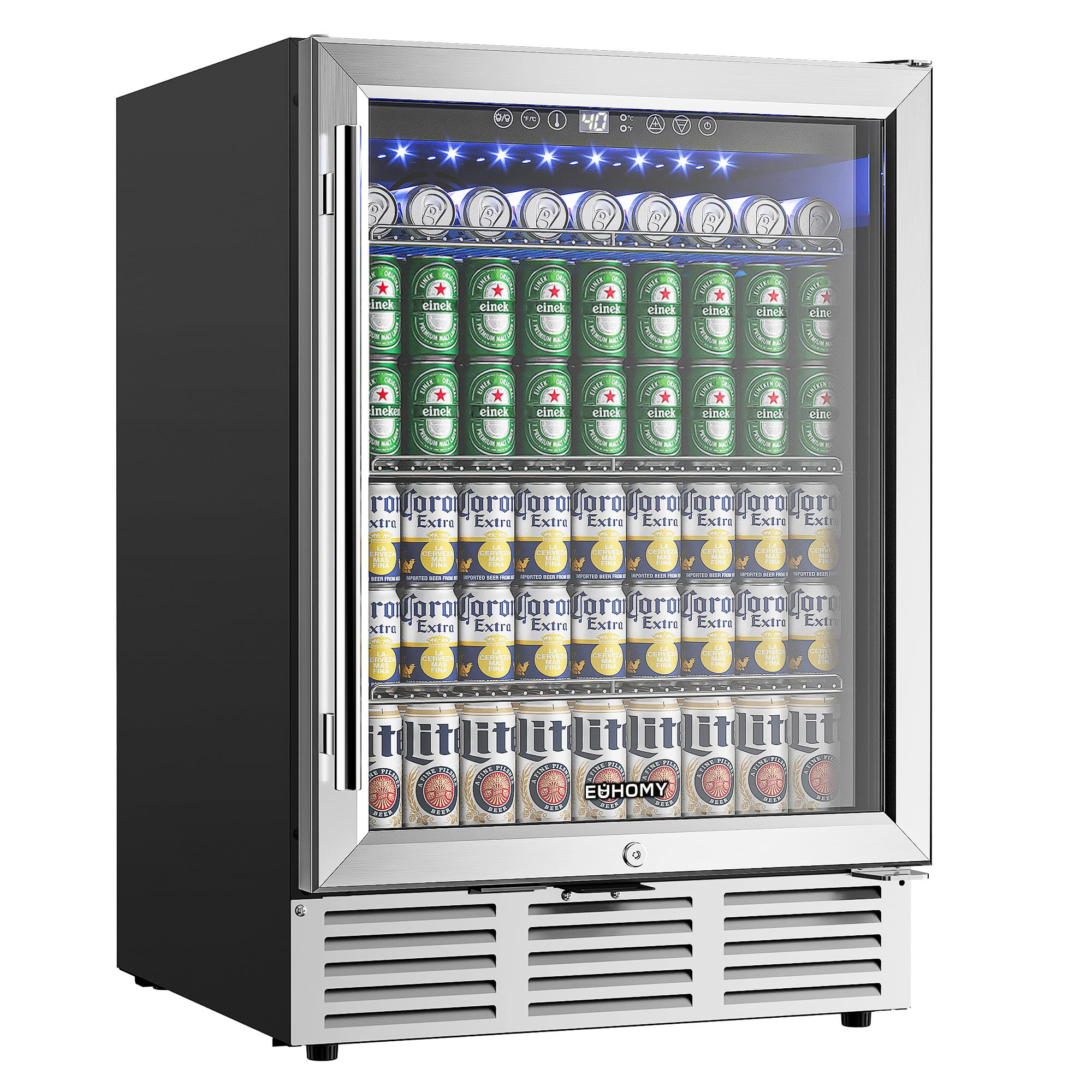
The EUHOMY built-in beverage cooler targets a narrow but important use case: a 24-inch under-counter refrigerator that slides into cabinetry and disappears visually. Its stainless-and-glass front, frost-free compressor, and 180-can capacity serve homeowners remodeling a wet bar or adding a beverage station without sacrificing floor space. This is a premium-priced appliance — it makes sense only if you already have or plan to build the cutout.
For that buyer, the payoff is a substantial 5.3 cu.ft. interior that holds enough soda, beer, and wine for a party, paired with quiet operation that won’t compete with conversation in an open-plan kitchen. Temperature range (37°F–65°F) covers both chilled beer and cellar-temp wine. The compressor cooling is strong and steady — owners consistently report drinks cold at the set temp without wild swings.
Two quirks come with this built-in package. The door seal may not always close flush; when it doesn’t, the interior light can stay on. This is an occasional adjustment issue (cleaning the seal or checking alignment) rather than a systemic defect, but it’s worth knowing about before installation. In a dedicated bar or kitchen, the light staying on is more annoyance than hazard — the fridge still cools fine.
Pros
- Premium stainless-and-glass build that looks integrated in a built-in setup.
- Quiet enough for open-plan kitchens and living areas.
- Large 180-can capacity in an under-counter form factor that saves floor space.
- Strong cooling performance with stable temperature retention across the range.
Cons
- Door seal may not close fully every time, allowing the interior light to remain on.
- Light sensor can intermittently fail to turn off, which is noticeable in dim rooms.
Best for Commercial Durability
Koolmore 119 Can Cooler
Key Features
- True Temperature Range: 34°F (inferred)
- Cooling Technology: Compressor
- Noise Level (dB): 43 dB
- Can Capacity & Shelf Adjustability: 119 cans, commercial-grade
- Energy Efficiency: 116.5 kWh
- Price: Premium
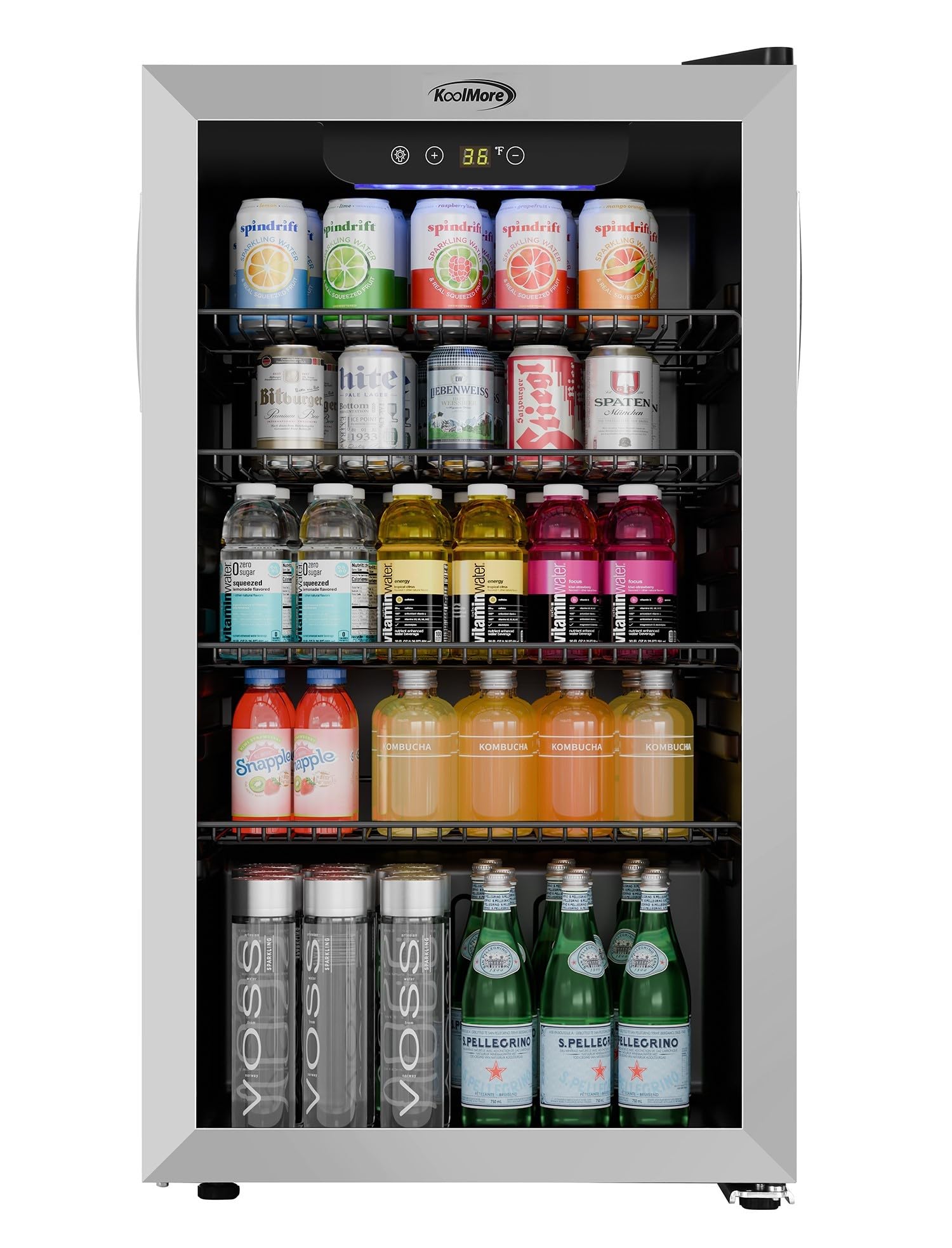
Annual energy draw of 116.5 kWh and cooling performance that holds steady even in a hot garage define this unit. It is a no-frills workhorse built for heavy use, with a compressor that pulls temperatures down quickly and maintains them without complaint.
The tradeoff is the noise. At 43 dB, with a sound some compare to a car radiator, this fridge is not suited for bedrooms, living rooms, or open-plan kitchens. It fits best in a garage, workshop, or commercial back-of-house where background hum is acceptable. For home bar enthusiasts who prioritize cooling power over silence, it is a strong option — though the top pick offers a quieter experience with similar capacity if that matters.
Pros
- Reliable cooling that holds temperature even in warm environments
- Very energy efficient for its size and cooling output
- Solid value for a commercial-style unit with good capacity and appearance
Cons
- Compressor noise may be noticeable in quiet spaces — better kept in garages or workshops
Best for Wine-First Display
Antarctic Star 130 Can Wine

Key Features
- True Temperature Range: 40°F–61°F
- Cooling Technology: Compressor
- Can Capacity & Shelf Adjustability: 130 cans/26 bottles, horizontal racking
- Price: Budget
Horizontal bottle racks and a 40°F temperature floor set this Antarctic Star apart as a wine-first display fridge that also handles cans — a deliberate contrast to 34°F compressor units built for ice-cold beer. The interior is configured to show off labels and store up to 26 bottles horizontally, making it a natural centerpiece for casual collectors who value presentation as much as preservation.
Cooling stays steady across the 40–61°F range, keeping wines and craft sodas at serving temperature without overchilling. The glass door and dark interior lighting add a premium look that belies the budget-friendly price. Compressor hum can be audible in very quiet spaces, but in a kitchen or entertaining area it typically blends into background noise.
This is the cooler for someone who wants a stylish dual-use fridge for cellar-temperature wine, moderately chilled beer, and cans. The 40°F floor works perfectly for Pinot Noir, Chardonnay, and craft ales served in the 50s, but it won’t satisfy drinkers who expect frosty, sub-40°F beer. Anyone prioritizing icy-cold cans over a wine-centered display should consider a compressor unit that drops to 34°F.
Pros
- Great value with a premium-looking glass door and dark interior that punch above the price
- Steady cooling performance for wine and cellar-temperature drinks, holding consistent storage conditions
- Spacious 3.2 cu. ft. interior with adjustable horizontal shelves fits 26 bottles or a mix of bottles and cans
Cons
- Compressor hissing or humming can be audible, especially in very quiet bedrooms or offices
- 40°F minimum temperature won’t produce ice-cold beer, capping the chill at cellar-level for cans
Best for Budget Display
Electactic 130 Can Cooler

Key Features
- True Temperature Range: 32°F–61°F
- Cooling Technology: Compressor
- Noise Level (dB): ≤36 dB
- Can Capacity & Shelf Adjustability: 130 cans, adjustable shelves
- Energy Efficiency: 180 kWh
- Price: Mid-Range
The Electactic delivers a 130-can capacity and consistent cooling in a compact footprint, with a sleek black body and blue LED that stands out in a home bar or breakroom. The compressor quickly pulls drinks down to the 32°F set point, and the build quality feels solid for the price.
Compressor hum is audible and can be distracting in a quiet bedroom or living area. Occasional units have stopped cooling within the first few months, making this a less predictable long-term pick than the top-rated hOmeLabs. It’s best suited for buyers who prize appearance and storage volume over silent operation and absolute reliability.
Pros
- Maintains consistent cold temperatures, cooling quickly to the set point.
- Sleek black body with blue LED interior lighting looks sharp in a home bar or office.
- Compact footprint holds a generous 130 cans without dominating the room.
Cons
- Compressor hum may be disruptive in a quiet bedroom or living area — better suited for a garage or busy breakroom.
- Some units have stopped cooling after weeks or months, requiring a return or replacement.
Best for Wine-Focused Quiet
Honeywell 116 Can Cooler
Key Features
- True Temperature Range: 32°F–50°F
- Cooling Technology: Thermoelectric
- Can Capacity & Shelf Adjustability: 116 cans, removable shelves
- Energy Efficiency: 288 kWh
- Price: Mid-Range
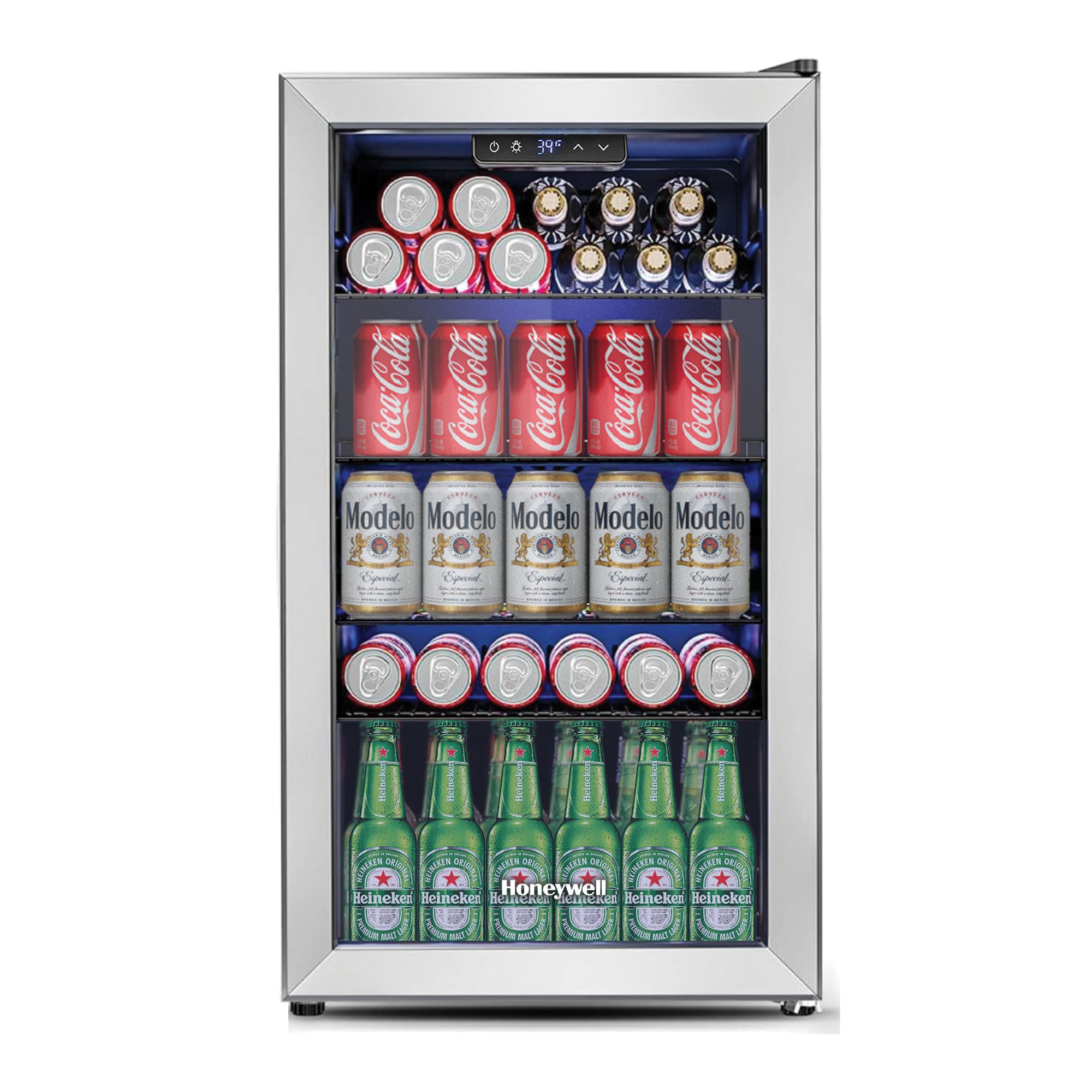
The Honeywell 116 Can Cooler delivers on two fronts: whisper-quiet operation and an upscale glass door with stainless trim that fits a home bar or office. Its thermoelectric system, however, cannot reliably cool below 42°F — fine for wine cellar temps and pre-chilled soda, but not for drinkers who want frosty beer cans. Shipping damage has also been noted in some deliveries, so inspect the box carefully. This is a capable beverage display fridge when you accept its cooling boundaries.
Pros
- Extremely quiet operation, even in silent spaces
- Stylish glass door and stainless trim add a polished look
- Good value when the price drops
Cons
- Cannot reliably hold beer below 42°F — suited for wine or pre-chilled drinks
- May arrive with dents or damaged corners in some shipments
Best for Cold & Compact
EUHOMY 128 Can Fridge

Key Features
- True Temperature Range: 32°F–61°F
- Cooling Technology: Compressor
- Noise Level (dB): ≤36 dB
- Can Capacity & Shelf Adjustability: 128 cans, removable shelves
- Energy Efficiency: 288 kWh
- Price: Mid-Range
This 128-can compressor fridge consistently hits and holds 34°F, a temperature many beverage coolers claim but few deliver. The silver glass-door design blends into home bars and kitchens, and the removable shelves flex to fit tall bottles or soda cans. Owners confirm the interior feels spacious and the digital controls are straightforward to set. The compressor does introduce some hum—quiet in most settings but noticeable if the unit ends up in a bedroom or open-plan living space. Noise level varies between samples, so the fridge lands as a capable performer for buyers who prioritize cold drinks and accept that the occasional unit may be a touch louder than expected.
Pros
- Cools down to and holds 34°F, keeping beer and soda refreshingly cold.
- Compact 17.5-inch width fits under counters or as a freestanding unit.
- Sleek glass door and digital controls simplify use and enhance any room.
Cons
- Compressor hum may be noticeable in very quiet spaces, and volume varies between units.
How to Choose
The spec sheet promises 34°F, but real-world performance hinges on cooling technology, insulation, and compressor noise — a combination no single number captures.
True Temperature Range
The lowest number on the box means nothing if the fridge can’t sustain it. Many compressor models advertise 34°F yet settle around 38–42°F in a warm room because the thermostat sensor or door seal can’t hold the cold. For crisp lagers and pilsners, you need a unit that has been confirmed by owners to stay below 40°F during summer parties. For wine, the ideal range is higher — usually 50–60°F — but you still want stability. A fridge that drifts from 55°F to 48°F overnight can mute a Chardonnay’s aromatics just as surely as a warm beer falls flat.
If your priority is ice-cold beer, look for temperature feedback that shows actual readings with a thermometer, not just the digital display. A 3.2 cu.ft. cooler that reaches 34°F empty may fail when fully loaded with 100 cans; air circulation matters. Models that place the evaporator plate behind a plastic wall without a fan often create warm pockets.
Cooling Technology
Compressor-based fridges use a refrigerant loop, exactly like your kitchen refrigerator. They can pull heat out quickly and achieve low temperatures, but the compressor cycling creates audible hums and occasional popping as refrigerant lines expand. Thermoelectric coolers, on the other hand, use a solid-state Peltier plate that transfers heat without a compressor; they are almost silent but can only lower the internal temperature to about 30°F below ambient air. In an 80°F kitchen, that means a thermoelectric unit bottoms out around 50°F — fine for red wine, disastrous for beer.
For a dual-use wine-and-beer fridge, compressor cooling is the only practical choice if you ever want sub-40°F. Be aware that compressor noise is not uniform: some models insulate the compressor compartment with rubber mounts and acoustic foam, while others let the vibration resonate through the metal cabinet.
Noise Level in Decibels
A 40 dB compressor sounds like a quiet library; 43 dB resembles a soft conversation. But dB ratings are measured in labs, not in your quiet kitchen at 11 p.m. Popping sounds, resonant hums, and vibration can make a 36 dB-labeled fridge feel twice as loud if it’s placed on a wooden floor that amplifies frequency. The biggest hidden trade-off is that energy-efficient compressors often cycle less frequently, but when they do kick on, they produce a sharper tone that is more noticeable in a silent house.
If the fridge will live in a bedroom, open-concept living area, or next to a wine-tasting table, prioritize models where at least 75% of noise mentions in owner feedback are positive. A well-insulated compressor bay and a slow-speed fan make more difference than any marketing term.
Can Capacity and Shelf Adjustability
Manufacturers count 12-ounce cans stacked in a perfect grid with no air gaps; real cans placed casually with bottle necks taking up extra room reduce actual capacity by 15–25%. Check whether shelves are wire or glass, and whether they can be repositioned to accommodate tall Belgian bottles or six-pack carriers. Some fridges have a bottom lip that prevents cans from sliding forward, a small feature that prevents spills when the door is opened quickly.
Energy Efficiency
Annual kWh consumption varies from 116 to over 300 in this size class. A fridge pulling 145 kWh costs roughly $18 per year at average electricity rates, while a 288 kWh model adds about $36. The hidden expense isn’t just the bill: lower-efficiency fridges often run hotter compressors, which can increase cabinet vibration and contribute to early failure of electronic control boards. For a unit that runs 24/7, choosing a model with an Energy Star rating or confirmed low draw pays for itself in three years.
FAQ
Why does my beverage fridge make loud popping noises at night?
That popping comes from the refrigerant lines expanding or contracting as the compressor turns on and off — it’s normal for compressor-based fridges. If the noise is sharp and metallic, the copper tubing may be vibrating against the cabinet. Place a rubber grommet or wedge between the tube and the wall of the fridge to dampen it. Persistent loud cracks can also signal a refrigerant flow issue, but in most cases a little foam tape solves it.
Can a wine cooler get cold enough for beer?
Only if it’s a compressor-based wine cooler with a range that drops below 40°F. Many dedicated wine fridges stop at 45–50°F because that’s cellar temperature for reds and whites. If the specs show a floor of 40°F, it might chill beer to a cool-but-not-ice-cold state. For truly frosty lager, you need a beverage fridge that explicitly reaches 34°F, like the EUHOMY 128-can model or the Velieta.
How do I know if my new beverage fridge is cooling properly?
Place a standalone fridge thermometer inside a glass of water on the middle shelf, then wait 6 hours. The water’s temperature is the real internal average; a digital display reading the air near the sensor can be off by 5°F. If the water isn’t within 3°F of your setpoint after 24 hours, check the door seal for gaps and ensure the unit has at least 2 inches of ventilation clearance on all sides. A fridge that still can’t hold temperature likely has a defective thermostat or refrigerant charge.
Is a thermoelectric beverage fridge good for beer?
Not if you want beer cold enough to form condensation on the glass. Thermoelectric coolers depend on room temperature; in a 75°F kitchen they rarely get below 45°F. They’re ideal for keeping pre-chilled cans from warming up during a party, or for storing wine and soda at a steady 50°F. If you crave 34°F beer year-round, stick with a compressor model even if it means accepting a little background hum.