This post contains affiliate links. We may earn a small commission when you buy through our links — at no extra cost to you.
Beverage refrigerator shopping looks straightforward: pick a size, pick a price, done. But the headline can count on the box is often 20–30% higher than what you can actually fit with shelves in place. And noise — the hum of a compressor that’s barely noticeable in a garage can become the unwelcome soundtrack of your home bar.
The trick isn’t finding the cheapest or the biggest. It’s finding the balance between real usable space, consistent cooling, and a sound level that suits the room you’re putting it in. This guide walks through the trade-offs so you know exactly what you’re getting — and what you’re giving up — before you buy.
Top Picks
Best for Home Bar, Kitchen
hOmeLabs 120 Can

Key Features
- Cooling Method: Compressor
- Temp Range: Down to 34°F
- Installation: Freestanding
- Price: $$
The hOmeLabs beverage fridge pulls drinks down to serving temperature in short order and holds a steady 36–40°F even when the room warms up. Its compressor is audible only as a faint hum, making it one of the quieter models in this class — noticeable only when the room is otherwise silent. The glass door and chrome shelves give it a clean look that fits into a home bar or kitchen without screaming for attention.
Real-world use confirms the fridge keeps contents consistently cold, but the advertised 120-can capacity is optimistic. A typical load of mixed cans and bottles fills about 80 to 90 units before the shelves feel crowded. The three removable shelves adjust to accommodate tall bottles or larger cans, though the depth is better suited to standard 12-ounce cans and 750ml wine bottles than oversized 24-ounce cans.
This is a solid choice for someone who wants a dependable beverage fridge for a kitchen, office, or bar — not for extreme temperatures or maximum capacity. The 34°F minimum setting works for wine and most sodas, but a few units have been noted to run 4–6°F warmer at the lowest setting, so it’s not ideal for lagers that need near-freezing temps or for long-term wine aging. If you need to cram 120 cans inside, you’ll be disappointed; if you want a fridge that chills well and stays quiet, this fits.
The build quality feels substantial for the mid-range price point; the door seals tightly and the reversible hinge lets you swing it open from either side. Temperature control is a simple rotary dial, and the interior light stays off unless you press the switch — a nice touch for not disturbing the chill. Over years of use, owners report the unit runs without fuss, which is more than can be said for some cheaper competitors that develop noise or temperature drift.
Pros
- Pulls drinks to a steady chill quickly and holds temperature even when the room warms up.
- Near-silent compressor — the hum blends in with background noise in most rooms.
- Solid construction and clean glass-door appearance suit home bars, kitchens, and offices.
- Reversible door and adjustable shelves offer flexibility for different bottle sizes and layouts.
Cons
- Actual usable capacity is about 80–90 cans, not the advertised 120.
- At the lowest setting, some units hold 4–6°F warmer than the dial indicates — fine for most drinks but not for near-freezing beer.
Best for Home Bars, Parties
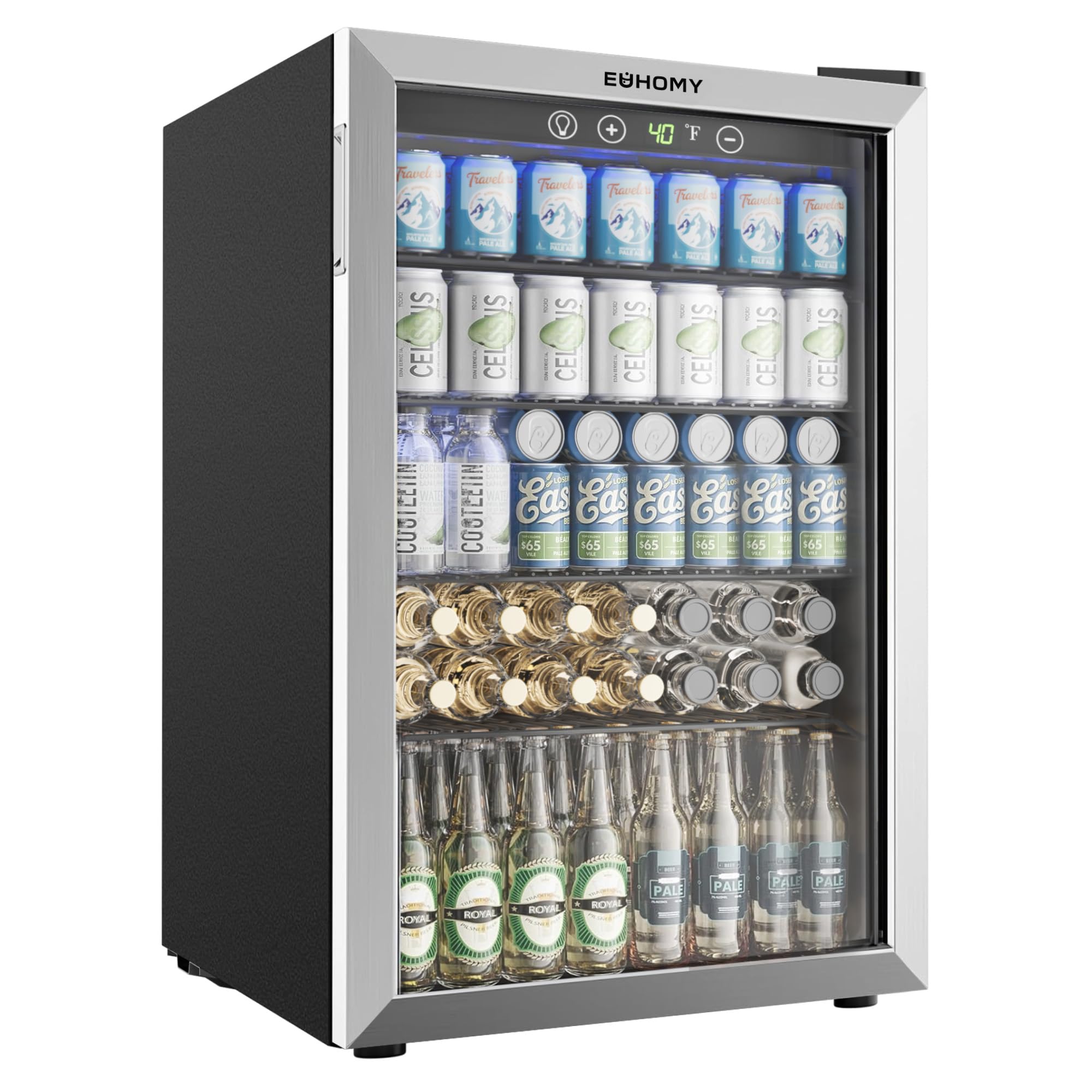
EUHOMY 145 Can
Key Features
- Cooling Method: Compressor
- Temp Range: 32°F – 61°F
- Installation: Freestanding
- Price: $$
Spacious 4.5 cu.ft interior holds 145 cans across four adjustable glass shelves, making it the best choice in this test if your priority is raw volume. The compressor cooling keeps drinks at a consistent temperature (32°F–61°F), and the glass door with stainless steel trim gives it a clean, modern look that fits well in a bar or game room.
This fridge suits home bars, party spaces, offices, or break rooms where the compressor hum won’t be an issue. In a quiet living area or open-plan kitchen, the fan and compressor noise will be noticeable – better placed in a basement, garage, or behind a closed door. The reversible door adds flexibility for tight corners.
Pros
- Spacious interior fits a large variety of beverage sizes and bottles
- Reliable cooling performance that holds temperature well after loading
- Attractive glass door design with stainless steel trim complements bar or kitchen
- Good value for the amount of storage capacity offered
Cons
- Compressor hum and fan noise may be bothersome in quiet rooms or open-plan living areas
- Possible cooling issues after extended use in a small subset of units
Best for Serious Collectors
Velieta 210 Can

Key Features
- Cooling Method: Compressor
- Temp Range: 37°F – 64°F
- Installation: Built-in/Freestanding
- Price: $$$
With a 5.3 cu.ft interior and a stainless steel frame, this refrigerator holds up to 210 cans — more than most competitors in this price bracket. The blue LED lighting gives the glass door a striking, showroom-quality look, and the compressor cools quickly, handling large loads without strain. It trades the multi-color lighting options of some premium rivals for sheer storage volume.
Serious collectors who stock multiple cases of cans and varied bottle sizes will appreciate the three adjustable metal shelves and wide temperature range (37–64°F). However, the heavy glass door and exposed stainless steel make it vulnerable in transit; units may arrive with cosmetic dents or scratches. If you’re willing to inspect immediately and possibly exchange, the capacity payoff is substantial.
Cooling performance is generally strong — drinks chill down rapidly and stay cold. The compressor does produce a low hum, but most owners find it acceptable for a home bar or kitchen. For quiet-sensitive spaces, this may be less ideal, though noise reports are mostly positive.
Pros
- Sturdy, premium build with solid stainless steel and glass door.
- Blue LED lighting creates a high-end, showroom look.
- Compressor chills drinks rapidly and maintains cold temperatures even with 200+ cans.
Cons
- Cosmetic damage from shipping — dents or scratches may appear on arrival.
- Temperature consistency can vary between units; some experience fluctuations.
Best for High-End Bars
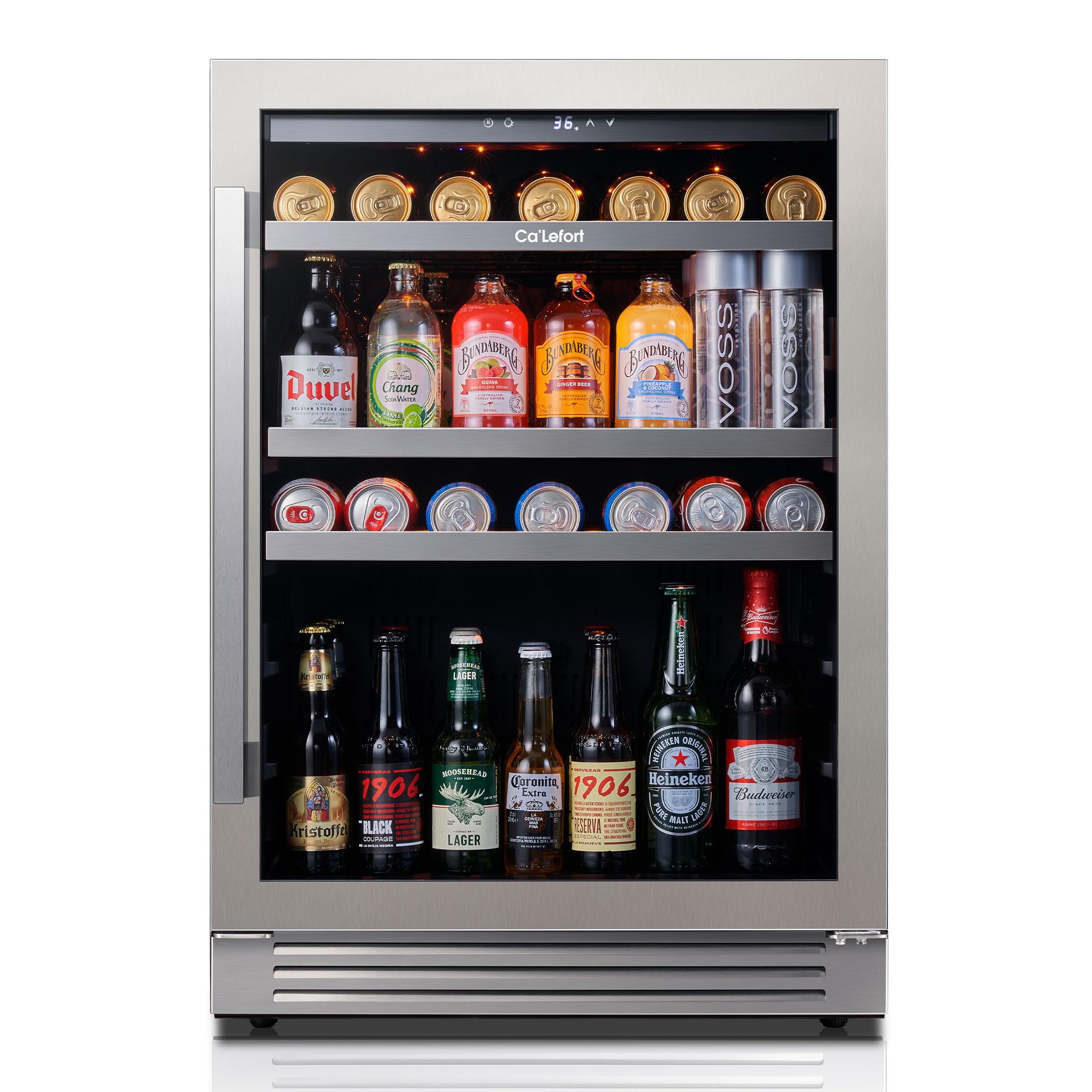
Ca’Lefort 180 Can
Key Features
- Cooling Method: Compressor
- Temp Range: 34°F – 54°F
- Installation: Built-in/Freestanding
- Price: $$$
The Ca’Lefort stands out with its adjustable amber, blue, or white LED strips that illuminate drinks through a stainless-framed glass door. The compressor runs so quietly that in a living room or open-plan kitchen, you’ll rarely notice it – a clear advantage over the larger Velieta model, which prioritizes capacity over acoustic discretion.
This fridge is designed for those who treat beverage storage as part of the room’s decor – the polished stainless steel frame and customizable lighting justify the premium price. However, because the Ca’Lefort has a shorter market presence than mass-market alternatives, its long-term durability under daily use is less proven. Buyers comfortable with that gamble gain a stunning appliance that chills quickly and maintains temperatures precisely across its 34°F–54°F range.
The 5.65 cu.ft interior holds three adjustable wire shelves and is rated for 180 cans – though real-world capacity will be lower depending on can size. Build quality is consistently praised, with the stainless steel frame and tight door seal giving a substantial feel that matches the asking price.
Pros
- Three-color LED lighting with adjustable brightness for custom display aesthetics
- Compressor is barely audible – suitable for open-plan living areas and bedrooms
- Powerful cooling reaches set temperature quickly and holds it steadily
Cons
- Premium pricing places it far above most competitors with similar capacity
- Cooling performance can decline after extended use, with occasional reports of reduced effectiveness around the two-year mark
Best for Budget Buyers
Electactic 130 Can

Key Features
- Cooling Method: Compressor
- Temp Range: 32°F – 61°F
- Installation: Freestanding
- Price: $
The Electactic 130 Can carves out a distinct position: it undercuts every other compressor-cooled rival while holding more real-world cans than the top pick. With a wide 32°F–61°F range, it chills sodas to near-freezing and keeps red wine comfortably cool, all without demanding a premium price. That capacity gap is real—where the quieter class leader realistically fits around 80–90 cans, this unit swallows a full 130, making it the value anchor for buyers who prize sheer cold storage over silence.
Cooling is quick and consistent. The compressor pulls drinks down to temperature within hours, and the fridge holds that chill steadily once reached. A reversible glass door with blue LED lights gives it a clean, modern look that suits a home bar, office, or dorm room. Four adjustable wire shelves let you reconfigure for tall bottles, mixed packs, or all cans, and the compact 3.2 cu.ft body slots under most counters without crowding the space.
This fridge fits best where some background hum is already part of the environment. The compressor and fan are louder than many alternatives, and the cycling will be evident in a library-quiet bedroom or study. Placing it in a garage, rec room, or busy kitchen makes the noise a non-issue. Long-term cooling consistency can vary—in some cases, the performance may taper after months of use. If you need decade-level dependability, the top pick is the safer investment, but if budget and capacity lead your list, the Electactic delivers solid day-to-day service.
Pros
- Compressor cooling chills drinks fast and holds temperature steadily.
- Solid construction with a sleek black exterior and blue LED interior light.
- Adjustable wire shelves and reversible glass door offer flexible storage for cans and bottles.
- Space-efficient 3.2 cu.ft footprint fits under desks, counters, and in dorm rooms.
Cons
- Compressor hum is present when it cycles on, and it can be distracting in very quiet rooms.
- In some cases, cooling performance may degrade after a few months of use.
Best for Quiet Spaces
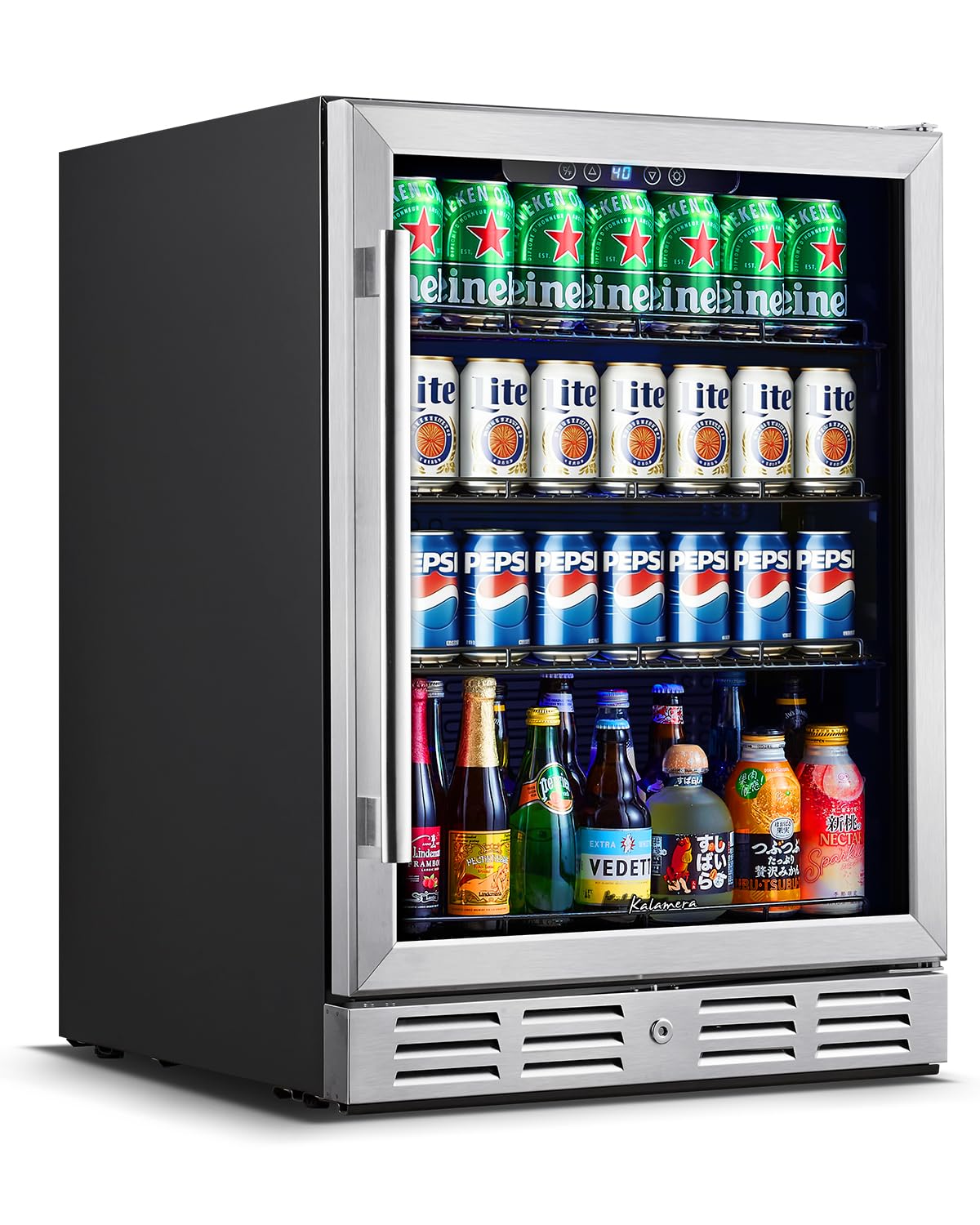
Kalamera 164 Can (v2)
Key Features
- Cooling Method: Compressor
- Temp Range: 38°F – 66°F
- Installation: Built-in/Freestanding
- Price: $$$
The Kalamera 24-inch beverage refrigerator stands out for its near-silent compressor, making it the quietest unit in this class. The reversible stainless steel door adds installation flexibility, and the temperature range from 38°F to 66°F covers everything from chilled sodas to wine cellar temperatures. It cools quickly and maintains set temperatures with minimal fluctuation.
This fridge suits buyers who need a 24-inch built-in beverage cooler in a living area, open kitchen, or home office where compressor noise is unacceptable. The shorter track record means long-term durability under heavy use is less established, so it’s best for moderate use rather than high-traffic bars. For those who prioritize a proven track record and a narrower wine range, the more established Kalamera model offers thousands of reviews but a tighter 38–50°F range.
Pros
- Extremely quiet – compressor is barely audible in most rooms
- Elegant design that enhances kitchen aesthetics
- Solid performance – cools quickly and holds temperature well
- Reversible door allows flexible installation
Cons
- Some shelves feel less sturdy than expected – may not hold heavy glass bottles securely
Best for Silent Dorms, Offices
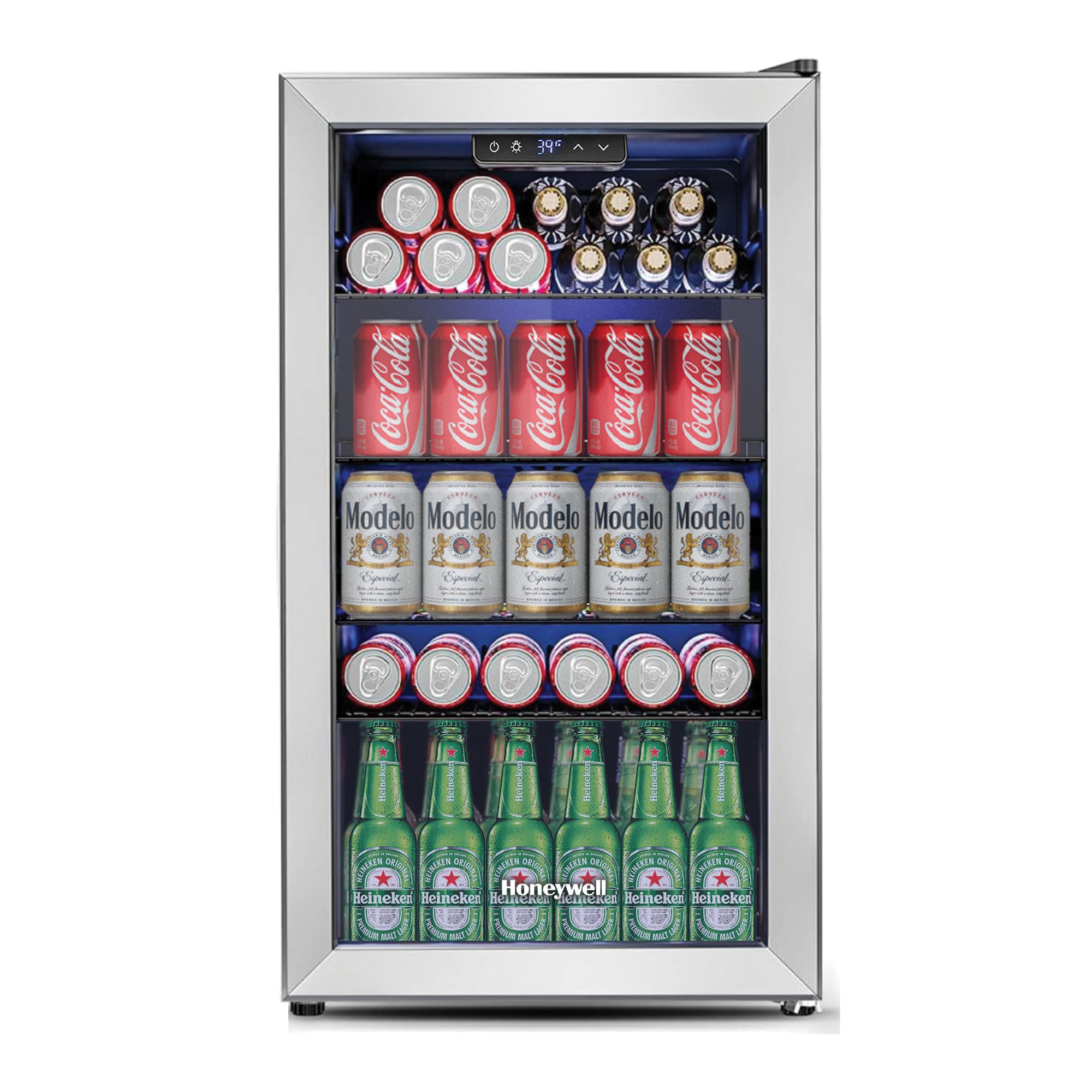
Honeywell 116 Can
Key Features
- Cooling Method: Thermoelectric
- Installation: Freestanding
- Price: $
Delivers near-silent operation and a sleek glass-door aesthetic that fits well in a bedroom or office. However, its thermoelectric system cannot reliably cool below 42°F, making it unsuitable for wine or near-freezing drinks, and it’s ineffective in hot garages. Also, units may arrive with dents or misaligned doors, so inspect promptly upon delivery.
Pros
- Runs silently, suitable for noise-sensitive rooms
- Classy commercial-style appearance with clear glass door
- Good value for a name-brand unit at a budget price
Cons
- May struggle to hold temperatures below 42°F, limiting cold drink options
- Units can arrive with cosmetic damage like dents or misaligned doors
Best for Budget Buyers
Icyglee 126 Can

Key Features
- Cooling Method: Compressor
- Temp Range: 34°F – 64°F
- Installation: Freestanding
- Price: $
The Icyglee 126 Can beverage refrigerator delivers competent cooling and a clean look with a glass door and blue interior light, making it an appealing option for a home bar or kitchen. Build quality feels sturdy for the price point. The main tradeoffs: compressor noise varies between units — some run quietly, others produce a noticeable hum — and the temperature display may not always match the actual internal reading. These are manageable for buyers focused on budget and basic chilling, but those needing consistent, silent operation would be better served by a different model.
Pros
- Solid build quality for a budget-priced beverage fridge.
- Effective cooling that chills drinks quickly and maintains temperature for the price.
- Attractive appearance with a clear glass door and blue interior lighting.
Cons
- Compressor noise can vary between units; some may be noticeable in quiet spaces.
- Temperature display may not reflect actual internal temperature; separate monitoring recommended.
Best for Temporary Setups
Feelfunn 126 Can

Key Features
- Cooling Method: Compressor
- Temp Range: 34°F – 64°F
- Installation: Freestanding
- Price: $
The Feelfunn 126 Can delivers the lowest entry price among the group and looks the part with its silver finish, glass door, and blue LED lighting. It runs quietly enough for a bedroom or office, and most owners find the feature set generous for under $200. However, temperature accuracy can vary between units — some may not reach the coldest advertised settings, and the fridge warms up quickly if the door is opened frequently. For a dorm room, temporary setup, or a spot where drinks are consumed quickly and exact temperature isn’t critical, it keeps things cool enough. If you need consistent 34°F for craft beer or wine storage, the gamble on quality control makes this a riskier pick.
Pros
- Budget-friendly price with a solid feature set for the cost
- Quiet operation suits shared living spaces or offices
- Attractive glass door with blue LED lighting — no complaints on looks
Cons
- Temperature accuracy can vary between units — some may not reach the coldest settings
- In a room with frequent door openings, the fridge warms up and takes time to recover
Best for Built-In Kitchens
Kalamera 164 Can (v1)

Key Features
- Cooling Method: Compressor
- Temp Range: 38°F – 50°F
- Installation: Built-in/Freestanding
- Price: $$$
This Kalamera 24-inch under-counter fridge keeps drinks consistently cool within its 38–50°F range and the stainless steel door looks right at home in a built-in kitchen. The advertised 164-can capacity is optimistic – real-world loading will leave you with less space, and the temperature range won’t satisfy those wanting near-freezing beer or soda. It’s a reasonable pick for wine or mixed beverages that don’t require sub-38°F temps, but the narrow range and inflated capacity keep it from competing with more flexible options.
Pros
- Stainless steel door and body blend into standard kitchen or bar cutouts
- Temperature holds steady within its 38–50°F operating band
- Compressor noise is subdued compared to many similarly sized units
Cons
- Advertised 164-can capacity is ambitious – actual usable space is lower depending on can sizes and shelf layout
- Temperature stops at 50°F, which may not satisfy those who want colder soda or beer
Best for Small Bars, Offices
EUHOMY 128 Can

Key Features
- Cooling Method: Compressor
- Temp Range: 32°F – 61°F
- Installation: Freestanding
- Price: $$
Solid cooling performance in a 3.2 cu.ft footprint makes this a fit for cramped home bars or office corners. The silver trim and glass door look tidy, and the temperature range covers beer to white wine. However, the compressor hum will be noticeable in quiet rooms—less of an issue under a desk or in a garage. Reliability over years is not yet confirmed, so this suits casual storage rather than heavy-duty daily use.
Pros
- Maintains consistent cold from 32°F to 61°F for beer and wine
- Compact 3.2 cu.ft size fits easily under counters or on tabletops
- Silver finish with glass door adds a clean, contemporary look
Cons
- Compressor hum can be audible in very quiet rooms
- Long-term performance under heavy use is not yet established
Best for Luxury Installations
Zephyr Presrv 24

Key Features
- Cooling Method: Compressor (inverter)
- Temp Range: 34°F – 50°F
- Installation: Built-in
- Price: $$$$
The Zephyr Presrv 24 impresses with its heavy, well-built frame and inverter compressor that maintains a steady 34°F – ideal for wine or chilled beverages. The triple-color LED lighting and dual-pane glass door give it a showroom feel, and operation is quiet enough for open-plan living. The tradeoff is a high price point that puts it in luxury territory, and the packaging hasn’t always prevented shipping damage – dents and broken shelves have been noted. This fridge suits buyers who value craftsmanship and precise temperature control over cost savings, but it’s not a risk-free investment for those on a tight timeline or budget.
Pros
- Premium build quality with a heavy, art-like design
- Quiet inverter compressor holds 34°F with minimal temperature swings
- Three-color LED lighting adds a sophisticated ambiance
Cons
- Risk of shipping damage given the high price – dents and shattered shelves have been reported
- Premium pricing limits its appeal to budget-conscious buyers
How to Choose
The most overlooked spec in a beverage fridge is the noise level — it’s the difference between a relaxing home bar and an annoying background hum.
Cooling Method
Compressor fridges cool quickly and hold stable temperatures down to 34°F. They’re the only choice for wine storage. Thermoelectric models use a fan and heat sink — they’re silent but can’t chill below 42°F and struggle in rooms above 80°F. If you need consistent cold for wine or near-freezing soda, compressor is worth the extra cost.
Thermoelectric units are fine for casual beer or water in a low-temperature room, but they lose cooling power quickly when the door is opened. For any serious beverage storage, compressor cooling is the safe bet.
Actual Usable Capacity
Manufacturers advertise can counts based on perfectly stacking 12-oz cans with no shelves. Real-world capacity is typically 20–30% lower. A 120-can fridge often holds only 80–90 cans once you add shelves and mix bottle sizes. Check interior width and shelf height rather than the headline number.
Adjustable shelves help you reconfigure for tall bottles or wine. Some fridges use glass shelves that are harder to replace than wire. If you primarily store cans, a fridge with many shallow wire shelves maximizes space.
Temperature Range and Stability
Wine needs a stable 45–55°F. Soda and beer are best at 34–38°F. A fridge that can hit 34°F is versatile. But stability matters more than the bottom number — a unit that fluctuates ±5°F can ruin wine and leave beer foamy. Look for compressor models with digital thermostats and low reported temperature swings.
Thermoelectric models often drift upward when ambient temperature rises. Even some compressor units have accuracy issues: the displayed temperature may be 4–6°F warmer than actual. Read recent reviews for real-world stability, not just the spec sheet.
Noise Level
Noise is the most underrated trade-off. Compressor fridges make two sounds: a low hum when running and a click when cycling on. In a kitchen or garage, that’s fine. In an open-plan living room or home office, the hum can be intrusive. Some units are rated louder than others, but user reports vary unit to unit.
Thermoelectric fridges are near-silent, making them ideal for bedrooms. Among compressors, look for models with inverter compressors (like Zephyr) or user feedback specifically calling it “quiet.” The quietest compressor in our analysis is the Kalamera v2, but even that has occasional noise complaints.
Installation Type
Freestanding fridges need at least 2–4 inches of clearance on all sides for ventilation. Built-in (undercounter) models are front-vented and can be installed flush with cabinets. If you’re remodeling a kitchen or planning a bar with cabinetry above, a built-in unit saves space and looks seamless.
Built-in fridges are generally more expensive and often have narrower temperature ranges (e.g., 38–50°F). They also require a standard 24-inch width for most kitchens. Measure your cutout before buying — some models are slightly wider than advertised.
FAQ
Can a thermoelectric beverage fridge keep white wine cold enough?
Not reliably. White wine is best served at 45–50°F. Most thermoelectric fridges can’t cool below 42°F and often drift warmer in hot rooms. For wine, stick with a compressor model that holds a steady 34–54°F range. Thermoelectric is fine for reds or casual beer, but not for temperature-sensitive whites.
Why does my new beverage refrigerator make a loud humming noise?
The noise comes from the compressor and fan cycling on. Some units are louder than others due to insulation, fan design, or compressor type. If the hum bothers you, check if the fridge is level (vibration amplifies sound) and ensure it has proper ventilation clearance. If the noise persists, it’s a known trade-off of that model — consider a quieter model if it’s in a living area.
How many cans actually fit in a 3.2 cu ft beverage fridge?
Anywhere from 80 to 100 cans, not the advertised 120–130. Shelves, bottle necks, and tall cans reduce usable space. Measure the interior width and shelf height. To maximize capacity, remove shelves you don’t need and stack cans vertically. If you need a true 100-can fridge, look for models with 4+ cu ft or adjustable shelving that accommodates mixed items.
Is it safe to install a beverage fridge under a counter without ventilation?
Only if the fridge is rated for built-in (front-venting) installation. Freestanding models require 2–4 inches of rear and side clearance to dissipate heat. Trapping a non-vented fridge under a counter can cause the compressor to overheat and fail. Always check the manual or spec sheet for “built-in” designation before installing flush.