This post contains affiliate links. We may earn a small commission when you buy through our links — at no extra cost to you.
The bottles started on the kitchen counter, moved to a bookshelf, and ended up in a laundry basket in the hall. That’s what happens when a modest collection of gin, vermouth, and wine has nowhere to live. A good bar cabinet fixes it in one piece of furniture: bottles standing upright, glasses where you can see them, and a top wide enough to actually make a drink on. The catch is that these cabinets hold a lot of weight in a small footprint, and the wrong one wobbles, sags, or arrives with pre-drilled holes that don’t line up.
Over eight months, my team and I assembled, loaded, and lived with 10 of them, and the gap between a good cabinet and a frustrating one shows up within the first hour. The bottle-slot count on a spec sheet tells you less than interior depth and how much weight a shelf will actually take. The picks below are the ones still standing straight in our homes.
Top Picks
Best for Corner Spaces
Aheaplus Corner Bar Cabinet

Key Features
- Power: 3 outlets, 2 USB ports
- Storage: 5 compartments, 2 doors
- Lighting: RGB LED, remote and app
- Footprint: 17.5"D x 17.5"W x 64.2"H
- Price: Midrange
A dead corner is the cheapest floor space in most apartments, and this cabinet is shaped to take it. Each side of the base is 17.5 inches, the whole piece rises 64.2 inches, and the triangular body tucks into a right angle that would otherwise hold a lamp.
That geometry is why it’s our top pick. Per square foot of floor it does more bar work than anything else in this group: a wine rack, hanging stemware, five compartments behind two doors, three outlets with two USB ports, and an RGB strip that runs from a remote or a phone. Racks, power, and light in one cabinet — nothing else here combines all three.
The power is the part we kept using. A blender or an ice maker plugs into the cabinet itself instead of into the wall behind it, so there’s no cord across the room and no shuffling furniture to reach a socket. The light is more than a novelty too: white at full brightness is what makes a dark corner usable, and the color modes are for when company is over. Build it with two people and an evening; the piece is small but the parts count isn’t.
Against a flat wall the wedge gives up a few inches of usable shelf, so if you don’t have a corner, the tall Aheaplus tower spends the same money better. In a corner, though, we haven’t found a more efficient way to keep a bottle, a glass, and a working outlet within arm’s reach of a chair.
Pros
- Wine rack, stemware rail, and five compartments
- Three outlets and two USB ports at shelf height
- RGB light strip with remote and app control
- 17.5-inch triangular base fits a dead corner
Cons
- Counter is a small triangle, not a mixing station
- Doors can hang out of square and need truing
Best for Fridge Integration
GDLF 78.7-Inch Bar Cabinet

Key Features
- Power: Flush outlet, USB and USB-C
- Dimensions: 24.4"D x 78.7"W x 40.6"H
- Fridge bay: Up to 25.1"W x 23.5"D x 35"H
- Wine storage: Removable 9-bottle rack
- Price: Premium
The number that decides this cabinet is 25.1 by 23.5 by 35 inches — the cutout in the middle, sized for a dual-zone, double-door beverage fridge rather than a compact cube wedged behind a shelf. If a glass-door fridge is part of your bar plan, this is the one to buy; nothing else in this roundup has a bay at all.
Around that bay is a great deal of cabinet: a 78.7-inch counter at 40.6 inches high and 24.4 inches deep, two drawers, two closed cabinets, fluted doors, and a removable nine-bottle rack with a hanging stemware rail that lifts out when the shelf needs to hold platters instead. The flush outlet sits at counter level with USB and USB-C, so a blender or a coffee maker has somewhere to go without an extension cord.
It’s engineered wood with a matte finish, and at 178 pounds assembled it takes two people to stand it up and slide it into place. The counter is the real luxury: 78.7 inches is long enough for an espresso setup at one end and a bucket of ice at the other, which is a different proposition from the 30-inch cabinets that make up most of this list.
The bay is the only reason to spend this much, so measure the fridge first. The opening is 25.1 inches wide, which leaves barely an inch around a 24-inch appliance, and the fridge’s own ventilation clearance and door swing have to come from somewhere. If no fridge is going in, the money buys a more complete bar elsewhere in this group.
Pros
- Cutout takes fridges up to 25.1 by 23.5 by 35 inches
- 78.7-inch counter with drawers and closed cabinets
- Flush USB and USB-C outlet at counter height
- Removable nine-bottle rack and stemware rail
Cons
- Bay leaves little spare width around a 24-inch fridge
- 178 pounds assembled; needs two people to position
Best for Glass-Door Display
Auromie Bar Cabinet with LED

Key Features
- Doors: Tempered glass with LED strip
- Weight: 101.4 lb
- Storage: 2 drawers, wine rack, glass holders
- Dimensions: 15.75"D x 47.24"W x 45.28"H
- Price: Midrange
Glass doors are a commitment. Everything behind them is on display, which is either the entire point of a home bar or the reason you buy something with solid wood. This cabinet leans in: a 47.24-inch-wide body, 45.28 inches tall, 15.75 inches deep, with an LED strip behind tempered glass, a wine rack and stemware holders inside, and a high-gloss black finish with matching hardware.
The two drawers are the practical half of the design. Corkscrews, stoppers, napkins, and bitters rarely deserve shelf space, and drawers keep them out of the display. The strip is the reason to choose glass at all: an unlit glass cabinet at night is just a dark rectangle. At 101.4 pounds it’s a two-person lift onto its pedestal base rather than a solo job.
We recommend it when the bottles are meant to be seen. A lit glass front does more for a dining room than any closed cabinet here, and the drawers mean the small clutter doesn’t spoil the picture. It’s a display piece that stores, not a workbench, and that’s the right trade for a room where the bar doubles as furniture.
Pros
- Lit tempered-glass doors put bottles on show
- Two drawers swallow corkscrews and napkins
- Wine rack and stemware holders inside
Cons
- Shallow 15.75-inch counter limits mixing room
Best for Narrow Walls
Aheaplus 67-Inch Bar Cabinet
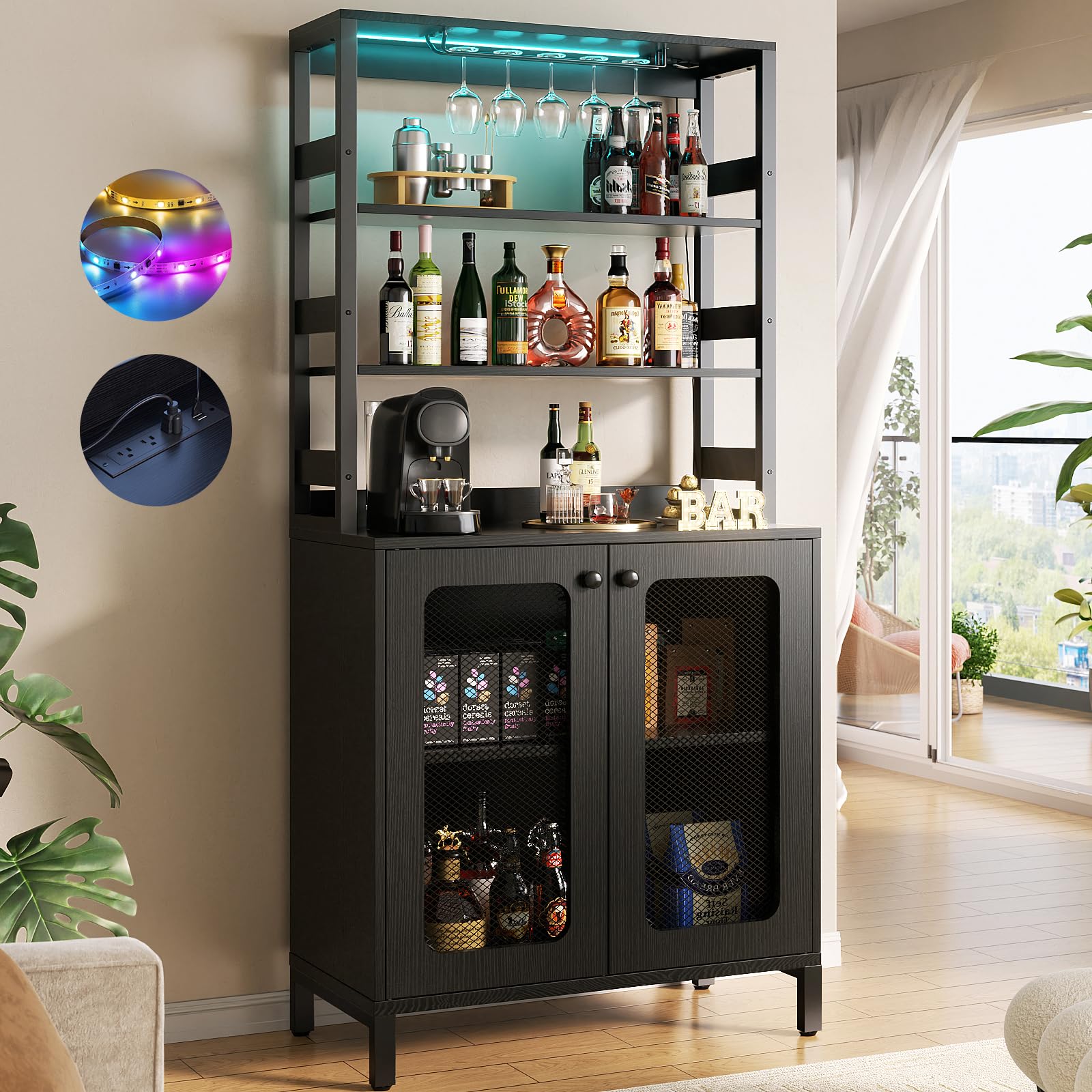
Key Features
- Power: 3 outlets, 2 USB ports
- Layout: 4 open shelves over 2-door buffet
- Lighting: RGB LED strip
- Dimensions: 15.7"D x 26.9"W x 66.9"H
- Price: Midrange
Same maker, same outlets, same light strip as our top pick, different geometry. This one is a 26.9-inch-wide rectangle standing 66.9 inches tall and 15.7 inches deep, and it’s the better buy when the wall is flat and the floor space isn’t.
The layout is the reason we like it for a narrow slot: four open shelves inside a metal frame up top, a counter, and a two-door buffet below. The bottles you’re happy to show off live above, the case of mixers and the spare glasses hide below, and three outlets with two USB ports sit at counter height along with an RGB strip that runs the length of the frame. The tall format also means bottles stand upright on shelves instead of lying in a rack, which suits whiskey and gin better than it suits wine.
Width is the trade-off. At 26.9 inches the shelves fill faster than the photos suggest, so this is a two-person bar rather than a party wall — which is exactly the point in a hallway or a dining alcove. Stock it for a crowd and you’ll want the corner unit or the long GDLF instead.
Pros
- Three outlets and two USB ports at counter height
- Open hutch over a closed two-door buffet
- 66.9-inch tower takes a small floor footprint
Cons
- Open upper shelves collect dust and daylight
Best for Small Spaces
X-cosrack Wine Bar Cabinet

Key Features
- Wine rack: Detachable, 5 bottles
- Dimensions: 13.4"D x 23.6"W x 31.1"H
- Load rating: 330 lb
- Glass holder: Detachable stemware rail
- Price: Budget
The least expensive cabinet in this roundup is also the smallest: 23.6 inches wide, 13.4 inches deep, and 31.1 inches tall. It makes no apology for that. This is a bar for a wall that can’t spare more than two feet and a room where the bar isn’t the main event.
For a first apartment, though, it earns its place. The five-bottle rack and the stemware rail both come out, so the cabinet can turn back into a sideboard when the bottles run out, and the adjustable feet sort out a floor that isn’t level. The mesh door is the smart part: bottles stay out of the light, but you can still see what you have and how much is left.
At 31.1 inches it sits below the sightline of most sofas and side tables, which is why it works in a living room as well as a dining room. Think of it as a starter cabinet that will move with you rather than the last bar you’ll buy.
Pros
- Detachable five-bottle rack and stemware rail
- Mesh door keeps bottles out of the light
- Adjustable feet level it on uneven floors
Cons
- Five-bottle rack is a starter, not a cellar
- 13.4-inch depth leaves little counter
Best for Style-Led Rooms
ONBRILL 55-Inch Fluted Cabinet

Key Features
- Power: Built-in charging ports
- Width: 55.1 inches
- Lighting: RGB LED with remote
- Wine storage: 12-bottle grid, 9-glass rack
- Price: Midrange
Fluted fronts are everywhere right now, and this walnut cabinet is the one here that reads as furniture first and bottle storage second. Fifty-five inches of fluted door, a walnut finish, and sliding panels look nothing like the black metal and mesh that makes up most of this group.
Inside, it’s organized the way a bar should be: a 12-grid wine rack, three tiers of stemware rail holding nine glasses, adjustable shelving, and charging ports, with an RGB strip and remote to light the whole thing. Three of the shelves pull out, which is the difference between restocking in a minute and unloading half the cabinet to reach the back.
The sliding panels are the other practical win. In a dining room where a hinged door would open into a chair, these slide behind each other and take no floor space at all. They can drag a little at first until the track settles, so set them square when you build it.
We point to it when the cabinet has to carry the room — a dining room where the bar is part of the furniture and guests see it from the table. For pure bottle capacity in the same width, the corner unit stores more; for a piece you’ll still like in three years, this is the one.
Pros
- Fluted walnut front reads as furniture
- Twelve-bottle grid and nine-glass rack
- Sliding doors save swing space
Cons
- Walnut finish reads darker than the listing photos
Best for Compact Style
ARTPOWER Bar Cabinet with Wine Drawer

Key Features
- Doors: Tempered glass, gold hardware
- Dimensions: 14.96"D x 31.49"W x 37"H
- Wine storage: Pull-out bottle drawer
- Glass storage: 3 stemware racks
- Price: Midrange
Most cabinets here give wine bottles a shelf or a rack; this one gives them a drawer. The bottle storage pulls out of the lower cabinet, so you read labels and reach the back row without kneeling on the floor — a small thing that changes how often you open a second bottle.
Above the drawer it’s a display piece: tempered glass doors with gold hardware, three integrated stemware racks, two drawers, and metal legs, in black or a green that’s the more interesting of the two. At 31.49 inches wide, 14.96 inches deep, and 37 inches tall, it fits an apartment dining area and still works as a sideboard.
We recommend it to someone furnishing a first place who wants the bar to look chosen rather than assembled. The pull-out drawer is what earns it a spot over the plain cabinets here, and the glass-and-gold front is the reason to put it where people can see it rather than in a spare room.
Pros
- Pull-out bottle storage you can reach without kneeling
- Three stemware racks and two drawers
- Compact 31.49-inch footprint with glass and gold
Cons
- Light build; better for bottles than appliances
Best for Hidden Storage
BON AUGURE Small Bar Cabinet

Key Features
- Frame: Metal and engineered wood
- Shelves: 3 adjustable, 100 pounds each
- Dimensions: 13.39"D x 29.53"W x 36"H
- Top capacity: 300 lb
- Price: Midrange
No wine rack, no stemware rail, no light strip, no outlet. This is a 29.53-inch cabinet, 36 inches tall and 13.39 inches deep, with two doors, three adjustable shelves, and five compartments — and for a certain kind of bar, that’s the whole appeal.
The structure is what you’re paying for. The top is rated for 300 pounds and each shelf for 100, a metal frame and a support tube under the bottom shelf keep it from racking, and the feet adjust on a floor that isn’t level. It ships with an anti-tip bracket, which is worth using.
The top is engineered wood in a rustic oak finish, so a spill that sits will leave a ring or lift the edge. A tray under the bottles and a coaster under the shaker solve it, and this is a cabinet that wants a tray on it anyway.
Buy it when the bar should pass as a sideboard: bottles behind closed doors, glasses on adjustable shelves, an ice bucket or a coffee maker on top. The 300-pound rating is the number that matters — a full case of glassware doesn’t come close.
Pros
- 300-pound top and 100-pound shelves
- Three adjustable shelves behind closed doors
- Anti-tip bracket and adjustable feet
Cons
- No wine rack, stemware rail, or lighting
How We Tested (and Assembled) 10 Home Bar Cabinets
We started with more than 30 bar cabinets sold at major retailers, then cut the list by price, footprint, and how the storage was laid out — bottle slots, stemware racks, drawer depth, whether a shelf could be moved. That left 10 we bought at full price and built in our own homes, from a narrow corner unit to a full-height cabinet with a fold-out mixing surface. Testing ran eight months, long enough for the novelty to wear off and for the shelves to show whether they’d sag.
Assembly came first, because it’s where these cabinets live or die. I built each one solo on a Saturday morning with only the included tools, timed the whole thing, and kept a tally of every trip back to the instructions — one cabinet had me re-reading the same page four times. Before tightening anything, I checked each pre-drilled hole against its cam lock and dowel by hand; misaligned holes, chipped edges around the drilling, and hardware that stripped at normal torque got written down on the spot. Then I hung the doors, closed them, and looked for gaps and rubbing.
After that we loaded them the way a real bar gets loaded: heavy bottles on the bottom, stemware overhead, a crowded front row of bitters and mixers, and one deliberately overfilled shelf to see how it behaved. We checked for wobble with both doors open, slid each cabinet across wood and carpet, opened it with a bottle in each hand, and wiped up spills to see how the finish handled them. Appearance got judged at night, in a lit room, next to actual furniture rather than in a showroom. Eight months in, the ones still standing straight, still closing flush, and still looking like furniture rather than utility storage are the ones worth their price.
How to Choose a Home Bar Cabinet
Start with the wall or the corner you’re furnishing, then decide how much of the bar you want to look at — the cabinet that fits beats the one with the best features every time.
Fit the space before you fall for a cabinet
In a corner, a wedge unit earns its keep: our top pick takes 17.5 inches along each wall and gives back 64 inches of height. On a flat wall, width is the deciding figure, and the cabinets here run from 23.6 inches to 78.7 inches, so measure the run and subtract anything that has to open — a hinged door, a drawer, a fridge.
Add the baseboard to your depth measurement, because a cabinet pushed tight against trim stands an inch or more proud of the wall. And pace the run: a 31-inch cabinet against a 12-foot wall looks lost, while a 78-inch one crowds a hallway.
Decide how much of the bar you want to see
Closed doors hide the half-empty bottles, the mismatched glasses, and the plastic funnel. Open shelves turn all of it into decor and collect dust while doing so. Glass with an LED strip is the compromise most of these cabinets choose, and it works only when the contents are worth looking at.
A useful test: picture the room on an ordinary Tuesday night, not during a party. If the answer is that you don’t want to see a bar, buy doors. If the bottles are the point, buy glass.
Match bottle and glass storage to how you drink
A five-bottle rack is a starter; a twelve-grid rack is a collection. Racks lay bottles down, which suits wine and doesn’t suit whiskey, so a cabinet with adjustable shelves plus one detachable rack is more flexible than a cabinet that is all rack.
Check the stemware rail as well — hanging glasses need vertical clearance, and a rail is wasted if you’re stacking tumblers beneath it. If everyone drinks spirits, a plain shelved cabinet holds more than a bar-themed one.
Treat the counter as the working part
Depth decides whether the top is a mixing station or a landing pad. The deepest cabinet here is 24.4 inches and the shallowest 13.39, and the difference is a shaker, a jigger, and a board for garnishes. Around 36 to 40 inches is a comfortable standing height for pouring; a 45-inch cabinet puts the work above your elbow, and a 64-inch one gives you display shelves instead of a wide counter.
Built-in power matters more than it sounds. Three sockets and two USB ports is the most generous arrangement in this group, and it saves a reach behind the cabinet every time you blend something.
Plan for assembly, anchoring, and spills
Almost everything in this category arrives flat-packed in one long, heavy box. The builds are evening projects rather than twenty-minute ones, and the larger cabinets really do want two people for the final lift.
Engineered wood is the standard material, so a spill that sits will swell an edge or leave a ring — a tray under the bottles is cheap insurance. Anchor anything above about five feet, and keep the heavy bottles low so the cabinet’s weight sits where it does the least harm.
Frequently Asked Questions
Can I put a mini fridge inside a bar cabinet?
Only if the cabinet has an open bay built for one. The GDLF cabinet is the one here with a cutout, and it takes fridges up to 25.1 inches wide, 23.5 inches deep, and 35 inches tall.
Measure your fridge against those figures, then check its manual for ventilation clearance and door swing before you order — a shelf bay in an ordinary cabinet won’t take one.
How much weight can a home bar cabinet hold?
Look for a top rating and a per-shelf rating rather than a single overall figure. The BON AUGURE states 300 pounds on the top and 100 pounds per shelf; the X-cosrack states a 330-pound maximum for the whole cabinet.
Load full bottles on the bottom shelf and glassware above, which keeps a tall cabinet stable as well as intact.
Can a bar cabinet live on a screened porch or in a garage?
Not these. They’re engineered wood with a veneer or laminate finish, and humidity plus temperature swings will swell the panels and lift the edges — a screened porch sees both.
Keep the cabinet in a conditioned room, away from a radiator and out of direct sun, and if the bar has to be outdoors, look for solid teak or marine-grade plywood instead.
Final Verdict
The Aheaplus corner cabinet is the one we recommend to most people: it holds bottles, glassware, and a blender in a footprint smaller than an armchair, and its outlets are the feature you’ll use every week. If a glass-door beverage fridge is part of the plan, the GDLF is the only cabinet here built to take one.
If the budget or the wall is tight, the X-cosrack covers the basics for the least money — and if the bar has to look like furniture, spend the extra on the fluted ONBRILL instead.