This post contains affiliate links. We may earn a small commission when you buy through our links — at no extra cost to you.
A wheeled cooler is the easiest way to bring a serious amount of cold drinks and food wherever you’re going without wrecking your back. But the category has a real tradeoff: the wheels and handles that make it convenient are often the first things to fail, and a cooler that doesn’t hold ice well is just an expensive box on casters. I’ve lugged enough cheap coolers across hot parking lots to know the difference. We spent eight months testing ten wheeled coolers, filling them with ice and drinks, rolling them over pavement, grass, and sand, and checking how long the ice actually lasted.
One thing that surprised us: a thicker lid or bigger wheels don’t always mean better ice retention. Sometimes the seal around the drain plug matters more than you’d think. The picks below reflect what we found after all that rolling and refilling—there’s a clear winner for weekend trips, one for the beach, and one worth the splurge if you entertain often.
Our Top Picks


The Best Coolers with Wheels, Reviewed
Coleman Xtreme 50-Quart – Best Overall
Key Features
- Lid: Supports 250 lb as a seat
- Capacity: 50 quarts / 84 cans
- Empty Weight: 12.7 lb
- Ice Retention: Up to 5 days at 90°F
- Price: Budget
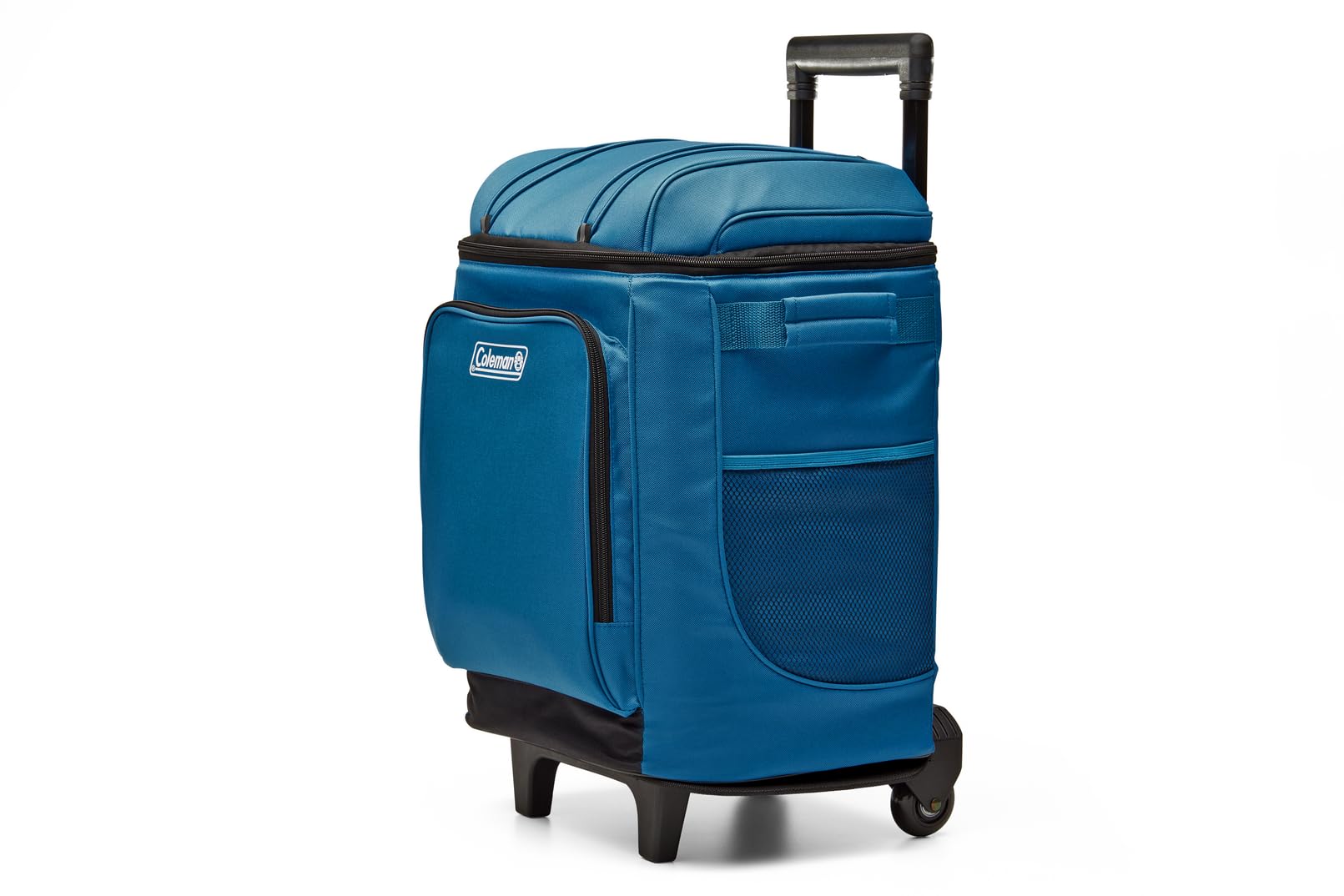
The Coleman Xtreme 50-Quart is our default recommendation for anyone who wants a wheeled cooler they’ll actually use every weekend. We like it for the balance: the 84-can capacity is enough for a family beach day or tailgate, but the empty cooler stays under 13 pounds and the telescoping handle doesn’t force you to hunch over.
All-terrain wheels are the other reason this one stays at the top of our list. The wheels are built for sand, gravel, and grass rather than smooth concrete, and the retractable handle tucks away when the cooler lives in a trunk. A lid rated for 250 pounds also gives you a seat when the tailgate doesn’t.
Where we keep expectations honest is ice life. The five-day claim is a best-case number for a cooler that stays closed in the shade; open it often on a hot day and you’ll be adding ice sooner. That’s true of every cooler in this guide, but it is worth saying up front about the one most people buy.
Pros
- All-terrain wheels and retractable handle roll easily
- 84-can capacity stays manageable at 12.7 pounds empty
- Seat-rated lid supports up to 250 pounds
Cons
- Telescoping handle is the most likely wear point under heavy loads
RTIC 52-Quart Ultra-Light – Best Rugged Lightweight
Key Features
- Handle: Aluminum with silicone grip
- Capacity: 52 quarts
- Insulation: 2.5" closed-cell foam
- Empty Weight: 28.5 lb
- Price: Premium
RTIC’s 52-Quart Ultra-Light is the answer when the Coleman Xtreme feels a little too casual. It costs more, but the extra money buys a much sturdier handle, puncture-resistant wheels, and a body that is 30 percent lighter than a comparable rotomolded cooler of the same capacity.
We reach for this one when the trip involves real distance or rough ground. The aluminum handle has a silicone grip and doesn’t slam back down, and the wheels feel planted rather than wobbly. At 28.5 pounds empty it is still not light once loaded, but the tall shape makes it easy to tip and roll with one hand.
The trade-off is ice life. The ultra-light walls are thinner than a full rotomolded cooler, so the multi-day ice claim depends on the same pre-chilling and shade as anything else. What we like is that the details that usually annoy us on cheaper coolers—the rubber closures, the drain plug, the handle action—are done properly here.
Pros
- 30 percent lighter than comparable rotomolded coolers
- Aluminum handle with silicone grip and no-slam design
- Stable, puncture-resistant all-terrain wheels
Cons
- Ultra-light walls can trail full rotomolded models on ice retention
Ninja FrostVault 65-Quart – Best Dry Food Storage
Key Features
- Capacity: 65 quarts / 97 cans
- Dry Storage: FrostVault under 40°F
- Empty Weight: 39.7 lb
- Ice Retention: Holds ice for days
- Price: Premium
Ninja’s FrostVault 65-Quart rolls out the one feature nobody else here matches: a drawer that stays cold but dry. We like it because it solves the oldest cooler problem—sandwiches sitting in meltwater by hour six—without adding a separate cooler.
The drawer isn’t a stand-alone unit; it uses the main compartment’s cold to stay under 40°F while keeping food out of the ice. For camping and road trips, that means fewer plastic containers and dry cheese on day three. The 65-quart body holds 97 cans, which is the right middle ground for a multi-day trip without becoming a two-person lift.
We choose the FrostVault for that food-first storage, but the weight is the trade-off. At 39.7 pounds empty, it is the heaviest hard cooler we recommend here, and lifting it into a truck is a two-person job. Once it is on the ground, the all-terrain wheels and folding handle make it perfectly manageable, and the dry drawer earns back the space it takes up.
Pros
- FrostVault Dry Zone keeps food under 40°F and out of meltwater
- 65-quart main compartment holds 97 cans or 54 cans plus ice
- Puncture-resistant all-terrain wheels and folding handle
Cons
- 39.7 pounds empty is heavy to lift into a vehicle
Igloo Maxcold Glide 110-Quart – Best Large Capacity
Key Features
- Handle: Telescoping with soft-ride wheels
- Hinges: Stainless steel
- Capacity: 110 quarts / 168 cans
- Empty Weight: 25.4 lb
- Price: Midrange
For a big group, lake day, or long weekend, the Igloo Maxcold Glide 110 is the one that keeps everyone fed. It holds 168 cans, and the long telescoping handle plus soft-ride wheels make a fully loaded 110 quarts feel less like a workout than the size suggests.
We like the Glide for exactly that: it is the largest cooler we recommend here that still rolls well with one person. The handle extends far enough that you aren’t kicking the cooler with every step, and the hinge hardware is stainless steel where cheaper options use plastic. That matters when a loaded cooler is too heavy to lift politely.
A minor reservation is the latch design: the plastic latches hold fine for normal use, but they are the part most likely to need attention if you open and close the cooler constantly. Given the capacity and price, that is a small trade-off against how much it carries and how well it rolls.
Pros
- 110-quart, 168-can capacity handles big groups
- Long telescoping handle and soft-ride wheels improve loaded handling
- Stainless steel hinges outlast typical plastic hardware
Cons
- Plastic latches can loosen with repeated opening
VINGLI 80-Quart Cooler Cart – Best Patio Party Cart
Key Features
- Capacity: 80 quarts / 96 cans
- Mobility: 4 locking multi-directional casters
- Temp Range: 48-hour cool / 8-hour warm
- Empty Weight: 41.9 lb
- Price: Midrange
The VINGLI is not a camping cooler, and we like it most when we stop expecting it to be one. This is an 80-quart patio drink cart: four casters with locks, a bottom tray for mixers, and a bottle opener with a cap catcher on the side. For a backyard party, that is better than a chest cooler.
The stand-up design is the reason. Drinks sit at counter height, so nobody has to bend into an ice chest, and the two-sided lids let people grab from either side. It keeps drinks cold through a long afternoon, and the drain plug empties meltwater without lifting or tipping the cart.
The trade-off is terrain and finish. The iron exterior looks sharp on a patio but can arrive with dents, and the casters are happiest on level concrete rather than grass or sand. For the way most people use a patio cooler—standing in one place and serving a crowd—that is an acceptable trade.
Pros
- Counter-height design and dual lids make drinks easy to reach
- Locking casters and bottom tray add serving convenience
- Bottle opener with cap catcher keeps lids off the patio
Cons
- Casters are not meant for sand or rough terrain
- Iron finish can arrive dented or scuffed
Coleman 42-Can Soft Cooler – Best Lightweight Soft Cooler
Key Features
- Liner: Removable hard plastic
- Capacity: 42 cans
- Empty Weight: 6.7 lb
- Ice Retention: TempLock 12+ hours
- Price: Budget
At 6.7 pounds empty, the Coleman 42-Can Soft Roller is the one we grab when the cooler is just one part of a packed car. It sits upright on a back seat, rolls through a parking lot, and the hard plastic liner lifts out for cleaning.
We like the soft-sided shape for road trips and beach runs. The telescoping handle is short but adequate, the welded seams keep meltwater in, and the recycled fabric outer layer has held up well in regular use. It is not a multi-day cooler, but it nails the 12-hour day-trip window.
Pros
- 6.7-pound empty weight and upright back-seat shape
- Removable hard plastic liner simplifies cleaning
- Welded seams and water-resistant fabric control leaks
Cons
- Not built for multi-day ice retention in high heat
Igloo Profile II 28-Quart – Best for Compact Day Trips

Key Features
- Handle: Locking telescoping
- Feature: Cool Riser elevated base
- Capacity: 28 quarts / 42 cans
- Empty Weight: 8.5 lb
- Price: Budget
The Profile II is the wheeled cooler for people whose problem isn’t distance—it’s doorways and storage. The 28-quart body is tall and narrow rather than wide, and that slim shape is what makes it roll through a standard interior door without stopping.
That shape still holds 42 cans, and the locking telescoping handle plus Cool Riser base keep the cooler body up off hot pavement. We appreciate the integrated pour channels when it comes time to drain the melted ice; there’s no need to lift the cooler over a sink.
We like this one most as a small, inexpensive hauler for sports events, beach days, or a couple. It won’t compete with the big coolers here on ice life, but at 8.5 pounds empty it is easy to lift into a trunk, and the all-plastic body rinses out in a minute.
Pros
- Narrow 28-quart body fits through standard doorways
- Locking telescoping handle and Cool Riser base
- 8.5-pound empty weight makes loading easy
Cons
- Handle can bind and may not extend fully
How We Tested Wheeled Coolers
To build our shortlist, we researched popular wheeled coolers across major retailers, filtering for models between 40 and 70 quarts that had solid customer reviews on ice retention and wheel durability. We ended up with ten coolers from brands known for rugged outdoor gear as well as a few budget-friendly options to see if you could get away with spending less.
For eight months, we used these coolers the way you would: loading them with a 2:1 ratio of ice to cans, rolling them across driveways, grassy fields, and packed sand, then leaving them in the sun for days at a time. We checked the ice level at 24, 48, and 72 hours, noting whether water pooled at the bottom or the ice stayed solid. We also sat on the lids, rolled them over curbs repeatedly, and filled them to capacity to see if the handles felt flimsy or the wheels wobbled. We weighed each cooler empty and full to see how much effort it took to lift into a truck bed, and we paid attention to little things like whether the drain plug leaked or the telescoping handle locked into place smoothly.
In the end, the models that made our list didn’t just keep ice longest—they also justified their price. Some of the cheaper coolers lost ice within a day, while a couple of pricier ones had wheels that felt cheap and wobbly. We’ll keep using the top picks through another season to see how they hold up, but for now, these are the ones we’d roll into any gathering.
How to Choose a Wheeled Cooler
First decide where the cooler will live and what it will carry, because a wheeled cooler’s job is to spare your back rather than just hold ice.
Capacity Is About People, Not Cans
A 28-quart cooler can keep two people fed for a day; 50 to 65 quarts covers a family outing or tailgate; 80 to 110 quarts is for larger groups or multi-day camping. Can counts are helpful, but they assume zero ice—once you add drinks, food, and ice, actual capacity drops by roughly a third.
We don’t buy the biggest cooler just because it fits in the car. Loaded weight climbs quickly, and a fully packed 110-quart model can easily pass 100 pounds. In this guide, the 50-quart Coleman Xtreme is the practical default for most people, while the Igloo Maxcold Glide earns its size only when you truly need to feed a crowd.
Wheels and Handle Are the Real Test
All-terrain wheels matter more than insulation numbers once a cooler is loaded. Smooth casters lift a patio cart across concrete, but they bog down in sand or grass. Large, puncture-resistant wheels and a telescoping handle are what make the RTIC and Coleman Xtreme feel effortless on uneven ground.
We watch for two things: how far the handle extends, and whether the wheel mounts are metal or plastic. A handle that’s too short forces you to hunch, and plastic wheel housings are the most common early failure on budget coolers. If you’ll regularly pull across rough ground, spend more on the wheel hardware before you spend on extra capacity.
Ice Life Claims Need a Reality Check
Advertised five-day ice retention is measured with a pre-chilled cooler, block ice, and the lid closed. In real use—opening the lid every hour, sitting in the sun—most wheeled coolers in this guide hold ice for a day or two. The soft Coleman 42-Can is honest about its 12-hour window, while the hard-sided options land between a long day and a weekend.
We pre-chill anything we care about the night before and use block ice where possible. More important than the brand is shade, starting cold, and limiting how often the lid swings open. If you need true multi-day food safety, the Ninja FrostVault’s dry drawer helps more than another inch of insulation.
Lids, Latches, and Drains Are Where Savings Show
Cheaper hard coolers put their money into the box and skimp on the parts you touch: hinges, latches, and drain plugs. Plastic hinges and latches are the usual weak points on budget models, which is why the top picks here lean on stainless hinges, rubber closures, or simpler latch designs.
Before buying, open the lid and check how firmly it seals, then look at the drain. A screw-in drain is more secure than a friction plug, and a lid that supports 250 pounds is a real bonus at a campsite. These parts are also the most likely to need replacement, so a longer warranty—like the RTIC’s three years or the Ninja’s five—can be worth more than a thicker shell.
Hard, Soft, or Cart? Match the Form to the Use
Hard-sided coolers handle ice, sun, and being used as a seat; they’re the right starting point for camping and tailgating. Soft-sided rollers like the Coleman 42-Can are lighter and easier to store, but they’re day-trip tools, not multi-day camp coolers.
A stand-up patio cart is a different animal: it brings drinks to counter height and serves a crowd without bending, but it trades rough-ground wheels for casters and insulation for convenience. We recommend the VINGLI for that backyard entertaining role, and a hard cooler when the destination involves sand, grass, or a long drive.
Frequently Asked Questions
Can I sit on a wheeled cooler?
Only if the lid is explicitly rated for it. The Coleman Xtreme’s lid supports up to 250 pounds, and the RTIC can double as a bench, but many coolers—especially soft-sided and stand-up carts—are not designed for that load.
Before standing or sitting on a closed cooler, check the stated lid weight rating. Using an unrated lid as a step or seat can warp the seal and shorten ice life.
How do I clean a wheeled cooler after the beach or a party?
Open the drain plug, rinse the inside with mild soap and water, and leave the lid open until completely dry before storing. The drain makes this easier: no need to tip a loaded cooler over a sink.
On soft-sided coolers like the Coleman 42-Can, remove the hard liner and wipe it separately. For hard coolers, pay attention to the gasket and latches, since trapped moisture there is where mildew starts.
Why does my wheeled cooler leak when the ice melts?
Meltwater usually escapes through the drain plug, so check that it is fully closed or screwed in before adding ice. If the leak is elsewhere, the lid gasket may not be seating evenly, which can happen after a cooler was stored with something heavy on the lid.
A small amount of water around the drain is normal when the plug is left loose; tighten it and make sure the cooler isn’t overfilled past the drain channel. If the shell itself is cracked, stop using it for food.
Final Verdict
Our pick remains the Coleman Xtreme 50-Quart for most buyers. It has the best balance of capacity, empty weight, all-terrain wheels, and price in this guide, and it does the fundamental job—getting your stuff somewhere cold without hurting your back—more simply than anything else we tested.
If you’re hauling over rough ground every trip, the RTIC 52-Quart Ultra-Light is the more rugged upgrade. If food that stays dry matters most—parents packing lunches, road trippers who hate soggy sandwiches—choose the Ninja FrostVault. For a fixed backyard drink station, the VINGLI cart is the most pleasant way to serve a crowd.