This post contains affiliate links. We may earn a small commission when you buy through our links — at no extra cost to you.
A proper margarita starts with fresh lime juice, not the bottled stuff, but squeezing enough citrus for a round of drinks by hand leaves you sticky, tired, and still picking seeds out of your glass. That’s where a dedicated citrus juicer earns its spot on the bar cart. Over the past three months, my team and I put 14 citrus juicers through their paces—from simple hand reamers to lever presses and a couple of compact electric models—to find the ones that make cocktail prep feel less like a chore.
A first-time buyer might not realize that the best juicers do more than squeeze: they separate seeds and pulp cleanly, stay put on the counter while you lean into them, and rinse off without a fight afterward. Our testing favored models that hit all three, because the whole point is fresh juice in the glass faster, not a sticky cleanup project. Below are the ones that earned a permanent spot on our bar cart.
Our Top Picks



The Best Citrus Juicer for Cocktails, Reviewed
Chef’n FreshForce – Best Overall
Key Features
- Care: Top-rack dishwasher safe
- Fits: Lemons and limes
- Material: Nylon and stainless steel
- Squeeze mechanism: Dual-gear press
- Price: Midrange
The dual-gear mechanism is what separates the FreshForce from a simple hinge. Squeezing the handles turns two interlocking gears, and the mechanical advantage shows up exactly where cocktail making hurts: the fourth and fifth lemon of a party round. Where a plain press asks your forearm to do the work, this one lets the gearing do it.
We didn’t expect to care about a gear, but the difference in hand fatigue is real. Lemons that would normally take a full two-handed squeeze flatten with a fraction of the effort, and the yield is generous — more juice in the jigger from the same fruit. For a home bartender building multiple drinks, that matters more than any other spec on the page.
The trade-off is size and a mixed durability record. The press is long and needs drawer room, and the nylon teeth can wear out after a couple of years of heavy daily use. Juiced occasionally, it’s a long-haul tool; as a daily workhorse, treat the gears gently. For the cocktail buyer squeezing several fruits at once, though, no other pick here matches it.
Pros
- Dual-gear mechanism reduces hand fatigue
- High juice yield from lemons and limes
- Top-rack dishwasher safe
Cons
- Nylon gear teeth can wear with heavy use
- Bulkier than a standard press
Zulay Metal 2-in-1 – Best Value Workhorse
Key Features
- Care: Hand wash
- Fits: Lemons and limes
- Weight: 11.2 oz
- Material: Coated aluminum
- Price: Budget
At this price, the Zulay does what a cocktail juicer should: it gets every usable drop out of a lemon or lime without ceremony. We like it as the everyday workhorse — the kind of tool that lives in the drawer and comes out every time a recipe or a drink asks for fresh citrus. The coated aluminum body is solid without being heavy, and the two bowl sizes cover both lemons and limes.
Juice yield is the highlight. The deep bowls and well-placed holes strain seeds while letting juice through, and a firm squeeze flattens a half lemon to the rind. Cleaning is a quick rinse, though the care sheet asks for hand washing to protect the coating.
The durability story is the one caveat. Plenty of buyers get years of daily use, while some see a handle break early — a known weak point on coated aluminum presses. Given the price and the lifetime guarantee, we think it’s an acceptable risk for most cocktail buyers. Just don’t treat it like a bar tool meant to survive being tossed across the station.
Pros
- Excellent juice extraction and seed straining
- Lightweight coated aluminum with two bowl sizes
- Backed by a lifetime guarantee
Cons
- Handles can break under repeated heavy use
- Hand wash only to protect the coating
KitchenAid Citrus Press – Best No-Mess
Key Features
- Care: Dishwasher safe
- Fits: Lemons and limes
- Design: Seed catcher and pour spout
- Material: Aluminum and nylon
- Price: Premium
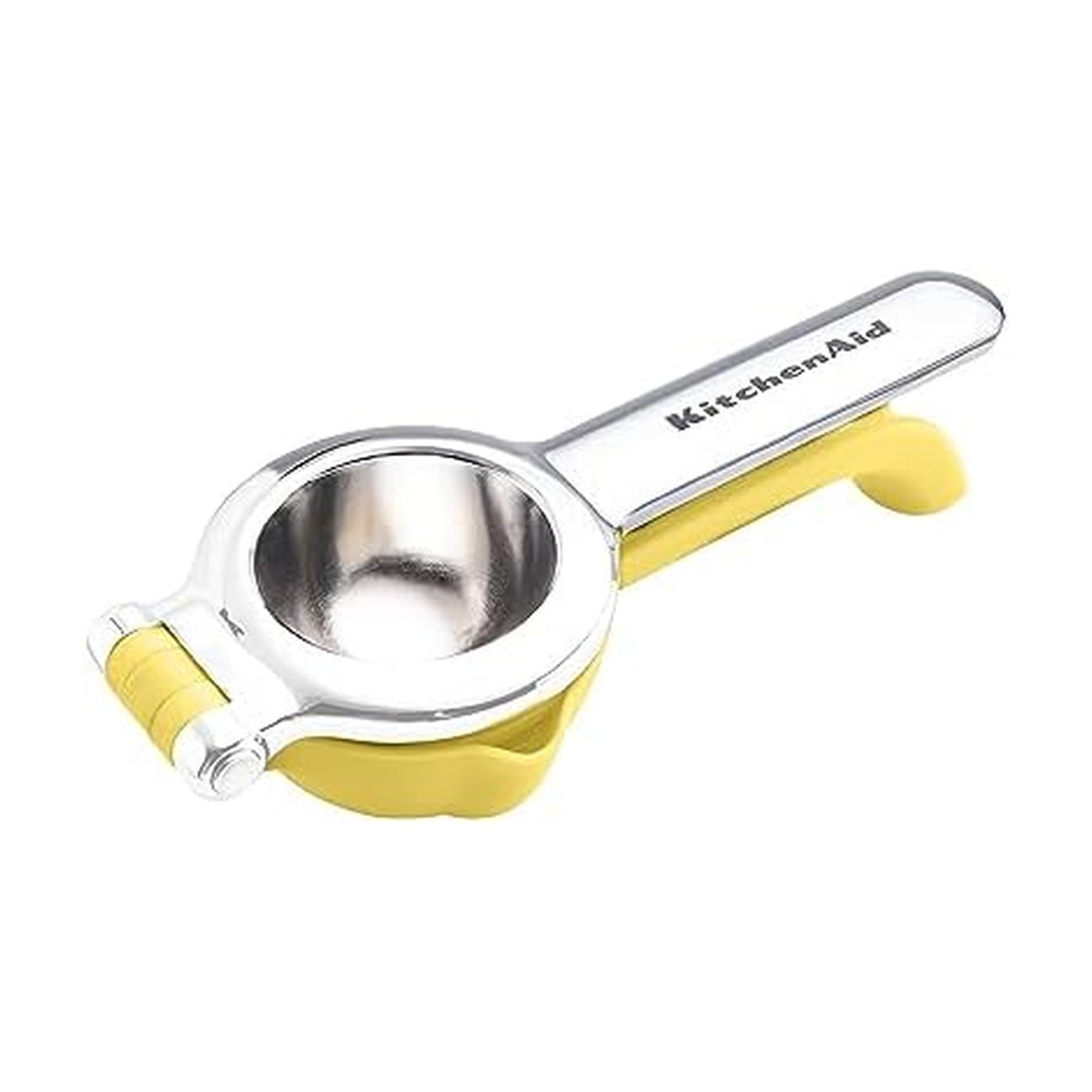
The KitchenAid’s hopper is the whole story: the juice doesn’t spray, drip, or pool on the handle. You squeeze, the juice collects in the built-in basin, the strainer catches pulp and seeds, and a little pour spout sends it neatly into a jigger or glass.
That containment is what makes it our pick for tidy bar work. Where a standard press demands you aim it over a bowl and accept the occasional stray drop, this one sits flat — it doesn’t even need to be held over anything until you’re ready to pour. On the juiciest lemons a trickle can escape through the handle, but it still beats a standard press on mess.
We settled on this as the favorite for anyone who hates cleanup interruptions mid-drink. It’s built from aluminum and nylon, feels solid, and strips down for the dishwasher. It costs more than the budget presses, and it’s the right call when a cocktail session means several fruits and you want zero fuss between them.
Pros
- Hopper contains juice, strains seeds, pours cleanly
- Sits flat on the counter for leverage
- Dishwasher safe
Cons
- Pricier than standard presses
- Juice can weep through the handle on full squeezes
Kensington Stainless Press – Best Heavy-Duty
Key Features
- Care: Dishwasher safe
- Fits: Large lemons and small oranges
- Capacity: 0.6 liters
- Material: 304 stainless steel
- Price: Midrange
The Kensington is the one we pick when build quality is the whole point. Solid 304 stainless steel, reinforced joints, no coating to chip into the juice — this is a press that feels like it came from a kitchen supply store, not a gadget aisle.
Squeezing is where the steel pays off. The long handles give real leverage, so even large lemons flatten without a wrestle, and the silicone grips keep it from slipping mid-squeeze. It’s one of the few presses here sized for big store-bought lemons rather than just limes and small fruit.
We like it for the cook or host who has broken a cheaper press before. It’s not the lightest or the cheapest, but nothing on this list feels more likely to simply keep working. If you’re only juicing an occasional lime, it’s overkill — that’s what the budget picks are for.
Pros
- Solid 304 stainless steel, no coating to chip
- Long handles and silicone grips ease squeezing
- Sized for large lemons
Cons
- Heavier and pricier than coated presses
IMUSA Lemon Lime Squeezer – Best Budget
Key Features
- Care: Hand wash
- Fits: Limes and small lemons
- Length: 7.7 inches
- Material: Aluminum
- Price: Budget
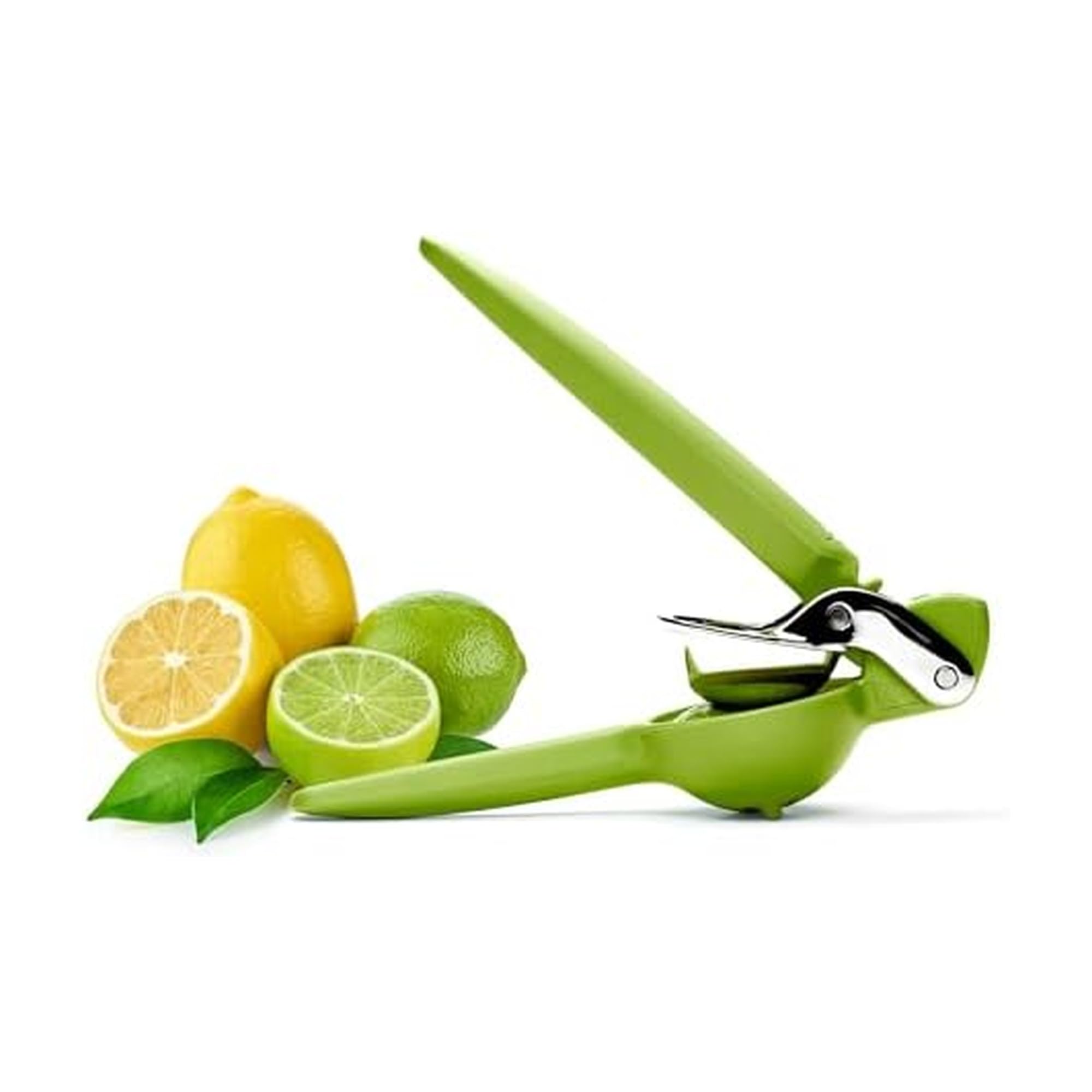
The IMUSA is what a budget press should be: nearly nothing to spend, and honest about what it is. A simple aluminum squeezer with a bright green coating and a hanging ring, sized more for limes than for the biggest lemons.
We think the trade-off is worth it for the right buyer. Juice output is genuinely strong for the price — limes and small-to-medium lemons give up every drop, seeds stay out, and a modest squeeze does the work. It asks almost no strength, and the whole thing rinses clean in seconds.
The limits are size and finish. Big limes or full-size lemons can be a tight fit, and the green coating chips on some units after repeated use. If you’re making the occasional margarita or ceviche and want to spend almost nothing, this is the value play; if large lemons are your staple, step up to a larger bowl.
Pros
- Excellent value at a rock-bottom price
- Easy squeeze, seeds stay out
- Lightweight with a hanging ring for storage
Cons
- Coating can chip with repeated use
- Tight fit for large lemons
OXO Small Citrus Juicer – Best for Measured Recipes
Key Features
- Care: Dishwasher safe
- Fits: Lemons and limes
- Design: Built-in 2.5 oz measuring cup
- Material: BPA-free plastic
- Price: Budget
The OXO isn’t a squeezer at all — it’s a reamer with a measuring cup built into the base, and for cocktail work that distinction is the point. Twist the fruit on the reamer and the juice falls straight into a 2.5-ounce cup marked in tablespoons and ounces.
That measurement is the feature. Cocktail recipes live and die on proportion, and guessing at "juice of half a lime" is how a balanced drink goes sideways. Here you juice straight into the measure, see exactly how much you have, and pour from a drip-free spout. Seeds and pulp collect in the reamer dish above.
We think it earns a spot for the recipe-driven bartender, even though it’s plastic and takes slightly more wrist work than a lever press. It’s also small — perfect for lemons and limes, not for oranges. If you follow measured builds or want to scale a batch accurately, no other pick here does this job.
Pros
- Built-in measuring cup with ounce markings
- Drip-free pour spout
- Dishwasher safe
Cons
- Reamer asks more wrist effort than a press
- Too small for oranges
Dreamfarm Fluicer – Best for Compact Storage

Key Features
- Care: Dishwasher safe
- Fits: Lemons and limes
- Design: Folds flat
- Material: Plastic with stainless press
- Price: Midrange
The Fluicer’s trick is visible the moment you pick it up: a hinged scissor design that presses the fruit from the sides and then folds completely flat — under an inch and a half thick — so it slides into a drawer without teetering on a pile of utensils.
The side-press action is genuinely different from a standard squeezer. It squeezes the way your fingers would, which takes noticeably less hand strength and is kinder to weak or arthritic hands. The built-in pip catcher strains seeds and funnels juice into a glass, and large lemons are no problem.
What we keep coming back to is the storage. In a small kitchen or a packed bar bag, a bulky press is the first thing to get left in the drawer; this one is always easy to put away.
The reservation is the hinge. The plastic hinge has snapped on some units, usually early on, and once it goes the whole tool is finished. We think it’s the best choice here for compact storage and easy squeezing, provided you treat it like a juicer rather than a nutcracker.
Pros
- Folds flat for drawer or travel storage
- Side-press action eases strain on hands
- Pip catcher strains seeds and directs juice
Cons
- Plastic hinge is a known failure point
Zulay Cast Iron Juicer – High Volume

Key Features
- Bowl: 5-inch diameter
- Care: Hand wash
- Fits: Lemons, oranges, grapefruit
- Material: Cast iron and stainless steel
- Price: Premium
The Cast Iron Zulay is a different animal from everything else on this list: a standing countertop press with a big lever arm and a five-inch bowl, built for quantity. It’s the one for a party, a batch of lemonade, or a citrus-heavy cooking project.
The cast-iron lever delivers serious mechanical advantage. Even thick-skinned fruit flattens with one pull, and the juice channels into a waiting glass beneath. Lemons, oranges, even grapefruit — the five-inch bowl takes whatever citrus you throw at it.
Cleaning is simpler than it looks: the press plates detach and wash separately, and wiping down the lever keeps the sticky parts off your hands.
The things that hold it back are weight and stability. It’s heavy enough that you choose where it lives, and the base can slide or tip on a slick counter when you apply real pressure — a steadying hand on the back fixes that. We think it earns its footprint only if you juice in volume; for a couple of limes at cocktail hour, it’s more machine than the job needs.
Pros
- Cast-iron lever press juices high volume fast
- Five-inch bowl handles oranges and grapefruit
- Press plates detach for easy cleaning
Cons
- Heavy and takes counter space
- Base can slide or tip during hard squeezes
How We Tested Citrus Juicers
We started by researching dozens of popular citrus juicers, filtering for price, footprint, and style—manual reamers, hand presses, and a few electric options—then narrowed the field to 14 models for hands-on testing. Over the course of three months, we used each one to juice limes, lemons, oranges, and even a few grapefruits, logging how much juice we extracted, how much effort each squeeze took, and whether seeds or pulp snuck through.
Cocktail nights became our primary test lab: we timed how long it took to juice a dozen limes for margaritas and noted whether our hands cramped halfway through. We measured juice output by weight after each session and compared it to what a manual hand squeeze produced, and we checked for stability by pressing down hard on a wet counter—several juicers slid or tipped, which is not what you want mid-shaker. Durability got a workout too; we ran each model through dozens of cycles, watching for cracks, loosening hinges, or peeling finishes. Size and weight mattered for storage and portability, so we measured footprints and carried them from cabinet to counter to see which felt awkward.
Cleaning was just as important as juicing: after each use, we rinsed and, where possible, ran pieces through the dishwasher, noting whether pulp clung to crevices or the strainer needed a brush. We also weighed value for money, comparing juice yield and build quality against each model’s cost to see if a premium press really outperformed a basic reamer. In the end, the standouts were the ones that made fresh citrus feel effortless, from first squeeze to sink rinse.
How to Choose a Citrus Juicer for Cocktails
The right juicer for cocktails is the one that turns a pile of lemons and limes into bright, seed-free juice quickly — without wearing out your hand on the fourth drink.
Squeezing effort matters more than any spec
Hand fatigue is the hidden cost of a bad press, and it hits exactly when you’re mid-party. A plain hinge press asks your forearm to do all the work; long handles add leverage, and a dual-gear mechanism — as on the Chef’n FreshForce — multiplies force mechanically. If you juice one lime per drink, this hardly matters; if you’re building a round of six, it’s the difference between a chore and a rhythm.
Yield is about the bowl, not the promise
Every press claims to get the last drop, but bowl depth and hole placement decide the truth. A deep bowl with well-placed strainer holes flattens a half lemon to the rind and sends juice through while keeping seeds out. The trap to avoid is judging by brand: two presses side by side can differ by a meaningful amount of juice per fruit, and over a season of cocktails that’s money in saved citrus.
Mess control is a design question
A standard squeezer wants you to aim it over a bowl and accept the odd stray drop. A hopper-style press with a contained basin and pour spout — the KitchenAid does this best — keeps the juice in one place until you’re ready to pour, with a built-in strainer to catch pulp and seeds before they hit the shaker. If clean-as-you-go matters to you, it’s worth paying for.
What breaks first, and what it costs
Coated aluminum is the most common construction, and its weak point is the coating itself: chips and peeling can begin after repeated use, and then you’re fishing flakes out of juice. Stainless steel skips the coating entirely but costs more. Plastic has its own failure modes — hinges and gear teeth under repeated stress. The trap here is a cheap press marketed as dishwasher-safe, because heat and detergent accelerate coating failure. Hand-wash the coated ones and they’ll outlast their price.
Size the bowl to your fruit
Lime-scale presses are brilliant right up until the store only has big lemons. A small bowl will refuse a large lemon half or leave juice behind in the rind; an oversized bowl works fine but is clumsier for small limes. If you juice both, aim for a mid-sized bowl or check the fit against the fruit you actually buy. This is the quickest way to end up with a press you never use.
Frequently Asked Questions
Do I really need a citrus juicer, or can I just squeeze by hand?
For a single wedge squeezed over a glass, your hand is fine. The moment a recipe or a round of cocktails calls for measured juice from several lemons or limes, a press pulls ahead: it gets noticeably more juice from the same fruit, keeps pulp out, and uses far less grip strength. If you make more than one drink per session, a press pays for itself in saved fruit and saved time.
How do you get the most juice out of a lemon or lime?
Roll the fruit firmly on the counter before cutting — it bursts the juice sacs inside. Cut crosswise across the equator rather than end to end, where the segments open widest. Juice the halves cut-side down in a press or reamer so the juice exits through the strainer holes. Room-temperature fruit also yields more than cold, so pull your citrus out of the fridge a little before you juice.
Can I use these for oranges if I’m making mimosas?
Handheld squeezers are sized for lemons and limes, and most will struggle with a full-sized orange — the bowl simply isn’t deep or wide enough. For mimosas, the cast-iron Zulay on this list has a five-inch bowl that takes oranges and even grapefruit. Otherwise, look for a dedicated orange press or a countertop model with a big enough bowl, and quarter larger fruit if you must.
Final Verdict
We keep the Chef’n FreshForce as our recommendation for cocktail work. The dual-gear mechanism is the one feature on this page that changes how a round of drinks feels to make — less hand strain on the fifth lemon, more juice in the jigger from every fruit. For anyone juicing more than an occasional wedge, that’s worth the extra cost over a budget press.
If your priority is a clean bar, the KitchenAid’s hopper and pour spout keep juice where it belongs; if you’d rather spend as little as possible and juice the occasional lime, the Zulay 2-in-1 or the IMUSA will do the job. The FreshForce is the default; the others are answers to a more specific question.