This post contains affiliate links. We may earn a small commission when you buy through our links — at no extra cost to you.
A block of cheddar deserves better than a knife. Saw at it and the cheese slumps, crumbles at the edges, and ends up in uneven wedges that melt at different rates — a wire slicer turns that same block into even planks in one clean pull. The catch is that the wire does all the work, and a loose or brittle one will snap halfway through a block of Gouda. We spent four months putting 14 slicers through soft mozzarella and aged Parmesan to find the ones that hold tension, stay balanced in the hand, and don’t flex under pressure.
The spec first-time buyers rarely check is how the wire attaches: a wire you can’t re-tension or replace makes a slicer disposable. Thickness control matters just as much — the same tool should shave paper-thin curls for a cheese board and cut a thick slab for a melt. The picks below are the ones that held up through our blocks, our dishwasher, and a few months of real dinners.
Our Top Picks


The Best Cheese Slicers, Reviewed
Boska Copenhagen Cheese Slicer – Best Overall
Key Features
- Care: Dishwasher safe
- Blade: Round stainless steel
- Warranty: Lifetime
- Price: Budget
Every wire slicer in this guide shares one weak point, and the Copenhagen doesn’t have it. There’s no wire to stretch, snap, or slacken overnight — just a round stainless blade set into a plane you pull across the block. One pass gives you a thin, even slice of cheddar or gouda that holds together instead of tearing, and there’s nothing to re-tighten before a party.
The rest of the design is just as undemanding. The hollow handle keeps the whole thing around two ounces, so an aged block doesn’t fight you the way it does with a heavy roller slicer, and the tool goes straight into the dishwasher instead of being hand-washed while cheese dries on the wire. Parmesan is the real test, and a plane shaves it into clean curls where a wire tends to snap. Stainless body, stainless blade, lifetime warranty.
Soft cheese is where it stops. Brie, fresh mozzarella, and anything spreadable squash under a plane rather than slice, so keep a knife for those. Everything firm — sandwich cheddar, a wedge of parmesan, a quick plate for guests — is a single pull away, and you can see exactly where the blade will land before you commit.
Pros
- No wire to stretch, snap, or replace
- Thin, even slices of semi-hard and hard cheese
- Dishwasher safe stainless, about two ounces
- Lifetime warranty
Cons
- Only one thin slice thickness
- Aged cheese can crumble at the edge
Bellemain Wire Cheese Slicer – Best for Adjustable Thickness
Key Features
- Care: Hand wash
- Material: Zinc alloy, stainless wire
- Extra wires: 2 included
- Thickness range: Paper-thin to 1/4 inch
- Price: Midrange
Most slicers ask you to control thickness with your wrist. This one lets you set it: the wire roller slides to a new position, from paper-thin up to about a quarter inch, holds the setting, and gives you the same slice next time without any guesswork.
The heft is the other thing we appreciate. At 7.2 ounces, the one-piece zinc body sits still on a firm block instead of skating, so the 3.5-inch wire tracks straight through a cheddar brick rather than wandering off line. Nothing about it flexes or feels assembled from parts, and the roller moves smoothly enough that changing thickness mid-block isn’t a chore.
The wire is the part that will eventually let you down, which is true of every wire slicer rather than just this one. What Bellemain gets right is shipping two spares in the box, so a snapped wire costs two minutes at the counter instead of a new order. That’s the difference between an annoyance and a replacement purchase.
Pros
- Adjusts from paper-thin to a quarter inch
- Two spare wires in the box
- Heavy one-piece body steadies the cut
- Smooth roller glides across the block
Cons
- Hand wash only
KITCHENDAO Cheese Slicer with Board – Best with a Board
Key Features
- Care: Dishwasher safe
- Plate size: 9.65 x 8.5 inches
- Extra wires: 2, in a storage case
- Thickness guide: Etched measuring grids
- Price: Premium
The etched grid lines on the plate are the detail that makes this one worth its counter space. Instead of eyeballing a quarter inch, you set the block against a line, drop the wire, and get the same slice every time — which is what you want when the cheddar is meant to match the gouda on a board.
It’s the only cheese cutter here built for volume. The stainless plate is wide enough to take a warehouse-store brick in one pass, the wire is anchored at three points instead of two so it holds tension through a firm block, and the whole thing goes in the dishwasher afterward.
Replacement is genuinely quick: the wire swaps in about a minute, and two spares ride in a small case that clips to the frame, so you’re not hunting a drawer mid-recipe. Tightness is a screw adjustment rather than a guess.
The thinnest setting takes a slow, deliberate pull; rush it and the wire drags and the slice tears. At an eighth of an inch and up, it’s effortless.
Pros
- Etched grids keep slices consistent
- Wide stainless plate handles big bricks
- Wire swaps in about a minute
- Dishwasher safe
Cons
- Takes up counter space
- Priciest slicer in this group
Westmark Wire Cheese Slicer – Best Lightweight Wire Slicer
Key Features
- Care: Hand wash
- Weight: 2.4 oz
- Material: Cast aluminum, stainless wire
- Warranty: 5 years
- Price: Budget
There’s no dial, no roller, and no screw on this one — thickness comes from the angle you hold it at. Lay the frame flat against the block for the widest slice, tilt it up and the wire takes off less. Two or three cuts and your hand has it; after that you stop thinking about it.
What we appreciate is how little there is to go wrong. A cast aluminum handle, a short stainless wire, 2.4 ounces in the hand: nothing flexes, the wire arrives taut, and a soapy cloth has it clean in seconds.
The wire is the risk. It can pull loose from the frame or snap outright, and Westmark doesn’t put a spare in the box, so a failure takes the tool out of service until you find a replacement. It’s the lightest wire slicer here and the simplest to use, and Westmark backs it for five years.
Pros
- Angle sets thickness without a dial
- 2.4 ounces, the lightest wire slicer here
- Taut wire cuts semi-hard cheese cleanly
- Five-year backing
Cons
- Hand wash only
KITCHENDAO Adjustable Wire Slicer – Best Handheld Wire Slicer
Key Features
- Care: Dishwasher safe
- Material: Aluminum alloy, stainless steel
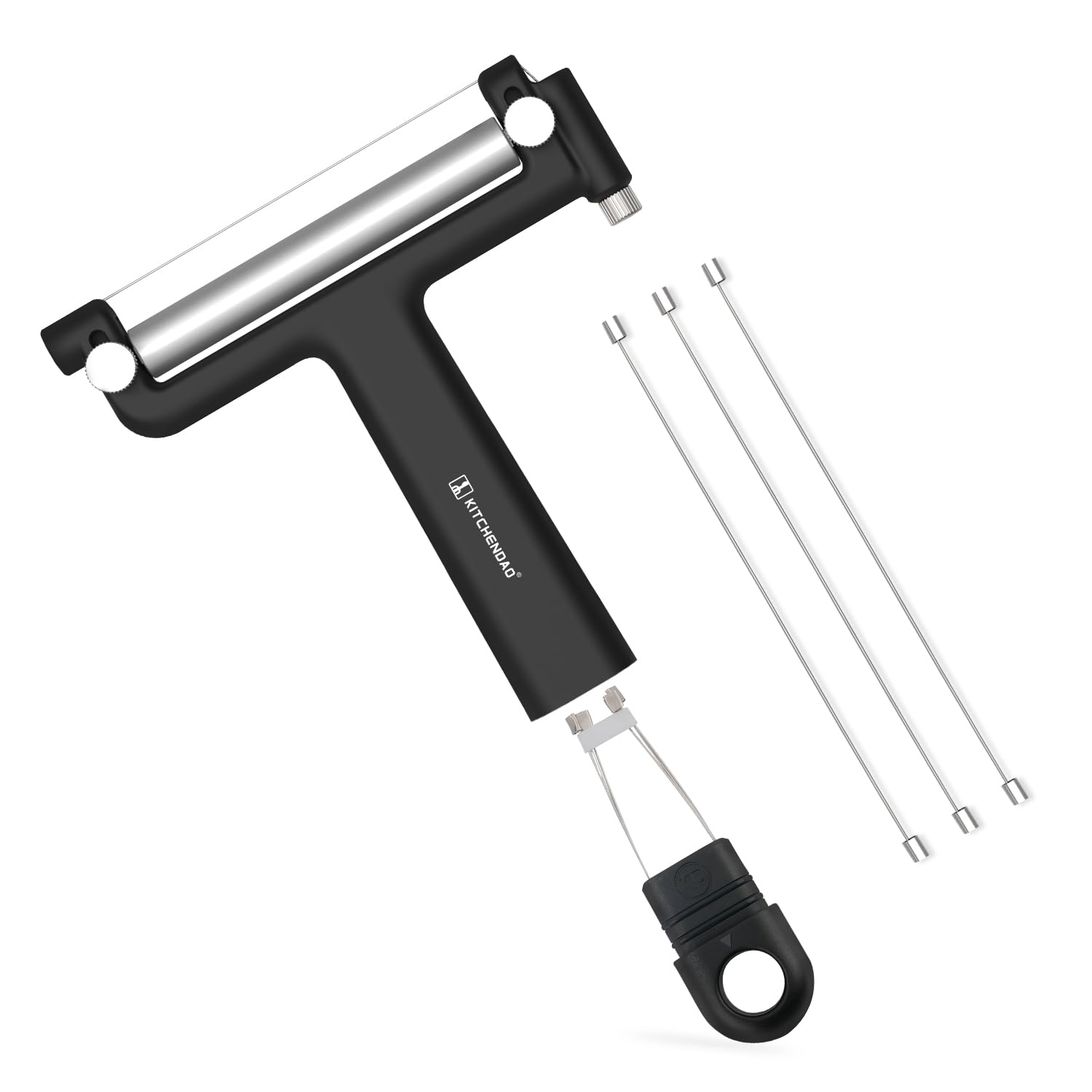
- Extra wires: 3, stored in handle
- Wire length: 3.75 inches
- Price: Midrange
Three spare wires live inside the handle, behind a cap, and that’s the detail we appreciated most — the day the original lets go, you’re slicing again in the time it takes to unscrew a cap, with nothing to order and no drawer to dig through.
The rest follows the same logic. The wire is fixed at three points instead of two, so it holds tension through a firm cheddar block; a screw lets you take up slack when it starts to sag; and the aluminum frame is dishwasher safe, which is rare among the wire slicers here.
In the hand it’s light, and the grip stays comfortable through a long block. Thickness moves in small steps, so you can go from a sandwich slice to something thin enough for a cracker without changing tools.
Against the Bellemain, the difference is temperament. Bellemain is heavier and adjusts in broader steps; this one is lighter, tighter, and fussier about tension — and on a cold block, the taut wire is what gets you through.
Pros
- Three spare wires stored in the handle
- Three-point wire fixing holds tension
- Dishwasher-safe aluminum frame
- Adjustable thickness in small steps
Cons
- Short 3.75-inch wire limits block width
OXO Non-Stick Cheese Slicer – Best for Thin Sandwich Slices

Key Features
- Care: Dishwasher safe
- Blade: Stainless steel, non-stick head
- Length: 9 inches
- Thickness: Set by blade angle
- Price: Midrange
This is the other plane here, and it works the same job from a different angle — literally, since you tilt the head to change thickness. The non-stick surface is meant to let cheese drop away instead of clinging, and on a warm counter that matters more than it sounds.
The soft handle is the most comfortable in this group, the one we reach for with wet hands, and 9 inches of reach lets you take a slice off a wide block in one stroke. Stainless blade, dishwasher safe, and light enough to hang on to through a whole board.
Where it gives ground to the Copenhagen is rigidity. The blade arm has flex to it, and a firm, cold cheddar takes more pressure than it should; slices also run thicker than you expect unless you commit to a steep angle. For semi-hard cheese and thin sandwich slices, neither is a dealbreaker.
Pros
- Non-stick head releases cheese
- Comfortable non-slip handle
- 9-inch reach for wide blocks
Cons
- Blade arm flexes on firm blocks
Boska Monaco+ Cheese Slicer – Best for Paper-Thin Slices

Key Features
- Care: Dishwasher safe
- Blade: Stainless steel, quilted pattern
- Weight: 4.23 oz
- Warranty: 10 years
- Price: Midrange
The Monaco+ makes one thickness of slice, and it makes it better than anything else here. The embossed diamond pattern on the blade plate cuts the contact between cheese and steel, so a slice of Havarti releases instead of clinging, and the edge is sharp enough to shave parmesan into curls.
The rest is one piece of stainless with no moving parts and nothing to tighten, which is why it can go in the dishwasher and why Boska backs it for ten years. At 120 g it has more heft than the Copenhagen, and the extra mass does the work on a firm block.
The single thickness is the whole trade. There’s no wire to reposition and no setting, so a quarter-inch slab for a burger isn’t happening; what you get instead is the thin, even slice that suits a sandwich or a cracker. As a gift, the finish and the warranty do a lot of the talking.
Pros
- Quilted blade resists sticking
- One-piece stainless, dishwasher safe
- Ten-year warranty
- Sharp enough for parmesan
Cons
- Thin slices only, no thickness setting
Zulay Kitchen Wire Cheese Slicer – Best for Weighty Everyday Slicing

Key Features
- Care: Hand wash
- Material: Zinc-aluminum alloy, 304 stainless wire
- Extra wires: 2 included
- Thickness range: Paper-thin to 1/4 inch
- Price: Midrange
Pick this one up and the weight is the first thing you notice: a single piece of zinc-aluminum alloy with no joints to flex, heavy enough that a cold block of cheddar doesn’t push it around the board.
The roller adjusts from paper-thin to about a quarter inch, the large roller is easy to find with a thumb, and the body is finished well enough to leave out on the counter. Zulay also ships two replacement wires.
Two things to know before you buy. The wire is what decides how long this lasts, and the two spares plus a lifetime warranty are the most generous coverage on any wire slicer here. And it’s hand wash only, which matters if your kitchen tools normally go straight into the dishwasher.
Next to the Bellemain, it’s the better-looking tool with the broader warranty; Bellemain adjusts in smaller steps but feels more utilitarian in the hand.
Pros
- Heavy one-piece body stays put
- Paper-thin to quarter-inch adjustment
- Two spare wires and lifetime warranty
Cons
- Hard cheese takes a slow, deliberate pull
How We Tested Cheese Slicers
We started with a shortlist of more than 40 slicers drawn from manufacturer specs, retailer listings, and review sections, then narrowed it by price, wire replaceability, and whether the maker actually sells spare wires. Fourteen made the cut, and we spent four months with them — long enough for a wire to stretch or a hinge to loosen, which is where cheap slicers give themselves away.
Most of the testing happened in the middle of dinner. I sliced block cheddar for grilled cheeses on weeknights, cut Gouda, Emmental, and mozzarella for a Saturday cheese board, and portioned Parmesan for pasta. For each slicer I counted how many clean slices I got before the wire started bowing, measured three consecutive slices with calipers to see whether the thickness setting drifted, and pressed down hard on the frame to judge how much it gave under a firm hand.
Wire care got its own round. I noted whether tension could be adjusted with an accessible screw or lever, how easily a replacement wire threaded through the frame, and whether the wire ran true or wandered off its guides. After each session the slicers went into the dishwasher per the maker’s instructions, and I checked weekly for rust spots, tacky coatings, and handles that had worked loose. Every model was also weighed and used one-handed, since a heavy handle on a light frame tips sideways mid-slice — the kind of flaw that only surfaces after a few dozen blocks.
How to Choose a Cheese Slicer
The right slicer depends less on brand than on the cheese you buy most: a wire, a plane, and a board each fail at something different, and the failure you can live with is the one to buy.
Wire, Plane, or Board
A wire cheese cutter with a roller gives you adjustable thickness and clean slices through semi-hard blocks, and it is the format most kitchens settle on. A plane has no wire to stretch: it shaves thin, even slices off firm cheese and often goes in the dishwasher, but it cannot give you a thick slab. A board model puts a wide plate and measuring grids under the wire, which is what you want for parties and big bricks, at the cost of counter space.
Count what you slice most and buy for that. If most of your cheese ends up on a sandwich, a plane is quicker than any wire. If you cut for a crowd, the plate is worth the footprint.
Match the Tool to the Cheese
Hardness decides more than any feature. Aged gouda and parmesan reward a rigid plane or a wire held under firm tension; a slack wire skids across the rind instead of biting. Soft cheese — brie, fresh mozzarella, anything spreadable — squashes under a wire or a plane, so keep a knife for those.
Temperature matters too. Firm, cold cheese slices cleanest; a block that has been out on the counter for an hour smears. If your fridge holds mostly cheddar and gouda, almost any pick on this page will do the job.
Thickness Control Is Where They Divide
Three systems show up here, and they are not interchangeable. A roller wire sets thickness by position and holds it. A screw-set wire does the same with a little more fiddling. An angle-set slicer asks you to control thickness with your wrist — quick once learned, imprecise until then. A fixed plane gives you one thin slice and no decisions at all.
If you slice for sandwiches one day and crackers the next, buy a setting rather than a skill. If you only ever want thin, the fixed planes here are the least fussy tools on the page.
Buy for the Wire, and for the Washing
The wire is the part most likely to let you down, so check what comes with it: two or three spares in the box, a tension screw, and a wire you can swap without tools are worth more than a pretty handle.
Cleaning splits the group as well. Stainless planes and a few wire models are dishwasher safe; the zinc-bodied wire slicers here are hand wash only, and a wire that goes through a hot cycle again and again is the one that fails first. If your tools always end up in the dishwasher, let that decide it.
Frequently Asked Questions
Do I really need a cheese slicer if I have a good knife?
For firm blocks, yes. A slicer gives you slices of even thickness with less waste and far less pressure, and it is quicker than a chef’s knife on a cold brick of cheddar. A knife still wins for soft cheese, crumbly blue, and any block headed for a melt.
Buy one if firm blocks are a weekly purchase. If your fridge holds mostly soft cheese or pre-sliced slices, a knife covers you.
Can I use a cheese slicer for butter, soap, or vegetables?
Wire models handle more than cheese: cold butter, melt-and-pour soap, and firm vegetables all go through a taut wire, and some makers sell the same tool for exactly that. Wipe and dry the wire afterward, since soap residue and butter both cling.
So if you want one tool for cheese and cold butter, buy a wire. A plane is happiest on firm, sliceable things like cucumber or chocolate, and it will only smear anything soft.
Will a handheld slicer get through a five-pound block?
Only if you cut the brick down first. The wire on a handheld spans roughly 3 to 5 inches, so a wide warehouse-store block will not fit under it in one pass — halve it lengthwise and slice from there.
A board model with a plate around 9 inches takes the whole brick without rearranging your counter, which is the main reason to give up the drawer space.
Final Verdict
We recommend the Boska Copenhagen as the default. It slices firm cheese evenly, has no wire to replace, and goes in the dishwasher — a combination most of this group cannot manage — and it costs less than the alternatives.
If you want to choose the thickness, the Bellemain covers paper-thin to a quarter inch and ships with two spares. And if you are building boards for a crowd, the KITCHENDAO plate with the etched grids earns its counter space.