This post contains affiliate links. We may earn a small commission when you buy through our links — at no extra cost to you.
Dual-zone wine fridges promise two independently controlled climates for reds and whites. But once plugged in, many owners discover the noise from a cycling compressor drowns out dinner conversation. Bottle capacity claims often assume perfect Bordeaux shapes, leaving Champagne flutes awkwardly balanced.
This guide cuts through the marketing. The models here earned their spots by passing three real-world tests: maintaining set temperatures within 2°F, running quietly enough for a living room, and holding as many bottles as advertised. The right fridge lets you enjoy the wine, not the hum.
Top Picks
Best for Compact Kitchens/bars
Yeego 28-Bottle

Key Features
- Capacity: 28 bottles
- Temp Range: Upper 40–55°F, Lower 55–65°F
- Installation: Freestanding/Built-in
- Price: $
The Yeego 28-Bottle runs quietly enough to blend into a kitchen counter or home bar without drawing attention to itself. Its compressor cooling delivers a low, steady hum that is far less intrusive than most budget fridge models – a meaningful difference for anyone who has lived with a noisy cooler under a counter. This makes it a practical choice for open-plan spaces where equipment noise can otherwise become a background annoyance.
The dual-zone setup offers separate temperature ranges: upper 40–55°F for whites, lower 55–65°F for reds, covering the typical serving spectrum. Actual bottle capacity depends on bottle shape – standard 750ml Bordeaux bottles fill all 28 slots, but wider Burgundy or taller Champagne bottles may drop usable storage to around 22–24 bottles. The shelving is adjustable to some extent, so a little planning before loading pays off.
This fridge suits anyone who wants independent temperature zones without dedicating a full-size wine cooler. It fits under standard counter height (34 inches) and is narrow enough for tight spaces. Ideal for casual drinkers with a rotation of 10–20 bottles – not for serious collectors with odd-shaped bottles or those who need a silent bedroom unit. The digital display shows temperature in 1-degree increments, adequate for general storage but not for precision cellaring.
Pros
- Compressor noise is barely audible, suitable for open-plan kitchens and living areas.
- Wood shelves and blue LED lighting add a stylish touch to any bar or countertop.
- Holds set temperatures consistently with minimal adjustment after initial setup.
- Budget-friendly price for independent red and white temperature zones in a compact footprint.
Cons
- In a quiet home office or bedroom, the compressor hum will be present – less of an issue in kitchens or basements.
- Shelf spacing may not accommodate oversized Champagne or Burgundy bottles beyond 22–24 capacity.
Best for Home Bars/kitchens
Ca’Lefort 52-Bottle

Key Features
- Capacity: 52 bottles
- Temp Range: 40–65°F
- Installation: Freestanding/Built-in
- Price: $$
The Ca’Lefort 52-Bottle combines a polished design with reliable dual-zone performance. The three-color LED lighting lets you match the display to your decor, and the wood shelves add a classic look. Compressor cooling keeps both zones within a degree of their set points — a key requirement for storing reds and whites at different temperatures.
This unit fits well in home bars or kitchens with medium-sized collections of 30-50 bottles. The 24-inch width slides under standard counters, and the glass door makes it easy to browse your bottles without opening. For most buyers, the noise level is unobtrusive in active spaces.
Multiple owners remark that the Ca’Lefort looks and performs like a more expensive unit. At its mid-range price, it undercuts French-door alternatives while still delivering the temperature control needed for serious storage. It’s a practical investment for anyone building out a home bar.
Pros
- High-end appearance with adjustable three-color LED lighting
- Accurate temperature control with quick cooling in both zones
- Quiet operation that blends into ambient noise in kitchens or bars
- Good value for the capacity, with build quality that feels premium
Cons
- Wooden shelves can be difficult to slide and may need alignment adjustment on arrival
- Compressor hum may be noticeable in very quiet rooms like bedrooms
Best for Small Bars/kitchens
BODEGA Combo Cooler

Key Features
- Capacity: 19 bottles + 57 cans
- Temp Range: Dual zone for wine and beverages
- Installation: Freestanding/Built-in
- Price: $$
Premium build quality and near-silent operation define this 24-inch combo cooler. Against the more popular dual-zone option in this category, it trades higher bottle-per-dollar capacity for noticeably quieter running and a sturdier feel. The compressor-based cooling maintains separate temperatures for wine and drinks without audible hum intruding on a kitchen or bar space.
This unit fits best in small kitchens or under-counter bar setups where space is tight and the look matters. The dual-zone design works fine for everyday wine (upper compartment) and chilled beverages (lower). The 19-bottle limit means it won’t support large parties or serious collections — plan for it as a daily-use companion rather than a cellar replacement.
Temperature control stays consistent across both zones, and the glass doors add a clean professional aesthetic without letting light degrade the wine. For someone who values quietness and build over raw capacity, this fridge delivers a straightforward experience.
Pros
- Solid build with a premium feel that holds up to daily use.
- Operates quietly even when the compressor cycles.
- Dual-zone cooling keeps wine and beverages at their ideal temperatures.
- Two-glass-door design looks presentable in any room.
Cons
- Per-bottle cost is higher than larger models that hold more.
Best for Large Collections
Velieta 179-Bottle

Key Features
- Capacity: 179 bottles
- Temp Range: Upper 40–55°F, Lower 55–65°F
- Installation: Freestanding
- Price: $$$
The Velieta holds 179 standard bottles across two independently controlled zones, and the compressor runs quietly enough for most living spaces. Where it falls short is that a minority of units may stop cooling after months of use — a risk worth weighing against the top pick in this size class, which has a stronger long-term track record. This makes more sense for collectors who need the space immediately and are comfortable buying with a flexible return window, rather than those planning decades of uninterrupted aging.
Pros
- Holds 179 standard bottles across two independently controlled zones
- Compressor operates quietly enough for living areas
Cons
- In very quiet rooms, the compressor hum and occasional click will be present — less noticeable in basements or garages
Best for White Wine Lovers
FOVOMI 52-Bottle

Key Features
- Capacity: 52 bottles
- Temp Range: Upper 41–54°F, Lower 54–68°F
- Installation: Freestanding
- Price: $$
The FOVOMI 52-bottle fridge fits neatly into a 20-inch space and runs quietly — well suited for storing white wines and champagne at their ideal temperature. However, the upper zone’s maximum temperature of 54°F limits its use: full-bodied reds that need 55–65°F won’t be served well. This makes the unit a good match for white wine enthusiasts rather than red collectors.
Pros
- Sleek modern design with blue LED lighting that fits kitchen decor.
- Quiet compressor operation suitable for open living spaces.
Cons
- Shelves feel thin and lack back stops, requiring careful bottle placement to prevent falls.
- Long-term cooling consistency can vary between units — worth monitoring with a flexible return window.
Best for Narrow Spaces
Antarctic Star 28-Bottle

Key Features
- Capacity: 28 bottles
- Temp Range: Upper 41–54°F, Lower 54–68°F
- Installation: Freestanding/Built-in
- Price: $$
Where the top pick prioritizes hushed operation, the Antarctic Star 28-Bottle leans into its 15-inch width — a size that slots into tight under-counter cutouts most dual-zone models can’t touch. Upper and lower zones hold setpoints accurately, making it practical for storing both crisp whites and fuller reds at proper serving temperatures.
The stainless steel cabinet and double-layer tempered glass door, edged with cool blue LED lighting, deliver a polished built-in look. Shelves slide smoothly and feel robust, though spacing is optimized for standard Bordeaux bottles — wider Burgundy or Champagne shapes will need a shelf removed, trimming usable capacity below the advertised 28.
This fridge is a natural fit for kitchens with narrow cabinet openings, where the compressor hum during cycling blends into ambient household noise. In a quiet bedroom or open living area, that sound will be present. The door hinge is fixed left with no reversal — a non-issue for most standard installations, but a dealbreaker if your layout requires a right-hand swing.
Pros
- Beautiful under-counter design with blue LED lighting
- Dual-zone temperature control holds precise setpoints
- Sturdy construction and smooth sliding shelves
Cons
- Shelf spacing is tight for large bottles, reducing real capacity
- Compressor cycling can be noticeable in quiet rooms
- Door hinge is fixed left and not reversible
Best for High-End Kitchens
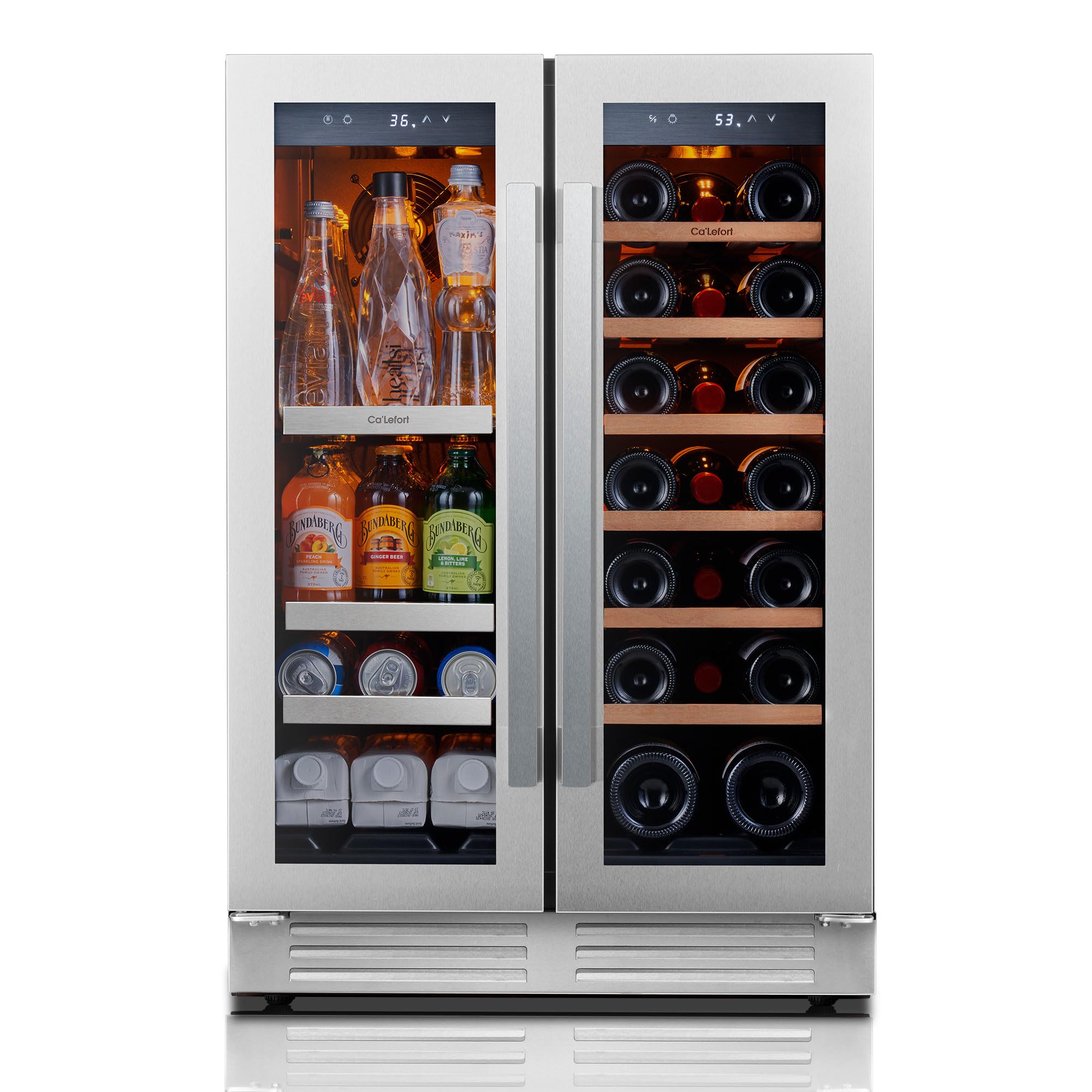
Ca’Lefort French Door Combo
Key Features
- Capacity: 20 bottles + 60 cans
- Temp Range: Left 36–72°F, Right dual zone
- Installation: Freestanding/Built-in
- Price: $$$
The Ca’Lefort French Door Combo offers a premium dual-zone layout with a beverage cooler on the left and wine storage on the right, all in a French-door design with 3-color LED lighting. Compressor cooling is efficient and quiet. The main tradeoff is the temperature floor: the beverage zone bottoms out around 38°F, not the advertised 34°F, so ice-cold drinks aren’t possible. At this price, you’re paying for the look; better value exists if performance is the priority, but for those who want a standout French-door fridge that keeps wine and beverages separate and stylish, it delivers.
Pros
- French-door design with 3-color LED creates a high-end, customizable look.
- Compressor operates quietly while cooling both zones efficiently.
- Clean lines and stainless finish allow seamless built-in or freestanding installation.
Cons
- Interior light requires manual activation; does not turn on when the door opens.
- Beverage zone may not reach advertised 34°F; actual low is around 38°F.
Best for Wine & Beer
Tylza Combo Cooler

Key Features
- Capacity: 20 bottles + 88 cans
- Temp Range: Left 35–50°F, Right 41–64°F
- Installation: Freestanding/Built-in
- Price: $$
The Tylza Combo Cooler separates wine storage from beverage cans in two independently controlled zones, giving you flexibility the top pick doesn’t match if you regularly stock both. The left compartment chills wine from 35–50°F while the right handles beer and soda from 41–64°F, so each side can hold different bottle sizes without temperature conflict. That dual-compartment layout is its main advantage over quieter, single-zone alternatives — you gain versatility at the cost of a larger footprint and some compressor sound.
In a living room or open-plan kitchen, the compressor hum blends into background noise — most buyers won’t notice it during daily use. The real constraint shows up in a quiet den or bedroom where the cycling becomes audible. Temperature consistency holds steady across the middle of each zone, though slight drift can occur when you push the settings to their extremes (very cold on the wine side, for example). This isn’t a precision cellar for long-term aging, but it handles weekly consumption and party prep without issues.
This cooler fits home bar owners who want wine and beer in one unit and prioritize storage capacity over silent operation. If you need near-silent performance for a library or master suite, the slimmer compact option in this set avoids the noise tradeoff but holds fewer bottles. The Tylza is a practical middle ground: acceptable sound for most rooms, two temperature zones that work independently, and a look that suits built-in under-counter installation.
Pros
- Separate temperature zones for wine (35–50°F) and beverages (41–64°F).
- Stainless steel and glass front fits well in kitchen or bar cabinetry.
- Quiet enough for typical home settings; compressor noise is manageable.
- Good value for a dual-zone combo unit with this capacity.
Cons
- In very quiet rooms, the compressor hum will be present — less of an issue in a kitchen or living area.
- Temperature consistency can drift near the upper or lower ends of the set range.
Best for Large Collections
ORYMUSE 200-Bottle

Key Features
- Capacity: 200 bottles
- Temp Range: Upper 40–55°F, Lower 55–65°F
- Installation: Freestanding
- Price: $$$$
The ORYMUSE packs 200 bottles into a tall, well-built cabinet with 15 beechwood shelves that slide out smoothly. Its compressor cooling holds dual zones independently (upper 40–55°F, lower 55–65°F) and runs quietly enough that the hum blends into a basement or garage — a meaningful upgrade over other large-capacity models where cooling reliability has been inconsistent.
Each shelf cradles bottles securely, and the intelligent temperature memory keeps settings after a power interruption. The unit stands 76.78 inches tall, which means it belongs in a room with ceiling clearance rather than under a standard counter. Minor compressor cycling noise may be noticeable in very quiet spaces, but for a cabinet this size the sound level is unremarkable.
This fridge suits the collector who has a dedicated wine room, basement, or large open area and wants one appliance to handle a growing collection without frequent restocking. The height tradeoff is the main constraint — measure your space first. If clearance is tight, a smaller dual-zone unit like the top pick will fit under counters; if you have the vertical room, the ORYMUSE gives you capacity and build quality that few alternatives match.
Pros
- Holds up to 200 bottles on 15 beechwood shelves that slide out for access.
- Solid construction and a premium appearance that fits a serious cellar setting.
- Compressor cooling runs quietly and reaches set temperatures quickly.
- Straightforward installation and strong value for the bottle capacity provided.
Cons
- In a quiet room the compressor hum may be audible during cycling — less of an issue in a basement or living area.
- Requires 77 inches of vertical clearance; will not fit under standard kitchen counters.
How to Choose
The most common buyer regret after purchasing a dual-zone wine fridge is unexpected noise and overestimated bottle capacity.
Capacity: Real vs. Advertised
Manufacturers count bottles using standard Bordeaux 750ml shapes laid in perfect rows. In practice, Champagne, Burgundy, and large Pinot Noir bottles take up 20–30% more space. A 28-bottle fridge often holds 18-22 real bottles.
Measure your largest bottles before buying. Check shelf depth and spacing between slats. If you store mixed shapes, downgrade any advertised number by a third.
Temperature Range and Accuracy
Compressor-based dual zones can usually maintain ±2°F of setpoint, but the top zone often struggles to reach 40°F if ambient temp is high. Some units list a range of 41–54°F for the upper zone, which is too cold for full-bodied reds that prefer 60–65°F.
Look for a lower zone that reaches at least 65°F. If you drink mostly reds, avoid models with a top zone max below 55°F.
Noise Level
Compressor fridges cycle on and off to maintain temperature. The hum and occasional click are normal, but some units produce a constant drone or loud vibration. This is the #1 unexpected complaint in reviews.
Decibel ratings are rarely published. Instead, read review mentions of ‘quiet’ and ‘loud’. Models with 80%+ positive mentions on noise are safe for open-plan living areas. Place any unit away from bedrooms.
Build Quality and Reliability
The cheapest units often use thin steel, flimsy shelves, and compressors that fail within 12 months. Look for solid stainless steel bodies, wood or heavy-gauge wire shelves, and a brand with at least 500 reviews and a rating above 4.3.
Door hinge failures are more common than expected—check reviews specifically for hinge or door alignment issues. A reversible door adds flexibility for built-in installations.
Installation Type: Freestanding vs. Built-In
Freestanding units need airflow on all sides—building them into a cabinet without gaps can cause overheating and compressor failure. Built-in rated models have front ventilation and can sit flush under counters.
Measure the intended tight space: many 24-inch wide units actually need 24.5 inches for clearance. Also check height—some tall units exceed 6 feet and won’t fit under standard countertops.
FAQ
Why does my wine fridge not get cold enough?
If the temperature doesn’t drop to the setpoint, check that the unit has proper ventilation (at least 4 inches behind) and the door seal is clean. For dual-zone models, the upper zone often has weaker cooling. If it still fails, the compressor may be defective—something to confirm within the return window.
How many bottles actually fit in a 28-bottle wine cooler?
Expect 18–22 standard 750ml Bordeaux bottles in a 28-bottle rated fridge. Champagne and Pinot Noir bottles are wider and reduce capacity further. Always measure your own bottles against the shelf spacing.
Is it normal for a dual-zone wine fridge to make noise?
Some compressor hum and occasional clicks are normal. But if the noise is a constant loud drone or rattling, something is wrong. Read reviews for each model—models with 80%+ positive comments on noise are fine for living spaces. Ours are picked for quietness.
Can a dual-zone wine fridge store both red and white wine at the same time?
Yes, that’s the point. Set the upper zone near 50°F for whites and the lower zone near 60°F for reds. But check that the lower zone reaches at least 60°F—some models cap at 55°F, which is too cold for full-bodied reds.