This post contains affiliate links. We may earn a small commission when you buy through our links — at no extra cost to you.
The first time I tried to salt a margarita glass without a rimmer, I ended up with a countertop crusted in kosher salt and a glass wearing a patchy, lopsided band. A salt rimmer fixes that mess: it provides a shallow bed of salt, a damp sponge for the rim, and a lip to catch the excess. Over the past four months, my team and I tested 14 of them, from simple trays to lidded containers.
The differences come down to stability, size, material, and how each one behaves after the first round. A rimmer that slides while you tilt a coupe, or one so narrow a wide margarita glass won’t fit, is a countertop annoyance no matter how nice it looks. I also noted versatility—whether it handled coarse salt, sugar, and chili-lime blends—and cleanup, since a soggy salt brick makes a small gadget feel like a bad buy. Below are the picks that stayed stable, rinsed clean, and earned their space.
Our Top Picks
The Best Salt Rimmers, Reviewed
New Star 48360 Glass Rimmer – Best Overall
Key Features
- Trays: 3 labeled swing-out trays
- Capacity: 240 ml
- Material: ABS plastic
- Footprint: 7 x 6.4 x 3 in
- Price: Midrange
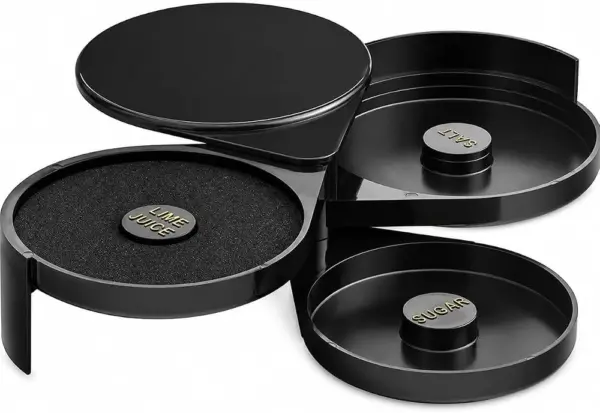
Three labeled trays and a listed 240 ml capacity are what make the New Star 48360 feel like a small bar station rather than a novelty. The black ABS body is plain, but the labels do real work after the first round, when salt and sugar look alike. Its 7 x 6.4 x 3-inch footprint is compact enough to leave out on a kitchen counter.
We make this our top pick because it balances those details with a base that feels planted. The 240 ml capacity is enough for a home round of margaritas without turning into a refill job, and the three trays give you salt, sugar, and a wet sponge in one place. The New Star also handles pint glasses and margarita glasses, so it is not a one-drink tool. Compared with the budget 3-tier units here, it feels less likely to skate across the counter when you press a glass into the sponge.
The capacity is the first thing a busy host will outgrow. If you are rimming dozens of drinks for a party, a larger station or a second unit makes more sense; for a household making a pitcher at a time, it is more than enough.
We also appreciate that the labeled trays keep the setup understandable for guests. The plastic will not win a design award, but the labels are the small detail we keep coming back to: they turn a three-compartment gadget into something anyone can use without a briefing.
Pros
- Keeps salt, sugar, and lime separate
- 240 ml capacity suits a home round
- Compact 7-inch footprint
- Handles pint and margarita glasses
Cons
- Trays can need a firm pull
TonJin 3-Tier Glass Rimmer – Best Budget
Key Features
- Lid: Snap-on lid
- Trays: 3 labeled trays
- Cleaning: Dishwasher safe
- Dimensions: 7.9 x 6.1 x 2.8 in
- Price: Budget
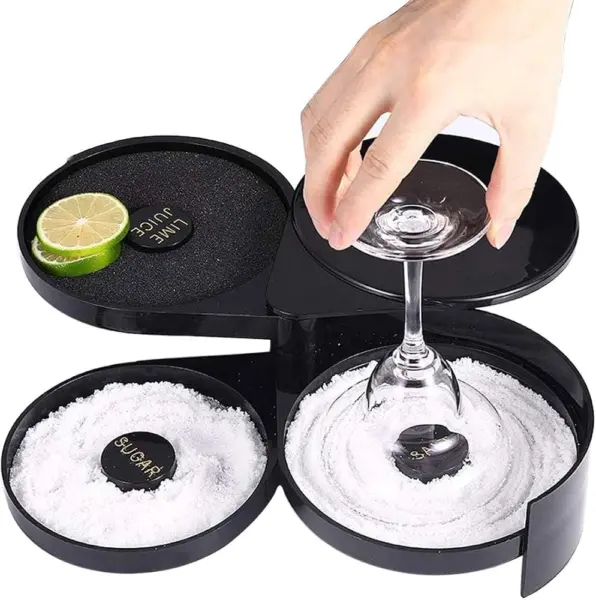
A budget price buys the full three-tray setup here, plus a snap-on lid. We think the TonJin is enough for a casual margarita night, especially if you want to keep salt and sugar covered between rounds. The ABS body is light, and the whole thing folds down to a 7.9 x 6.1 x 2.8-inch package.
The trade-off is the light 200-gram body: press a glass into the sponge and the station can shift, so hold the base with your free hand. The three trays are labeled, which saves the usual guessing, and the lime sponge sits in its own compartment. For a first apartment or a rental kitchen, that is a fair set of compromises.
Cleaning is straightforward: the TonJin is dishwasher safe, and the lid keeps dust off between uses. We like that the lid lets you stack it in a cabinet without worrying about a loose tray of salt. It is not the station for a busy bar, but the low cost and small footprint make it easy to justify as the casual setup.
Pros
- Includes three labeled trays
- Snap-on lid for storage
- Dishwasher-safe plastic
- Compact 7.9-inch footprint
Cons
- Trays can be hard to open
MONKKINO Collapsible Rimmer – Best for Wide Glasses
Key Features
- Trays: 3 swing-out trays
- Sponges: 2 included
- Storage: Collapsible with lid
- Max glass rim: 5.5 in
- Price: Budget
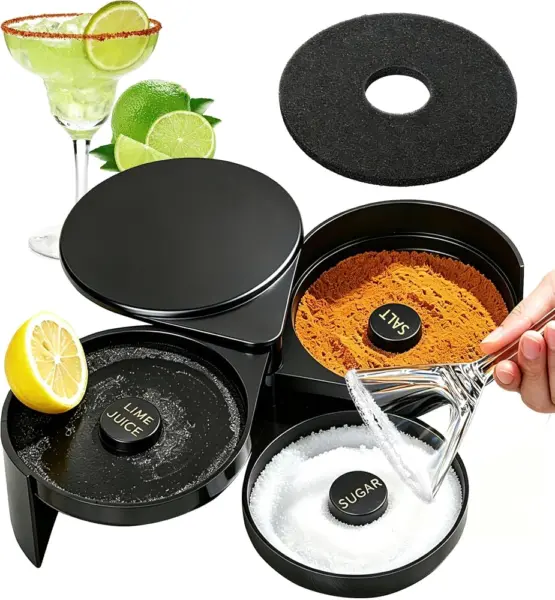
The 5.5-inch opening is the number to note: this is the rimmer that takes the broad margarita glasses that make smaller stations feel cramped. It also folds into a compact stack with a lid, and MONKKINO includes two washable sponges, so one can dry while the other is in use.
The three swing-out trays cover salt, sugar, and lime, and the labels keep you from mixing them up after a couple of rounds. The collapsible shape is the practical part: it closes into a footprint that is easier to tuck into a cabinet than a fixed 7-inch station. We like it for a small kitchen because the lid lets you keep the setup covered without leaving it on the counter.
Glass width is the reason to pick this one. We recommend it when your glassware is broad and storage is tight; it is a better fit for wide glasses than the acacia G & J’s, though it does not feel as substantial as the New Star in the hand.
Pros
- Fits rims up to 5.5 inches
- Collapsible with a lid
- Two washable sponges included
- Three labeled swing-out trays
Cons
- Trays can bind or crack with use
G & J’s Acacia Rimmer – Best-Looking
Key Features
- Trays: 3 swing-out trays
- Included: 3 sponges and recipe ebook
- Material: Acacia wood
- Max glass rim: 4.2 in
- Price: Premium
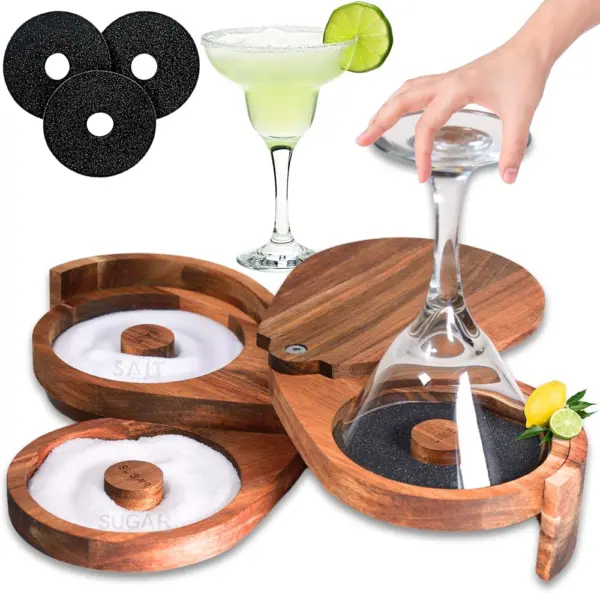
Acacia wood is the first thing you notice, and it changes the job: this is a rimmer you can leave on the bar instead of hiding in a cabinet. The three-tier layout is familiar, but the wood gives it a warmer look than the plastic stations here. It comes with three sponges and a small recipe ebook, so it reads as a complete gift set.
The trays swing out for salt, sugar, and lime, and the wood body gives the station a more solid presence on the counter. The opening fits glasses up to 4.2 inches, which is smaller than the 5.5-inch units here. If your margarita glasses are broad, measure the rim before you order; this is the one place where the acacia set gives up ground.
We think it earns its place for the host who cares how the bar looks and mostly uses standard glassware. The wood is the difference, and the three sponges mean you are not stuck waiting for one to dry. It is the one here that feels like decor as well as a tool.
Pros
- Acacia wood looks display-worthy
- Three swing-out trays
- Three sponges and recipe ebook
- Fits standard glassware
Cons
- Premium price for a bar tool
Suwimut 2-Pack Rimmer – Best Two-Pack
Key Features
- Pack: 2 rimmer stations
- Trays: 3 swing-out trays
- Material: ABS plastic
- Dimensions: 7.9 x 6.1 x 2.8 in
- Price: Midrange
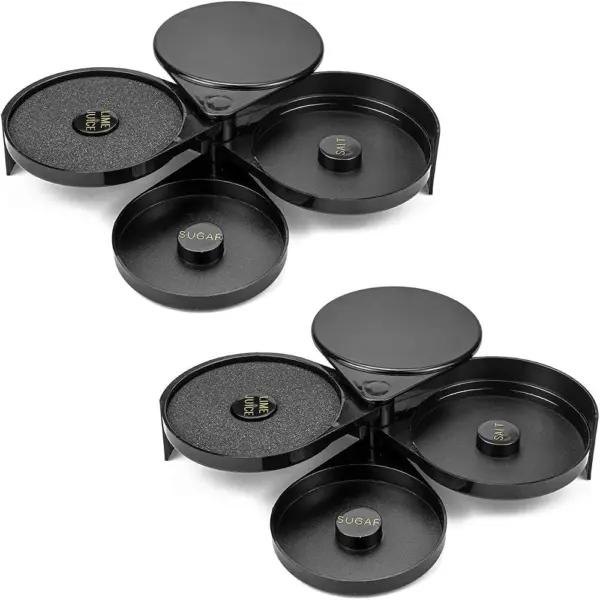
Two complete 3-tier stations arrive in this pack, which is the reason to consider it. We like the Suwimut for a host who wants one setup for salt and another for sugar, or for anyone who wants a spare without shopping again. Each unit measures 7.9 x 6.1 x 2.8 inches, so the pair takes the same counter space as two separate stations.
Each station has three labeled trays, a sponge, and dishwasher-safe ABS plastic. The two-pack is most useful when you are making a lot of drinks and do not want to stop to refill or swap flavors. It is also an easy gift for someone building a home bar, because the second unit does not go to waste.
Against the New Star, each Suwimut unit is more basic: the plastic is lighter and the finish is plainer. The two-pack makes sense when a second station means placing another order, not when you want the most substantial single unit on the counter.
Pros
- Two complete 3-tier stations
- Labeled trays on each unit
- Dishwasher-safe ABS plastic
- Useful for gifting or backup
Cons
- Only sold as a two-pack
Mingting 3-Tier Rimmer – Best for Compact Storage
Key Features
- Lid: Included
- Trays: 3 stacked compartments
- Material: PP plastic
- Max glass rim: 1.8 to 5.5 in
- Price: Budget
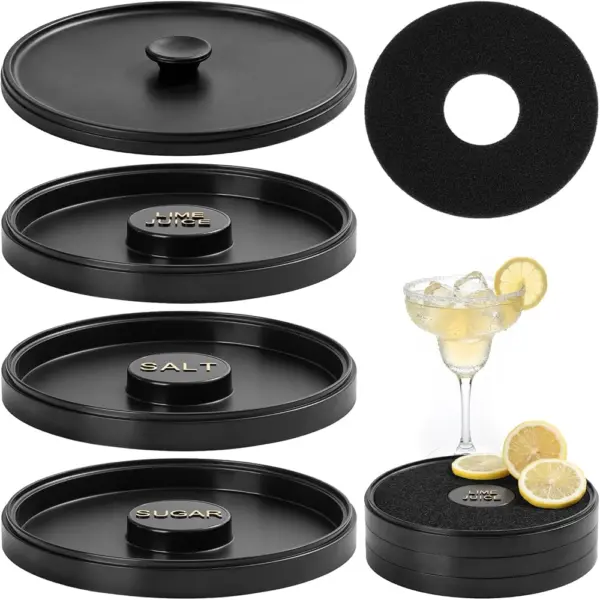
The lid and the stackable footprint are the reasons to consider the Mingting. It uses three stacked compartments for salt, sugar, and lime, and the removable trays make it easy to carry one section to the sink. The opening is rated for rims from 1.8 to 5.5 inches, which covers everything from small coupe glasses to wide margarita glasses.
We see it as the compact-storage choice: the lid closes over the stack, so the station can live in a cabinet instead of on the counter. The PP plastic is light, and the stack is simple enough to set up without instructions. For a small kitchen or a bar cart, that combination is more useful than another fixed tray.
The design is light-duty rather than bar-workhorse, so it suits a home bar used a few times a month. The lid is the detail that makes it easy to put away, and the wide rim range means one station can handle more than a single style of glass.
Pros
- Fits rims from 1.8 to 5.5 inches
- Lid covers the stack
- Removable trays for cleaning
- Stackable footprint saves space
Cons
KKJCXY Wide Glass Rimmer – Low-Profile Tray
Key Features
- Material: ABS plastic
- Footprint: 13 x 7 x 0.75 in
- Compartments: 2 sections
- Max glass rim: 5.2 in
- Price: Budget
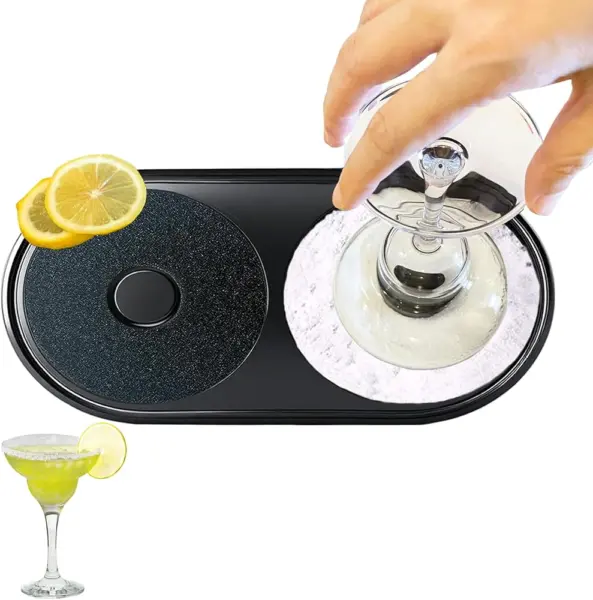
The low, rectangular 13 x 7-inch tray is a different shape from the round 3-tier stations here, and that is the point. The KKJCXY gives you a broad landing area for glasses up to 5.2 inches, with one section for salt or sugar and one for the juice sponge. It sits just 0.75 inch high, so it slides into a drawer or under a shelf.
The two-section layout is simpler than a three-tier station: fewer lids, fewer trays, and less to clean. The reusable sponge is included, and the ABS plastic has smooth edges. It is easier to set up for a single-style margarita night.
The footprint is the trade-off. At 13 x 7 inches, it claims more counter than a round 7-inch station, and the wide shape is more noticeable in a small kitchen. It is the kind of tool that works best when it has a dedicated spot rather than being pulled out of a crowded drawer.
We recommend it for big glasses and a bar corner where the wide landing area earns its keep. If you switch between salt, sugar, and a spicy rim, the 3-tier picks are easier; if you mostly make one style of margarita, this low tray is the simpler tool.
Pros
- Wide 5.2-inch rim opening
- Low 13 x 7-inch tray
- Simple two-section layout
- Reusable sponge included
Cons
- Only two compartments
How We Chose and Tested the Best Salt Rimmers
I started by pulling together every salt rimmer I could find that was actually designed for home bars—shallow trays, lidded containers, and a few adjustable models—then narrowed the field by size, material, and whether replacement sponges were available. We ended up with 14 units and used them for four months in my kitchen and on a friend’s back patio, usually during taco nights, birthday margarita batches, and the occasional quiet Tuesday when a paloma needed a salted rim.
Each rimmer got the same workout: I wet the sponge according to its instructions, dragged a chilled margarita glass through at the angle the tray allowed, and then repeated with a wider coupe and a narrow martini glass. I watched whether the glass sat steady or tipped, whether salt clumped on one side, and whether the rimmer slid across the counter when I pressed down. For versatility, I rotated coarse kosher salt, fine sea salt, sugar, and a chili-lime blend through the trays and noted which ones caked, which released cleanly, and which needed a full wash between flavors.
Cleaning mattered as much as the first rim. After each session I rinsed the trays, checked whether salt had packed into corners or under the sponge, and ran the dishwasher-safe models through a normal cycle; the ones with seams or porous material tended to hold onto residue. I also looked at material quality and design over the four months—whether hinges loosened, lids warped, or the tray scratched after regular use—and weighed that against how much counter space each one took up and whether it felt worth the money. A rimmer that only handled salt but did it perfectly could still beat a versatile one that wobbled every time.
How to Choose a Salt Rimmer
The useful question is not how many compartments a rimmer has but whether it opens easily, fits your glasses, and stays put while you use it.
Start With the Glass Rim
Measure across the rim, not the bowl, because a 5.5-inch rating refers to the opening the glass sits in. If you use oversized margarita or martini glasses, look for a 5.2- to 5.5-inch opening; the acacia G & J’s tops out at 4.2 inches and will not take the biggest glasses. A smaller rim can still work in a wide tray, but it is easier to tilt and get an uneven coat. Check the opening before you fall for the finish.
Choose the Tray Layout You’ll Actually Use
Three tiers are the default for a reason: salt, sugar, and a wet sponge live separately, so you can move from a margarita to a cinnamon-sugar rim without rebuilding the station. A two-section tray like the KKJCXY is simpler to clean and leaves a broader landing area, but it limits you to one seasoning at a time. If you mostly make one house margarita, two sections are enough; if you host, three earn their space.
Test the Tray Action Before You Fill It
Stiff trays are the most common letdown in this category, and you feel it most when your hands are wet. Open and close every tray before adding salt; if the hinge catches or the lid needs two hands, return it rather than fight it at a party. A fixed or stacked design can be steadier than a swing-out one, but it also takes more counter space to use. Stability matters as much as the hinge: hold the base while you press the glass into the sponge.
Plan for Cleaning and Storage
Salt and sugar are easy; the sponge is the part that needs attention. Rinse and dry it after each session, because citrus residue left in a closed tray can turn moldy. Check the maker’s care instructions before dishwashing a plastic or wood station; only some are rated for it. A lid is worth having if the rimmer lives on the counter, and a collapsible or stacking design is easier to put away in a small kitchen.
Match the Station to Your Counter and Crowd
A 7-inch round station suits most home bars; a 13-inch rectangular tray gives big glasses more room but claims more counter. Capacity matters if you rim a lot of drinks: the New Star lists 240 ml, enough for a home round but not a busy bar’s refill pace. A two-pack makes sense for a host who wants separate savory and sweet stations, while a single well-built unit is easier to store.
Frequently Asked Questions
What can I use if I don’t have a salt rimmer?
A shallow saucer of salt and a damp paper towel or a small dish of lime juice will get you a decent rim. The advantage of a rimmer is the separate sponge and covered trays, which keep the process tidy and stop salt and sugar mixing. For occasional margaritas, the saucer method is enough.
How do I get an even salt rim?
Wet only the outside lip of the glass, not the inside, then press it into the salt at a slight angle while turning. Tap off the loose grains before you fill the glass. A sponge that is damp rather than dripping gives you more control, and a wide tray lets you dip without dragging the rim through the pile.
Can I use a rimmer for Tajin or chili-lime seasoning?
Yes, and a three-tier station is useful for keeping a spicy seasoning away from sugar. Use a dry tray, apply it the same way as salt, and rinse the sponge and tray afterward so the chili does not linger. If you only rim with one seasoning, a two-section tray is simpler.
How do I keep salt from clumping in the tray?
Keep the salt dry: use a dry spoon, close the lid between rounds, and do not store a wet sponge directly under an open salt tray. If a tray does clump, spread the salt on a plate to dry and break it up before returning it. A covered, stackable rimmer makes this easier.
Final Verdict
The New Star 48360 is the one we point most people to. Its three labeled trays, 240 ml capacity, and planted 7-inch base make it the most complete home-bar station in this group, and it asks less patience than the budget picks.
If your glasses run wide, choose the MONKKINO for its 5.5-inch opening and collapsible lid. If you want a station that looks good enough to leave out, the acacia G & J’s is the better buy, provided your glasses fit its 4.2-inch opening.