This post contains affiliate links. We may earn a small commission when you buy through our links — at no extra cost to you.
The first time I saw a glass rinser was at a taproom, where a bartender pressed a pint glass over a tiny spray valve and stripped it clean in one motion. I immediately wanted one for my kitchen. A glass rinser is that same fixture — a spray head that mounts into an extra sink hole and blasts water upward into whatever you press over it, rinsing tall glasses, baby bottles, and cocktail tins more thoroughly than tilting them under the faucet.
We tested 13 of these at home over three months — through dinner parties, smoothie rounds, and late-night wine glasses — and the good ones have a lot in common. They seal without leaking under the sink, spray far enough to actually hit the inside of a tall glass, and still feel sturdy after dozens of presses. Price didn’t predict quality, either: a few expensive chrome models disappointed, while a couple of understated brass ones felt built for a bar. The picks below span budget plastic to showpiece brass, so there’s a rinser here that fits your sink.
Top Picks
Best for Home Bars
Delta GR150-SP

Key Features
- Mount: Single hole
- Finish: SpotShield Stainless
- Included: Supply line, cover
- Flow rate: 1.2 gpm
- Price: Midrange
The Delta GR150-SP is built for the home wine drinker who wants to stop scrubbing stems after a dinner party. It drops into a spare sink hole that previously held a soap dispenser or sprayer, and the included supply line connects to hot or cold water in one straightforward pass. That makes it the most accessible upgrade in this set, and the appeal is immediate: rinse the glass, let the overhang direct the water back into the sink, and move on to the next pour.
What sells us on the GR150 is how reliably it blasts residue from glasses, bottles and baby bottles. The 1.2-gallon-per-minute flow is modest, but the jets do the work of loosening dried wine and milk film without needing a full soak. We do mind the body: it reads as plastic with a stainless-style finish rather than solid metal, and that sits oddly at this price. The real limit is the roughly 3.5-inch opening — large-bowled wine glasses and wide-mouth bottles will not seat, so measure before you commit.
None of that keeps this from being the default pick. For standard wine stems, cocktail glasses and travel cups, it is easy to live with and easy to install, and the lifetime warranty covers the parts that matter. If metal and a wider opening are what you want, the GR250 below is the upgrade; otherwise, this is the rinser we choose for our own sink first.
Pros
- Easy single-hole install with included supply line
- Reliable residue-clearing spray for daily drinkware
- Overhang directs rinse water back into sink
Cons
- Mostly plastic body despite premium price
- Roughly 3.5-inch opening excludes wide glasses and bottles
Best for Showpiece Sinks
Delta GR250-AR

Key Features
- Mount: Countertop
- Finish: Arctic Stainless
- Material: Brass
- Drain type: Grid drain
- Price: Premium
The first thing you notice about the GR250 is what it is not: it is not another plastic rinser wearing a stainless costume. The base is solid metal with a premium finish, and that is precisely why we think it earns a spot as the step-up pick for anyone who has replaced a plastic accessory before and wished they had spent more.
That upgrade buys more than looks. The brass body resists the flex and wear that make plastic housings feel temporary, and the corrosion-resistant finish is built to outperform ordinary stainless by a meaningful margin. We did find one compromise: the included lid is still plastic, which stings at this price, but the mechanism itself feels built to stay put. Cleaning is straightforward — the black insert pops off for access, and the sprayer cap keeps the jets clear between uses.
If you rinse the same narrow-necked bottles and wine stems every day, the 4.5-inch footprint is plenty. What you are paying for is permanence and a finish that belongs next to a polished faucet. This is not a necessary upgrade — the plastic GR150 above does the same job for far less — but for a dedicated wine bar where the sink is on display, the GR250 is the one we keep coming back to.
Pros
- Solid brass body resists flex and wear
- Corrosion-resistant finish for long-term durability
- Removable insert simplifies cleaning
Cons
- Plastic lid feels cheap at this price
Best for Tight Budgets
Homewerks GR001SS
Key Features
- Mount: Deck mount
- Finish: Polished
- Material: Stainless Steel
- Flow rate: 1.8 gpm
- Price: Budget
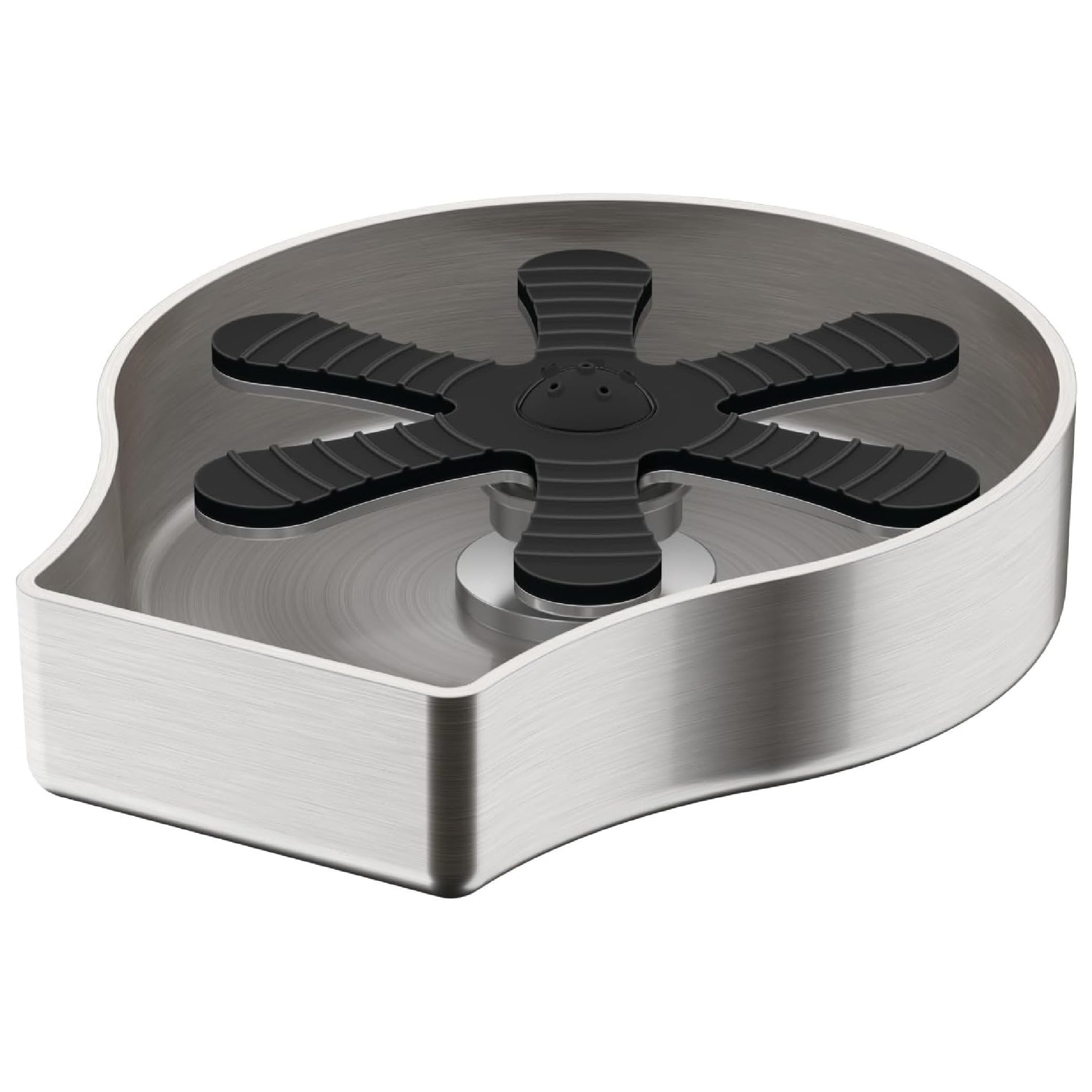
The Homewerks GR001SS is the bargain pick for anyone who wants actual stainless steel and doesn’t want to pay for a logo. It mounts in the same single-hole spot as a soap dispenser or sprayer, and the included supply line and extender tee cover most straightforward kitchen setups. For a first glass rinser, it makes a lot of sense on paper.
Where the savings show up is in raw blasting power. The 1.8-gallon-per-minute flow is the highest listed in this set, but it uses that volume to rinse rather than scour, and it leaves heavier dried-on milk or coffee residue behind. For wine glasses and cocktail stems — the things this keyword is actually about — that is not much of a problem. Red wine rinses away cleanly with a quick press and a little dish soap if needed.
We like the stainless body and the simple polished look next to a stainless faucet. The main concession is sealing: some installs need plumber’s tape at the o-ring to stop a slow counter drip, so check that connection before you tighten everything down. For the money, this is the best way to get real metal and solid daily performance.
Pros
- Real stainless steel body with polished finish
- High 1.8 gpm flow rate
- Included supply line and tee connector
Cons
- May need extra sealing at o-ring to stop drips
- Doesn’t remove heavy milk or coffee residue
Best for Dual-Use Sinks
AquatiQ 2-in-1

Key Features
- Mount: Countertop
- Includes: Pull-out sprayer, tee
- Hose length: 120 cm
- Basin material: 304 Stainless Steel
- Price: Budget
None of the other picks here can do what the AquatiQ does after the glass is clean: the sprayer pulls out on a 120 cm braided hose and rinses dishes, snack containers, or the sink itself. That makes it the most versatile glass rinser in this set, and the reason it earns a runner-up spot despite a couple of rough edges.
The basin is 304 stainless, not plastic, and the tilted base drains water efficiently instead of leaving a puddle on the counter. We appreciate the solid metal base and the extra spinning disk included for wear, but the press-down mechanism is stiffer than we want — light glassware can feel precarious until you get the motion down. More concerning is sealing: water can creep between the base and shaft, and the fix is not always obvious.
For a home cook who wants a rinser and a sprayer in one, the trade-off is worth it. It is not the pick for a high-volume bar where glasses are pressed down dozens of times a night, because the binding and leak risk get old fast. But at a family sink with an extra hole, it does two jobs for the price of one.
Pros
- 304 stainless basin with tilted drainage
- Pull-out sprayer reaches dishes and sink corners
- Includes extra spinning disk and o-rings
Cons
- Stiff press-down can feel unstable with light glasses
- Seal leaks between base and shaft
Best for Wide Glassware
KRAUS CleanMate

Key Features
- Jets: 9
- Opening: 5 inches
- Material: ABS plastic
- Safety lock: 1/8-turn
- Price: Budget
The KRAUS exists for the moment you realize a standard rinser won’t take your favorite pint glass. Its 5-inch opening is the widest here, and the nine jets are arranged to reach into deeper drinkware instead of just blasting the bottom. If most of your glassware is wider than 3.5 inches, this is the one that actually fits.
Even with that broad opening, KRAUS thought about the splash problem: a 1/8-turn integrated safety lock prevents accidental activation, which protects cabinets and walls if someone knocks the press plate. That is a small but genuinely useful detail in a busy kitchen. The prongs are coated in soft silicone, so glass does not chip on contact. Our only real reservation is the body itself — it is durable ABS plastic, not stainless, and at a similar price to the Homewerks metal model that matters.
If you can live with plastic, the CleanMate is an easy install, and the spot-free finish hides water marks better than polished stainless. We prefer the metal models for a showpiece sink, but as a family workhorse with a toddler banging bottles, the safety lock tips us toward this one.
Pros
- Widest 5-inch opening handles pint glasses and tall tumblers
- Integrated safety lock prevents accidental spray
- Soft silicone prongs protect glassware
Cons
- ABS plastic body instead of metal
Best for Bars and Carts
DIBTSA Pitcher Rinser

Key Features
- Drain: Inlet/outlet
- Mount: Deck mount
- Material: 304 Stainless Steel
- Hose length: 25 in
- Price: Budget
The DIBTSA comes from the commercial side of the market, where a pitcher rinser sits next to an espresso machine and gets pressed constantly. The stainless basin and dedicated water inlet and outlet are built to drain quickly rather than pool, which is exactly what a small coffee cart or home bar needs.
The basin is compact enough to sit on a counter without crowding, and the star-shaped base reaches up into narrow bottles. The one trade-off is drainage depth — this style can be shallow enough that water lingers when the basin is full. If you have room for a deeper freestanding model, choose that instead.
We like the size for a tight corner, and installation is a single-hole deck mount with an included three-way tee adapter covering most standard supply lines. The 25-inch hose is shorter than the pull-out picks, so plan the location near the water line. As a dedicated rinser for wine and beer glasses, it does the job without the premium price.
Pros
- 304 stainless construction stands up to frequent use
- Separate inlet and outlet drain dirty water quickly
- Includes tee adapter for standard supply
Cons
- Shallow basin can drain slowly
Best for No-Plumb Areas
YBB Countertop Rinser

Key Features
- Fit: 2.6–10 cm diameter
- Mount: Freestanding countertop
- Power: None (manual)
- Capacity: 1 gallon
- Price: Budget
This is the only pick here that sits on the counter and never touches a supply line. The YBB is a freestanding pitcher rinser built for bars, coffee carts and small households where cutting an extra hole isn’t an option.
The fit range is surprisingly useful: from 2.6 cm to 10 cm in diameter covers espresso shot cups through pint glasses. It is entirely manual, with no power draw or wiring, and the stainless inner base is sturdy enough for daily use.
You press the rim down and the star-shaped nozzle sprays up into the vessel. The trade-off is that it is a contained basin rather than an open sink-top rinse, so whatever you spray has to drain somewhere.
We see this as a second-station tool rather than a primary kitchen rinser. On a sideboard with a few wine glasses and a decanter, it works well and stows away easily. The one thing to watch is that the basin is not connected to plumbing, so empty it regularly. For the price, that is a reasonable compromise for no-install convenience.
Pros
- No plumbing or power required
- Fits drinkware from 2.6–10 cm diameter
- Compact enough for bars, carts and sideboards
Cons
- Basin isn’t plumbed, so it needs manual emptying
How We Tested Glass Rinsers
We started by researching dozens of models, filtering for ones that fit standard sink holes, come in a finish you’d actually want on display, and work with common sink deck thicknesses. From there, we ordered 13 to test at home over a three-month stretch.
Each one got installed in a real kitchen sink, so we timed the job from opening the box to first spray and noted whether it needed a second pair of hands or an extra trip to the hardware store. Then came the actual using. We pressed pint glasses, wine glasses, baby bottles, and cocktail tins over each spray head and watched whether water reached every inside surface in a single press or just dampened the bottom. After each use, we checked the cabinet below for drips, and we left every unit mounted for weeks to see whether the gasket stayed sealed through hot and cold cycles.
Finish and material mattered a lot in scoring. Chrome looked sharp on day one but showed water spots fast, while brushed and matte finishes hid them better. The plastic models cost far less, but some flexed under pressure, and their springs felt mushy after a month. The ones we kept reaching for, and the ones we recommend below, were the ones that felt like a permanent kitchen upgrade rather than a novelty.
How to Choose a Glass Rinser
Start with the sink you already have: the best glass rinser is the one that fits a spare hole or your counter, clears the neck of your largest glass, and stays leak-free after installation.
Decide Where It Will Live
A sink-mounted rinser replaces a soap dispenser, side sprayer, or sink-hole cover and needs a 1- to 1.25-inch hole within reach of the supply line. Countertop freestanding models like the YBB skip the hole but give you a basin that must be emptied. Pull-out units such as the AquatiQ use the same hole and add a sprayer. The trap: a listing that says "standard hole" may still not fit your sink’s ledge or faucet spacing. Measure the hole and the clearance before ordering.
Measure the Opening, Not Just the Sink
The opening diameter decides which glasses fit. Narrow rinsers like the Delta GR150 handle stems and many travel cups but top out around 3.5 inches, which excludes some large-bowl wine glasses and wide-mouth bottles. A 5-inch opening on the KRAUS takes pint glasses and wide tumblers. Know your widest everyday glass and choose a rinser at least half an inch larger.
Plastic, Stainless, or Brass
ABS plastic keeps cost down and handles normal daily pressure fine, but it can flex, crack, or simply feel temporary next to a metal faucet. Stainless steel gives you real metal at a budget, while brass models like the Delta GR250 add heft and a premium corrosion-resistant finish. The trade-off is price. For a home bar that sees wine glasses only, plastic is fine; for a permanent fixture, metal earns its keep.
Sealing Matters More Than Spray Power
More glass-rinser frustration comes from drips under the sink than weak jets. The common leak points are the tee adapter, the o-ring between the base and the supply line, and the connection to an existing faucet. Plumber’s tape on the threaded joints fixes most slow leaks. Some rinsers include spacers and extra o-rings; if yours doesn’t, plan a quick trip to the hardware store before you find water in the cabinet.
Pressure That Fits the Residue
High flow is not the same as scouring. A modest 1.2 to 1.8 gallons per minute clears fresh wine and milk film easily, but baked-on coffee or dried smoothie needs a soak or a brush first. If you mostly rinse after a pour, choose easy install and a wide opening over raw pressure; if you wash baby bottles daily, higher flow and a deeper basin matter more.
Frequently Asked Questions
Do glass rinsers need electricity?
No. They run entirely on water pressure: pressing a glass rim against the plate opens a valve and the jets spray. There is no power cord, battery, or wiring, and pull-out sprayer models still rely on water pressure. If your home has very low pressure, the jets will feel weak, but no electrical work is ever required.
How do I keep mineral deposits from clogging the spray jets?
Hard water leaves calcium and lime on the spray holes over time. When the flow starts to sputter, wipe the holes with a soft brush or a mild vinegar solution, then run clean water through. Some models have touch-clean spray holes that let you rub deposits away with a finger. Doing this once every month or two keeps the spray even.
Will a glass rinser remove dried red wine from a crystal decanter?
It blasts away fresh residue, but it will not scrub off baked-on stains inside a narrow decanter. For crystal, rinse right after the last pour to prevent staining, then use a soft decanter brush and soap if anything remains. Never force a delicate vessel onto the spray plate; press lightly and evenly so the jet does the work.
Final Verdict
We chose the Delta GR150-SP as the best overall glass rinser because it pairs the most dependable owner feedback with a straightforward single-hole install and enough power for everyday wine and cocktail glassware. Its plastic body and narrow opening are real, but for a standard home sink they don’t outweigh how easy it is to live with.
If you want solid metal from the start, step up to the Delta GR250. If your budget is tight and you want real stainless, the Homewerks does the job for less. Choose the AquatiQ only when the pull-out sprayer earns its place.