This post contains affiliate links. We may earn a small commission when you buy through our links — at no extra cost to you.
The hardest part of riding in traffic isn’t the pedaling — it’s the half-second of blindness when you turn your head to check what’s behind you. A bar mirror puts that view in your peripheral vision instead, but the wrong one makes things worse: glass that buzzes into a blur at speed, a stalk that droops after one pothole, a mount that won’t cinch down. Size is the first trade-off — more glass means more of the lane behind you, and more bulk competing with your bell and light.
I’ve run mirrors on flat bars and wedged them into drop-bar ends, and my team and I have spent four months riding 16 of them through commutes, gravel, and grocery runs. What separated the keepers wasn’t the spec sheet; it was whether the mirror stayed aimed where I put it and whether installation took ten minutes or an hour. One heads-up: convex glass widens the view but makes cars look farther away than they are, so budget a few rides to recalibrate. Here’s what earned a permanent spot on the bars.
Our Top Picks


The Best Bar Mirrors for Bikes, Reviewed
Mirrycle Mountain Handlebar Mirror – Best Overall
Key Features
- Lens: 3-inch round convex
- Weight: 4 oz
- Mount type: Bar end
- Handlebar fit: 13.75 to 22.5 mm inside diameter
- Price: Budget
The three-inch round lens is the first thing you notice, and it is the right size for a bar mirror: broad enough to show a lane behind you without turning the bike into a billboard. It mounts at the bar end, expanding inside a 13.75 to 22.5 mm handlebar, and the convex glass pivots to the angle you want. We like that combination for mountain, hybrid, and commuter bikes because the mirror sits ahead of your hand instead of crowding the grip.
Stability is where this one earns its keep. The mount tightens inside the bar and the head holds its position over rough pavement; we paid close attention to that because a mirror that droops is worse than no mirror at all. Adjusting it on the move is a light touch, not a project. The view is wide and clear, and the mirror does not buzz into a blur at ordinary cruising speed.
The bar-end fit is the one thing to check before ordering: your grips need an open end, or you need to cut one. The mirror is sold singly, so a two-sided setup costs double. What we appreciate most is the parts support: the mirror glass can be replaced without replacing the whole mount, which matters on a bike that gets knocked around in a rack.
Pros
- Wide three-inch convex view
- Holds its angle on rough pavement
- Straightforward bar-end install
- Replacement mirror parts available
Cons
- Single mirror per pack
Hafny HF-MR095 Handlebar Mirror – Best Clamp-On for Flat Bars
Key Features
- Lens: 5.5 x 2.45 inches, oblong
- Rotation: 360 degrees
- Mount type: Clamp-on handlebar
- Handlebar fit: 21 to 26 mm outside diameter
- Price: Midrange
The clamp-on mount is the reason to choose the HF-MR095. Instead of expanding inside an open bar end, it wraps around a 21 to 26 mm outside-diameter flat or cruiser handlebar, so closed grips are not a problem. The oblong 5.5 x 2.45 inch glass lens is larger than most here, with a convex curve and an anti-glare coating. We think it is the best clamp-on option in this set for a commuter or e-bike that spends a lot of time in traffic.
The look is a pleasant surprise. It reads as part of the bike rather than a stalk bolted on at the last minute, and it folds in when you park in a tight hallway. The 360-degree head gives you plenty of angles, and the anti-glare surface is useful on bright days. We like that it does not call attention to itself on a commuter or e-bike.
Measure the outside diameter where the clamp lands, not the grip, before ordering. For flat-bar riders who want a bigger view and a cleaner installation than a bar-end plug, it is an easy recommendation.
Pros
- Clamp-on fit avoids open-ended grips
- Wide oblong anti-glare lens
- Folds out of the way for storage
Cons
- Not for drop handlebars
- Mirror head can drift on rough pavement
Cateye BM-45 Bar End Mirror – Best Low-Profile for Drop Bars
Key Features
- Lens: Flat glass, circular
- Weight: 1.28 oz
- Mount type: Bar end
- Handlebar fit: Drop and flat bars
- Price: Midrange
The BM-45 is the mirror for riders who want the rear view without a big object hanging off the bar. It is a bar-end mirror with a circular flat glass lens, an aluminum body, and a listed weight of 1.28 ounces. On a road bike, that low profile matters: the mirror tucks below the drop and does not change the silhouette of the cockpit the way a clamp-on stalk can.
The trade-off is the view. The lens is small, so it shows a tighter slice of the lane than the three-inch Mirrycle or the wide Hafny clamp-on; you will still shoulder-check before changing lanes. We accept that for the kind of riding this mirror suits, because it stays put on bumpy pavement and the ball joint is easy to nudge into position. If you want a car-like rear view, this is not the one.
Installation is simpler than the size suggests: the mirror fits drop and flat bars, and it comes with the Allen key. It also fits neatly into Ergon GP1 grips, which is the kind of detail that matters if your bar ends are already occupied by a particular grip. We like it best on a road or gravel bike where a small, steady glance is enough.
Pros
- Low-profile aluminum body
- Fits drop and flat bars
- Holds position on rough roads
Cons
- Requires open-ended grips
BriskMore Extended-Reach Handlebar Mirror – Best Extended Reach
Key Features
- Lens: 4.7 x 2.4 inches, wing-shaped
- Arm length: 13 inches
- Mount type: Left-side flat-bar mount
- Handlebar fit: 21 to 26 mm outside diameter
- Price: Budget
Two mirrors in the box is the practical advantage here. Each one uses a 76 mm round convex glass lens with a shatterproof film, a nylon and glass-fiber frame, and a stainless screw that expands inside a 14 to 24 mm bar end. We like the pair for a household with two bikes: one set covers both sides of a single bike, or one mirror goes on the commuter and the spare waits for the weekend bike.
The view is wide and bright, and the mirror sits above or below the bar depending on how you angle the arm. We found the expanding plug locks down firmly, and the head holds its angle over ordinary road chatter. The lens is not as large as the oblong Hafny clamp-on, but it is big enough to spot a car before you move into the lane. On a drop bar, the round shape is less discreet than the Cateye, so we prefer it on flat-bar e-bikes and hybrids.
Setup is a one-time job: the expanding plug slides into the bar end and tightens with the included key. The second mirror is not filler; it is the reason this set makes sense for a two-bike household, and it keeps the cost per mirror low.
Pros
- Two matching mirrors
- Wide 76 mm convex lens
- Secure expanding bar-end mount
Cons
- Requires open-ended grips
- Heads can shift if knocked
BriskMore Extended-Reach Handlebar Mirror – Best Extended Reach
Key Features
- Lens: 4.7 x 2.4 inches, wing-shaped
- Arm length: 13 inches
- Mount type: Left-side flat-bar mount
- Handlebar fit: 21 to 26 mm outside diameter
- Price: Budget
A 13-inch arm is the reason to look at this BriskMore. The long stalk lifts the 4.7 x 2.4 inch wing-shaped lens out past broad shoulders, which is the problem short bar-end mirrors can leave unsolved. It mounts to a 21 to 26 mm outside-diameter flat handlebar, and the head rotates and folds. We like it for e-bikes, cruisers, and commuters where the rider sits upright and wants the mirror in peripheral vision rather than down by the grip.
The longer arm does introduce leverage. Over washboard pavement the joint can creep, so we check the angle after a rough stretch and tighten the fitting when needed. The folding action is worth that small upkeep: it swings in for doorways, bike racks, and tight storage, and the stainless screw and glass-fiber frame feel built for weather. The lens is large enough to show a full lane, and the wing shape gives a wider horizontal slice than a round mirror of the same height.
The 21 to 26 mm clamp window is narrow enough that you should measure the bar before ordering, especially on heavily shaped e-bike bars. For a flat-bar rider who has tried a standard mirror and mostly seen their own shoulder, the extra reach is the fix.
Pros
- 13-inch arm clears shoulders
- Large wing-shaped lens
- Folds for storage and doorways
Cons
- Left-side only
Hafny HF-M956-FR06 Drop Bar Mirror – Best for Drop-Bar Road Bikes
Key Features
- Lens: 6 x 5.5 cm rectangular convex
- Weight: 2.12 oz
- Mount type: Bar end
- Handlebar fit: 16 to 24 mm inside diameter
- Price: Midrange
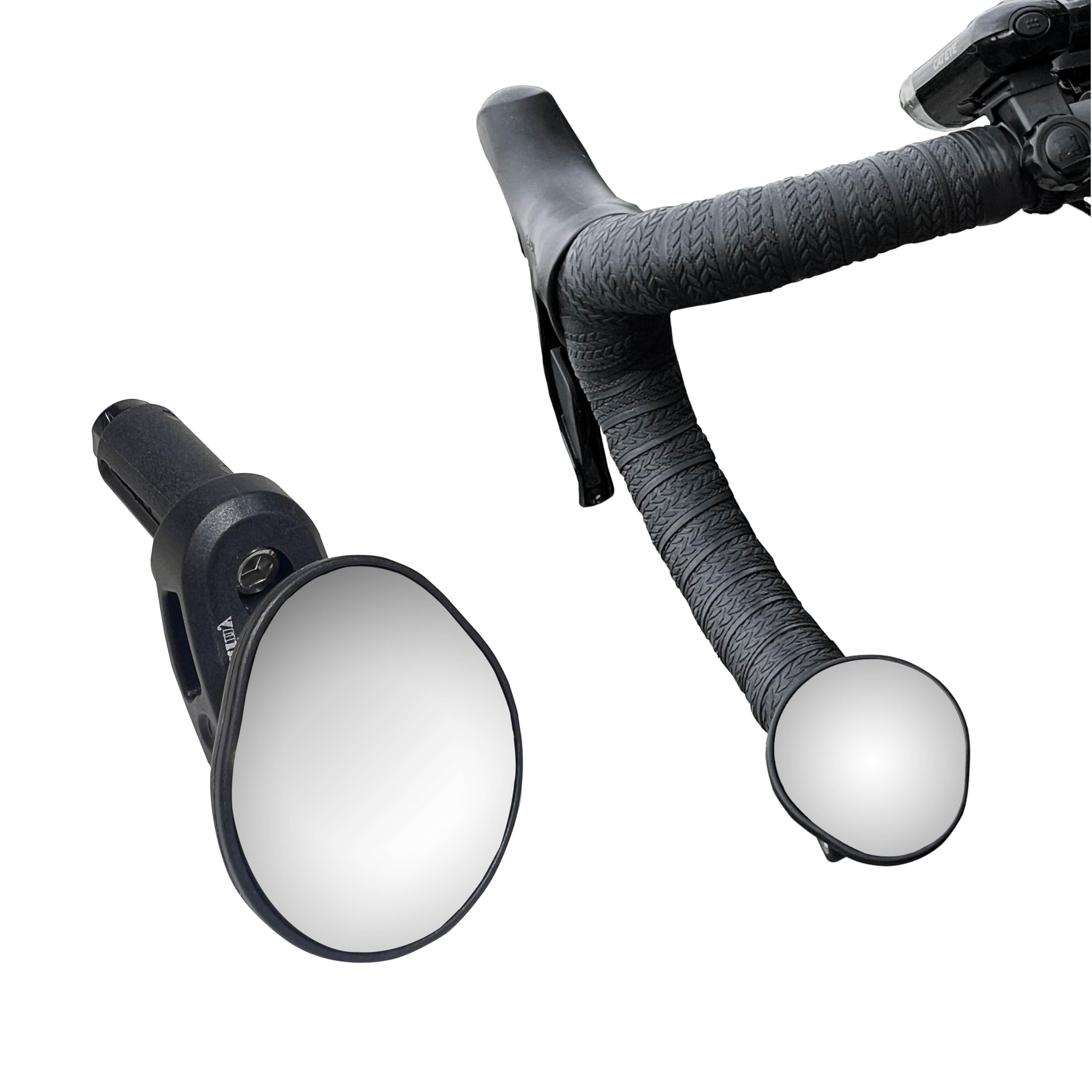
Drop-bar riders get a dedicated shape here, not a flat-bar mirror squeezed onto a road bike. The HF-M956-FR06 fits 16 to 24 mm inside-diameter bar ends, uses a convex glass lens, and weighs 60 grams. It is adjustable through 360 degrees and can go on either side. The rectangular head is small enough to sit below the hoods without turning the front of the bike into a hardware display.
The glass is the good part: the reflection is clear, and the low-profile shape does not snag when you wheel the bike through a garage or hallway. The head sits below the hoods and stays out of the way of your hand. We like that it does not call attention to itself on a road bike, where a clamp-on stalk can look out of place.
The mirror mounts at the bar end. On a road or gravel bike, the glass head and low-snag shape make it easy to leave installed and forget about until you need it. It is the kind of mirror you leave on the bike rather than remove for every ride.
Pros
- Purpose-built for drop bars
- Clear convex glass lens
- Light 60 g build
- Low-profile, low-snag shape
Cons
- Small lens shows a narrow slice of the lane
- Requires open-ended drop-bar ends
Sprintech Drop Bar Mirror Pair – Premium Drop-Bar Style

Key Features
- Lens: Oval convex
- Pack: Pair
- Weight: Under 30 g with plug
- Mount type: Bar end
- Price: Premium
The Sprintech pair costs more than the other mirrors here, and the money goes into a very different look. Each mirror weighs under 30 grams with its plug, replaces the bar-end cap, and uses a small oval convex lens. The pair is made in Switzerland and is shatterproof. On a road bike, the effect is closer to a finished cockpit detail than a bolted-on accessory.
Installation is a simple end-cap swap: pull the old cap, fit the Sprintech cap, and push the mirror into its receptor. The ball joint lets you place the mirror quickly, and the pair gives you left and right coverage without adding much weight. We like the pair for group rides, where a quick glance at either side is useful and a bulky mirror would be out of place.
The low profile is the whole point, and it comes with a cost: the lens is small, and objects can look farther away than they are. It works best as a scanning aid rather than a distance gauge. The finish and low weight are what you are paying for, not a panoramic view.
For a rider who wants a matched pair that looks like part of the bike, the Sprintech earns its place. We prefer the Cateye or the Hafny drop-bar mirror when we want a larger image and a mount that shrugs off rough pavement. The Sprintech is the style-led choice, not the broad-view choice.
Pros
- Very light under-30 g mirrors
- Clean end-cap design
- Pair covers both sides
Cons
- Can shift on heavy bumps
How We Tested Bar Mirrors
We started with every bar mirror we could find that actually plugs into a bar end or clamps to a handlebar, then cut the list by mount type, claimed bar diameter, and glass style. Fit alone eliminated a few — a mirror that only works on one odd size isn’t much use to most riders. That left 16 mirrors, which we rode for four months.
Installation came first. I timed each one from opening the box to a snug, rattle-free mount, noted whether the included hex key was usable or whether I had to dig out my own, and checked whether the supplied shims covered the handlebar diameters in my house. We also set lens size against overall footprint, since a big mirror that crowds your grips is a net loss. Then adjustability: I rotated each mirror through its full range wearing cycling gloves, folded and unfolded it, and checked whether it came back to the same angle or needed re-aiming.
On the road, the test was a commuter route lined with parked cars, a weekend gravel loop, and a rough half mile of patched pavement. I watched whether the mirror drifted or buzzed into an unreadable blur at speed, and how much of the lane behind me I could actually see — a convex lens shows more road but shrinks the car, so I noted how quickly I could judge distance before changing lanes. After four months of sun, scratches, and being folded into a bag, we compared lens clarity, new rattles, and whether any stalk had loosened.
How to Choose a Bike Bar Mirror
A bike mirror earns its place when it shows the lane behind you without asking for a hand or a second look.
Start With the Mount, Not the Lens
The first decision is whether your handlebar can accept a bar-end plug or needs a clamp. Bar-end mirrors need open-ended grips or a bar end you can open, and they fit by inside diameter: the Mirrycle covers 13.75 to 22.5 mm, the BriskMore pair covers 14 to 24 mm, and the Cateye fits drop and flat bars. Clamp-on mirrors fit by outside diameter, like the Hafny HF-MR095 at 21 to 26 mm. Measure the bar where the mount lands, not the grip, and check that the mirror will not collide with your brake lever or bar tape.
Prioritize a Steady Image Over a Big Lens
Vibration is the difference between a useful mirror and a distraction. A large lens does not help if the arm droops or the head buzzes into a blur. Look for a mount that tightens positively and a head that holds its angle without constant fussing; the Mirrycle and Cateye are the steadier shapes here, while the long-arm BriskMore and the Sprintech pair can creep on rough pavement. A little maintenance is normal. Check the joint after a bumpy ride and tighten it before the mirror starts pointing at your knee.
Choose the Field of View for Your Riding Position
On an upright flat bar, a three-inch round lens or a wide oblong gives you a useful slice of the lane. On drop bars, a smaller mirror sits lower and clears the hoods, but it shows less; the Cateye and Hafny HF-M956 are built around that compromise. Convex glass widens the view but makes following traffic look farther away, so use the mirror to spot a vehicle and a shoulder check to judge the gap. If you ride in tight traffic, favor a clear image over the widest possible lens.
Decide Between One Mirror, a Pair, and Folding Clearance
One mirror on the traffic side is enough for many riders, and it keeps the cockpit simple. A pair suits two-bike households, group rides, or anyone who wants both sides covered; the BriskMore pair is the value route, while the Sprintech pair is the light, style-led one. Folding heads matter if your bike lives in a hallway or goes through narrow doors. A bar-end mirror that cannot fold is more likely to catch on a jacket or a doorframe, so check the folded position before you commit.
Frequently Asked Questions
Do bike mirrors replace looking over your shoulder?
No. A mirror is a scanning tool, not a substitute for a shoulder check. Use it to spot a vehicle early, then turn your head before changing lane position or crossing a traffic line. The mirror is most useful on a steady stretch where a quick glance saves repeated head turns; in heavy, unpredictable traffic, keep the shoulder check as the final word.
Are glass lenses better than plastic on a bike mirror?
Glass usually gives a clearer, more scratch-resistant image, but it can crack if the bike falls. Many glass mirrors here use a shatterproof film or a stainless steel lens for that reason. Plastic or acrylic is lighter and cheaper, but it scratches more easily. If your bike gets knocked over in a rack, prioritize a protected glass or steel lens over ultimate optical clarity.
Can I use a bar-end mirror with bar-end shifters?
A plug-style bar-end mirror needs an open bar end, and a bar-end shifter already uses that space. In that case, use a clamp-on mirror such as the Hafny HF-MR095, or choose a mirror designed to share the bar end. Check clearance with the shifter through its full swing before riding; a mirror that blocks the lever is not safe.
How should I clean a bike mirror without scratching it?
Rinse the lens with water before wiping so grit does not drag across the surface, then use a soft microfiber cloth and a little mild soap. Avoid paper towels and ammonia-based cleaners, which can scratch or haze the coating. Clean the mount and joint at the same time; grit in the ball joint is what makes a mirror feel loose even after you tighten it.
Final Verdict
The Mirrycle Mountain is the bar mirror we recommend first for flat-bar bikes. Its three-inch convex lens gives a broad, steady view, and the expanding bar-end mount is simple to live with; just confirm your grips are open-ended before you order. If they are not, the Hafny HF-MR095 is the clamp-on alternative, with a larger oblong lens and a tidy flat-bar fit. On drop bars, the Cateye BM-45 is the low-profile choice. Pick the mount your handlebar can take, then choose the lens size that matches how much of the lane you want to see without turning your head.